Identify that UFO: Identify Drones with Remote ID
Matt Luba
Overview
In his CypherCon talk, "Identify that UFO: Identify Drones with Remote ID," Matt Luba presented a compelling case for building open-source, community-driven drone detection networks. Luba, a CISSP and information security professional, shared his journey into developing a low-cost, scalable system capable of identifying drones by leveraging their Remote ID broadcasts. This initiative stems from a personal desire to foster community awareness and provide an alternative to commercial flight trackers, which often fail to capture low-elevation drone activity. The talk highlighted the practical application of readily available, inexpensive hardware like ESP32-based systems and the Meshtastic communication protocol to create a distributed network that can detect, track, and identify drones in real-time.
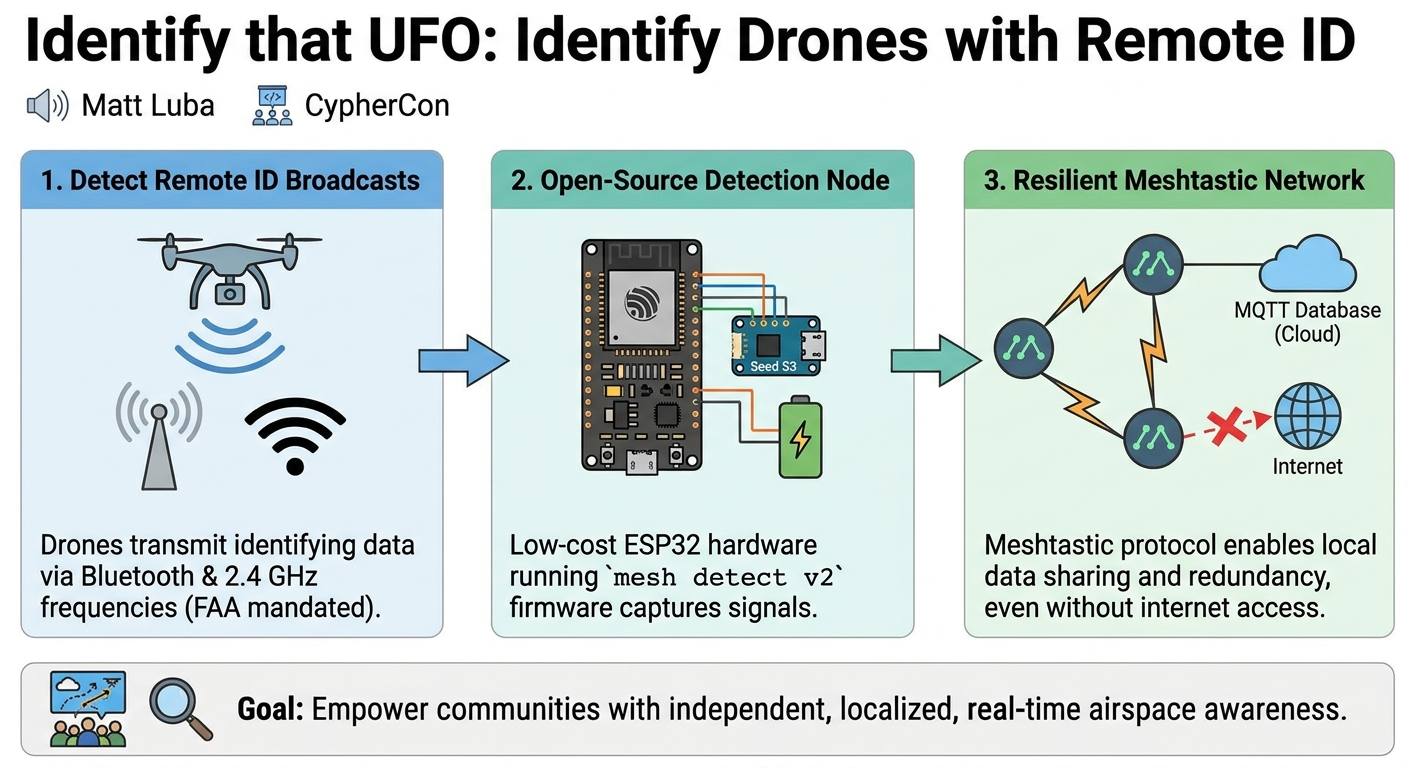
Key moments
- 3:20 Why track drones? Open source vision.
- 4:30 Remote ID detection paired with Meshtastic.
- 6:30 The OG node: hardware and components.
- 10:00 Mapping drone flights and FAA database integration.
- 13:00 Essential lessons: sealing connections and environmental protection.
- 14:40 Simple, repeatable design for anyone to build.
- 15:30 Q&A and project website details.
Identify that UFO: Identify Drones with Remote ID
Speakers: Matt Luba, CISSP, Information Security Professional
Conference: CypherCon
YouTube: https://www.youtube.com/watch?v=LN8L_DRpvOU
Overview
In his CypherCon talk, "Identify that UFO: Identify Drones with Remote ID," Matt Luba presented a compelling case for building open-source, community-driven drone detection networks. Luba, a CISSP and information security professional, shared his journey into developing a low-cost, scalable system capable of identifying drones by leveraging their Remote ID broadcasts. This initiative stems from a personal desire to foster community awareness and provide an alternative to commercial flight trackers, which often fail to capture low-elevation drone activity. The talk highlighted the practical application of readily available, inexpensive hardware like ESP32-based systems and the Meshtastic communication protocol to create a distributed network that can detect, track, and identify drones in real-time.
Luba's work addresses a growing need for local visibility into drone operations, moving beyond the limitations of large-scale, often opaque, tracking services. By demonstrating how a small, dedicated community can deploy and maintain its own drone detection infrastructure, the talk underscored the power of open-source solutions in enhancing local security and situational awareness. The project, utilizing tools like Colonel Panic's mesh detect v2 and a custom Meshtastic integration, aims to empower individuals to understand "what that drone is" in their local airspace, distinguishing between benign and potentially concerning activity. This approach not only democratizes drone tracking but also provides a resilient, redundant system for data collection, even in environments with intermittent internet connectivity.
Background
▶ Watch: Why track drones? Open source vision. (3:20)
The motivation behind Luba's project emerged from a combination of personal interest and a perceived gap in existing drone tracking capabilities. As a parent looking for engaging activities with his middle schooler, Luba initially explored Meshtastic for simple, low-power communication. However, his background in information security quickly led him to consider more advanced applications, specifically LoRa tracking drones. He recognized that while commercial flight trackers exist, they often lack the granularity or comprehensive coverage needed to detect all drone activity, particularly at lower altitudes where drones might pose local security or privacy concerns. The desire for transparency and community empowerment became a central driver, fueled by the belief that "everybody should be able to see this."
Luba's initiative is built upon the premise that open-source technologies can provide a robust and affordable solution to this challenge. The talk referenced the impact of the pandemic in highlighting the accessibility and cost-effectiveness of ESP32-based systems, which can be adapted for a multitude of detection purposes. Key to this project is the utilization of Remote ID, a standard mandated by the FAA for most drones, which broadcasts identifying information over Bluetooth and the 2.4 GHz spectrum (detectable with Wi-Fi). Luba's work leverages existing open-source projects, notably mesh detect v2 from Colonel Panic (known for Flock U), which specializes in drone tracking using Remote ID. The innovation lies in pairing this detection capability with Meshtastic to create a real-time, localized information sharing network, enabling communities to identify "that drone" and understand its flight patterns without relying on external, often less transparent, services.
Key Findings
▶ Watch: The OG node: hardware and components. (6:30)
Luba's exploration into open-source drone detection yielded several significant findings, demonstrating the viability and potential of community-driven surveillance. Firstly, the project conclusively showed that a low-cost, scalable drone detection network is entirely achievable using off-the-shelf ESP32-based hardware and open-source software. The affordability of these components, often costing as little as $30 for multi-packs of solar panels, makes widespread deployment feasible for individuals and local groups.
Secondly, the talk highlighted the critical role of Remote ID broadcasts. Drones now regularly transmit identifying data over Bluetooth and 2.4 GHz frequencies, making them detectable by standard Wi-Fi-enabled devices running specialized firmware. This broadcast mechanism provides the raw data necessary for identification and tracking, allowing the system to query the FAA database for additional information about the drone and its operator.
Thirdly, the integration of Meshtastic proved to be a pivotal contribution. This protocol enables the real-time transmission of detected drone data between nodes in a local mesh network, fostering immediate community awareness. Meshtastic's resilience offers a crucial redundancy link: even if internet access is lost at a detection node, data can still be relayed to a central home base, ensuring continuous operation.
Finally, while the current firmware iteration for mesh detect v2 has a limitation of tracking eight drones simultaneously per node, the system is designed for scalability. By deploying multiple nodes and linking them via Meshtastic or MQTT database links, the coverage area and detection capacity can be significantly expanded. This distributed architecture not only enhances resilience but also provides a more comprehensive picture of local airspace activity, allowing communities to build a robust and independent drone monitoring capability.
Technical Deep Dive
▶ Watch: Mapping drone flights and FAA database integration. (10:00)
The core of Matt Luba's drone detection system revolves around a synergistic combination of inexpensive hardware, specialized firmware, and a resilient communication protocol. At its heart, the system leverages ESP32-based microcontrollers, specifically the Seed S3 board, which serves as the primary detection unit. These boards are chosen for their low cost and versatility, acting as the "magic" that captures Remote ID broadcasts.
The detection process begins with the Seed S3 running a custom firmware, mesh detect v2, developed by Colonel Panic. This firmware is engineered to passively listen for Remote ID signals, which are mandated by the FAA for most drones. Remote ID data is broadcast over two primary channels: Bluetooth and the 2.4 GHz spectrum, making it detectable by Wi-Fi-capable ESP32 devices. Once a drone's Remote ID signal is detected, the mesh detect v2 firmware extracts crucial information, including the drone's unique identifier, location, and potentially its operator's information (which can then be cross-referenced with the FAA database).
For communication and data relay, the Seed S3 is paired with a Meshtastic device. Luba specifically mentioned using Heltec V4s for his upgraded nodes, noting their advantages such as a dedicated GPS module and a dedicated battery pin, which simplify power management and location services for the node itself. The Seed S3 connects to the Meshtastic device via two pins, transferring the detected flight data. The Meshtastic device then transmits this data across its mesh network.
The network architecture is designed for both coverage and redundancy. Luba described a three-node setup for his Milwaukee deployment: a central "home base" node, a node at his parents' residence, and a third at a friend's house, strategically placed to cover a significant area. Each node is configured to operate in "short range turbo" mode for optimal direct communication within line of sight. The primary method for data aggregation is sending all flight data to an MQTT database running on a Linode server in the cloud. However, a critical design choice for resilience is the Meshtastic redundancy link. If a detection node loses its internet connection, it can still communicate with the home base node via Meshtastic, logging data locally until internet connectivity is restored, at which point the buffered data can be offloaded to the cloud. This ensures continuous operation and data collection even in adverse network conditions.
The detected drone data, once aggregated, can be visualized and analyzed using tools like meshmapper. This Python-based software, available on a Git 32 repository, allows users to plot tracked drones on a map, providing a clear visual representation of drone flight paths and activity patterns. Luba acknowledged that while he had seen meshmapper in action, he had yet to set it up on a Raspberry Pi himself.
Hardware deployment considerations are also crucial for the longevity and reliability of the nodes. Luba emphasized the importance of sealing connections with dielectric grease to protect against moisture, which is detrimental to electronics. He also integrated 40-cell temp switches connected to fans within the node enclosures, ensuring active cooling when internal temperatures exceed approximately 90°F (32°C), similar to cooling solutions found in Raspberry Pi setups. Breather holes are also incorporated to prevent pressure buildup within sealed enclosures. While Heltec devices were used, Luba noted that the design is flexible, and any Meshtastic node can be adapted, highlighting the simplicity and repeatability of the overall system. The project's open-source nature, with ongoing development on GitHub, encourages community contributions and the exploration of alternative ESP32 boards or solutions to overcome limitations like the eight-drone tracking limit per node.
Demo / Proof of Concept
▶ Watch: Simple, repeatable design for anyone to build. (14:40)
Matt Luba explicitly stated at the outset of his talk that he did not have a live demo ready, citing recent personal commitments and challenges. He explained, "SADLY, my ADHD has kicked in over the past couple of weeks with the kid being off school. So, I didn't have the demo ready for today that I had hoped."
Despite the absence of a live demonstration, Luba brought an "OG node" (original node) to the conference, showcasing the compact and inconspicuous nature of the hardware. He described it as "two little PCBs, a S3, and you plug it in and all of a sudden it's in a pre-desated mode." He illustrated how easily such a device could be brought into a venue unnoticed, emphasizing its small footprint. While the node was not active due to soldering issues, he detailed its components and functionality, explaining how it would connect to a Meshtastic device and transmit data. He also mentioned that while he had seen meshmapper in use for plotting drone data, he personally had not yet gotten it stood up on a Raspberry Pi for his own visualization needs.
Defensive Implications
▶ Watch: Q&A and project website details. (15:30)
The open-source drone detection system presented by Matt Luba offers significant defensive implications for individuals, communities, and potentially critical infrastructure. Foremost, it democratizes situational awareness regarding local airspace. By providing a low-cost, accessible method to identify and track drones, communities are no longer solely reliant on commercial services that may lack coverage or transparency. This empowers residents to understand "what that drone is," distinguishing between innocuous recreational flights and potentially suspicious or malicious activity.
From a security perspective, the ability to detect Remote ID broadcasts provides crucial intelligence. Knowing the unique identifier, location, and flight path of a drone allows for potential investigation through the FAA database, revealing operator information. This capability can be vital for incident response if a drone is observed violating airspace regulations, trespassing, or engaging in surveillance. The system effectively turns drones, which Luba jokingly referred to as "vulnerabilities," into identifiable entities rather than anonymous aerial threats.
Furthermore, the Meshtastic-based communication network introduces a layer of resilience and redundancy critical for defensive operations. In scenarios where internet connectivity is compromised—whether due to natural disaster, targeted attack, or simple outage—the mesh network ensures that drone detection data can still be collected and shared locally. This makes the system robust against single points of failure, maintaining a continuous monitoring capability.
However, Luba also highlighted a defensive implication regarding the system itself: the physical security of the nodes. While Meshtastic communication can be encrypted, doing so requires all three nodes in Luba's setup to synchronize their private keys. This presents a risk of physical intrusion and key theft. If an adversary gains physical access to a node, they could potentially compromise the encryption keys, undermining the security of the entire network's communications. This underscores the need for robust physical security measures for deployed nodes, especially in sensitive locations.
Ultimately, this open-source approach fosters a community-driven counter-drone capability. It encourages local collaboration, knowledge sharing, and the development of customized solutions to address specific defensive needs. By providing the tools and methodology to "identify that UFO," Luba's work contributes to a more informed and potentially safer local environment, allowing communities to actively monitor and respond to drone activity.
Key Takeaways
- Accessible Drone Detection: Open-source hardware (ESP32-based systems like Seed S3) and software (
mesh detect v2) enable low-cost, DIY drone detection using Remote ID broadcasts. - Leveraging Remote ID: Drones transmit identifying information over Bluetooth and 2.4 GHz, which can be detected and used to query the FAA database for operator details.
- Meshtastic for Community Networks: Meshtastic provides a resilient, real-time, local communication layer for sharing drone detection data among distributed nodes, offering redundancy even without internet.
- Scalable and Redundant Architecture: A multi-node network can cover wider areas, increase detection capacity (though limited to 8 drones per node with current firmware), and utilize MQTT databases for centralized data aggregation with Meshtastic as a backup link.
- Deployment Best Practices: Proper environmental protection (sealing connections, temperature management with fans and breather holes) is crucial for the longevity and reliability of deployed nodes.
- Community Empowerment: The project advocates for community-led initiatives in airspace monitoring, fostering local awareness and providing an independent alternative to commercial tracking services.
About the Speaker(s)
Matt Luba is an accomplished information security professional holding the CISSP certification. He is a self-described "neurospicy parent" of one, and his personal interests often intertwine with his professional curiosity. While his primary occupation is in infosac, he also dedicates his time to community service as a volunteer lifeguard and swim instructor. His passion for staying active with his children led him to explore new technologies like Meshtastic, which unexpectedly sparked his innovative project in drone tracking. Luba explicitly stated he was not representing his employer during the talk. He is an advocate for open-source solutions and community empowerment. He can be found online on Mastodon, LinkedIn, and his project's progress is hosted at resurrectedkittens.ninja.
Reviews
Dr. Zero (Offensive Security Researcher) — WEAK
Matt Luba showed up to CypherCon to explain how he flashed Colonel Panic's code onto an ESP32, but couldn't even bring a working demo. Gluing two off-the-shelf boards together to sniff FAA Remote ID broadcasts is a perfectly fine weekend homelab project, but presenting half-finished work as conference research is a stretch. This should have been a blog post.
Heather Calloway (CISO) — SOLID
This is a hobbyist hardware project with direct enterprise physical security implications. The speaker demonstrates how to build a decentralized, $30 drone-detection mesh using ESP32 boards and the FAA’s Remote ID mandate, offering a cheap way to map low-altitude airspace risks.