Choose Your Own Adventure: The Interactive Talk on Tabletop Exercises
Josh Harr
Overview
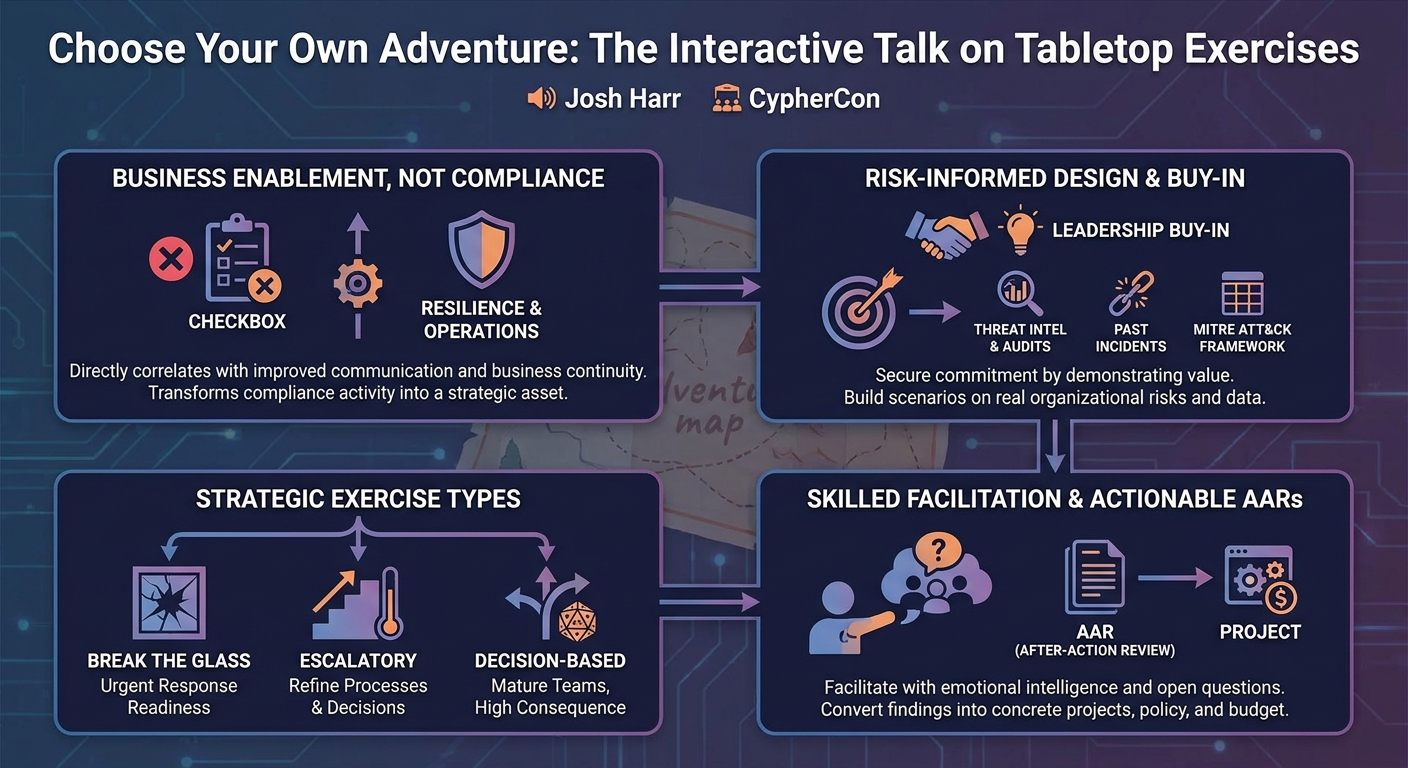
In "Choose Your Own Adventure: The Interactive Talk on Tabletop Exercises," Josh Harr delivers a compelling and unconventional presentation on the critical role of tabletop exercises in enhancing an organization's incident response capabilities. Drawing parallels between cybersecurity exercises and the collaborative storytelling of Dungeons & Dragons, Harr argues that these simulations are not merely compliance checkboxes but vital tools for business enablement and resilience. His talk challenges the traditional, often dry, approach to tabletop exercises, advocating for a dynamic, engaging, and highly personalized methodology that fosters communication, strengthens processes, and develops people.
Key moments
- 2:00 Introduction to interactive tabletop exercises
- 4:45 Why tabletop exercises are hard: The Japan incident
- 7:50 Tabletop exercises directly correlate to business success
- 10:30 Key preparation: buy-in, communication, people, processes
- 29:45 Detailed Master Scenario Event List (MISEL) framework
- 43:45 After-Action Review (AAR) for organizational change
- 58:10 Q&A: Managing participants and desired outcomes
Choose Your Own Adventure: The Interactive Talk on Tabletop Exercises
Speakers: Josh Harr, Diplomatic Cybersecurity Advisor, Information Security Executive, Founder
Conference: CypherCon
YouTube: https://www.youtube.com/watch?v=njj6e-fVcwk
Overview
In "Choose Your Own Adventure: The Interactive Talk on Tabletop Exercises," Josh Harr delivers a compelling and unconventional presentation on the critical role of tabletop exercises in enhancing an organization's incident response capabilities. Drawing parallels between cybersecurity exercises and the collaborative storytelling of Dungeons & Dragons, Harr argues that these simulations are not merely compliance checkboxes but vital tools for business enablement and resilience. His talk challenges the traditional, often dry, approach to tabletop exercises, advocating for a dynamic, engaging, and highly personalized methodology that fosters communication, strengthens processes, and develops people.
Harr, a self-proclaimed "professional dungeon master for the corporate world," leverages his extensive experience as a diplomatic cybersecurity advisor and an information security executive to illustrate how well-designed exercises directly correlate with business success. The presentation itself mirrors its subject matter, employing an interactive "choose your own adventure" format where the audience's votes determine the direction of the discussion. This innovative approach underscores Harr's central thesis: effective tabletop exercises should be immersive, challenging, and designed to reveal true organizational strengths and weaknesses, not just confirm existing plans.
This article delves into Harr's practical framework for developing and facilitating impactful tabletop exercises. It explores the foundational principles, technical considerations, and critical "soft skills" required to transform a mundane compliance activity into a powerful mechanism for organizational learning and improvement. By reframing incident response as an inherently non-technical challenge centered on communication and human interaction, Harr provides a fresh perspective for security professionals seeking to elevate their organization's preparedness.
Background
▶ Watch: Introduction to interactive tabletop exercises (2:00)
The genesis of Josh Harr's philosophy on tabletop exercises stems from a deeply formative, and somewhat traumatic, experience during a military exercise in Japan. Witnessing a communication squadron's incident response exercise devolve into a public berating by a commander after a "failure" highlighted a critical flaw: traditional exercises often focus on identifying failures rather than fostering improvement. This experience underscored a pervasive issue in the corporate world where tabletop exercises are frequently viewed as mere compliance checkboxes by GRC teams, lacking genuine engagement or perceived business value.
Harr contends that this perception is fundamentally misguided. He passionately argues that incident response and the communication exercises that support it are not just about cybersecurity; they directly correlate to the success of the business. Evidence, he notes, consistently shows that companies practicing and improving their communication during crises see their business operations improve "tenfold." The core problem, as Harr identifies it, is that incident response is often misunderstood as purely technical. While technical operators may excel at their tasks, the breakdown frequently occurs in communication—how operators communicate with process facilitators, and how strategic decisions are relayed and executed.
This disconnect leads to exercises that are "not cultivated and not curated to the risks that your organization has," rendering them ineffective and disengaging. Harr's approach seeks to rectify this by emphasizing that effective tabletop exercises must provide a "way forward to develop better communication" and maintain business enablement throughout a crisis. This holistic view acknowledges that while technical prowess is essential, the human elements of communication, people, and processes are the true determinants of an organization's ability to navigate and recover from a significant cyber incident.
Key Findings
▶ Watch: Tabletop exercises directly correlate to business success (7:50)
Josh Harr’s talk unveils a comprehensive framework for designing and executing tabletop exercises that transcend mere compliance, transforming them into powerful tools for organizational resilience and business enablement. His key findings can be distilled into several core principles:
- Cultivating Buy-in is Paramount: Harr stresses that securing buy-in from leadership and participants is the "incredibly significant" first step. Without it, individuals will lack interest and perceive the exercise as a waste of time. He likens it to a D&D campaign where all players and the Dungeon Master must be genuinely invested. For the corporate world, this means demonstrating the business utility of incident response, emphasizing how it maintains business continuity and leader confidence during a crisis.
- Focus on Business Enablement: Effective exercises must be understood through the lens of business enablement, addressing three critical components:
- Communication: Acknowledging that individuals transmit and receive information differently, exercises provide a crucial platform to practice and refine communication pathways among diverse stakeholders (e.g., HR, legal, technical teams).
- People: The most vital asset. Participants should include those with influence on budget, process ownership, and recognized centers of gravity—individuals whose input is highly valued. It's also an opportunity to train new hires and introduce non-technical teams (HR, marketing, legal) to the incident response (IR) plan.
- Processes: Exercises help to validate and refine playbooks and IR plans, moving beyond the "monotony of incident response" to allow operators to focus on making "hard choices" when true positives occur.
- Risk-Informed Scenario Development: Scenarios must be relevant and actionable. Harr advises basing them on:
- Risk analysis: Leveraging NIST CSF, 800-171, 800-53 assessments.
- Previous incidents: Stress-testing how the organization would respond to past events.
- Threat intelligence: Incorporating current geopolitical and threat actor insights, especially for larger organizations.
- Audit findings: Using exercises to address and stress-test identified weaknesses. He advocates for not "reinventing the wheel," suggesting that repeating past scenarios with minor tweaks (e.g., changing IP addresses or usernames) can serve as a litmus test for improvement.
- Strategic Selection of Exercise Types: Harr outlines three primary exercise types, each suited for different objectives and organizational maturity levels:
- Break the Glass: Ideal for simulating immediate, real-world incident response reactivity ("right of the boom"). It establishes investigative processes, provides urgency, and is effective for tactical and strategic levels, though less so for operational nuance.
- Escalatory: His personal favorite for its nuance, this type starts with small events (e.g., a phishing exercise targeting 85% of the workforce) and gradually escalates. It's excellent for understanding thresholds, discussing decision points, and works across all organizational levels.
- Decision-Based: A high-effort, high-reward type that mimics a D&D campaign, where "every decision creates a completely different branch." It requires significant preparation and is best suited for highly technical teams with strong mutual trust, as it allows for scenarios where "you will most likely lose" if wrong decisions are made.
- The Master Scenario Event List (MSEL) as the "Map": The MSEL is the foundational document for any exercise, serving as the "DM guide" for facilitators. It details every event, correlating them to specific phases within frameworks like MITRE ATT&CK or the Lockheed Martin Kill Chain.
- After-Action Review (AAR) is Critical for Change: The AAR is "essential to the success" of the entire process. It's the "key to creating organizational change," providing tangible evidence of discussions, challenges, and decisions. Without a thorough AAR presented to leadership, trust erodes, and opportunities for project initiation (e.g., policy creation for ransomware payment authorization) are lost.
- The Art of Facilitation: Beyond technical preparation, successful facilitation demands "simple things" and an understanding of human dynamics. This includes:
- Logistics: Ensuring comfortable room temperature, adequate seating at the main table, and individual materials.
- Preparation: Being early and "practiced in being able to roll with the punches," embracing improv rather than rigid adherence to a script.
- Questioning: Using open-ended questions ("Tell me how...") instead of "why" to avoid defensiveness.
- Cultural Awareness (Fingerspitzengefühl): Having a "finger on the pulse" of the room, knowing when to take breaks, encouraging early participation, advocating for quieter voices, and maintaining a safe, professional environment.
- Engagement Tools: Using dice (e.g., a D100) to introduce uncertainty and make participants, even new ones like a CFO, feel tangibly involved in determining impact (e.g., "85% of your employee base got hit").
- Ethical Boundaries: Never trick participants or surprise external parties (e.g., legal counsel) with an unannounced "live" incident.
These findings collectively underscore that effective tabletop exercises are a blend of meticulous planning, strategic scenario design, and skillful human-centered facilitation, all aimed at bolstering an organization's ability to respond to and recover from cyber crises.
Technical Deep Dive
▶ Watch: Key preparation: buy-in, communication, people, processes (10:30)
At the heart of a well-orchestrated tabletop exercise, according to Josh Harr, lies the Master Scenario Event List (MSEL). Harr emphatically describes the MSEL as the "map" that guides the entire exercise, much like a Dungeon Master's guide for a D&D campaign. This detailed document is crucial for ensuring that scenarios are not only realistic but also directly tied to an organization's specific risks and technical capabilities.
Harr advocates for utilizing established cybersecurity frameworks to structure the MSEL, specifically recommending MITRE ATT&CK over the Cyber Kill Chain. While the Cyber Kill Chain offers a seven-phase, process-focused view, MITRE ATT&CK's 14 phases provide a far more granular and actionable breakdown, incorporating T-codes (Tactics, Techniques, and Procedures), data codes, and mitigation codes. This allows for extreme specificity in scenario design, moving beyond broad phases to precise techniques like lateral movement T1247.3.
An example MSEL entry presented by Harr illustrates its comprehensive structure:
- MITRE ATT&CK Phase: E.g., Reconnaissance
- T-code: E.g., T1595.001 (Active Scanning)
- Event Number: A unique identifier (e.g., 001)
- Event Function: Categorizes the event (e.g., Initial Event, Inject, Informational, Question, White Cell Pause/Resume)
- Precondition: Any existing information or data that sets the stage (e.g., "data that has exfiltrated, here is the evidence")
- Event Description: The specific scenario detail (e.g., "external IP getting organizational IP range using noisy methods such as Nmap")
- Responder: The individual or team expected to react (e.g., Security Analyst)
- Desired Outcome: The ideal response based on established playbooks or best practices (e.g., "follow active scanning playbook, report threat intelligence, identify IP function")
- Actual Outcome: What genuinely happened during the exercise (e.g., "security analyst froze and then started staring into space")
- Notes: Crucial for capturing observations and recommendations for improvement (e.g., "build out checklist for the response scenario, provide training budget for the security analysts so they don't cry anymore")
This level of detail ensures the MSEL is technically robust enough for tactical teams (e.g., security analysts), operationally relevant for understanding necessary playbook and process adjustments, and strategically informative for justifying budget and funding requests. Harr recounts a bilateral exercise in Bulgaria where this granular approach, coupled with a cyber range, directly addressed an organization's identified weakness in detecting lateral movement, using specific T-codes.
Furthermore, the MSEL aids in managing the exercise flow, especially with multiple scribes dedicated to real-time note-taking. These scribes track not only the outcomes but also any questions, challenges, or debates that arise among participants. Capturing these discussions is vital, as Harr notes, because they often reveal critical insights into communication breakdowns, differing interpretations of policy, or areas where processes are unclear. The potential use of AI tools like Google Gemini or Microsoft Copilot for automated note-taking is also mentioned, provided organizational policies are followed, to reduce the burden on human scribes.
By meticulously mapping out each potential event and its desired (and actual) responses against a recognized framework, the MSEL transforms an abstract scenario into a tangible, measurable, and highly educational experience, connecting technical details to broader organizational impact.
Demo / Proof of Concept
▶ Watch: After-Action Review (AAR) for organizational change (43:45)
Josh Harr's entire presentation at CypherCon serves as a living demonstration and proof of concept for his "Choose Your Own Adventure" approach to tabletop exercises. Instead of a static lecture, Harr designed his talk to be inherently interactive, mirroring the dynamic and decision-based nature he advocates for in corporate cybersecurity simulations.
The core of this demonstration was the use of Slido polls, where the audience actively voted on which section of the presentation to explore next. For instance, early in the talk, the audience was presented with an "impass with three doors" and chose "preparation" as their first path. Later, when faced with options in a "bustling town," they debated between a "bounty board" and "MSEL documentation," ultimately selecting the latter. This direct audience participation underscored Harr's point that participants in a tabletop exercise should have agency and that their decisions drive the narrative, revealing different facets of a problem or solution.
Harr further enhanced the interactive experience by weaving in Dungeons & Dragons (D&D) analogies throughout. He frequently referred to himself as a "Dungeon Master" and the audience as "players," framing cybersecurity challenges within a familiar fantasy context. This not only made the content more engaging but also subtly illustrated how the principles of collaborative storytelling and problem-solving in D&D can be applied to incident response. His use of dice rolls in his facilitation examples, such as a CFO rolling a D100 to determine the impact of a phishing campaign (e.g., 85% of employees hit), showcased how introducing elements of chance can create urgency, generate concrete data points, and foster tangible engagement from participants, regardless of their technical background or tenure.
By making his talk a "choose your own adventure," Harr effectively demonstrated that engaging, decision-driven, and even fun, exercises are not only possible but highly effective in conveying complex concepts and fostering active learning.
Defensive Implications
▶ Watch: Q&A: Managing participants and desired outcomes (58:10)
The insights shared by Josh Harr offer critical defensive implications for organizations aiming to strengthen their cybersecurity posture and incident response capabilities. These actionable recommendations move beyond mere technical controls to emphasize strategic planning, human factors, and continuous improvement.
First and foremost, organizations must fundamentally shift their perception of tabletop exercises from a compliance burden to a business enablement strategy. Defenders should champion the idea that robust incident response, honed through regular, effective exercises, directly contributes to business continuity and financial resilience. This requires securing executive buy-in by clearly articulating how these exercises protect the organization's mission, reputation, and bottom line, rather than just checking a box.
Security teams should meticulously design risk-informed scenarios that are highly relevant to their organization. This means moving beyond generic threats to incorporate real-world threat intelligence, past incident reports, current NIST CSF or other framework assessments, and internal audit findings. Re-running previous, unresolved scenarios with minor modifications (e.g., new IP addresses or usernames) can serve as a vital litmus test to measure actual improvement over time. The goal is to stress-test existing plans and identify specific weaknesses, such as a lack of clear communication protocols or an inability to detect specific MITRE ATT&CK T-codes like lateral movement (e.g., T1247.3).
Strategic selection of exercise types is also crucial. For rapid response readiness, Break the Glass exercises simulate immediate incident impact. To refine processes and decision thresholds, Escalatory exercises are invaluable, demonstrating how small events can spiral. For highly mature and trusting technical teams, Decision-Based exercises offer the most immersive and challenging experience, revealing the real consequences of choices. Defenders should ensure a mix of these types to address different learning objectives and organizational levels (tactical, operational, strategic).
Furthermore, careful consideration must be given to participant selection. Inviting individuals with budget influence, process ownership, and those recognized as centers of gravity ensures that exercise outcomes can translate into tangible organizational change. It also creates opportunities to onboard new hires and cross-train non-technical departments (HR, legal, marketing) on their roles within the IR plan, fostering a more integrated response.
The development of a detailed Master Scenario Event List (MSEL), structured around frameworks like MITRE ATT&CK, is non-negotiable. This "DM guide" ensures that scenarios are granular enough to challenge technical teams while providing sufficient detail for operational and strategic leaders. It serves as the single source of truth for the exercise, documenting expected and actual outcomes, and highlighting areas for improvement, such as the need for clearer playbooks or additional training budgets.
Finally, the After-Action Review (AAR) is paramount. Defenders must commit to thorough, documented AARs that translate exercise findings into concrete projects (e.g., developing a ransomware payment authorization policy), assign ownership, and establish timelines. This continuous feedback loop builds trust, demonstrates value, and ensures that lessons learned are not lost but actively drive organizational change and investment in cybersecurity. Training facilitators in the "art" of managing discussions, asking open-ended questions, and embracing uncertainty (even using dice for impact determination) will significantly enhance participant engagement and the overall effectiveness of these critical defensive drills.
Key Takeaways
- Tabletop exercises are business enablers, not just compliance checkboxes. They directly correlate with improved business operations and resilience by enhancing communication, strengthening processes, and developing people.
- Effective exercises demand buy-in and relevant scenarios. Secure leadership commitment by demonstrating business value, and build scenarios based on real organizational risks, past incidents, threat intelligence, and audit findings, leveraging frameworks like MITRE ATT&CK.
- Choose the right exercise type for your objectives. Utilize Break the Glass for urgent response, Escalatory for nuanced process refinement and decision points, and Decision-Based for highly mature, trusting technical teams.
- Facilitation is an art that requires preparation and emotional intelligence. Create an inclusive environment, ask open-ended questions, manage group dynamics with "Fingerspitzengefühl," and embrace uncertainty to foster engagement and learning.
- The Master Scenario Event List (MSEL) is your exercise blueprint. Use it as a detailed "DM guide" to track events, desired outcomes, and actual responses, providing granular technical detail (e.g., MITRE ATT&CK T-codes) and strategic insights.
- After-Action Reviews (AARs) are crucial for driving organizational change. Document all findings, debates, and recommendations to translate lessons learned into actionable projects, secure budget, and maintain trust for future exercises.
About the Speaker(s)
Josh Harr is a passionate advocate for effective cybersecurity tabletop exercises, drawing on a diverse background to inform his unique approach. He is an information security executive who understands the critical link between incident response and business success. Harr has served as a diplomatic cybersecurity advisor to the Ministry of Defense in Bulgaria, where he gained firsthand experience in managing international cyber incidents and developing sophisticated exercises. Beyond his corporate and governmental roles, Harr is a self-proclaimed Dungeons & Dragons fan and a "real Dungeon Master," which he humorously translates into his professional life as a "professional dungeon master for the corporate world." He also owns his own company, which specializes in building tabletop exercises for various organizations. His experience in improv in Nashville further hones his ability to facilitate dynamic and unpredictable scenarios, making his exercises engaging and highly effective.
Reviews
Dr. Zero (Offensive Security Researcher) — SOLID
Josh Harr is trying to fix the mind-numbing compliance theater of corporate tabletops by running them like a D&D campaign. The gimmick is heavy, but the underlying mechanics—specifically mapping the Master Scenario Event List (MSEL) directly to MITRE ATT&CK T-codes—give defenders something concrete to measure. It's a highly practical methodology for IR managers tired of watching their executives zone out during paper drills.
Heather Calloway (CISO) — SOLID
This talk rescues the tabletop exercise from the GRC compliance graveyard. By introducing dynamic variables and forcing actual executive decisions, it transforms a scripted rehearsal into a genuine test of organizational resilience. Worth your IR leader's time to operationalize.