The Personal Branding Patch You Didn’t Know You Needed
Terra L. Fletcher
Overview
In the fast-evolving landscape of cybersecurity, technical prowess is often considered the sole determinant of success. However, Terra L. Fletcher's CypherCon talk, "The Personal Branding Patch You Didn’t Know You Needed," challenges this conventional wisdom, asserting the critical importance of a well-defined and strategically managed personal brand. Fletcher, a marketing consultant with over 15 years of experience, expertly translates abstract marketing concepts into actionable "patches" for security professionals, emphasizing that visibility and clear communication of value are as vital as any technical skill. This talk serves as a crucial reminder that even the most brilliant minds in the industry can remain overlooked without an intentional approach to how they present themselves to the world.
Key moments
- 2:00 Who do people come to you for?
- 4:30 Define your professional goal and increase visibility.
- 8:30 Leverage unique experiences: Jesse's upholstery background.
- 11:30 Formula for a clear personal brand statement.
- 18:00 Optimize your LinkedIn headline and profile photo.
- 21:30 Prove what you can do; niche down.
- 26:30 Key 'patch notes' and sharing valuable content.
The Personal Branding Patch You Didn’t Know You Needed
Speakers: Terra L. Fletcher
Conference: CypherCon
YouTube: https://www.youtube.com/watch?v=5ZuDAhC8TbM
Overview
In the fast-evolving landscape of cybersecurity, technical prowess is often considered the sole determinant of success. However, Terra L. Fletcher's CypherCon talk, "The Personal Branding Patch You Didn’t Know You Needed," challenges this conventional wisdom, asserting the critical importance of a well-defined and strategically managed personal brand. Fletcher, a marketing consultant with over 15 years of experience, expertly translates abstract marketing concepts into actionable "patches" for security professionals, emphasizing that visibility and clear communication of value are as vital as any technical skill. This talk serves as a crucial reminder that even the most brilliant minds in the industry can remain overlooked without an intentional approach to how they present themselves to the world.
Fletcher's presentation is particularly relevant for the CypherCon audience, a community deeply entrenched in highly specialized and often opaque technical domains. She posits that while security experts excel at identifying and mitigating vulnerabilities in systems, many overlook the "vulnerabilities" in their own professional identity – outdated profiles, unclear value propositions, or a failure to articulate their unique contributions in an accessible manner. The talk aims to equip attendees with the tools to proactively "patch" these gaps, ensuring their professional identity accurately reflects their expertise and aligns with their career aspirations.
The core message resonates deeply within a field where networking, thought leadership, and the ability to articulate complex solutions to non-technical stakeholders are increasingly paramount. By framing personal branding as a series of essential "patches," Fletcher skillfully demystifies the process, making it tangible and immediately applicable for technical professionals. This talk is not merely about self-promotion; it’s about strategic self-positioning, enabling individuals to attract the right opportunities, influence their career trajectory, and ultimately, become the go-to expert in their chosen niche.
Background
▶ Watch: Who do people come to you for? (2:00)
The premise of Fletcher's talk is built upon a fundamental human tendency: seeking out trusted individuals for specialized needs. She illustrates this with relatable scenarios, asking the audience who they consult for car troubles ("Kenny from Oshkosh") or fashion advice ("Cedric from Chicago"). The underlying principle is that people gravitate towards those perceived as experts or reliable sources for specific problems. The challenge, particularly for technical professionals, is to intentionally cultivate this perception within their own professional domain. In an industry saturated with talent, simply possessing technical skills is no longer sufficient; one must also be known for those skills and the unique value they bring.
FHistorically, the cybersecurity and broader tech industry has often valued raw technical skill above all else. Engineers, developers, and security analysts might focus heavily on acquiring certifications, mastering programming languages, or understanding complex protocols, assuming their work will speak for itself. However, this often leads to a disconnect: brilliant individuals remain obscure because their online presence doesn't adequately reflect their capabilities, or they struggle to articulate their value beyond highly technical jargon. This creates a "problem-solution gap" where potential employers, collaborators, or clients cannot easily identify who can solve their specific technical challenges.
Fletcher highlights that this problem is exacerbated by the sheer volume of information available online and the increasingly automated nature of recruitment. Recruiters and hiring managers often rely on quick searches and AI-generated summaries to vet candidates. If a professional's digital footprint is inconsistent, outdated, or fails to clearly communicate their unique value, they risk being overlooked, regardless of their actual expertise. The talk addresses this by emphasizing the need for intentionality in crafting one's professional digital identity, moving beyond passive accumulation of credentials to active curation and strategic communication. This proactive approach is essential for bridging the gap between technical competence and professional visibility.
Key Findings
▶ Watch: Leverage unique experiences: Jesse's upholstery background. (8:30)
Terra L. Fletcher's presentation meticulously outlines several critical "patches" for personal branding, each designed to enhance a professional's visibility and impact. These aren't abstract concepts but concrete actions for cultivating a robust and authentic professional identity.
- Define Your Professional Goal and "The Thing": The foundational patch involves clearly articulating your professional objective. As Fletcher asks, "What is your professional goal? Where do you want to go? What do you want to do?" This clarity is crucial for directing all subsequent branding efforts. It's about identifying "the thing" you want to be known for, transforming vague aspirations into a focused target. Without a clear goal, efforts to build a brand become directionless, akin to playing tennis without a ball—you might go through the motions, but you won't score.
- Leverage Your Unique Mix of Experience: A significant finding is that authenticity and uniqueness stem from combining diverse, even seemingly unrelated, experiences. Fletcher illustrates this with the example of "Jesse," an IT professional with an upholstery background. She suggested he could create content comparing "patching vulnerabilities in IT" to "repairing a worn seat"—both requiring precision, insight, and knowing what to reinforce. This concept of "unique perspective" is vital for standing out in a crowded field. It moves beyond generic skill lists to highlight what truly makes an individual memorable and valuable.
- Craft a Repeatable Brand Statement: For others to refer and recommend you effectively, your value proposition must be clear and repeatable. Fletcher provides a potent formula: "I help [who you serve] do [what] by [how you do it] (and especially if you have your unique perspective)." Examples included "I help manufacturing companies patch vulnerabilities the way only an IT architect with an upholstery background can" or "I help companies move to the cloud without chaos by breaking big transitions into steps people can actually follow." This structured approach ensures consistency and memorability, minimizing jargon to make your value accessible to a broader audience, including non-technical hiring managers.
- Audit and Curate Your Digital Footprint: One of the most critical "patches" is actively managing what appears when your name is searched. Fletcher urges attendees to conduct incognito browser searches and, ideally, have someone else search their name. The goal is to ensure that search results clearly communicate "who I am and what I do" and align with professional goals. She shared an anecdote about a software company founder whose college football achievements overshadowed his current business in search results. This patch underscores the importance of digital reputation management and proactive content curation.
- Optimize Your LinkedIn Headline for Value: Beyond a simple job title, your LinkedIn headline should explain your value. Fletcher notes that titles like "CISO" might be meaningless to a recruiter outside the immediate industry. She advocates for headlines that "explain your value," such as "offensive security nerd" (from an example profile). The headline is often the first impression, and it must capture attention by clearly articulating what problems you solve or what unique contributions you make, drawing readers in to learn more.
- Maintain a Current and Intentional Profile Photo: An often-overlooked detail, the profile photo, needs to be current and authentic. Fletcher humorously recounts instances of meeting individuals who look "20 years later" than their profile picture, emphasizing that an outdated photo can create distrust or confusion. The photo should reflect your current professional self, conveying authenticity and approachability.
- Ensure Consistent Messaging Across Platforms: Your bio and professional statements across all online platforms—LinkedIn, GitHub, personal websites, speaker profiles—must deliver consistent messaging. This alignment reinforces your personal brand statement and makes you more recognizable and identifiable. Inconsistency creates confusion and dilutes your brand's impact.
- Provide Visible Proof Points: Professionals need to "prove what you can do." This means having one or more easily discoverable proof points pinned or prominently displayed. These could be case studies, examples of problems solved, or documented contributions. Fletcher provided an example: "prevented a potential breach by identifying a misconfigured access point... Fixed it the same day and documented the issue so it won't happen again." Such specific, outcome-oriented examples speak directly to decision-makers, showcasing tangible value.
- Share Valuable Content Publicly: The final patch encourages sharing valuable content, such as checklists, write-ups, or lessons learned. While some might fear "giving away secrets," Fletcher argues that this builds trust and demonstrates expertise. By providing free value, professionals establish themselves as authorities, often leading to paid opportunities when individuals realize they need expert assistance to implement the shared information.
Technical Deep Dive
▶ Watch: Formula for a clear personal brand statement. (11:30)
While Terra L. Fletcher's talk is not technical in the traditional sense of discussing exploits, code, or network architectures, its principles can be deeply interpreted and applied within a technical framework, particularly for cybersecurity professionals. The concept of "patching" a personal brand directly parallels the methodologies used in vulnerability management and digital forensics applied to one's professional identity.
Consider the analogy of a personal brand as a digital asset – a curated collection of information, skills, and reputation existing across various online platforms. Just as a security team performs regular audits on critical systems, individuals must audit their digital footprint. Fletcher's recommendation to "search your name incognito" and "have someone else search you" is a form of reconnaissance or vulnerability scanning on this personal digital asset. What "vulnerabilities" might be discovered?
- Misconfigured Access Points (Digital Footprint): Like a misconfigured network device, an online presence might unintentionally expose irrelevant or outdated information (e.g., college football stats overshadowing current professional work) or fail to showcase relevant credentials. This is a "misconfiguration" of one's public digital identity.
- Outdated Software (Profile Photos/Bios): An old profile picture or an un-updated "About Me" section is akin to running vulnerable, unpatched software. It creates an inaccurate representation, potentially leading to misidentification or a perception of neglect.
- Lack of Logging/Proof Points: Without visible proof points (case studies, solved problems), a professional's capabilities are undocumented, much like a system lacking proper logging. When a recruiter or potential client performs an "investigation," there are no clear artifacts to demonstrate competence or impact.
Fletcher's emphasis on a repeatable brand statement and consistent messaging across platforms (LinkedIn, GitHub, personal website) can be viewed as maintaining data integrity and system hardening for one's professional persona. Inconsistent information across different "nodes" of one's digital presence creates a fragmented and unreliable image, akin to a distributed system with conflicting data. Ensuring alignment minimizes confusion and strengthens the overall "security posture" of the personal brand.
The concept of "proof points" is particularly significant for technical individuals. For a cybersecurity professional, a proof point could be:
- A GitHub repository showcasing contributions to open-source security tools.
- A blog post detailing a novel approach to threat detection or a post-mortem analysis of a simulated incident.
- A case study (even anonymized) describing how a specific vulnerability was identified and mitigated, including the technical steps and the business impact ("No incident, no downtime"). The example provided by Fletcher – "prevented a potential breach by identifying a misconfigured access point. Fixed it the same day. And documented the issue so it won't happen again" – is a perfect illustration of a concise, impact-driven technical proof point.
Furthermore, the advice to "make one thing public" – sharing checklists, write-ups, or lessons learned – is a form of knowledge sharing and community contribution that builds authority. For a technical audience, this could translate to:
- Releasing a whitepaper on a specific attack vector.
- Publishing a tool or script to aid in security tasks.
- Contributing to CVE analysis or publishing advisories.
This public demonstration of expertise not only serves as a proof point but also fosters trust, creating a positive feedback loop where the individual becomes a recognized authority. The "Personal Branding Patch" thus becomes a framework for managing one's professional digital footprint with the same rigor and strategic thinking applied to securing complex technical systems. It's about proactively identifying and remediating "vulnerabilities" in one's professional narrative to achieve desired career "outcomes."
Demo / Proof of Concept
▶ Watch: Prove what you can do; niche down. (21:30)
Terra L. Fletcher's talk did not feature a live technical demonstration in the traditional sense of a cybersecurity conference, such as showcasing code, exploiting a vulnerability, or demonstrating a security tool. Instead, the "demo" and "proof of concept" were conceptual and interactive, designed to immediately engage the audience in applying the branding principles.
The primary "demonstration" of effective branding was through illustrative examples and real-world profiles. Fletcher showcased Jared's LinkedIn profile, highlighting elements like a clear, simple cover image and a value-driven headline ("offensive security nerd"). These served as visual case studies of how to implement the recommended "patches." Similarly, the hypothetical example of Jesse, the IT architect with an upholstery background, provided a powerful conceptual demonstration of leveraging unique experiences to craft a memorable brand statement. While not a live software demo, these examples effectively illustrated the output of successful personal branding.
The "proof of concept" for the audience was an immediate, hands-on exercise. Fletcher prompted attendees to:
- Search their own name (or have a peer search it) using an incognito browser. This direct action allowed individuals to instantly assess their current digital footprint and identify any discrepancies or areas for improvement against their professional goals.
- Review their LinkedIn headline, challenging them to move beyond a mere job title to articulate their value.
These interactive elements served as a low-friction "POC" for the principles discussed. By engaging the audience directly, Fletcher allowed them to experience the immediate impact of their existing branding (or lack thereof) and recognize the tangible benefits of applying the suggested "patches." This approach validated the talk's core arguments by showing, rather than just telling, the current state and potential improvements in their personal brand.
Defensive Implications
▶ Watch: Key 'patch notes' and sharing valuable content. (26:30)
For cybersecurity professionals, the concept of "personal branding patches" translates directly into powerful defensive strategies for managing one's professional identity and career trajectory. This isn't about defending against digital attacks, but about proactively defending one's professional reputation and opportunities in a competitive landscape.
- Proactive Digital Identity Management: Just as organizations implement Identity and Access Management (IAM) systems to control who can access what, individuals need to manage their own digital identity. This involves regular auditing of online profiles (LinkedIn, GitHub, personal blogs, speaker bios) to ensure consistency, accuracy, and alignment with career goals. Fletcher's advice to search oneself in an incognito browser is a basic reconnaissance step, allowing professionals to understand their public-facing "attack surface" from a recruiter's perspective. Any outdated information, irrelevant content, or unclear value propositions represent a "vulnerability" that could deter opportunities.
- Reputation Hardening through Proof Points: In cybersecurity, systems are hardened by removing unnecessary services and configurations. Similarly, a personal brand is hardened by emphasizing key strengths and providing concrete "proof points." Documenting solved problems, successful projects, or contributions to open-source security tools (e.g., a CVE analysis write-up, a novel SIEM rule, or a successful penetration test summary) acts as evidence of capability. These artifacts defend against skepticism and provide tangible validation of skills, making it harder for others to question one's expertise. Pinning these proof points (like a featured post on LinkedIn or prominent placement on a personal website) ensures they are immediately accessible, much like critical security controls are always active.
- Strategic Communication as a Defensive Layer: The ability to translate complex technical concepts into understandable language is a critical defensive skill. Many security incidents arise from miscommunication or a lack of understanding between technical teams and business stakeholders. Similarly, a personal brand can suffer if a professional's value proposition is shrouded in jargon. By crafting clear, jargon-free brand statements and explaining "what you do" in terms of problems solved and value delivered, security professionals can defend against misinterpretation and ensure their expertise is recognized by a broader audience, including non-technical hiring managers or potential clients. This is akin to implementing a security awareness program for one's own professional narrative.
- Mitigating "Identity Drift": Over time, a professional's skills, interests, and career goals evolve. Without intentional effort, their online presence can suffer from "identity drift," where it no longer accurately reflects their current capabilities. Regularly "patching" one's brand – updating bios, photos, and proof points – prevents this drift. It ensures that the digital representation of the professional remains current and relevant, similar to keeping security definitions and software up-to-date to defend against new threats. This continuous maintenance is vital for maintaining a strong, defensible professional posture.
- Building Trust through Transparency and Value Sharing: Fletcher's recommendation to "make one thing public" (e.g., a checklist or lesson learned) builds trust. In the security community, sharing threat intelligence, open-source tools, or educational content is a form of collective defense. For an individual, this transparency and willingness to share knowledge position them as a trusted expert. This trust is a powerful defensive asset, fostering credibility and attracting opportunities, rather than having to constantly "defend" one's expertise. It establishes a reputation as a valuable resource, making individuals sought after rather than having to constantly seek validation.
Key Takeaways
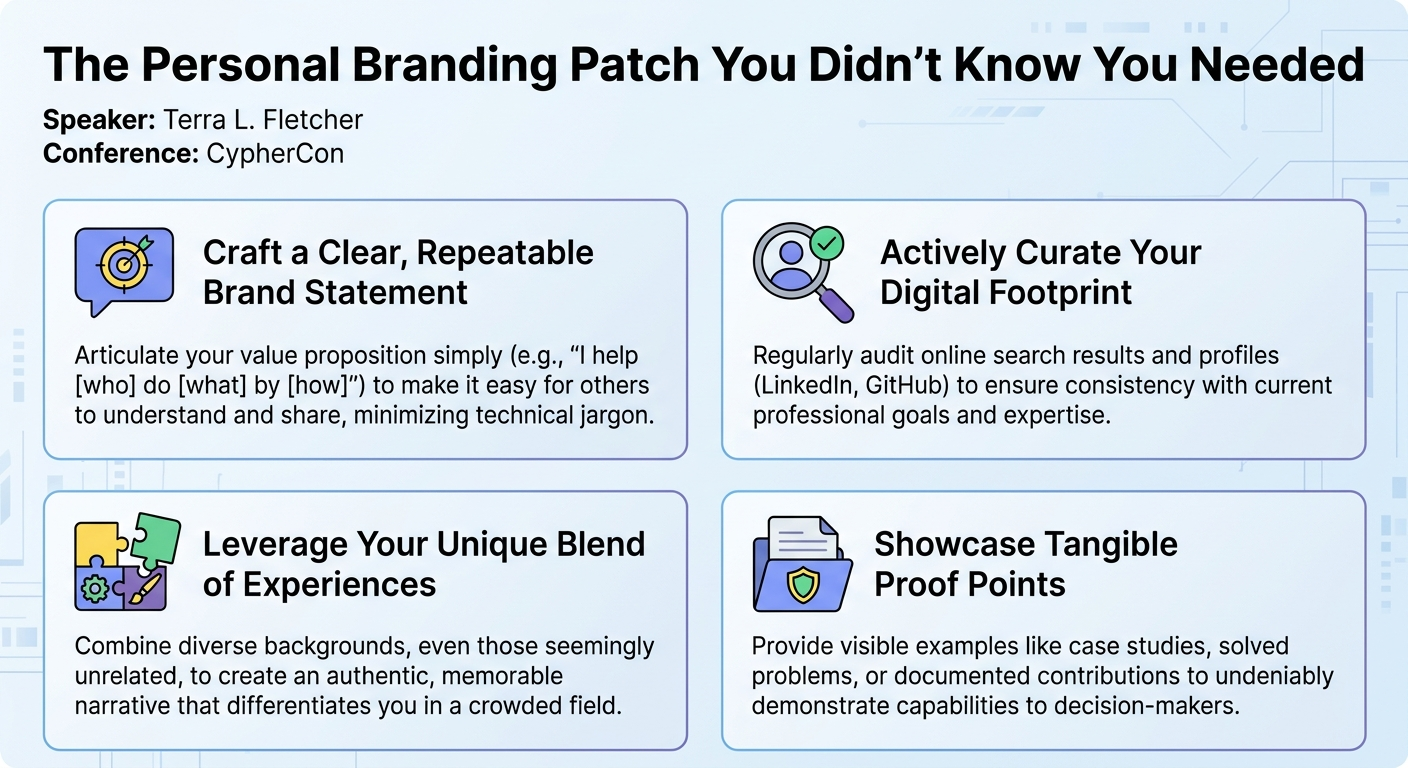
- Define Your Professional Goal: Clearly articulate what you want to achieve and "the thing" you want to be known for; this is the foundation for all branding efforts.
- Leverage Your Unique Blend of Experiences: Differentiate yourself by combining diverse experiences, even those seemingly unrelated to your core profession, to create a memorable and authentic personal narrative.
- Craft a Clear, Repeatable Brand Statement: Use a simple formula ("I help [who] do [what] by [how]") to articulate your value proposition in a way that is easy for others to understand and share, minimizing technical jargon.
- Actively Curate Your Digital Footprint: Regularly audit what appears when your name is searched (using incognito mode) and ensure all online profiles (LinkedIn, GitHub, etc.) consistently reflect your professional goals and current expertise.
- Showcase Tangible Proof Points: Provide visible examples (case studies, solved problems, documented contributions) that demonstrate your capabilities and the impact of your work, making your value undeniable to decision-makers.
- Share Knowledge and Build Trust: Don't be afraid to publicly share valuable insights, checklists, or lessons learned; this establishes you as an authority and fosters trust, leading to future opportunities.
About the Speaker(s)
Terra L. Fletcher is an experienced marketing consultant and business owner who founded her company in 2007 in Shawano, Wisconsin. With over 15 years in the field, she has honed her expertise in marketing and advertising, particularly for businesses undergoing significant transitions. Fletcher specializes in providing marketing and advertising services for mergers and acquisitions (M&A), working with manufacturers and other B2B companies. Her focus includes both internal and external communication strategies during processes like mergers, acquisitions, rebrands, and other major organizational changes. She emphasizes the importance of niching down to serve a specific audience effectively, enabling easier referrals and greater professional recognition.
Reviews
Dr. Zero (Offensive Security Researcher) — HARD PASS
A B2B marketing consultant walked into CypherCon to tell hackers to update their LinkedIn headshots. This is repackaged influencer garbage dressed up with cringeworthy 'patching' analogies to pander to a technical crowd. Skip this unless you literally just woke up from a 15-year coma and need someone to explain how search engines work.
Heather Calloway (CISO) — SOLID
This is a professional development workshop for practitioners, not a security briefing. The enterprise takeaway isn't about LinkedIn profiles; it is a blunt reminder that technical staff consistently fail to articulate business value without coaching.