Simple Steps for Security Teams to Stay on the Right Side of the Law
Zach Willenbrink
Overview
In an era of escalating cyber threats and increasingly stringent regulatory oversight, the personal liability of security professionals has become a palpable concern. This compelling talk by Zach Willenbrink, an attorney specializing in cybersecurity and privacy law at Godfrey & Kahn, sheds critical light on the personal legal risks faced by individuals within security teams. Willenbrink meticulously dissects two high-profile cases – the Uber Joe Sullivan conviction and the SEC lawsuit against SolarWinds' Tim Brown – to illustrate how security leaders can find themselves personally embroiled in civil and criminal litigation.
Key moments
- 0:00 Introduction to legal liabilities for security teams
- 7:45 Analysis of Uber CISO Joe Sullivan's conviction
- 9:00 SolarWinds VP Tim Brown's SEC lawsuit challenges
- 12:00 Increasing personal liability across the org chart
- 14:00 Commandment 1: Secure personal protections at hire
- 15:00 IR prep: Involve legal, establish bug bounty programs
- 16:00 During response: Stick to plan, keep good records
- 18:30 Crucial advice: Always tell the whole truth carefully
Simple Steps for Security Teams to Stay on the Right Side of the Law
Speakers: Zach Willenbrink, Attorney, Godfrey & Kahn
Conference: CypherCon
YouTube: https://www.youtube.com/watch?v=kXcaYESJz6g
Overview
In an era of escalating cyber threats and increasingly stringent regulatory oversight, the personal liability of security professionals has become a palpable concern. This compelling talk by Zach Willenbrink, an attorney specializing in cybersecurity and privacy law at Godfrey & Kahn, sheds critical light on the personal legal risks faced by individuals within security teams. Willenbrink meticulously dissects two high-profile cases – the Uber Joe Sullivan conviction and the SEC lawsuit against SolarWinds' Tim Brown – to illustrate how security leaders can find themselves personally embroiled in civil and criminal litigation.
The presentation serves as a stark warning, highlighting the "collective chill" felt by security professionals following these cases. It argues that while the stakes are undeniably high, adopting a series of "simple steps" can significantly mitigate the risk of personal liability. Willenbrink's unique perspective, blending deep legal expertise with a practical understanding of cybersecurity operations (bolstered by his CompTIA Security+ certification), offers invaluable guidance for security teams navigating this complex legal landscape. The talk is essential viewing for anyone in a security leadership role, from CISOs to VPs of security architecture, who seek to protect themselves and their teams from potential legal repercussions.
Background
▶ Watch: Introduction to legal liabilities for security teams (0:00)
The landscape of legal accountability in cybersecurity has undergone a significant transformation, with a noticeable shift from holding only the highest echelons of corporate leadership responsible to increasingly targeting individual security professionals. Historically, personal civil liability was largely reserved for boards of directors, CEOs, or CFOs in cases of egregious corporate misconduct. However, recent high-profile cases demonstrate a clear expansion of this scope, reaching down the organizational chart to individuals directly involved in cybersecurity operations and decision-making.
The most prominent example of this paradigm shift is the Uber Joe Sullivan case. Sullivan, Uber's Chief Security Officer, found himself at the center of a federal investigation. He took on the role amidst an FTC investigation into a prior 2014 breach, publicly claiming the underlying issues had been resolved, despite evidence to the contrary. In 2016, a second breach occurred. To conceal this incident, particularly while the FTC investigation was ongoing, Sullivan orchestrated a scheme: he identified the hackers, had them sign NDAs (Non-Disclosure Agreements) that falsely claimed no personal information was accessed, and paid them $100,000 through Uber's bug bounty program. This payment dramatically exceeded the program's usual $10,000 limit, effectively masking what was, in essence, a ransom payment. His actions were aimed at avoiding internal escalation and keeping the breach hidden from the FTC. Ultimately, Sullivan was charged with and convicted of obstruction of justice for impeding the FTC's investigation, a landmark case demonstrating criminal liability for a CISO.
A second, equally impactful case is the SolarWinds Tim Brown lawsuit. Brown, who was the VP of Security Architecture at SolarWinds at the time of the infamous 2020 supply chain attack, later became a public face for the company's security posture. He participated in podcasts, authored blog posts, and critically, helped establish SolarWinds' "Trust Center" and drafted its security statement. Following the massive breach, the SEC (Securities and Exchange Commission) sued Brown personally, alleging securities fraud. The SEC claimed that Brown's public statements – through podcasts, blogs, and the Trust Center – defrauded the market by misrepresenting SolarWinds' cybersecurity practices. While many of the claims against Brown were dismissed during pre-trial motions, the Trust Center claims persisted, with the court finding potentially verifiable incorrect statements. Although the case against Tim Brown was eventually dismissed entirely with a change in SEC administration, Willenbrink emphasizes the severe personal toll and stress Brown endured over several years of litigation.
These cases are not isolated incidents but rather indicators of a broader trend. Willenbrink cites statements from Senator Ron Wyden following the Change Healthcare breach, indicating a growing sentiment among lawmakers and regulators that executives and individuals must have "skin in the game" to ensure proper security and incident response. The Adobe case, involving regulatory actions against a president and SVP for "dark patterns" (though not cyber-related), further illustrates the expanding scope of individual accountability downwards in the organizational hierarchy, with Tim Brown representing the lowest level (VP of Security Architecture) targeted so far. This evolving legal landscape underscores the urgent need for security teams to understand and proactively manage their personal legal exposure.
Key Findings
▶ Watch: SolarWinds VP Tim Brown's SEC lawsuit challenges (9:00)
The central and most critical finding from this presentation is the undeniable and escalating risk of personal legal liability for cybersecurity professionals across various organizational levels. This risk, once primarily confined to the C-suite, now extends to individuals in roles such as Chief Security Officers (CSOs) and VPs of Security Architecture, with the potential to reach even lower levels.
Willenbrink identifies several key areas where security professionals are particularly vulnerable:
- Misrepresentation and Concealment: The Uber case vividly demonstrates that actively concealing security incidents, misleading regulators, or making false statements (even through seemingly innocuous mechanisms like NDAs or bug bounty programs) can lead to severe criminal charges, including obstruction of justice.
- Public Statements as Evidence: The SolarWinds case highlights that public communications about an organization's security posture—whether through official "Trust Centers," security statements, blog posts, or even podcast appearances—are subject to intense scrutiny. Aspirational statements or claims of robust security that are not factually supported can be construed as securities fraud or other forms of misrepresentation, attracting regulatory action.
- Deviation from Established Procedures: Operating outside of or manipulating established internal policies, procedures, and programs (e.g., exceeding bug bounty limits, failing to follow incident response plans) is a significant red flag for regulators and plaintiffs' counsel, suggesting impropriety or a lack of preparedness.
- Internal Communications as Discoverable Evidence: Internal chat logs, emails, and other communications can become critical evidence in legal proceedings. Discrepancies between internal discussions (e.g., security team members complaining about poor internal security) and external statements can be highly damaging, serving as direct proof of misrepresentation.
- The Personal Toll of Litigation: Even when cases are ultimately dismissed, the process of being personally named in a lawsuit, enduring years of legal battles, and having one's professional reputation publicly questioned imposes immense personal stress and financial burden.
In essence, the talk underscores that security professionals are no longer just technical experts; they are also fiduciaries whose actions and communications can have profound legal consequences, not just for their organizations, but for themselves personally.
Technical Deep Dive
▶ Watch: Commandment 1: Secure personal protections at hire (14:00)
While Zach Willenbrink's talk primarily focuses on legal implications, it provides crucial insights into how technical actions, processes, and artifacts become central to legal scrutiny and personal liability. The "technical deep dive" here is less about exploiting vulnerabilities and more about the technical governance and operational security practices that intersect with legal requirements.
The incident response plan (IRP) emerges as a paramount technical document with significant legal weight. Willenbrink stresses that security teams must not only have an IRP but also adhere to it rigorously. Deviations from the plan, especially during a crisis, must be meticulously documented with clear justifications. The location and accessibility of the IRP are also critical; storing it on a potentially compromised system like SharePoint during a ransomware attack renders it useless. Modern solutions, such as cloud-based incident response platforms or external legal counsel storing copies, are recommended to ensure availability. The act of "freestyling" during an incident, without reference to the IRP, is highlighted as a major risk factor, indicative of unpreparedness or, worse, an attempt to bypass established protocols.
Bug bounty programs are presented as a technical mechanism that, if improperly managed, can lead to severe legal trouble. The Uber case exemplifies this: Sullivan used the program not for its intended purpose of identifying vulnerabilities, but to mask a ransom payment by exceeding the program's defined $10,000 limit with a $100,000 payout. This demonstrates the necessity of clearly defined guardrails and policies for such programs, distinguishing legitimate vulnerability reports from extortion attempts or full-blown incidents. The technical design and operational limits of these programs directly impact their legal defensibility.
The way an organization communicates its security posture is also a critical technical-legal interface. Willenbrink advises against making aspirational statements about security, such as claiming to be "fully secure" or "fully compliant." Instead, he recommends factual, verifiable technical statements. For instance, declaring "we're certified to ISO 27001" is a concrete, auditable fact that is legally safer than broad, subjective claims. The content of a "Trust Center" or security statement, which often details technical controls, architecture, and compliance frameworks, must accurately reflect the current state, not a future roadmap. Misrepresentations here, as seen in the SolarWinds case, can form the basis of securities fraud allegations.
During an incident, the technical findings related to data exfiltration and lateral movement are highly scrutinized. The Blackbaud case serves as a cautionary tale: initial, premature technical assessments that stated "no data was impacted" or "no exfiltration" proved false, leading to significant FTC fines. Security teams must use precise, cautious language, such as "we don't have evidence of exfiltration" or "our preliminary findings are," rather than definitive conclusions, to avoid later accusations of misstatement.
Finally, logging and record-keeping are fundamental technical practices with immense legal implications. Willenbrink emphasizes the need to preserve all relevant logs, emails, and chat communications during an incident. The technical configuration of systems to prevent purging of these records is vital. Furthermore, the use of "off-channel communications" (e.g., personal chat apps) during an incident response is strongly discouraged because they are harder to preserve and often lead to less formal, more reckless communication that can be used as damning evidence. The internal chat logs in the SolarWinds case, revealing security team members complaining about poor internal security while public statements claimed the opposite, underscore the technical reality of discoverable internal communications.
In essence, the "technical deep dive" from this talk reveals that every technical decision, every configuration, every communication about security, and every step in the incident response process, must be viewed through a legal lens. The precision, documentation, and adherence to established technical and procedural frameworks are not just best practices; they are critical safeguards against personal legal liability.
Demo / Proof of Concept
▶ Watch: IR prep: Involve legal, establish bug bounty programs (15:00)
As a legal discourse focused on liability, compliance, and strategic communication, Zach Willenbrink's talk did not feature a live technical demonstration or proof of concept. Instead, its "proof" lay in the stark realities of the legal cases discussed, particularly the Uber Joe Sullivan conviction and the SEC lawsuit against SolarWinds' Tim Brown. These real-world examples served as compelling evidence of the legal risks security professionals face, highlighting the direct consequences of actions and statements within the cybersecurity domain. The presentation's power derived from its analytical breakdown of these incidents, rather than a hands-on technical display.
Defensive Implications
▶ Watch: Crucial advice: Always tell the whole truth carefully (18:30)
The insights from Zach Willenbrink's talk offer a comprehensive playbook for security teams to proactively mitigate personal legal liability. These defensive implications can be categorized into actions to take at different stages of a security professional's career and during the incident response lifecycle.
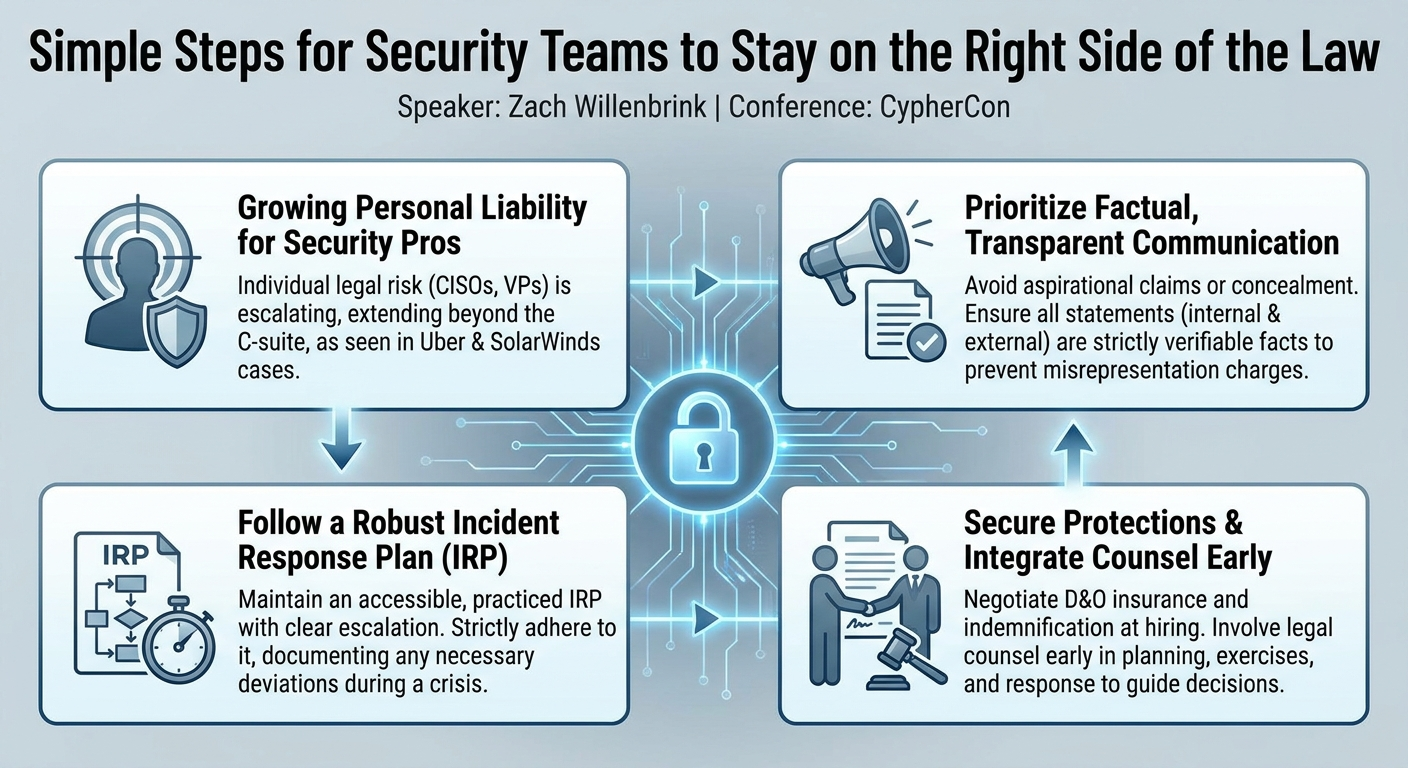
1. Personal Protections at Hiring:
Before even starting a new role, especially in leadership positions (CISO, VP), security professionals must confirm their personal legal safeguards. This includes:
- Directors and Officers (D&O) Insurance: Verify coverage under the company's D&O policy and ensure it explicitly extends to your role.
- Indemnification: Secure a commitment from the company to pay for your legal defense and any judgments rendered against you if you are sued personally.
- Exceptions to Coverage: Understand any limitations or exceptions in both D&O and indemnification agreements.
- Independent Counsel: Ensure the company will pay for your own independent legal counsel if a conflict of interest arises between you and the business (e.g., if the company tries to shift blame onto you). This is crucial to avoid having the same lawyers represent both potentially conflicting parties.
2. Incident Response Preparedness (Left of Boom):
Proactive planning is paramount to establishing clear boundaries and processes.
- Clearly Defined Roles and Escalation: Establish explicit documentation outlining your and your team's authority to make decisions during an incident and clear escalation paths to legal counsel or executive leadership. This prevents "freestyling" and ensures key stakeholders are informed.
- Formal Vulnerability Response Programs: Implement or refine bug bounty programs or responsible reporting initiatives. These programs should have clear rules, limits (e.g., the $10,000 limit in Uber's program), and processes to differentiate between a vulnerability report and a potential incident or extortion attempt. This reduces ambiguity and provides a structured response framework.
- Integrate Legal Counsel Early: Engage legal counsel (in-house or external breach coach) in the incident response planning phase. Conduct tabletop exercises with legal present to ensure they understand your IRP and can advise on legal decisions and maintaining privilege over incident communications. Develop specific playbooks for scenarios like ransomware, including legal flowcharts for payment decisions.
3. During Incident Response (Right of Boom):
Adherence to established plans and meticulous documentation are critical during a crisis.
- Consult the IRP First: Always refer to your incident response plan as the primary guide. While deviations may be necessary, they must be documented, along with the rationale, to demonstrate a thoughtful and controlled response rather than arbitrary actions.
- Follow the "Four Ps": Operate within the bounds of the organization's Policies, Procedures, Programs, and Practices. Deviating from these internal requirements without strong justification can be interpreted as negligence or an attempt to conceal.
- Meticulous Record Keeping: Ensure all relevant logs, emails, and chat communications are preserved. Disable any automatic purging mechanisms during an active incident. Avoid "off-channel communications" (e.g., personal messaging apps) as they are difficult to preserve and can lead to less cautious language.
- Voice Dissent Internally: If other teams or leadership attempt to shift the narrative or misrepresent facts, security professionals have a responsibility to voice dissent and correct factual misunderstandings internally. Documenting these corrections can protect individuals from being implicated in false statements.
4. Strategic and Honest Communication (Across the Timeline):
This is arguably the most crucial defensive measure.
- Always Tell the Whole Truth: This is the paramount commandment. Avoid any form of concealment or fabrication.
- Avoid Aspirational Statements: Do not make definitive claims about security posture (e.g., "we are fully secure," "we are fully compliant") unless they are verifiable facts. Instead, use factual, descriptive language (e.g., "we are certified to ISO 27001"). Wait until a security control is fully implemented before announcing it publicly.
- Use Cautious, Factual Language: During an incident, avoid definitive conclusions like "no exfiltration" or "very little access" without conclusive evidence. Use qualifying language such as "we don't have evidence of..." or "our preliminary findings indicate..." This precision prevents later accusations of misrepresentation, as seen in the Blackbaud case.
- Consult Legal Before Public Statements: Before publishing anything to the company website (especially security statements), making public comments on podcasts, or writing blogs, consult with your legal team. They can assess potential legal risks and ensure accuracy and appropriate phrasing.
- Ensure Leadership Awareness: Maintain transparency with leadership about your team's activities and any significant findings. Avoid operating in a silo or concealing information from internal stakeholders.
By embedding these defensive strategies into daily operations and career planning, security teams can significantly reduce their personal exposure to legal risks, fostering a more secure and legally resilient environment for both themselves and their organizations.
Key Takeaways
- Personal Liability is a Growing Threat: Security professionals, from CISOs to VPs, face increasing personal legal risk, as demonstrated by the Uber Joe Sullivan conviction and the SolarWinds Tim Brown lawsuit, extending beyond traditional C-suite accountability.
- Transparency and Factual Accuracy are Paramount: All communications, both internal (chat logs, emails) and external (Trust Centers, podcasts, blogs), must be scrupulously truthful and factual. Aspirational statements or concealment of incidents can lead to severe legal consequences, including charges of obstruction of justice or securities fraud.
- Robust Incident Response Planning is Essential: A well-defined, accessible, and practiced incident response plan (IRP), coupled with clear escalation paths and specific playbooks (e.g., for ransomware), is critical. Deviations from the IRP must be documented and justified.
- Integrate Legal Counsel Early and Often: Engaging legal professionals (in-house or breach coach) during planning, tabletop exercises, and incident response is crucial for navigating legal decisions, maintaining privilege, and guiding sensitive communications.
- Secure Personal Protections at Hiring: Negotiating D&O insurance, indemnification, and the right to independent counsel as part of an employment agreement is a vital proactive step to safeguard against personal financial and legal burdens.
- Adherence to Internal Policies Mitigates Risk: Operating within the established Policies, Procedures, Programs, and Practices of the organization, and meticulously documenting actions and decisions, provides a strong defense against accusations of negligence or impropriety.
About the Speaker(s)
Zach Willenbrink is an attorney at Godfrey & Kahn, a Wisconsin-based law firm, where he specializes in cybersecurity and privacy law. His practice includes extensive work in incident response and handling the subsequent litigation that often arises from data breaches. Willenbrink brings a unique blend of legal and technical expertise to his role, holding a dual certification as a Certified Information Privacy Technologist and having completed the CompTIA Security+ certification. He also shares his knowledge as an instructor, teaching cyber law at Marquette University. His background allows him to bridge the gap between complex legal frameworks and the practical realities faced by security teams.
Reviews
Dr. Zero (Offensive Security Researcher) — STRONG ACCEPT
This is a survival guide for anyone with 'Security' in their job title who doesn't want to end up in federal court. It's a lawyer actually giving actionable advice on D&O insurance and indemnification instead of the usual compliance theater. Required viewing if you're a CISO, a VP, or just the poor bastard writing the public RCA.
Heather Calloway (CISO) — MUST SEE
This is mandatory viewing for anyone stepping into a senior security role. Willenbrink translates SEC and FTC enforcement trends out of legal theory and into concrete employment requirements. It answers exactly what your leadership team needs to negotiate before they sign an offer letter or declare an incident.