Red Team on a Budget
Jacob Peacy
Overview
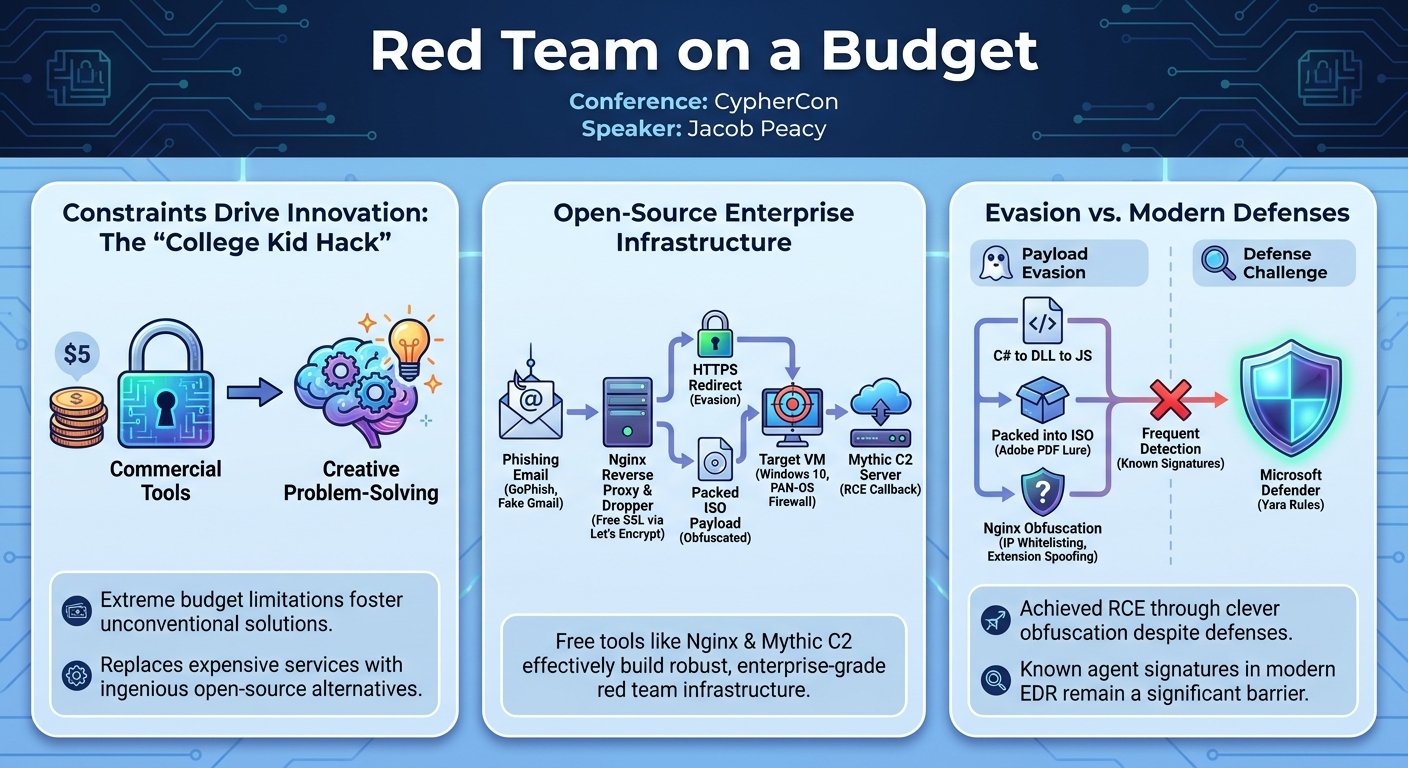
In his CypherCon talk, "Red Team on a Budget," Jacob Peacy, a graduate student and product security engineer, meticulously details his journey to construct an enterprise-worthy red team infrastructure with virtually no financial outlay. Driven by the resource constraints inherent to a college student's budget – a mere $5 in his bank account and limited access to cloud services – Peacy demonstrates how ingenuity and a deep understanding of open-source tools can overcome significant financial and technical hurdles. The talk serves as a compelling case study for individuals and organizations seeking to establish or enhance their offensive security capabilities without incurring substantial costs.
Key moments
- 2:00 Introduction: Building red team infrastructure on a budget
- 5:00 Original plan: Azure Front Door and Mythic C2
- 7:00 The "College Kid Hack": Overcoming budget and Azure limitations
- 10:00 Budget infrastructure: Nginx, Let's Encrypt, and "notmaliciousurl.com"
- 11:00 Successful kill chain and achieving "hacker high"
- 13:00 Obfuscation methods: IP whitelisting and extension spoofing
- 16:00 Key takeaways: Constraints drive innovation, resourcefulness
- 17:40 Q&A: The true cost, including caffeine and pizza
Red Team on a Budget
Speakers: Jacob Peacy, Graduate Student, University of Wisconsin-Whitewater / Product Security Engineer, Rockwell Automation
Conference: CypherCon
YouTube: https://www.youtube.com/watch?v=akSyefZZ9Bg
Overview
In his CypherCon talk, "Red Team on a Budget," Jacob Peacy, a graduate student and product security engineer, meticulously details his journey to construct an enterprise-worthy red team infrastructure with virtually no financial outlay. Driven by the resource constraints inherent to a college student's budget – a mere $5 in his bank account and limited access to cloud services – Peacy demonstrates how ingenuity and a deep understanding of open-source tools can overcome significant financial and technical hurdles. The talk serves as a compelling case study for individuals and organizations seeking to establish or enhance their offensive security capabilities without incurring substantial costs.
Peacy’s project wasn't just an academic exercise; it was a practical application of advanced red team methodologies, culminating in a successful remote code execution (RCE) against a target system protected by modern defenses. He outlines the complete kill chain, from initial phishing campaigns to C2 beacon deployment, showcasing how he leveraged free tiers of cloud providers, open-source C2 frameworks, and creative payload obfuscation techniques. This presentation is particularly relevant for aspiring penetration testers, red teamers, and security professionals in resource-constrained environments, offering actionable insights into building robust offensive capabilities through strategic use of readily available tools and a "college kid hack" mindset.
The significance of Peacy's work extends beyond cost-saving; it highlights the critical importance of resourcefulness and innovative problem-solving in the cybersecurity domain. By demonstrating that sophisticated red team operations are not exclusively the domain of well-funded teams, he empowers a broader audience to engage in practical offensive security research and development. The talk also implicitly underscores the need for defenders to understand these budget-friendly attack vectors, as adversaries often operate with similar constraints and leverage comparable techniques.
Background
▶ Watch: Introduction: Building red team infrastructure on a budget (2:00)
The genesis of this project stemmed from Jacob Peacy’s academic and competitive cybersecurity pursuits. As a graduate student at the University of Wisconsin-Whitewater, pursuing a master's in computer science with a cybersecurity engineering emphasis, he sought to gain practical experience in red teaming. His inspiration came from a Cyber Warfare Labs certification that outlined the setup of red team infrastructure, which he decided to integrate into his computer networking coursework for honors credits. Additionally, his involvement with the University of Wisconsin-Whitewater cybersecurity club, the CyberHawks competition team, and the Collegiate Cyber Defense Competition (CCDC) further fueled his desire to understand and implement advanced attack patterns, particularly those related to C2 beacon traffic.
The initial vision for the project involved a sophisticated setup utilizing Azure Front Door as the primary entry point for a phishing campaign, directing traffic to an open-source C2 server like Mythic, a phishing setup, and a payload dropper. This architecture was designed to deliver a malicious executable, ultimately granting remote code execution (RCE) to the C2 server. The expected kill chain involved sending a phishing email (e.g., an Adobe Acrobat license expiration notice), a user clicking a link, redirection through Azure Front Door, downloading a double-clickable file (LNK or ISO), execution of the file, opening a benign PDF, and finally, achieving RCE.
However, the reality of a college student's budget quickly introduced significant constraints. With only $5 in his bank account and limited access to Azure's free tier, Peacy faced several critical limitations:
- Budget: Effectively zero, precluding paid Azure services.
- Azure Free Tier Restrictions: Only three virtual machines (VMs) were available, and crucially, no access to Azure Front Door, which was a cornerstone of his initial design.
- Time Constraints: Juggling 18 credits, including master's classes and personal expenses, meant efficiency was paramount.
These limitations forced a radical re-evaluation of the project's architecture, giving rise to what Peacy terms the "college kid hack" – a creative approach to problem-solving by substituting unavailable or expensive resources with free, open-source, and resourceful alternatives. This necessity to innovate under duress became the driving force behind the entire project, transforming it from a standard implementation into a testament to ingenuity in cybersecurity.
Key Findings
▶ Watch: The "College Kid Hack": Overcoming budget and Azure limitations (7:00)
The central discovery and contribution of Peacy's project is the demonstration that sophisticated, "enterprise-worthy" red team infrastructure can be established and operated effectively with minimal financial investment, primarily leveraging open-source tools and creative problem-solving. This dispels the notion that advanced offensive capabilities are exclusive to well-funded organizations.
Key findings include:
- The "College Kid Hack" Philosophy: This core principle highlights that resource constraints, rather than being insurmountable obstacles, can be powerful catalysts for innovation. Peacy’s ability to completely redesign his attack architecture due to budget and platform limitations exemplifies this mindset, proving that creative approaches can bypass traditional barriers.
- Viability of Open-Source Alternatives: The project successfully substituted expensive commercial cloud services with free, open-source tools. Nginx effectively replaced Azure Front Door as a reverse proxy, load balancer, and payload dropper. Let's Encrypt provided free TLS certificates, and CloudFlare's free tier facilitated domain management. This demonstrates that robust, production-grade components for red teaming are freely available.
- Successful End-to-End Kill Chain Implementation: Despite the severe budget and resource constraints, Peacy engineered a complete phishing-to-C2 kill chain, achieving remote code execution (RCE) on a target Windows 10 VM protected by a PAN-OS firewall. This validates the practical effectiveness of the chosen open-source tools and the revised architecture.
- Effective Obfuscation and Evasion Techniques: Peacy implemented several layers of obfuscation within Nginx (IP/User-Agent whitelisting, extension spoofing, rate limiting) and for the payload (converting C# to DLL to JavaScript, then packing with Pack My Payload). These techniques were designed to bypass detection by network security devices and endpoint protection, although he noted challenges with Microsoft Defender.
- Challenges with Modern Endpoint Detection: A significant finding was the consistent challenge posed by Microsoft Defender. Even with obfuscation, Defender's pre-installed Yara rules for known open-source agents like Mythic and Apollo resulted in a low success rate (1 out of 10 tests). This underscores the continuous arms race between offensive techniques and defensive technologies, highlighting the need for custom agents or more advanced evasion.
- Resourcefulness in Cloud Utilization: Peacy maximized the limited Azure free tier (three VMs) by consolidating multiple services onto single instances, such as combining the payload dropper and reverse proxy functions on the Nginx VM. This demonstrates efficient resource management in a constrained cloud environment.
Overall, the project validates that a determined individual with a strong technical foundation can construct and execute sophisticated red team operations using only readily available, free resources, provided they apply a high degree of creativity and technical acumen.
Technical Deep Dive
▶ Watch: Successful kill chain and achieving "hacker high" (11:00)
Peacy's project involved a significant technical pivot from an ideal, well-funded architecture to a budget-constrained, ingenious implementation. The core objective remained consistent: achieving remote code execution (RCE) through a phishing campaign.
Original (Ideal) Architecture:
The envisioned architecture relied heavily on Azure's paid services:
- Azure Front Door: Intended as the primary entry point, acting as a global load balancer and secure entry for the phishing campaign.
- Mythic C2 Server: Hosted on an Azure VM, serving as the command and control infrastructure.
- GoPhish: A separate service for managing phishing campaigns.
- Payload Dropper: A dedicated server to host and deliver malicious payloads.
- Redirection Server: To direct traffic appropriately.
This setup assumed ample Azure VM access and the built-in TLS certificates provided by Front Door.
Revised (Budget-Friendly) Architecture – The "College Kid Hack":
Due to the $5 budget and Azure free tier limitations (3 VMs, no Front Door), Peacy engineered a new architecture:
- Mail Server (VM 1): Hosted a GoPhish Docker container. This allowed for the creation and sending of phishing emails. To send emails, a fake Gmail account was set up, and its OAuth token was used within GoPhish, demonstrating a simple yet effective bypass for traditional email security.
- C2 Server (VM 2): Hosted the Mythic C2 framework. Mythic is an open-source, post-exploitation C2 framework that supports multiple agents (e.g., Apollo for .NET).
- Reverse Proxy / Payload Dropper (VM 3): This single VM was the most critical innovation. Nginx was deployed to perform multiple roles:
- Reverse Proxy: Replaced Azure Front Door, handling incoming requests.
- Load Balancer: While not strictly load balancing multiple servers, it managed traffic flow to the C2 and payload.
- Payload Dropper: Stored and delivered the malicious ISO file. Nginx's
302 logicwas repurposed to serve specific files based on requests.
Domain and TLS:
- Domain Name: The last $5 was spent on
notmaliciousurl.comusing CloudFlare's free tier for DNS management. This provided a seemingly legitimate domain for the phishing campaign. - TLS/HTTPS: Since Azure Front Door's automatic TLS was unavailable, Let's Encrypt was used to obtain a free SSL certificate for
notmaliciousurl.com. This ensured HTTPS encryption for the phishing links, lending credibility and bypassing basic network filters looking for plain HTTP.
The Kill Chain (Budget Edition):
- Phishing Email: GoPhish sent emails from the fake Gmail account (e.g.,
[email protected]), using an Adobe Acrobat license expiration as a social engineering lure. - User Interaction: The target (a Windows 10 VM behind a PAN-OS firewall) clicked the malicious link in the email.
- Redirection & Payload Delivery: The link directed to
notmaliciousurl.com, hitting the Nginx reverse proxy. Nginx, acting as the payload dropper, delivered a double-clickable file (e.g., an ISO container or LNK file). - Payload Execution: The user double-clicked the ISO, which was crafted to appear as a benign PDF while simultaneously deploying the C2 beacon.
- C2 Callback: The beacon established a connection back to the Mythic C2 server.
- RCE Achieved: Peacy gained remote access, confirmed with commands like
whoami, enabling further enumeration and penetration testing.
Nginx Obfuscation and Evasion Techniques:
Peacy implemented several clever techniques within Nginx to evade detection and ensure only legitimate targets received the payload:
- IP and User-Agent Whitelisting: Nginx was configured to only serve the malicious payload to specific in-scope target IP addresses and/or user agents. Any request from an unknown IP or user agent would be redirected.
- Extension Spoofing / Redirection Logic: If an unauthorized user or scanner requested the malicious ISO, Nginx's
302 logicwould redirect them to a harmless page, such as a Rickroll or a fake.txtfile download, preventing discovery of the actual payload. - Rate Limiting: To deter automated scanning or brute-force attempts, Nginx implemented rate limiting. If a single IP address attempted to access the HTTPS server five times, it would be permanently redirected to a Rickroll, effectively blocking further interaction.
Payload Creation and Obfuscation:
The malicious payload itself underwent several layers of obfuscation:
- Initial Beacon: A C# .NET process was created as the main callback agent for Mythic C2 (using the Apollo agent).
- DLL Conversion: This C# code was compiled into a DLL.
- JavaScript Instance: An open-source project called DotNETtoJS was used to convert the DLL into a JavaScript instance, making it harder for static analysis to detect.
- Packing: Another open-source tool, Pack My Payload, was used to combine the JavaScript beacon with a benign Adobe Acrobat PDF into a single, self-extracting ISO file. This ISO file was then delivered disguised, for example, as
trust.batinstead ofmalicious.iso. When the user double-clicked the ISO, the PDF would open, providing a decoy, while the embedded beacon would execute in the background.
Challenges Encountered:
The primary challenge was Microsoft Defender. Despite the obfuscation, Defender's pre-installed Yara rules for known open-source agents like Apollo and Mythic frequently detected the payload. Peacy reported a success rate of only 1 out of 10 tests, with Defender being the main reason for failure. This highlights the effectiveness of modern EDR/AV solutions against publicly known offensive tools. The target Windows 10 VM was also protected by a PAN-OS firewall, which the initial phishing vector bypassed.
This detailed technical breakdown illustrates Peacy's innovative approach to red teaming under severe budget constraints, showcasing how open-source tools and clever engineering can mimic the capabilities of expensive commercial solutions.
Demo / Proof of Concept
▶ Watch: Obfuscation methods: IP whitelisting and extension spoofing (13:00)
While the talk did not feature a live, real-time demonstration of the entire attack chain, Jacob Peacy explicitly described the successful execution of his proof of concept (POC). His methodology culminated in achieving remote code execution (RCE) on a target Windows 10 virtual machine (VM). This VM was intentionally set up with defensive measures, specifically being placed behind a PAN-OS (Palo Alto Networks Operating System) firewall, to simulate a more realistic enterprise environment.
Peacy detailed the "hacker high" feeling he experienced upon successfully receiving the callback to his Mythic C2 server, confirming that his meticulously crafted phishing campaign and payload delivery mechanism had bypassed the initial defenses. He was able to run basic commands like whoami, which verified his access level and allowed for initial enumeration, marking the successful completion of the kill chain.
The demonstration of success, albeit described rather than live, validates the efficacy of his budget-friendly red team infrastructure. He confirmed that the Apollo agent, deployed via the obfuscated ISO, successfully communicated back to Mythic. The challenges he faced, particularly with Microsoft Defender, underscore that while the overall architecture worked, specific components (like the known Apollo agent) are increasingly detected by modern endpoint protection, necessitating further research into custom agents and advanced evasion techniques. Despite these challenges, the fact that he achieved RCE even once, against a defended target, serves as a powerful testament to the ingenuity and resourcefulness employed in the project.
Defensive Implications
▶ Watch: Q&A: The true cost, including caffeine and pizza (17:40)
Jacob Peacy's "Red Team on a Budget" talk provides crucial insights for defenders, highlighting common attack vectors and the effectiveness (or lack thereof) of various security controls against resourceful, budget-conscious adversaries.
- Endpoint Detection and Response (EDR) / Antivirus (AV) Evasion:
- Challenge: Microsoft Defender, with its pre-installed Yara rules for known open-source C2 agents like Mythic and Apollo, proved to be a significant barrier. Peacy's 1/10 success rate was primarily due to Defender catching the beacon.
- Implication for Defenders: Modern EDR/AV solutions are effective against publicly known offensive tools. Organizations should ensure their EDR/AV is up-to-date, configured for maximum detection, and integrates threat intelligence that includes signatures for common open-source red team tools. However, defenders must also anticipate that sophisticated attackers will use custom agents or employ more advanced obfuscation/polymorphism (as Peacy plans for future work) to bypass these defenses.
- Actionable Advice: Invest in robust EDR solutions. Implement application whitelisting where feasible to prevent execution of unknown binaries. Regularly review EDR logs for suspicious process creation, network connections, and file modifications.
- Network Intrusion Detection Systems (NIDS) / Firewalls:
- Challenge: The target VM was behind a PAN-OS firewall, but the initial phishing vector successfully bypassed it. Nginx's obfuscation (IP whitelisting, extension spoofing, rate limiting) was designed to evade network-level detection of the C2 infrastructure itself. However, Peacy noted that NIDS could potentially detect suspicious Let's Encrypt wildcard certificates or unusual TLS signatures.
- Implication for Defenders: Firewalls primarily block known bad traffic or enforce policy. They are less effective against initial access via user interaction with a legitimate-looking, HTTPS-encrypted phishing link. NIDS can provide an additional layer, but require careful tuning to detect anomalies in encrypted traffic.
- Actionable Advice: Deploy NIDS/NIPS (Network Intrusion Prevention Systems) capable of TLS inspection where permissible and practical. Monitor for unusual certificate usage (e.g., newly registered Let's Encrypt certs from unknown domains, especially if they are wildcard certs). Implement robust egress filtering to prevent C2 callbacks to unusual destinations.
- Email Security and User Awareness:
- Challenge: Peacy successfully sent phishing emails using GoPhish and a fake Gmail account with an OAuth token, bypassing Gmail's advanced filters. The social engineering lure (Adobe Acrobat license expiration) was effective enough to prompt user interaction.
- Implication for Defenders: Even with advanced email security gateways, determined attackers can craft emails that bypass filters. User education remains a critical defense layer.
- Actionable Advice: Conduct regular and realistic phishing simulations. Provide ongoing user training on identifying phishing attempts, especially those leveraging common lures like software license expirations or account issues. Implement multi-factor authentication (MFA) to mitigate the impact of credential theft, even if a phishing email is successful. Implement DMARC, DKIM, and SPF records to prevent email spoofing.
- Supply Chain Security and Open-Source Tools:
- Challenge: The reliance on open-source tools like Mythic and Apollo, while cost-effective for attackers, means their signatures and behaviors become known to defenders.
- Implication for Defenders: Understanding the capabilities and signatures of popular open-source offensive tools is vital. Defenders should familiarize themselves with frameworks commonly used by red teams and adversaries.
- Actionable Advice: Integrate threat intelligence feeds that track new and updated open-source offensive tools. Develop or acquire custom detection rules (e.g., Yara rules, Sigma rules) for known attacker toolkits.
- Resourcefulness of Adversaries:
- Challenge: The entire project demonstrates that significant resources are not a prerequisite for effective red teaming (and by extension, real-world attacks). Creative problem-solving can circumvent budget limitations.
- Implication for Defenders: Do not underestimate adversaries based on their perceived resources. Small, dedicated teams or individuals can achieve sophisticated results through ingenuity and open-source intelligence.
- Actionable Advice: Focus on defense-in-depth across multiple layers. Assume breach and prioritize detection and response capabilities. Continuously test your defenses with internal red teams or external penetration testers who can simulate realistic, resourceful attacks.
In summary, Peacy's talk is a stark reminder that defenders must adopt a proactive and adaptive stance. Relying solely on off-the-shelf security products is insufficient; a combination of layered defenses, robust monitoring, continuous user education, and an understanding of attacker methodologies (especially those driven by resourcefulness) is paramount.
Key Takeaways
- Constraints Drive Innovation: Jacob Peacy's project exemplifies the "college kid hack," demonstrating that severe budget and resource limitations can force creative problem-solving and lead to highly effective, unconventional solutions in cybersecurity.
- Resourcefulness is Paramount: Replacing expensive commercial services like Azure Front Door with free open-source alternatives (Nginx, Let's Encrypt, CloudFlare free tier) and maximizing limited resources (3 Azure VMs) showcases the critical importance of resourcefulness in red teaming.
- Open-Source Tools are Enterprise-Worthy: Tools like Mythic C2, GoPhish, DotNETtoJS, and Pack My Payload, when combined with technical skill, can form the backbone of a robust, enterprise-level red team infrastructure without significant financial investment.
- Phishing Remains a Potent Initial Access Vector: Despite advancements in email security, a well-crafted phishing email using social engineering (e.g., Adobe license expiration) and legitimate-looking infrastructure (HTTPS, custom domain) can still lead to initial access and remote code execution.
- Modern Defenses Require Advanced Evasion: While the project achieved RCE, Microsoft Defender (with its Yara rules for known agents) proved to be a significant challenge, highlighting the constant arms race between offensive and defensive capabilities and the need for more sophisticated, custom payload obfuscation.
- Understanding the Full Kill Chain is Essential: Both red teamers and defenders benefit from a comprehensive understanding of the entire attack kill chain, from initial reconnaissance and phishing to payload delivery, C2 communication, and post-exploitation.
About the Speaker(s)
Jacob Peacy is a dynamic and highly accomplished individual in the cybersecurity field, even at an early stage of his career. He is currently a graduate student at the University of Wisconsin-Whitewater, pursuing a Master's degree in Computer Science with a specialized emphasis in Cybersecurity Engineering. Prior to his graduate studies, Peacy earned his Bachelor's degree in Cybersecurity from the same institution, graduating with honors and also completing a minor in Mathematics and Computer Science.
Beyond his academic pursuits, Jacob is actively engaged in the professional world as a Product Security Engineer at Rockwell Automation. He is also deeply involved in the cybersecurity community at his university, holding leadership positions such as President of the University of Wisconsin-Whitewater cybersecurity club. He is the founder and a leader of the university's competitive cybersecurity teams, known as the CyberHawks, and has served as a co-captain for the Collegiate Cyber Defense Competition (CCDC) team. Peacy is characterized by his drive and commitment, often managing a demanding schedule while still undertaking numerous projects and initiatives, reflecting his passion for cybersecurity and continuous learning.
Reviews
Dr. Zero (Offensive Security Researcher) — SOLID
Jacob strung together GoPhish, Mythic, and Nginx for five bucks. It's a competent primer for students on how to set up basic C2 infrastructure, but acting like routing a default Apollo payload through a free Cloudflare tier is 'enterprise-worthy' is a massive stretch.
Heather Calloway (CISO) — SOLID
This talk validates that the financial barrier to entry for establishing C2 infrastructure is effectively zero. A student built a functional kill chain using free cloud tiers and open-source tools, proving to leadership that sophisticated-looking infrastructure does not require a well-funded adversary.