Analysis Without Paralysis: Mastering the Art of Investigation
Terryn Valikodath
Overview
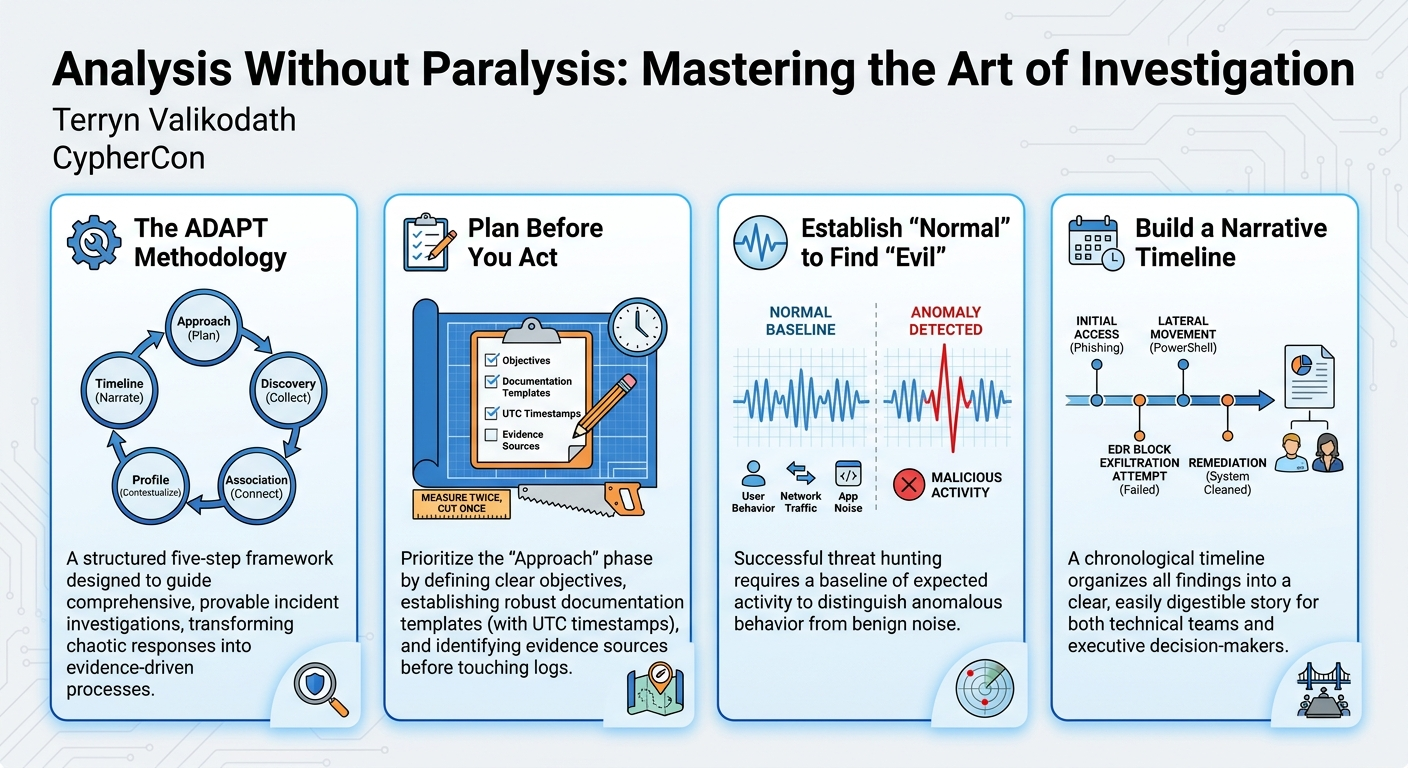
In his CypherCon talk, "Analysis Without Paralysis: Mastering the Art of Investigation," Terryn Valikodath, a Senior Incident Response Consultant with Cisco Talos, addresses a critical gap in the cybersecurity industry: while many professionals are adept at technical analysis, few are formally taught the structured process of conducting a comprehensive investigation. Valikodath, who also runs the Chocolate Coat Forensics blog, argues that this lack of structure leads to analyst burnout, missed details, and an inability to effectively communicate findings to stakeholders. His presentation introduces the ADAPT methodology—Approach, Discovery, Association, Profile, Timeline—a practical framework designed to guide incident responders and security professionals through any investigation, from minor network anomalies to major breaches.
Key moments
- 4:00 Why structured investigation is crucial
- 8:00 Defining investigation: from unknown to provable
- 10:00 Introducing the ADAPT methodology framework
- 10:45 The 'Approach' phase: planning and documentation
- 23:00 Documenting investigation findings effectively
- 36:00 Creating the investigation timeline
- 41:30 Practical benefits of the ADAPT methodology
- 48:30 Speaker's stance on using AI in investigations
Analysis Without Paralysis: Mastering the Art of Investigation
Speakers: Terryn Valikodath, Senior Incident Response Consultant, Cisco Talos
Conference: CypherCon
YouTube: https://www.youtube.com/watch?v=Yd9Yw-ZFAk4
Overview
In his CypherCon talk, "Analysis Without Paralysis: Mastering the Art of Investigation," Terryn Valikodath, a Senior Incident Response Consultant with Cisco Talos, addresses a critical gap in the cybersecurity industry: while many professionals are adept at technical analysis, few are formally taught the structured process of conducting a comprehensive investigation. Valikodath, who also runs the Chocolate Coat Forensics blog, argues that this lack of structure leads to analyst burnout, missed details, and an inability to effectively communicate findings to stakeholders. His presentation introduces the ADAPT methodology—Approach, Discovery, Association, Profile, Timeline—a practical framework designed to guide incident responders and security professionals through any investigation, from minor network anomalies to major breaches.
Valikodath’s insights are particularly pertinent in today's complex threat landscape, where security incidents are not just technical challenges but also organizational crises requiring clear communication and strategic decision-making. By emphasizing a systematic approach, the talk empowers analysts to move beyond merely interpreting logs to constructing a coherent, provable narrative of an incident. This structured methodology aims to transform chaotic, reactive responses into efficient, evidence-driven investigations, ultimately fostering greater confidence in findings and enabling more effective defensive strategies.
The talk highlights that the goal of an investigation extends beyond simply understanding what happened; it's about understanding why, how, and what to do next, all while maintaining a clear, documented chain of events. This framework is not just for seasoned incident responders but also serves as a foundational guide for those new to the field, offering a clear path to contribute meaningfully even without deep technical expertise, such as by serving as a dedicated scribe.
Background
▶ Watch: Why structured investigation is crucial (4:00)
The premise of Valikodath's talk stems from a fundamental observation: most IT and cybersecurity professionals are routinely asked to investigate issues, yet formal training in structured investigation methodologies is conspicuously absent. While individuals often possess strong analytical skills—capable of sifting through Windows event logs or interpreting security console data—they frequently struggle to synthesize these disparate pieces of analysis into a coherent, provable investigation. This deficiency becomes particularly acute during high-stress incident response scenarios, where a lack of planning can exacerbate an already critical situation, leading to burnout, errors, and an inability to provide clear answers to management.
Valikodath clarifies the distinction between digital forensics (DF) and incident response (IR). While often conflated under the umbrella term DFIR, their primary goals differ significantly. Digital forensics typically focuses on collecting, analyzing, and presenting evidence of past events, aiming for a complete understanding of what has occurred. Incident response, conversely, operates in a live, dynamic environment where the incident is often still unfolding. Its objectives are multifaceted: to understand what is happening, to manage and mitigate ongoing threats, to prevent further damage, and ultimately, to prevent recurrence. This active, disruptive nature of IR necessitates a more agile yet structured approach. Valikodath identifies himself as approximately 70% IR and 30% DF, reflecting the realities of his role.
He defines an investigation as the process of moving from the unknown to the known, and then further to the provable. The "provable" aspect is crucial, as an unproven hypothesis, no matter how insightful, holds little weight in a professional context. This definition naturally aligns with the scientific method—observation, question, hypothesis, answer, conclusion—which Valikodath advocates applying mentally to every incident. Instead of aimlessly searching logs, analysts should form hypotheses based on initial observations and then seek evidence to validate or refute them, leading to more thorough and complete analysis.
The talk briefly touches upon MITRE ATT&CK, acknowledging its role as a common language for describing adversary tactics, techniques, and procedures (TTPs). Valikodath encourages familiarity with MITRE, recognizing its widespread adoption over the past five years as a standard for communicating about threat behaviors. This common terminology helps foster consistency and shared understanding across the cybersecurity community, contrasting with the disparate attack descriptions prevalent in the past.
The core problem, therefore, is not a lack of analytical capability but a deficit in the overarching framework to guide and organize that analysis into a defensible, actionable investigation. This structured approach is essential for setting realistic expectations, articulating a clear plan to stakeholders, and ultimately transforming chaotic incident handling into a systematic, repeatable process.
Key Findings
▶ Watch: Introducing the ADAPT methodology framework (10:00)
The central contribution of Terryn Valikodath's talk is the ADAPT methodology, a five-step framework designed to bring structure and clarity to incident investigations. This methodology addresses the common challenge faced by analysts who often know how to analyze data but lack a systematic approach to conduct a full investigation.
- The ADAPT Methodology (Approach, Discovery, Association, Profile, Timeline): This framework is presented as a practical, analyst-centric guide for navigating investigations. It emphasizes planning ahead, thorough evidence analysis, logical sequencing of events, contextualizing findings, and clear communication.
- Prioritizing the "Approach" Phase: Valikodath strongly advocates for planning before touching any logs or consoles. This initial phase involves setting clear objectives (which can evolve), establishing a robust documentation plan (using templates, consistent note-taking methods, and shared platforms), and identifying relevant evidence sources based on the questions being asked. The "measure twice, cut once" principle is paramount here, preventing wasted effort on irrelevant data acquisition.
- Documentation as a Core Pillar: Effective documentation is highlighted as non-negotiable. Valikodath provides basic templates (available on GitHub) to overcome the "blank cursor" paralysis, guiding analysts on what to record. Key elements for findings include consistent timestamps (ISO 8601, UTC preferred), the evidence source, a concise event description, the analyst's interpretation or context (explaining why something is suspicious), and a visual snippet (screenshot or log copy). He stresses writing in full sentences to naturally fill in contextual blanks and documenting gaps in findings, not just positive hits.
- The Importance of a Baseline for Threat Hunting: In the Discovery phase, effective threat hunting is underscored as crucial for uncovering the full scope of an incident. This requires establishing a baseline of expected activity—understanding normal user behavior, internal and external network traffic patterns, and typical application noise. Without knowing what's normal, identifying malicious activity becomes a "needle in a haystack" problem. The PEAK threat hunting framework is recommended for guidance.
- The Timeline as a Narrative and Database: The final "Timeline" phase, built upon the preceding steps, is presented as a powerful communication and analytical tool. It visually organizes events chronologically, providing a clear narrative for decision-makers (CFOs, executives) and serving as a database for the incident. This timeline should include not only malicious events but also defensive actions taken, like EDR block events, to demonstrate efficacy and impact.
- Tangible Benefits of a Structured Approach: Beyond improved investigation quality, Valikodath outlines significant benefits for analysts and organizations:
- Comprehensive Reports: The structured notes directly translate into 80-90% complete incident reports, reducing post-incident scramble.
- Enhanced Communication: Clear documentation and timelines facilitate communication with both technical and non-technical stakeholders.
- Metrics and Justification: The data collected can be used to justify investments in security tools (e.g., a new SIEM), improve existing processes, and identify useful evidence sources.
- Personal Accomplishment and Career Growth: A documented investigation provides a clear record of an analyst's contributions, crucial for performance reviews and career advancement.
- Skepticism Towards AI in IR: Valikodath expresses strong reservations about using AI in incident response, primarily due to concerns about repeatability and the inability to explain its internal workings. He argues that for critical tasks, especially those that might end up in court, the transparency and explainability of open-source tools are preferable to black-box AI solutions. He humorously notes his limited use of AI for "defanging" IP addresses from reports.
These findings collectively present a compelling case for adopting a methodical, disciplined approach to incident investigation, transforming a often chaotic and intuitive process into a strategic and defensible practice.
Technical Deep Dive
▶ Watch: Documenting investigation findings effectively (23:00)
The core of Valikodath's presentation is the ADAPT methodology, a structured framework for incident investigation. This methodology is broken down into five distinct, yet often iterative, phases: Approach, Discovery, Association, Profile, and Timeline.
Approach
The "Approach" phase is paramount, emphasizing proactive planning before any technical analysis begins. It's about defining the investigative strategy.
- Setting Objectives: Every investigation must start with a clear objective. This could range from "bring services back online" to "understand malware better" or "determine root cause." Objectives are dynamic and may change as the investigation unfolds. For leadership, defining and prioritizing these objectives is a primary responsibility. This phase also introduces the iterative process of asking a question, identifying evidence to answer it, and then finding the answer.
- Documentation Plan: Crucial for preventing "blank cursor" paralysis. Valikodath provides basic templates (available on his GitHub) to guide note-taking, ensuring consistency from the outset. Key considerations include:
- Note-taking Method: Using tools like OneNote, text files, SharePoint, or Google Drive. The key is accessibility for relevant team members.
- Live Sharing: Encouraged for collaborative environments, allowing team members to see ongoing work and avoid duplication.
- Scribe Role: For less technical team members or students, acting as a scribe is a valuable way to contribute and learn, documenting tasks and assignments.
- Knowing Where to Look (Evidence Sources): Experience is key here, but Valikodath categorizes evidence into five general areas:
- Logs: System logs, application logs, firewall logs, etc.
- Security Tools: Existing security consoles, Endpoint Detection and Response (EDR) systems.
- Intelligence: Threat intelligence feeds, external reports.
- Forensic Analysis: Traditional bit-for-bit copies of devices for deep analysis.
- Triage: A faster alternative to full forensics, extracting specific forensic artifacts (Windows event logs, MFT, memory dumps) from a system. Tools like KAPE and Velociraptor are mentioned as prominent examples. Valikodath clarifies that triage and full forensics are not mutually exclusive; they can be used interchangeably or sequentially based on investigative needs.
- Prioritization and Acquisition: Based on the defined objectives and questions (e.g., "how did they get in?" for an initial breach), analysts identify necessary evidence sources (Office 365 sign-in logs, Windows event logs, firewall logs). This list is then prioritized according to the objective (e.g., user account sign-in details over detailed malware analysis if uptime is the priority). The actual acquisition of evidence can present "hiccups" (access issues, system constraints), so having a prioritized list allows for agile adaptation. The example of pulling a full forensic image of a workstation for an Office 365 email spam incident, only to find the activity was remote, underscores the importance of asking the right questions before evidence collection.
Discovery
This is where the actual analysis of acquired evidence begins, often involving threat hunting.
- Threat Hunting Baseline: A core tenet is that "you can't find evil if you don't know what's normal." Establishing a baseline of expected activity is critical. This includes:
- User Behavior: Typical login patterns, application usage.
- Internal and External Network Traffic Patterns: Normal communication flows.
- Application Noise: Expected services and processes on systems (e.g., Windows startup services).
- The PEAK threat hunting framework is recommended for structuring hunting activities.
- Avoiding Distraction: Analysts must stick to their initial hypotheses (e.g., "did any users log in after 5 PM?"). While other suspicious artifacts (e.g., a strange IP address) may be encountered, they should be noted and delegated or addressed later, ensuring the primary question is answered first to avoid endless "pivoting."
Association
After initial discoveries, this phase focuses on making sense of the collected findings.
- Ordering Events: If consistent UTC timestamps were used, this becomes straightforward: simply arranging findings chronologically. This process reveals the chain of events, identifies any gaps in knowledge, and helps determine what fits or doesn't fit the emerging narrative.
- Capturing Indicators of Compromise (IOCs): As events are associated, key IOCs should be captured. Valikodath categorizes these into:
- Network: DNS, IP addresses.
- File: File hashes, file names, file paths.
- Identity: Usernames, MFA devices, browser/user tokens.
- Behavioral: General patterns of events (e.g., phishing leading to PowerShell execution).
- Normalization and Consistency: Ensuring consistent timestamps and terminology across all findings is vital. Valikodath highlights the challenge of varying vendor terminology (e.g., "connected IP" vs. "source network address" for a source IP). Analysts must confirm meanings and standardize terms for clarity.
- Writing for a Broad Audience: Notes should be written as if for someone unfamiliar with the analyst's specific role or technical jargon. This might involve linking to articles explaining complex terms (e.g., Mimikatz) or providing additional context to avoid constant clarification requests.
Profile
This phase aims to contextualize the incident within a broader threat landscape.
- Behavioral Pattern Recognition: The goal is not necessarily to attribute the attack to a specific adversary or country, but to determine: "Have we seen this behavior before?" or "Has this behavior been documented by others?"
- Leveraging Threat Intelligence: Reviewing external reports and internal historical data is crucial. Threat intelligence teams, if available, are invaluable for deep research into IOCs and correlating them with known attack campaigns.
- Internal Checks: The collected IOCs (IP addresses, usernames) should be searched across internal systems, such as EDR solutions, to identify any missed activity or broader compromise. Valikodath uses simple tools like Word, Excel, and Notepad for organizing IOCs, emphasizing practicality over complex orchestration systems.
Timeline
The final stage synthesizes all findings into a clear, chronological narrative.
- Excel-Based Structure: Valikodath recommends an Excel sheet with specific headers:
- Timestamp (UTC): Consistent time.
- Origin: Where the event started (user, host, external).
- Target: What was affected (host, user, system).
- Evidence Source: Where the finding came from (tool, query, log).
- Event Type: A brief, 2-3 word description (e.g., "failed login," "PowerShell execution").
- Description: The objective statement copied from the findings notes.
- MITRE: Corresponding MITRE ATT&CK techniques, if applicable.
- Narrative and Database: This timeline tells the story of the incident, from initial access to defensive actions. It serves as an easily digestible document for decision-makers and a comprehensive database for the incident response team. Including defensive actions, such as EDR block events, provides crucial context and demonstrates the effectiveness of security controls. The timeline can also yield valuable metrics, such as identifying the most useful evidence sources for future investment decisions.
The ADAPT methodology, while presented sequentially, is often iterative. Analysts may loop back from Discovery to Approach to refine objectives or from Association to Discovery to investigate new leads. This flexible yet structured approach is designed to provide clarity and confidence throughout the investigative process.
Demo / Proof of Concept
▶ Watch: Creating the investigation timeline (36:00)
While Terryn Valikodath's talk does not feature a live, interactive technical demonstration in the traditional sense, he effectively "demos" the practical application of his ADAPT methodology by showcasing examples of the documentation and output generated at various stages. He explicitly mentions and displays snippets from the templates he has created, which are freely available on his GitHub repository.
Specifically, Valikodath provides:
- Documentation Template Example: He illustrates how a well-structured finding should appear in notes, demonstrating the inclusion of a UTC timestamp, the source of the event, a clear event description, the analyst's contextual interpretation (explaining why it's suspicious), and a "code snippet" or visual representation of the raw event (e.g., a truncated log copy). This serves as a concrete example of how to fulfill the "Discovery" phase's documentation requirements. The emphasis is on writing in full sentences to naturally encourage thoroughness and context.
- IOC List Example: He presents a simple, organized list of Indicators of Compromise (IOCs), categorized by network, file, identity, and behavioral types. This visual reinforces his point about using basic tools like Word, Excel, or Notepad for this purpose, prioritizing accessibility and simplicity over complex dedicated platforms, especially in potentially compromised environments. This directly ties into the "Profile" phase.
- Timeline Example: A key visual demonstration is an Excel sheet serving as an incident timeline. This example clearly shows the recommended headers (Timestamp (UTC), Origin, Target, Evidence Source, Event Type, Description, MITRE) filled with sample incident data. This visually demonstrates how the final "Timeline" phase synthesizes all findings into a coherent, chronological narrative, making it easy for both technical and non-technical stakeholders (like a CFO) to understand the progression of an attack and the response efforts. The example highlights how defensive actions, such as an EDR block event, can be integrated into the timeline to illustrate their impact.
These examples function as a "proof of concept" for the ADAPT methodology's output, illustrating how following the structured steps leads to clear, comprehensive, and actionable documentation. The availability of these templates on his GitHub further empowers attendees to immediately implement these practices in their own investigations.
Defensive Implications
▶ Watch: Speaker's stance on using AI in investigations (48:30)
Terryn Valikodath's ADAPT methodology offers several crucial defensive implications for organizations aiming to strengthen their cybersecurity posture and incident response capabilities:
- Standardize Investigation Processes: The most significant implication is the call to adopt a structured, repeatable methodology for all investigations. Implementing a framework like ADAPT ensures consistency, reduces reliance on individual analyst experience, and improves the overall quality and thoroughness of incident handling. This leads to more predictable outcomes and better resource allocation during crises.
- Prioritize Proactive Planning and Documentation: Organizations must shift focus to the "Approach" phase before an incident occurs. This means:
- Developing Incident Response Plans: Clearly defined objectives for various incident types.
- Creating Documentation Templates: Providing analysts with ready-to-use templates (like Valikodath's GitHub examples) for note-taking, findings, and IOC tracking.
- Establishing Note-Taking Standards: Mandating consistent formats, especially UTC timestamps (ISO 8601), and encouraging detailed, contextualized notes written in full sentences.
- Inventory Management: Proactively documenting all systems, service accounts, and the location of sensitive data (PII, PHI) to quickly identify relevant evidence sources during an incident.
- Enhance Logging and Telemetry Collection: The ability to effectively investigate hinges on having the right evidence. Defenders should:
- Identify Critical Log Sources: Understand which logs (e.g., Office 365 sign-in logs, Windows event logs, firewall logs) are essential for answering common investigative questions.
- Improve Log Retention: Ensure logs are retained for sufficient periods to support investigations that may span weeks or months.
- Invest in Triage Tools: Tools like KAPE and Velociraptor can significantly speed up evidence collection, allowing for quicker initial leads and broader coverage across affected systems without the overhead of full forensic imaging.
- Cultivate a Threat Hunting Mindset: Organizations should invest in establishing a baseline of normal activity for user behavior, network traffic, and application processes. This foundational understanding is indispensable for effective threat hunting, enabling security teams to quickly distinguish anomalous or malicious activity from benign noise. Training analysts in frameworks like PEAK can further enhance this capability.
- Leverage Threat Intelligence and Collaboration:
- Integrate Threat Intelligence: Actively use external threat intelligence to contextualize IOCs and identify known adversary behaviors (profiling).
- Foster Internal Collaboration: Encourage analysts to "phone a friend"—consulting help desk or system administrators who possess invaluable context about normal organizational operations. This breaks down silos and enriches investigations.
- Transform Findings into Actionable Insights: The ADAPT methodology's focus on clear reports and timelines allows security teams to:
- Justify Security Investments: Use documented incident findings and metrics (e.g., which evidence sources were most useful) to advocate for new security tools (e.g., a new SIEM) or improvements to existing infrastructure.
- Demonstrate Value: Clearly articulate the work done during an incident, demonstrating the efficacy of security controls (e.g., EDR block events) and the value of the IR team.
- Facilitate Post-Incident Learning: The detailed timeline and findings provide a robust foundation for post-incident reviews, identifying areas for improvement in detection, response, and prevention.
- Exercise Caution with AI in Critical IR: Valikodath's strong stance against using AI for core incident response tasks due to issues of repeatability and explainability serves as a critical defensive warning. Defenders should prioritize tools and methods where the logic and outcomes are transparent and verifiable, especially when findings might be subject to legal scrutiny.
By integrating these defensive implications, organizations can move beyond reactive chaos to a more mature, structured, and effective incident response posture, ultimately reducing the impact and frequency of security incidents.
Key Takeaways
- Structured Investigations are Crucial: The ADAPT methodology (Approach, Discovery, Association, Profile, Timeline) provides a systematic framework to move beyond mere analysis to a comprehensive, provable investigation, reducing burnout and improving outcomes.
- Planning Precedes Action: Prioritize the "Approach" phase by setting clear objectives, establishing robust documentation plans (including templates and consistent UTC timestamps), and identifying relevant evidence sources before touching any logs or consoles.
- Documentation is Paramount: Detailed, contextualized notes written in full sentences, including why something is suspicious and documenting gaps in findings, are essential for clear communication, future reference, and building comprehensive incident reports.
- Know Your Normal for Effective Threat Hunting: Establishing a baseline of expected user behavior, network traffic, and application noise is fundamental for effective threat hunting and quickly identifying anomalies that indicate malicious activity.
- The Timeline is a Powerful Communication Tool: A chronological timeline of events, incorporating both malicious activity and defensive actions, serves as an invaluable database for the incident and an easily digestible narrative for both technical teams and executive decision-makers.
- Leverage Findings for Strategic Improvements: Structured investigation reports and data can be used to justify investments in new security tools (e.g., a SIEM), improve existing processes, and demonstrate the tangible value and accomplishments of the incident response team.
About the Speaker(s)
Terryn Valikodath is a Senior Incident Response Consultant with Cisco Talos, a prominent threat intelligence and research group. In this role, he works on both the reactive and proactive sides of cybersecurity. Reactively, he functions as an Incident Response (IR) analyst, assisting organizations when security incidents occur. Proactively, he contributes to developing incident response plans, conducting tabletop exercises, providing training, and engaging in threat hunting and research.
Valikodath also runs a blog called Chocolate Coat Forensics, where he focuses on the non-technical aspects of incident response, emphasizing that while technical skills are vital, the human and procedural elements are equally important. His academic background is in traditional forensic science and criminology, which is what he studied for his bachelor's degree. He transitioned into digital forensics after realizing his early interests in jailbreaking iPhones, flashing ROMs, and creating emulators were highly applicable to the field. He gained experience through various IT roles, including help desk, system administration, and IT infrastructure, before specializing in digital forensics and incident response.
He credits several resources for shaping his expertise, notably Chris Sanders' investigation theory course, Brett Shavers' work on investigations, and Steve Anson's book, "Applied Incident Response," which he describes as instrumental in his career.
Reviews
Dr. Zero (Offensive Security Researcher) — SOLID
Valikodath delivers a meat-and-potatoes methodology talk aimed squarely at junior IR analysts drowning in alerts. It's not dropping any novel techniques, but it hammers home the investigative discipline required to actually close an incident without fucking up the chain of custody.
Heather Calloway (CISO) — MUST SEE
This is a masterclass in operational discipline. Valikodath targets a chronic failure in security operations: analysts who know how to query logs but don't know how to run a legally defensible, business-aligned investigation. I'd make this required viewing for my entire SOC and IR leadership.