Cyber $ & Uncommon Sense! WI CRT Cyber Fire Fighters
Troy Stairwalt
Overview
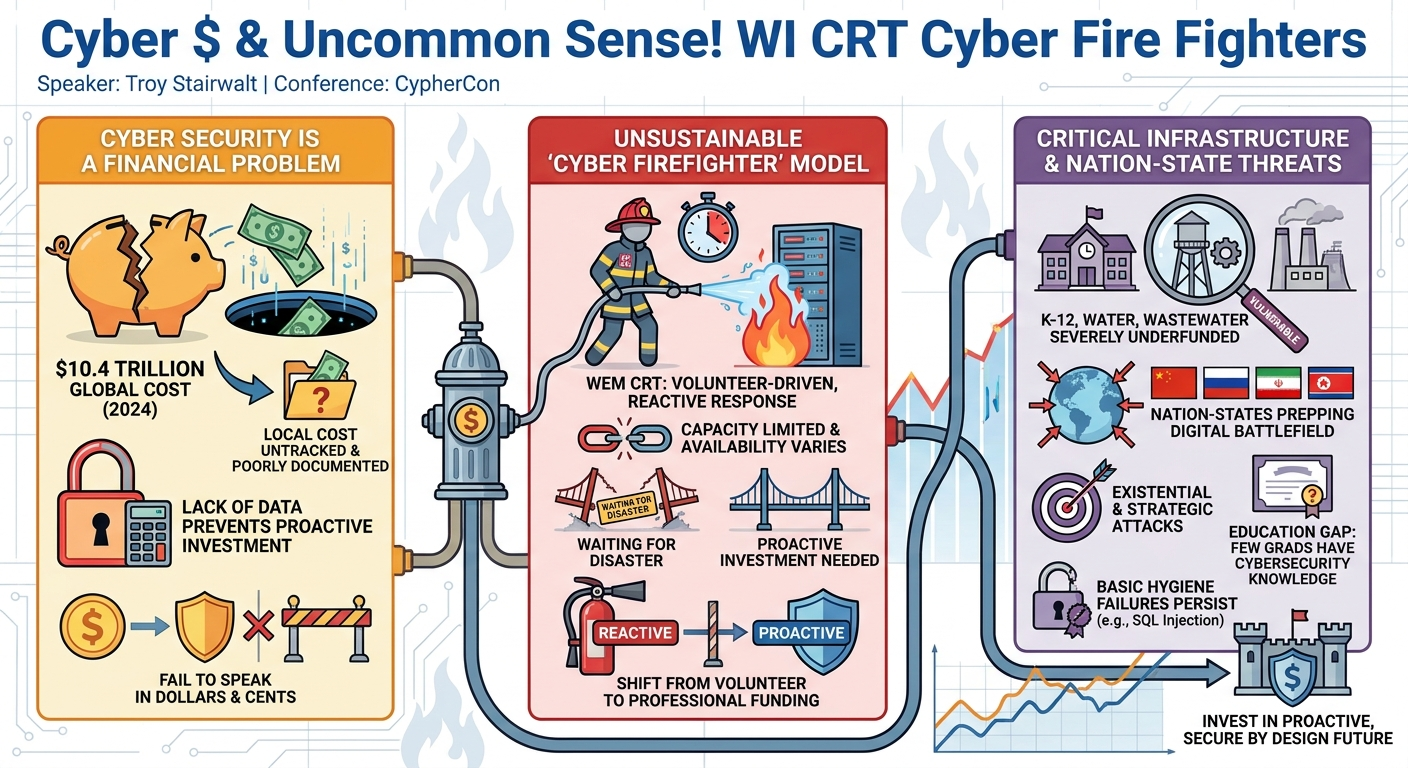
In his CypherCon talk, "Cyber $ & Uncommon Sense! WI CRT Cyber Fire Fighters," Troy Stairwalt, a seasoned cybersecurity professional and former CISO for the state of Wisconsin, delivers a passionate and urgent indictment of the current state of cybersecurity funding and prioritization. The presentation, originally conceived for the Wisconsin Emergency Management Cyber Response Team (WEM CRT), serves as a critical call to action, arguing that a pervasive lack of "common sense" in valuing and investing in cybersecurity is leading to catastrophic, often unquantified, financial and societal costs. Stairwalt champions the WEM CRT as "cyber firefighters" who bravely respond to incidents after the damage is done, highlighting the unsustainable reliance on volunteer efforts in the face of escalating, sophisticated threats.
Key moments
- 2:00 Introduction: Cyber Dollars & Uncommon Sense
- 4:00 Unpacking the true cost of cyberattacks
- 17:00 Wisconsin's volunteer cyber firefighters and state limitations
- 39:00 China's prepared threat to critical infrastructure
- 42:00 Alarming lack of cyber education for graduates
- 51:00 Critiquing the US "punch back" cyber strategy
- 56:00 Cybercrime: A $10.4 trillion global economy
- 68:00 Q&A: Cyber insurance driving security improvements
Cyber $ & Uncommon Sense! WI CRT Cyber Fire Fighters
Speakers: Troy Stairwalt
Conference: CypherCon
YouTube: https://www.youtube.com/watch?v=NIGE0ApjJgc
Overview
In his CypherCon talk, "Cyber $ & Uncommon Sense! WI CRT Cyber Fire Fighters," Troy Stairwalt, a seasoned cybersecurity professional and former CISO for the state of Wisconsin, delivers a passionate and urgent indictment of the current state of cybersecurity funding and prioritization. The presentation, originally conceived for the Wisconsin Emergency Management Cyber Response Team (WEM CRT), serves as a critical call to action, arguing that a pervasive lack of "common sense" in valuing and investing in cybersecurity is leading to catastrophic, often unquantified, financial and societal costs. Stairwalt champions the WEM CRT as "cyber firefighters" who bravely respond to incidents after the damage is done, highlighting the unsustainable reliance on volunteer efforts in the face of escalating, sophisticated threats.
The core of Stairwalt's argument is that policymakers and leaders fail to adequately fund cybersecurity because they do not grasp its true financial impact. He contends that the inability to speak about cybersecurity in terms of dollars and cents – the total cost to taxpayers, the economy, and critical infrastructure – prevents proactive investment. By drawing parallels to physical infrastructure, insurance-driven safety improvements in other industries, and the historical evolution of fire departments, Stairwalt meticulously builds a case for why a reactive, underfunded approach to cybersecurity is not only fiscally irresponsible but also leaves the nation's critical services vulnerable to both opportunistic cybercriminals and nation-state adversaries.
Background
▶ Watch: Introduction: Cyber Dollars & Uncommon Sense (2:00)
Stairwalt's talk is deeply rooted in the observation that, despite the increasingly digital nature of society, cybersecurity remains a reactive discipline, much like waiting for bridges to crumble before rebuilding them. He notes that while many aspects of life are meticulously tracked, the total cost of cybersecurity incidents—beyond immediate recovery—is often ignored or poorly documented. This oversight perpetuates a cycle where security controls are perceived as "too expensive," and the prevailing mindset is "it's never going to happen to me." The speaker's personal philosophy, shaped by his grandmothers' wisdom that "neither common sense nor common courtesy were all that common," underpins the talk's title and central theme.
The analogy of "cyber firefighters" is central to understanding the current operational model. The Wisconsin Emergency Management Cyber Response Team (WEM CRT), a volunteer organization active since 2015, exemplifies this reactive approach. They step in after a cyberattack has occurred, providing stability and reassurance. While invaluable, Stairwalt argues that relying solely on volunteers is a precarious position for a state of 6 million people, especially when facing multiple concurrent attacks. He highlights the historical precedent of volunteer fire departments in Philadelphia, founded by Ben Franklin in 1736, and how it took over a century for the first professional fire department to be established in Cincinnati in 1853, driven largely by the financial pressures of insurance companies. Stairwalt posits that cybersecurity is at a similar inflection point, needing to shift from a volunteer-driven, reactive model to a professionally funded, proactive one.
Stairwalt's extensive career, spanning 25 years in cybersecurity across financial services, healthcare (as CISO of a children's hospital), global manufacturing, and state government (as Wisconsin's CISO), provides him with unique insights. He recounts how his journey, initially as a technologist in the 90s, led him to realize that technical expertise alone was insufficient. He pursued certifications like CISA, CISM, and CISSP, and even a SANS 504 course for incident response, only to discover the increasing importance of political science, marketing, and sales skills. His experience as a CISO taught him that the challenge isn't a lack of knowledge on how to prevent, detect, or mitigate attacks, but rather the inability to convince leaders to dedicate the necessary budget and prioritize cybersecurity. This historical context of reactive measures, coupled with a failure to quantify and communicate risk effectively, sets the stage for the talk's urgent message.
Key Findings
▶ Watch: Wisconsin's volunteer cyber firefighters and state limitations (17:00)
Troy Stairwalt's presentation unveils several critical findings that underscore the precarious state of cybersecurity:
- Unsustainable Reliance on Volunteerism: The WEM CRT, while highly effective and credited with saving Wisconsin taxpayers over $1.5 million last year, is an entirely volunteer organization. Stairwalt argues this model is inadequate for systemic or multiple concurrent cyberattacks, as volunteers may not always be available, and their capacity is limited (estimated at 2-3 concurrent incidents). Furthermore, state statutes often restrict their ability to directly assist state agencies, creating critical gaps.
- Massive, Untracked Financial Costs: The speaker repeatedly emphasizes that the total financial cost of cyber incidents is largely untracked and poorly understood. While the global cost of cybercrime was reported at $10.4 trillion in 2024, making it the third-largest economy on the planet, individual states and municipalities struggle to quantify their losses. Examples include $96 billion in unemployment fraud during the pandemic (leveraging old data breaches), and local impacts such as a Wisconsin county experiencing a 40% property tax increase after two school cyberattacks. This lack of data prevents the construction of compelling business cases for proactive investment.
- Underfunding of Critical Infrastructure: Despite recognized threats, critical infrastructure like K-12 schools, water, and wastewater facilities remain severely under-resourced. Over 82% of K-12 schools nationwide have been compromised, and in Wisconsin, over 70% of WEM CRT's focus is on schools. Of 16,471 water/wastewater facilities, only two have ever been assessed in Wisconsin, with no dedicated funding for security. A $115 million state grant for high-speed internet allocated zero funds for cybersecurity, creating new "brush fires" without protective measures.
- Legislative and Executive Apathy/Ignorance: Stairwalt recounts direct conversations with Wisconsin's governor, who openly admitted knowing "nothing about cybersecurity." This ignorance, coupled with a lack of legislative venues for confidential vulnerability discussions (unlike 16 other states), means critical issues go unaddressed. State matching funds for federal grants (like the State and Local Cyber Grant Program's $18.5 million over four years) are often absent, leading to a lack of legislative sponsorship and long-term sustainability for grant recipients.
- Nation-State Threat Escalation: Citing testimony from Jen Easterly (former CISA Director) and FBI Director Christopher Wray, Stairwalt warns that China, Russia, Iran, and North Korea are actively "prepping the digital battlefield." China, in particular, has a "100-year plan" to become an economic and military superpower, largely by stealing intellectual property. Malicious code has been found in critical infrastructure going back seven years. The speaker highlights the vulnerability of critical systems (power, water, data centers) to a coordinated nation-state attack, which could coincide with geopolitical events (e.g., a Taiwan invasion).
- Flaws in "Punch Back" Strategy: Stairwalt challenges the U.S. government's "punch back" cyber strategy, arguing that attribution is challenging at best and impossible 100% of the time. This could lead to misattribution and escalation of tensions based on false flags. Furthermore, adversaries are in "readily defensible positions" (e.g., China's Great Firewall, Iran's control over its network infrastructure), unlike the U.S. public-private partnership model which complicates coordinated defense.
- Systemic Software Quality Issues: The talk points to a persistent "software quality problem," citing the Morris worm in 1988 and the fact that "Secure by Design" was first coined in 1972 (in the Rainbow Series), yet basic flaws like SQL injection remain prevalent. This indicates a deep-seated issue of reactive patching rather than proactive, secure development.
- Education Gap: A striking finding is that in 2024, out of 127 computer science or data science graduates interviewed, only five had taken a basic cybersecurity or data privacy class, and those were all elective. This highlights a critical failure in preparing future technologists for the security challenges they will face.
Technical Deep Dive
▶ Watch: Alarming lack of cyber education for graduates (42:00)
The technical aspects of Stairwalt's talk, while not focused on specific exploits or zero-days, highlight fundamental and systemic security weaknesses that adversaries exploit. His observations span from basic hygiene failures to nation-state capabilities:
- Lack of Standardization and Visibility: Across the state of Wisconsin, there is "no standardization" in IT infrastructure. Different municipalities and agencies use diverse firewalls, servers, and management systems. This heterogeneity makes coordinated defense, incident response, and threat intelligence sharing incredibly difficult for organizations like the WEM CRT, which must identify specific expertise for each unique environment.
- Exploitation of Old Data Stores: The speaker details how cybercriminals leverage historical data breaches. During the pandemic, old data stores were used to perpetrate unemployment fraud, costing the U.S. government $96 billion in the first year alone. Victims, some of whom had not used their maiden names since 2004, indicate the age and breadth of compromised data being weaponized.
- Persistent Software Flaws: Stairwalt laments the persistence of basic software vulnerabilities. He specifically mentions SQL injection, a flaw that could be prevented with simple input validation, yet remains a common attack vector. This underscores a fundamental "software quality problem" where "secure by design" principles, first articulated in 1972, are still not widely adopted.
- Critical Infrastructure Vulnerabilities: The talk touches upon the extreme vulnerability of Industrial Control Systems (ICS) and Operational Technology (OT). Stairwalt cites the Stuxnet attack (US/Israeli collaboration) against Iranian centrifuges as a pivotal moment where cyberattacks crossed into the physical, kinetic world. He also mentions Russian attacks on Ukrainian ICS and specific Iranian attacks against Israeli-made PLCs in Texas, Indiana, New Jersey, and Connecticut. The implication is that these critical systems, often unassessed and unprotected, are prime targets for disruption.
- Supply Chain Attacks: The speaker highlights the growing threat of supply chain attacks. He notes that North Korea recently compromised two Axios systems, demonstrating the widespread impact such attacks can have. Another example is the Stryker incident in Michigan, where attackers gained access through TNET and then used Intune (a legitimate system management tool) to wipe all devices, causing significant disruption to medical supply operations and canceled surgeries. This "living off the land" technique makes detection and response more challenging.
- Basic Security Controls Deficiencies: Stairwalt emphasizes that many organizations struggle with foundational cybersecurity. He points to the inability of most to provide a good asset inventory or even know where their critical data resides. The concepts of Zero Trust and Principle of Least Privilege are buzzwords, but practical implementation is lacking. Even a simple, no-cost measure like blocking known malicious China IPs at edge routers took six months to implement at the state level due to perceived communication disruption risks.
- Erosion of Federal Support and Visibility: Cuts to federal cybersecurity funding have tangible technical implications. The defunding of election ISAC and the Multi-State ISAC (MS-ISAC), coupled with CISA losing over 176 personnel, directly impacts states. Wisconsin, for instance, relied on Albert sensors from the MS-ISAC for network visibility, and with funding cuts, they now face a "blind spot" with no budget for alternatives. This diminishes collective defense capabilities and threat intelligence sharing.
- Challenges of AI in Security: While not a central theme, Stairwalt briefly touches on the emerging challenges of AI and Generative AI. He mentions an incident where turning on connectors for ChatGPT and Co-pilot in an organization led to an HR representative opening 27,000 documents in 24 hours. Without proper compliance enablement, it was impossible to differentiate between human and AI agent actions, highlighting new data governance and security complexities.
These technical observations collectively paint a picture of a cybersecurity landscape where fundamental principles are neglected, critical systems are exposed, and the defensive posture is eroding, leaving organizations vulnerable to increasingly sophisticated and patient adversaries.
Demo / Proof of Concept
▶ Watch: Critiquing the US "punch back" cyber strategy (51:00)
This technical article is based on a conference talk that primarily focuses on policy, funding, and strategic implications of cybersecurity. As such, the speaker did not present a technical demonstration or proof of concept during the session. The content is delivered through narrative, data points, and personal anecdotes to illustrate the urgency of the issues discussed.
Defensive Implications
▶ Watch: Q&A: Cyber insurance driving security improvements (68:00)
The insights from Troy Stairwalt's talk carry significant defensive implications for organizations, particularly at the state and local government levels:
- Quantify and Communicate Risk in Financial Terms: Defenders must shift from technical jargon to financial language when advocating for cybersecurity investments. Implement robust mechanisms to track the total cost of ownership (TCO) for security incidents, including direct recovery costs, downtime, data breach notification, reputational damage, property tax increases, and the opportunity cost of reallocated funds. This data is crucial for building a business case for proactive security measures.
- Prioritize Proactive Investment over Reactive Cleanup: The "cyber firefighter" model is unsustainable. Organizations need to invest in preventive and detective controls that limit the negative impact of attacks. This includes funding dedicated cybersecurity personnel, not just relying on volunteers, and establishing stable, multi-year budgets for security programs.
- Strengthen Foundational Security Hygiene: Despite advanced threats, many organizations fail at the basics. Defenders must focus on:
- Comprehensive Asset Inventory: Know what assets you have, where they are, and who owns them.
- Strong Access Controls: Implement Zero Trust architectures and enforce the Principle of Least Privilege for all users and systems.
- Multi-Factor Authentication (MFA): Mandate MFA across all services, especially for privileged accounts.
- Input Validation: Address fundamental software quality issues like SQL injection by enforcing rigorous input validation in all applications.
- Patch Management: Maintain an aggressive patching schedule for all software and systems.
- Immutable Backups: Ensure robust, isolated, and immutable backups to facilitate recovery from ransomware and data-wiping attacks.
- Advocate for Secure by Design: Demand that software and hardware vendors adhere to Secure by Design principles, rather than continuously patching flaws post-release. This involves embedding security into the development lifecycle from the outset.
- Enhance Critical Infrastructure Protection: Water, wastewater, and K-12 school systems are high-priority targets. Defenders in these sectors must push for comprehensive assessments (pentests, vulnerability assessments), dedicated funding for security improvements, and the implementation of ICS/OT-specific security controls.
- Leverage Economies of Scale and Collaboration: State and local entities should explore consolidated contracts for cybersecurity tools (e.g., state-wide MFA agreements) to gain economies of scale and improve telemetry for better threat detection. Foster stronger collaboration with organizations like the WEM CRT, sharing threat intelligence and best practices proactively.
- Strategic Threat Intelligence and Blocking: Implement strategic blocking of known malicious IP ranges, especially from nation-state adversaries like China, at the network edge. While not a silver bullet, it reduces the attack surface. Actively consume and share threat intelligence from federal agencies (CISA, FBI) and industry partners.
- Prepare for Nation-State Attacks: Defenders must recognize that adversaries are patient and strategic. Assume persistent threats and focus on resilience. Develop incident response plans that account for sophisticated, long-term compromises and potential kinetic impacts on physical infrastructure.
- Influence Education and Policy: Engage with educational institutions to advocate for mandatory cybersecurity and data privacy courses in computer science and data science curricula. Work with legislators and executive branches to educate them on the true costs of cyber insecurity and the necessity of dedicated funding, potentially through secure, confidential briefings.
- Embrace Compliance as a Floor, Not a Ceiling: Understand that compliance frameworks (e.g., HIPAA, PCI DSS, GDPR) are minimum standards. Organizations should strive to exceed these baselines, driven by actual risk rather than just checking boxes to avoid fines. The financial teeth of regulations and cyber insurance will eventually force greater adherence.
By adopting these proactive and financially-aware defensive strategies, organizations can move beyond a perpetually reactive posture and build more resilient, secure digital environments.
Key Takeaways
- Cybersecurity is a Financial Problem, Not Just a Technical One: The true cost of cybercrime, estimated at $10.4 trillion in 2024, is largely untracked at state and local levels, preventing effective advocacy for proactive investment. Leaders must understand cybersecurity in terms of dollars and cents to prioritize it.
- Reliance on Volunteers is Unsustainable and Dangerous: Organizations like the Wisconsin Emergency Management Cyber Response Team (WEM CRT) are invaluable but cannot indefinitely shoulder the burden of escalating, systemic cyberattacks. Dedicated, professional cybersecurity funding is essential to move beyond a reactive "cyber firefighter" model.
- Critical Infrastructure is Severely Vulnerable and Underfunded: K-12 schools, water, and wastewater facilities are prime targets with inadequate protection and assessment. Unfunded mandates and a lack of political will leave these essential services highly exposed to disruptive attacks.
- Nation-State Threats Are Existential and Strategic: Adversaries like China are actively preparing the "digital battlefield" for long-term, potentially kinetic attacks against critical infrastructure. A "punch back" strategy is problematic due to attribution challenges and the adversaries' superior defensive posture.
- Foundational Security and Secure by Design are Non-Negotiable: Basic hygiene (asset inventory, MFA, input validation) and secure development practices ("Secure by Design" from 1972) are still not universally adopted. Education systems also fail to prepare future technologists with basic cybersecurity knowledge.
- Cyber Insurance Will Drive Future Security Maturity: Due to mounting financial losses, cyber insurance companies are increasingly defining what constitutes a mature security program. Their financial leverage will eventually force organizations to invest in better controls, much like insurance drove safety improvements in construction and automobiles.
About the Speaker(s)
Troy Stairwalt is a highly experienced and passionate cybersecurity professional, deeply committed to advocating for better security practices and funding. With a career spanning 25 years in the profession, including two decades in financial services, he has served in significant leadership roles such as CISO and Vice President at a children's hospital, CISO for the state of Wisconsin, and a global manufacturer. Stairwalt is dedicated to lifelong learning, holding prestigious certifications including Certified Information Systems Auditor (CISA), Certified Information Security Manager (CISM), Certified Information Systems Security Professional (CISSP), and having completed SANS 504 for incident response. He also teaches at the university level, building STEM-accredited programs. Known for his direct, no-nonsense approach and a penchant for "bad dad jokes" to maintain his sanity, Stairwalt is a vocal proponent for shifting cybersecurity from a reactive, underfunded endeavor to a proactive, strategically prioritized investment, driven by a clear understanding of its financial implications.
Reviews
Dr. Zero (Offensive Security Researcher) — STRONG ACCEPT
Stairwalt actually uses his time on stage to name the specific funding failures and legislative blind spots crippling state-level defense. It's a bleak, necessary look at what happens when you run a state's incident response on a volunteer model. No exploits here, but it delivers more real-world impact than half the technical tracks.
Heather Calloway (CISO) — SOLID
Stairwalt delivers a stark diagnosis of public sector and critical infrastructure security, highlighting the dangerous unsustainability of relying on underfunded, volunteer incident response. While his core premise—that security must be quantified in dollars to secure budget—is basic table stakes for enterprise CISOs, his structural analysis of municipal fragility is a sharp reminder of the systemic risk sitting in our supply chains.