Hardware Implant Revolution II: Development of Hardware Implants for Red Team Operations
Victor Fernandez Minguillon
Overview
In "Hardware Implant Revolution II," Victor Fernandez Minguillon delivers a comprehensive exploration into the intricate design, methodology, and architecture required to construct sophisticated physical hardware implants for red team operations. This talk serves as a foundational "prequel" to his previous research, "Hardware Implant Evolution I," which delved into advanced wireless communication methods using ISM bands. Minguillon addresses the critical need for a structured approach to hardware implant development, emphasizing the importance of detailed requirements analysis and robust engineering principles to create effective and scalable offensive tools.
Key moments
- 2:00 Introduction to talk focus and speaker background
- 5:12 What are hardware implants and attack types
- 8:00 Methodology for embedded system requirements design
- 23:30 Raspberry Pi CM5 as ideal hardware choice
- 32:50 Software configuration for network bridging and control
- 39:00 Covert C2 communication using ICMP tunneling
- 42:00 Final architecture design and 3D renderings
Hardware Implant Revolution II: Development of Hardware Implants for Red Team Operations
Speakers: Victor Fernandez Minguillon, Founder of Red Defender Technologies, Senior Red Team Analyst at United
Conference: CypherCon
YouTube: https://www.youtube.com/watch?v=xjvk8IQbZcc
Overview
In "Hardware Implant Revolution II," Victor Fernandez Minguillon delivers a comprehensive exploration into the intricate design, methodology, and architecture required to construct sophisticated physical hardware implants for red team operations. This talk serves as a foundational "prequel" to his previous research, "Hardware Implant Evolution I," which delved into advanced wireless communication methods using ISM bands. Minguillon addresses the critical need for a structured approach to hardware implant development, emphasizing the importance of detailed requirements analysis and robust engineering principles to create effective and scalable offensive tools.
The presentation outlines a rigorous 10-layer embedded system design methodology, guiding attendees through the process of defining product, system, functional, software, security, and communication requirements. Minguillon then details the selection of the Raspberry Pi CM5 as the core System on Module (SoM), explaining its advantages in providing a Linux-based platform with ample interfaces for diverse attack scenarios. The discussion extends to custom hardware schematics, software configurations for networking and security, and advanced command and control (C2) techniques, including reverse SSH, ICMP tunneling, and persistent HTTPS/DNS beacons.
This talk is particularly significant for red teamers, penetration testers, and security engineers seeking to understand the underlying principles of physical hardware implant development. It provides invaluable insights into how these devices can be engineered to achieve objectives such as capturing credentials, bridging network segments, intercepting traffic, and maintaining covert remote control. By dissecting the entire development lifecycle, Minguillon equips the audience with a blueprint for designing, implementing, and deploying highly effective hardware implants, while also highlighting the defensive measures necessary to counter such threats.
Background
▶ Watch: Introduction to talk focus and speaker background (2:00)
This presentation builds upon Victor Fernandez Minguillon's prior research, specifically "Hardware Implant Evolution I," delivered at CypherCon in 2024, which focused on novel communication methods for hardware implants using ISM bands. Minguillon noted that his previous talk, while technically detailed, lacked a broader context regarding the full scope of capabilities and design considerations for such implants. This "prequel" aims to provide that essential foundational understanding, detailing the systematic approach to building these devices from the ground up.
Minguillon brings nearly nine years of experience in offensive security, with the last six years dedicated to his role as a Senior Red Team Analyst at United. His work encompasses a wide array of red team engagements, attack surface reduction, bug bounty programs, vulnerability disclosure, and crucial physical security assessments—the latter of which directly inspired this project. His prior presentations at prestigious events like DefCon Aerospace Village, CypherCon (this being his third consecutive year), and RootedCON, along with international talks in Spain, underscore his deep expertise and commitment to sharing cutting-edge research.
At its core, a hardware implant is defined as "an embedded device deployed into an environment to provide offensive access or remote control through a direct physical interaction or with system or interfaces." These devices are designed to support a range of objectives, including capturing credentials, logging keystrokes, bridging network segments, emulating trusted devices, intercepting or modifying network/binary traffic, and establishing persistent command and control (C2). Minguillon categorizes the types of attacks performable with hardware implants into several key areas:
- Interception: Capturing network packets, radio frequency (RF) signals, or binary data in transit, typically requiring one interface.
- Modification: Altering network packets, often utilizing one or two interfaces.
- Fabrication/Creation: Generating RF signals or binary data, requiring one interface.
- Disruption: Performing denial-of-service (DoS) attacks or jamming spectrum, needing one interface.
- Impersonation: Assuming another identity on the network, requiring one interface.
The overarching objective for the implant discussed in this talk is to create a network physical implant capable of supporting interception, modification, fabrication, replay, and impersonation from a remote C2 infrastructure. This design ensures ease of deployment, management, and provisioning, crucial for effective red team operations.
Key Findings
▶ Watch: Methodology for embedded system requirements design (8:00)
The talk presents several key findings and contributions to the field of offensive hardware development:
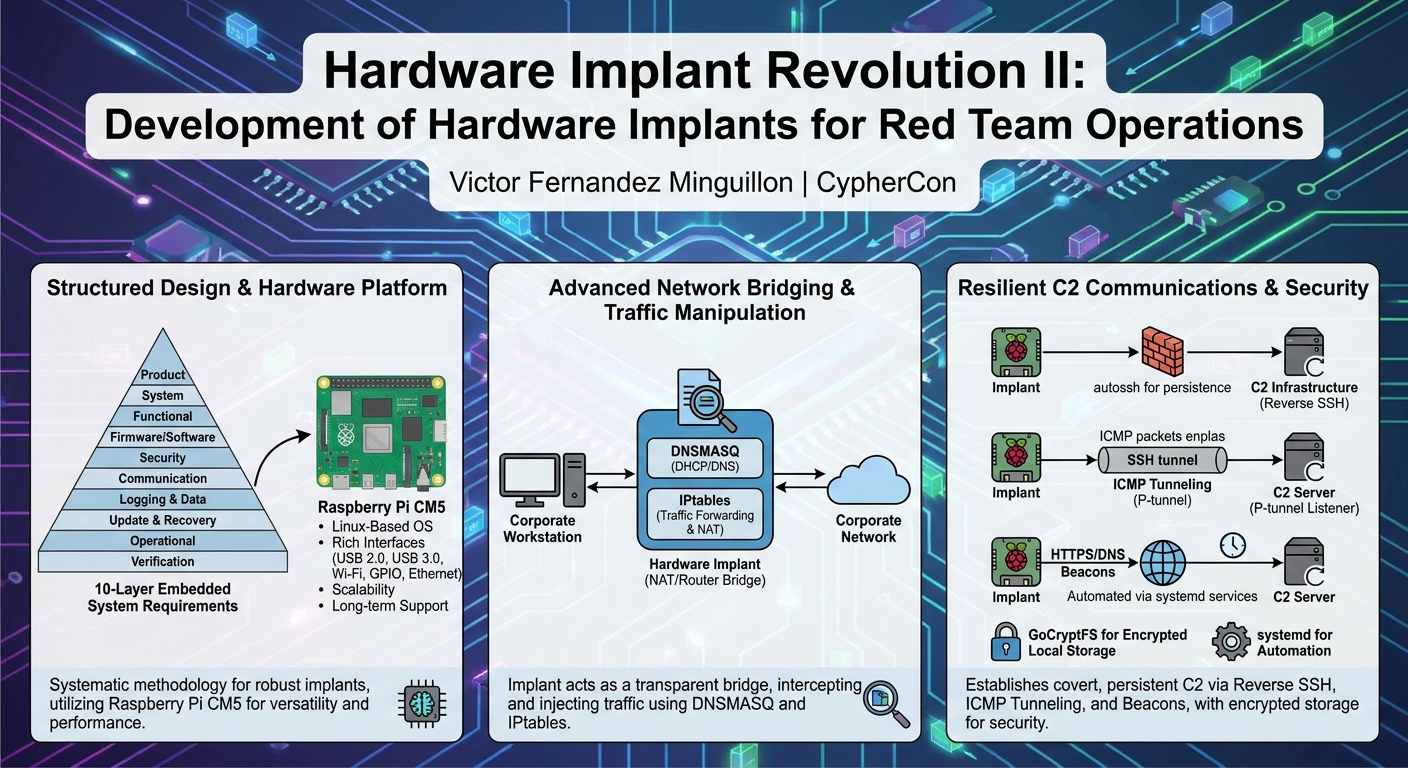
- Comprehensive Embedded System Design Methodology: Minguillon introduces a structured, 10-layer requirements analysis methodology for embedded systems. This systematic approach, covering product, system, functional, firmware/software, security, and communication aspects, ensures that all facets of implant design are rigorously considered, leading to a more robust and effective end product.
- Optimal Hardware Platform Identification: Through detailed analysis of minimum hardware requirements, the Raspberry Pi CM5 (Compute Module 5) is identified as the ideal System on Module (SoM). Its Linux-based support, rich set of interfaces (USB 2.0, USB 3.0, Wi-Fi, GPIO), scalability, strong documentation, and long-term support make it a powerful foundation for custom hardware implants.
- Custom PCB Architecture for Versatility: The presentation details a custom Printed Circuit Board (PCB) schematic that integrates the CM5 with essential components like the Realtek RTL8153 for a second Ethernet port over USB 3.0, advanced power management, GPIO breakout, LED indicators, and crucial recovery and power buttons. This architecture is designed for scalability, allowing for optional communications like 3G/4G (Teleta M2) or ISM RF (Ebyte E22 over UART).
- Advanced Network Bridging and Evasion Techniques: The implant is engineered to function as a sophisticated network bridge (NAT/router), enabling it to sit between a corporate workstation and the network. This setup facilitates interception, modification, and injection of traffic. The talk highlights the use of DNSMASQ for DHCP/DNS services and IPtables for traffic forwarding, showcasing how implants can seamlessly integrate into and manipulate target networks.
- Robust C2 Communication Channels: Minguillon demonstrates how to establish resilient and covert C2 communications. This includes the implementation of reverse SSH with
autosshfor persistent tunnels, ICMP tunneling using P-tunnel to encapsulate SSH over ICMP packets, and automated HTTPS/DNS beacons using Linuxsystemdservices configured for continuous reconnection attempts. - Secure Data Handling and Automation: The implant incorporates GoCryptFS for encrypting local storage, ensuring that logs and assessment artifacts are protected and require explicit operator authentication for decryption. Furthermore, the extensive use of
systemdservices for automating actions—such as executing sleeper binaries or starting C2 beacons at boot—enhances operational efficiency and stealth.
Technical Deep Dive
▶ Watch: Raspberry Pi CM5 as ideal hardware choice (23:30)
The development of a sophisticated hardware implant necessitates a rigorous, multi-layered approach to design and implementation. Minguillon's presentation meticulously outlines this process, starting with an in-depth requirements analysis and progressing through hardware selection, custom schematic design, and software configuration.
Embedded System Requirements Analysis
Minguillon proposes a 10-layer requirements methodology for embedded systems, focusing on six key areas in detail:
- Product Requirements: Defines the implant's purpose, authorized operators, operational environment, target assets, and permissible actions.
- Purpose: Exclusively for authorized red team exercises.
- Operator: Red team analysts.
- Environment: Internal corporate networks, not espionage.
- Assets: Corporate-owned devices.
- Actions: Must align with rules of engagement, distinguishing allowed from forbidden activities.
- System Requirements: Specifies the embedded product's system-level characteristics.
- Operating Modes: Assessment Mode (deployment) and Recovery Mode (firmware re-installation via button press).
- Power Model: USB-powered, battery-powered, or a hybrid model.
- Interfaces: USB, Ethernet, GPIO, Wi-Fi, with optional 3G/4G or ISM RF for external wireless communication.
- Local Storage: Determined by the size of the operating system and required assessment artifacts (e.g., eMMC flash memory).
- Functional System Requirements: Details the core capabilities the device must support.
- C2 Connectivity: Must connect to C2 infrastructure via various protocols (SSH, ICMP, HTTPS, DNS).
- Encrypted Storage: Support for local encrypted storage for logs and assessment artifacts.
- Authenticated Administration: Secure administration access.
- Automated Services: Ability to execute automated tasks for operational efficiency.
- Network Infrastructure: Creation of basic wired and wireless network infrastructure (e.g., acting as a NAT/router).
- Firmware and Software Requirements: Defines the boot behavior, authentication enforcement, and update handling.
- Operating System: Linux-based (e.g., Raspberry Pi OS).
- Service Startup: Some services activate at boot, others only after authenticated interaction (e.g., decryption).
- Encrypted Storage Unlock: Manual operator authentication required to unlock encrypted storage after boot for critical data.
- Wi-Fi State: Disabled by default, enabling only for specific attack paths.
- Security Requirements: Outlines the security properties of the device itself.
- Operator Authentication: Password-based or public key authentication (password chosen for simplicity).
- Admin User Segmentation: Local and remote admin users should ideally use segmented authentication methods.
- Failed Login Lockout: Support for lockout or access throttling after repeated failed authentication attempts to hinder forensics.
- Remote Admin Restriction: Remote administration restricted to a specific, approved USB interface, which presents as a network adapter for SSH access.
- Communication Requirements: Specifies the function of each communication interface.
- USB: Power delivery and authenticated administrative access.
- Ethernet: In-scope network access and isolated segmentation (acting as a NAT or router).
- Wireless (Wi-Fi): Disabled by default, potentially used for captive portals or other attacks.
- GPIO: Optional communications, sensor input, or extra buttons.
Other requirements briefly mentioned include Logging and Data Lifecycle, Update, Recovery, and Maintenance, Operational Performance and Resiliency, and Verification and Acceptance.
Hardware Architecture
Based on these requirements, Minguillon defined minimum hardware specifications:
- Linux-based hardware support.
- Interfaces: 1x USB, 2x Ethernet, 1x Wi-Fi, 1x GPIO, power, recovery, UART, SPI.
- Crucial non-functional requirements: Scalability, documentation, and a support platform to ensure longevity and ease of development.
The Raspberry Pi CM5 (Compute Module 5) was selected as the optimal System on Module (SoM). It provides a USB 2.0 interface, two USB 3.0 ports (one for a second Ethernet), built-in wireless capabilities, and extensive GPIO inputs/outputs, all running a Linux-based system.
The Bill of Materials (BoM) includes:
- Raspberry Pi CM5 (core SoM).
- Realtek RTL8153 IC for the second Ethernet interface, connected via USB 3.0.
- Standard components: button connectors, resistors, capacitors, oscillators, and LEDs.
- Optional communication modules: Teleta M2 for 3G/4G communications, or Ebyte E22 over UART for ISM RF.
The custom hardware schematics are organized hierarchically:
- USB Port: Manages power input (5V) and data, connecting to the power management unit.
- Power Management: Transforms the input 5V into clean, filtered voltage for the CM5, also accommodating battery solutions if a hybrid power model is chosen.
- CM5 High-Speed Bus: Includes USB 3.0 and USB 2.0 connections, with a current limit switch to prevent excessive power draw from the USB port.
- GPIO Bus: Integrates the primary Ethernet port, LED indicators for OS status, a power button, a dedicated recovery mode button (allowing clean OS re-installation via USB boot), and optional fan control.
- Second Ethernet: A dedicated schematic for the Realtek RTL8153 IC, including necessary filtering components and an oscillator for clock speed.
Software Implementation
The software stack complements the hardware design, focusing on provisioning, security, interface configuration, automation, and C2.
- Operating System and Provisioning:
- The implant uses a Linux-based embedded software, typically Raspberry Pi OS, but custom images are supported.
- USB boot is a key feature, allowing the CM5 to enter recovery mode via a button press and quickly install a fresh operating system image onto its eMMC flash storage. This streamlines provisioning during physical engagements.
- Security Tools:
- To meet the requirement for encrypted local storage for logs and artifacts, GoCryptFS is implemented. This tool encrypts a specified directory on the local system, rendering its contents unintelligible without explicit operator authentication. This ensures data confidentiality even if the implant is physically seized.
- Interface Configurations:
- USB Interface: Configured to act as a network interface (e.g.,
usb0) for authenticated administrative access (SSH). This is achieved by modifying/boot/config.txt(settingdr_mode=peripheral) and/boot/cmdline.txtto load theDWC2module as aGE threaded device, allowing the implant to present itself as a network adapter when connected via USB. A static IP address can then be assigned for direct SSH access. - Wired Network (NAT/Router): The implant is designed to sit transparently between a corporate workstation and the corporate network. It acts as a NAT or router, intercepting, replaying, and injecting traffic. This functionality relies on:
- DNSMASQ: Configured as a DHCP and DNS server to provide network information to the workstation, making the implant appear as a legitimate gateway.
- IPtables: Rules are set up to enable traffic forwarding and perform Network Address Translation (NAT).
sysctlConfiguration: Enablingnet.ipv4.ip_forwardto allow packet forwarding between interfaces.
- Automation:
- Linux
systemdservices are heavily utilized for automation. These services allow for the execution of any command or binary at specific stages, such as boot-up. For example,systemdcan be configured to execute sleeper binaries or C2 beacons automatically after the network target is up, without requiring a terminal window.
- Outbound Communications (C2):
- Reverse SSH: A primary C2 method for networks allowing outbound SSH. The implant establishes a reverse tunnel to the C2 server.
autosshis employed to maintain persistent connections, automatically re-establishing the tunnel if the connection drops. - ICMP Tunneling (P-tunnel): For highly restricted networks where only ICMP traffic is permitted, the implant encapsulates reverse SSH within ICMP packets. This involves:
- Starting a P-tunnel listener on the C2 server with an authentication password.
- On the implant, initiating a P-tunnel connection to the C2, encapsulating a P-tunnel listening port and a destination address (localhost).
- The implant then starts an SSH reverse connection, waiting for the C2 to connect.
- Finally, the C2 server connects via SSH to its local host on the specified reverse SSH listening port, effectively establishing an SSH session over ICMP.
- HTTPS/DNS Beacons: For more conventional covert channels,
systemdservices automate the execution of binaries (e.g., "real spy binary") that beacon out via HTTPS or DNS. These services are configured withRestart=alwaysandRestartSec=5sto ensure continuous reconnection attempts, maintaining persistent C2 even if temporary network disruptions occur.
Final Design and Architecture
Minguillon concludes with a visual representation of the implant's final architecture, illustrating its deployment within a corporate network, acting as a bridge between a workstation and the network, and communicating with a remote C2 server. He also provides renderings of the PCB design, showcasing the physical layout of components without specific routing, which helps in visualizing the compact form factor and component placement. The emphasis on a scalable design allows for future enhancements and modifications, making the implant a versatile tool for diverse red team scenarios.
Demo / Proof of Concept
▶ Watch: Covert C2 communication using ICMP tunneling (39:00)
While the talk did not feature a live, interactive demonstration of the hardware implant in action, Victor Fernandez Minguillon provided extensive visual proofs of concept through detailed architectural diagrams, hardware schematics, and software configuration examples. He presented renderings of the proposed PCB layout, illustrating the integration of the Raspberry Pi CM5 with the Realtek RTL8153 and other components, giving a clear picture of the physical design. The comprehensive walkthrough of config.txt, cmdline.txt, DNSMASQ, IPtables, and systemd service configurations served as a robust technical demonstration of how the implant's functionalities are implemented and orchestrated in a real-world scenario.
Defensive Implications
▶ Watch: Final architecture design and 3D renderings (42:00)
The detailed development of hardware implants for red team operations highlights several critical areas where defenders must focus their efforts to enhance organizational security:
- Reinforce Physical Security: Hardware implants fundamentally rely on physical access. Organizations must implement robust physical access controls, surveillance systems, and visitor management protocols for all sensitive areas. Regular physical security audits are essential to identify and mitigate vulnerabilities that could allow an attacker to deploy such a device.
- Network Segmentation and Zero Trust: The implant's ability to act as a NAT/router between a workstation and the corporate network demonstrates how it can bypass traditional network segmentation. Implementing micro-segmentation and a Zero Trust architecture can limit the lateral movement and impact of a compromised device, ensuring that even if an implant bridges a segment, its access to other critical resources is restricted.
- Comprehensive Network Traffic Monitoring: Defenders must monitor network traffic diligently for anomalies. This includes:
- Unusual ICMP traffic: The use of P-tunnel for ICMP tunneling should be detectable through deep packet inspection for non-standard ICMP payload sizes or patterns.
- Suspicious Outbound SSH: Monitoring for outbound SSH connections to unknown or suspicious external IP addresses, especially those originating from unexpected internal hosts.
- Non-standard DNS/HTTPS Beacons: Detecting unusual beaconing patterns, high-frequency DNS queries to suspicious domains, or HTTPS traffic to unknown C2 servers, particularly from devices not expected to initiate such communications.
- Endpoint Detection and Response (EDR) & Device Baselines: While a hardware implant itself, its interaction with endpoint devices (e.g., acting as a DHCP server, injecting traffic) can generate detectable events. EDR solutions should be configured to alert on:
- Unexpected changes in network configurations on workstations (e.g., sudden changes in DHCP server assignments).
- Unusual network traffic patterns originating from the workstation.
- The appearance of unknown devices on the network, especially those attempting to act as network infrastructure (e.g., DHCP servers).
- Maintaining a detailed inventory and baseline of all network-connected devices, including expected MAC addresses and IP assignments, can help identify unauthorized hardware.
- Supply Chain Security: Hardware implants can be introduced at various points in the supply chain. Organizations should implement rigorous supply chain security practices, including vetting hardware vendors, inspecting devices upon receipt, and maintaining secure procurement processes to prevent the introduction of malicious hardware.
- Strong Authentication and Access Control: Implementing strong authentication mechanisms (e.g., multi-factor authentication) for all network devices and services can prevent an implant from easily gaining further access or authenticating to systems. Restricting administrative access to specific interfaces, as highlighted by the speaker, is a good practice that defenders should enforce.
- Forensic Preparedness: The use of GoCryptFS for encrypted local storage means that if an implant is discovered, obtaining forensic data will be challenging without the correct decryption keys. Organizations need to have a well-defined incident response plan that includes procedures for handling encrypted devices and engaging with specialized forensic teams.
- Awareness and Training: Educating employees about the risks of unknown devices, the importance of reporting suspicious activity, and basic physical security hygiene can act as an effective first line of defense against physical implant deployment.
By addressing these defensive implications, organizations can significantly bolster their resilience against sophisticated hardware-based attacks, turning the insights from red team operations into actionable security improvements.
Key Takeaways
- A structured, multi-layered requirements analysis is fundamental for designing robust and scalable hardware implants for red team operations.
- The Raspberry Pi CM5 offers a powerful and flexible Linux-based platform for developing custom implants due to its rich interfaces and strong support ecosystem.
- Physical implants can be engineered to act as transparent network bridges (NAT/routers) using tools like DNSMASQ and IPtables to intercept and manipulate network traffic.
- Advanced and persistent C2 communication channels, including reverse SSH (with
autossh), ICMP tunneling (with P-tunnel), and automated HTTPS/DNS beacons, are crucial for covert operations. - Security measures like GoCryptFS for encrypted storage and
systemdservices for automated, persistent execution are vital for implant stealth and operational efficiency. - Effective defense against hardware implants requires a multi-pronged approach, focusing on physical security, granular network segmentation, comprehensive traffic monitoring, and strong endpoint detection capabilities.
About the Speaker(s)
Victor Fernandez Minguillon is a distinguished expert in offensive security, with nearly nine years of experience in the field. For the past six years, he has served as a Senior Red Team Analyst at United, where his responsibilities include conducting red team engagements, reducing attack surface, managing bug bounty programs, overseeing vulnerability disclosure, and performing physical security assessments. He is also the founder of Red Defender Technologies, a startup dedicated to developing innovative hardware and offensive security products. Minguillon is a prolific researcher and speaker, having presented his work at numerous prestigious conferences, including DefCon Aerospace Village, CypherCon (where this marks his third consecutive year presenting new research), and RootedCON, as well as delivering international presentations in his home country of Spain.
Reviews
Dr. Zero (Offensive Security Researcher) — SOLID
Minguillon designed a bespoke hardware implant using a Raspberry Pi CM5, wrapped in a rigid engineering methodology. It's honest red team hardware hacking that trades commercial lock-in for custom PCB design. Good blueprint, but functionally it's a masterclass in gluing together standard Linux utilities.
Heather Calloway (CISO) — SOLID
This is an offensive engineering talk detailing how to build and deploy custom hardware implants for network bridging and C2. It is not a strategic briefing, but it highlights exactly what happens when physical security and port-level access controls fail. Worth a review by your red team leads, but not required reading for the leadership team.