The Hardware Procurement Iceberg: A Framework For Keeping Embedded Research Fun, Cheap, and Ethical
yltsi
Overview
In this CypherCon talk, independent researcher yltsi (Ben) presents a unique framework for navigating the often-overlooked logistical challenges of embedded research and hardware hacking: the Hardware Procurement Iceberg. The presentation offers a comprehensive, albeit sometimes ethically and legally dubious, guide to acquiring target devices for security research, emphasizing cost-effectiveness, accessibility, and the inherent risks involved. Ben, a self-taught embedded researcher with a background in computer science, highlights that while resources for how to hack hardware are abundant, the practicalities of obtaining the necessary hardware are rarely discussed.
Key moments
- 0:00 Introduction and talk overview
- 4:07 Understanding the Hardware Procurement Iceberg
- 8:00 End-to-end embedded research workflow explained
- 16:00 Finding targets at electronics recyclers
- 24:00 Leveraging price trackers for deep discounts
- 26:30 Controversial 'Red to Retailer' strategy
- 31:50 The complete Hardware Procurement Iceberg
The Hardware Procurement Iceberg: A Framework For Keeping Embedded Research Fun, Cheap, and Ethical
Speakers: yltsi
Conference: CypherCon
YouTube: https://www.youtube.com/watch?v=-7MZXj1fhU0
Overview
In this CypherCon talk, independent researcher yltsi (Ben) presents a unique framework for navigating the often-overlooked logistical challenges of embedded research and hardware hacking: the Hardware Procurement Iceberg. The presentation offers a comprehensive, albeit sometimes ethically and legally dubious, guide to acquiring target devices for security research, emphasizing cost-effectiveness, accessibility, and the inherent risks involved. Ben, a self-taught embedded researcher with a background in computer science, highlights that while resources for how to hack hardware are abundant, the practicalities of obtaining the necessary hardware are rarely discussed.
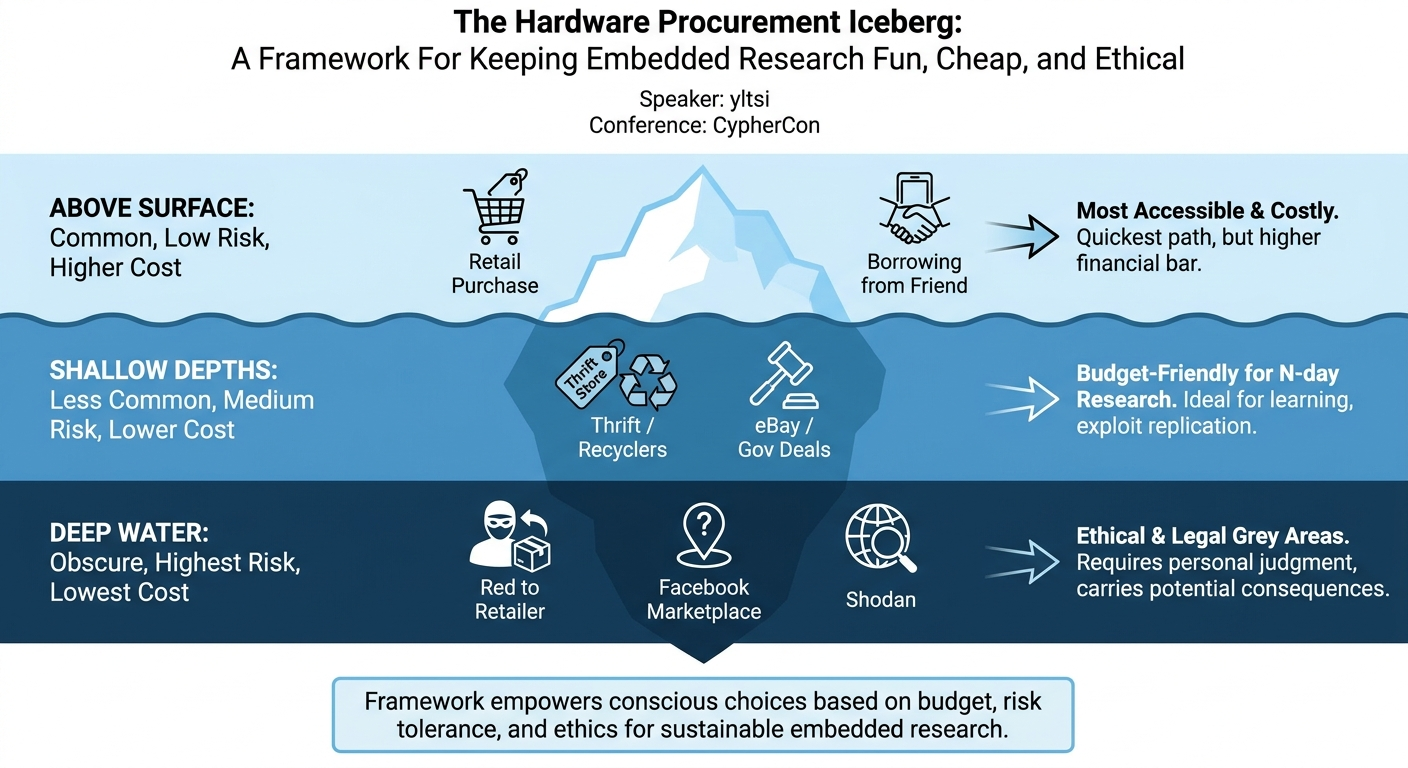
The core premise of the talk is that the methods for acquiring hardware exist on a spectrum, much like an iceberg. Above the surface are common, low-risk approaches, while deeper beneath lie less conventional, higher-risk strategies. Ben argues that accessibility to embedded research is at an all-time high, making it a "golden age" for newcomers. However, the financial and logistical hurdles can be significant, especially for independent researchers. This framework aims to demystify hardware acquisition, empowering researchers to do "more with less" by exploring diverse procurement channels, understanding their implications, and ultimately fostering a more thrifty and ethical approach to security discovery.
The talk is particularly relevant for aspiring hardware hackers, independent security researchers, and anyone interested in the practicalities of setting up a home lab on a budget. It delves into the nuances of various purchasing and acquisition methods, from standard retail purchases to more unconventional tactics like exploiting return policies or scouring government auctions. By dissecting the pros, cons, and associated risks of each method, yltsi provides a valuable roadmap for making informed decisions in hardware procurement, ultimately keeping embedded research both fun and financially sustainable.
Background
▶ Watch: Introduction and talk overview (0:00)
yltsi begins by asserting that the field of embedded research and hardware hacking is experiencing a "golden age" of accessibility. He points to several resources that have contributed to this, including Riverloop Security's archived blog posts (specifically "Introduction to Hardware Hacking"), Andrew Bellini's Defcon 32 talk on acquiring cheap tooling from platforms like Temu or Alibaba, and the District Con Junkyard competition, which focuses on live hacking of end-of-life (EOL) devices for CVEs and cash prizes. Philosophically, he references Milan Cvitkovic's blog post "Things You're Allowed To Do," which encourages a constructive mindset toward agency rather than focusing on limitations.
A central economic argument yltsi presents is that "a dollar saved is like $1.67 earned," highlighting the tax implications of income versus savings, especially for W2 employees or 1099 contractors. This underpins his philosophy of thriftiness in research. He emphasizes that while how to conduct embedded research is well-documented, the logistics of acquiring target devices and setting up a home lab are significantly under-discussed.
The typical workflow for embedded research often starts with firmware as the "source of truth." Researchers first attempt to acquire firmware images, which can sometimes be freely available from manufacturers. However, firmware can also be encrypted, requiring reverse engineering of encryption schemes, or it might need to be "lifted" directly from the physical device's NVRAM or other non-volatile storage. yltsi strongly advocates starting with firmware emulation using tools like QEMU, as it allows for free research without immediate hardware investment.
However, firmware emulation is imperfect. Researchers often encounter challenges like hardcoded references to NVRAM or other physical components, necessitating patching or "stubbing out" parts of binaries to get them to run. This can lead to proofs of concept (PoCs) that work in emulation but fail on live hardware because crucial behaviors were inadvertently patched out. This is where physical hardware becomes indispensable for vulnerability verification. Once a device is acquired, the standard procedure involves factory resetting it to default settings, testing the exploit, verifying the bug, and then pursuing bug bounties or brokering the vulnerability. Occasionally, embedded research crosses into hardware research, involving physically modifying or "goring" the device through soldering, cutting traces, scratching solder mask, chip-off reads (which often bricks the device), or fault injection (via voltage or light). This invasive nature makes hardware procurement even more critical, as devices may be destroyed in the process.
Key Findings
▶ Watch: End-to-end embedded research workflow explained (8:00)
The central contribution of this talk is the Hardware Procurement Iceberg framework itself. This intuitive model categorizes various methods for acquiring hardware, illustrating that as one delves "deeper" below the surface of the iceberg, the methods become less common, often cheaper, but also progressively higher in risk—encompassing time loss, financial loss, and potential legal repercussions. The speaker's primary finding is that there is a vast, underutilized spectrum of hardware acquisition strategies beyond simply buying new, each with its own trade-offs.
Key findings embedded within the framework include:
- Accessibility vs. Risk Trade-off: The iceberg visually represents that the most accessible and least risky methods (e.g., buying new) are at the top, while the most obscure and highest-risk methods (e.g., Shodan exploitation or "Red to Retailer") are at the bottom. This provides a mental model for evaluating procurement options.
- The "Dollar Saved" Philosophy: The speaker's personal tenant of "doing more with less" is a core finding, materialized in the argument that a dollar saved through thrifty procurement is economically more impactful than a dollar earned due to tax implications ($1 saved = $1.67 earned).
- Undiscussed Logistics: The talk highlights that the logistics of hardware acquisition are a significant, yet largely ignored, aspect of embedded research. The iceberg framework serves as a structured attempt to address this gap.
- Learning Opportunities in Less Conventional Methods: Methods like thrifting or using electronics recyclers, while requiring more effort, offer excellent opportunities for N-day research and exploit replication, providing a cheap and low-stakes environment for skill development.
- Ethical and Legal Grey Areas: The framework explicitly acknowledges that many cost-saving methods (e.g., "Red to Retailer," interacting with potentially fenced goods on Facebook Marketplace, or leveraging Shodan) operate in ethically or legally dubious territories, emphasizing the need for personal reflection and legal consultation.
In essence, the key finding is not a specific vulnerability, but rather a meta-framework that empowers researchers to consciously choose their hardware acquisition strategies based on their budget, risk tolerance, and ethical boundaries, thereby making embedded research more accessible and sustainable for a broader audience.
Technical Deep Dive
▶ Watch: Finding targets at electronics recyclers (16:00)
The Hardware Procurement Iceberg provides a structured deep dive into various acquisition methods, moving from the most common and least risky to the most unconventional and highest risk.
At the very top, the most straightforward method is Buying from a Retailer. This is the quickest path to hardware. The speaker explains the underlying contract: a purchase order is an offer, which the vendor accepts by taking payment or shipping. Once settled, the item is legally yours. Any post-sale clauses (returns, warranties) are generally to the buyer's benefit, though modifying the device for hardware hacking invalidates these. While convenient, this method is a "mixed bag" for non-consumer targets (e.g., ICS, SCADA, medical devices) or items confined to international markets.
Next is Borrowing from a Friend. This is zero-cost but comes with social risks. Establishing "rules of engagement" upfront is crucial to avoid returning a "smoldering brick." Offering collateral, a cut of bounty money, or a favor helps maintain the friendship. A recommended community service is updating the device's official firmware before returning it. The main limitation is that your target list is restricted to your friend's purchases.
Moving slightly below the surface, Thrift Shops offer "secondhand surprises." These are "undisputed budget champions," often yielding legacy tech or junk with no testing guarantees. However, they are ideal for N-day research and replication, allowing researchers to find devices with known CVEs and practice exploit development cheaply. This is a low-stakes environment for making mistakes. The speaker highlights finding PS/2 keyboards for 99 cents, which are useful for quick verification.
Electronics Recyclers (e-waste, e-recycling, salvage, asset retirement) are the "crossroads for all electronics." These businesses often liquidate office electronics, offering a diverse but localized inventory. They often adhere to EPA-defined certifications like R2, e-Stewards, or RIOS, which mandate processing steps including testing and verification. Researchers should look for "full function tested" devices, as "key function" might indicate subtle issues.
Deeper still, eBay is presented as a starting point for "amazing research stories," citing a Defcon talk on Snitchbucks. It's excellent for finding specific targets at a lower cost, provided you have time and patience. eBay's search capabilities are powerful, and its Global Shipping Program facilitates international procurement, theoretically saving money and navigating disruptions. Crucially, eBay offers robust buyer protection, making you whole if an item isn't as described. The speaker also recommends watchcount.com for viewing listing metadata, such as how long an item has been listed, which can inform haggling.
Facebook Marketplace is described as a "PVP arena" for goods, "unbelievably unhinged" due to the lack of a feedback system and prevalence of burner accounts and scammers. It's a prime environment for learning market psychology and haggling. However, it carries a risk of purchasing fenced or stolen goods, though laws often protect inadvertent buyers. It's hyper-local, typically requiring peer-to-peer pickup, and transactions are often cash, Zelle, or bartering, with no feasible return policy.
Gov Deals and other liquidity services brands (like Bidspotter.com) are auction sites for liquidations from state, federal agencies, and businesses. They often sell items in lots, offering significant value. You can find "literally anything," from vending machines to scientific DNA sequencers. Bidding increments are low, and many auctions lack a reserve price, creating opportunities for cheap acquisition. Reselling unwanted items from lots can even make the research target "net zero or even positive." Like Facebook Marketplace, these are typically pickup-only, limiting selection regionally.
The concept of Price Trackers introduces automated monitoring. Services like Brickseek scrape big box retailers (Best Buy, Target, Walmart) for online and "absolute steal" in-store deals. Alternatively, researchers can write their own trackers, fully customized to preferred vendors and hooked into notification systems (Telegram, Discord webhooks) to "beat the crowd" to deep discounts. A drawback is that deep discounts often invalidate return policies. The speaker shared a personal anecdote of getting a Bluetooth-enabled espresso scale (a research target) for $13 shipping instead of $250 using a custom price tracker.
The most controversial technique, coined "Red to Retailer," involves buying a device with the intent to return it after performing non-invasive research. This requires a "very delicate teardown" using plastic spudgers, rubber bands on screws, and masking tape to prevent damage. Highly invasive techniques like chip-off reads or fault injection are out of scope. The speaker advises batching returns to save gas and "paying it forward" by reinvesting bug bounty money into the store or updating firmware. He cautions against wardrobing and emphasizes examining and adhering to store return policies, citing the generous, now-defunct Fry's Electronics policy as an example.
Finally, at the very bottom, is Shodan. This is "super wouldn't recommend" as it involves scanning the internet for misconfigured devices. The hardware is "100% not your hardware," and there's a non-zero chance of encountering a honeypot. While ethically questionable for active exploitation, Shodan can be useful for testing non-vulnerability related assumptions, identifying default configurations, or differentiating real devices from honeypots by analyzing signatures. Using Shodan to give away a 0-day is explicitly discouraged.
Demo / Proof of Concept
▶ Watch: Controversial 'Red to Retailer' strategy (26:30)
This talk does not feature a live technical demonstration of a hardware hack or a proof of concept exploit. Instead, the presentation itself serves as a conceptual "demo" of the Hardware Procurement Iceberg framework. The speaker visually presents the iceberg model and systematically walks through each layer, explaining the methodologies, tools, and considerations for acquiring hardware. The "proof of concept" is the framework's utility in providing a structured approach to a common, yet undiscussed, challenge in embedded research. The speaker's anecdotes, such as acquiring an espresso scale for $13 using a price tracker, serve as illustrative examples of the framework's practical application.
Defensive Implications
▶ Watch: The complete Hardware Procurement Iceberg (31:50)
The Hardware Procurement Iceberg framework, while primarily aimed at researchers, carries significant defensive implications for manufacturers, retailers, and end-users.
For Manufacturers and Retailers, the "Red to Retailer" technique highlights a potential vulnerability in their return policies. Lax or overly generous return policies, particularly for electronics, can be exploited by individuals seeking to temporarily acquire devices for research or other purposes without permanent purchase. This suggests a need for more robust quality assurance and verification processes post-return to detect tampering or modification, and potentially revising return terms for certain product categories.
For Organizations and Individuals disposing of electronics, the prevalence of methods like Thrift Shops, Electronics Recyclers, eBay, and Gov Deals underscores the importance of secure data destruction and responsible e-waste management. Devices entering these secondary markets can contain sensitive information or be vulnerable due to outdated firmware. Companies liquidating assets through recyclers or auction sites must ensure all data is wiped and devices are properly sanitized, especially for non-consumer targets like ICS/SCADA or medical equipment, which could become research targets for malicious actors.
The discussion around Shodan serves as a stark reminder of the dangers of misconfigured devices exposed to the internet. Any device with an internet connection, if not properly secured, can become a target for scanning and potential exploitation. This emphasizes the critical need for robust network segmentation, strong default security configurations, and regular vulnerability assessments to prevent devices from appearing on public scanners. Honeypots are mentioned as a defensive measure against such scanning.
Finally, the emphasis on firmware updates throughout the talk (e.g., as a community service when returning borrowed devices) reinforces its fundamental role in security. Manufacturers must ensure easy access to updated firmware, and users should be diligent in applying them to mitigate known vulnerabilities, especially on end-of-life (EOL) devices that might still be in use or circulating in secondary markets. The concept of N-day research on thrifted devices directly illustrates how unpatched, older firmware remains a viable attack surface.
Key Takeaways
- The Hardware Procurement Iceberg provides a comprehensive framework for acquiring target devices for embedded research, ranging from common, low-risk methods to unconventional, high-risk strategies.
- Cost-Effectiveness is Achievable but Requires Strategy: Researchers can significantly reduce costs by exploring options beyond new retail purchases, such as thrift shops, electronics recyclers, and auction sites like Gov Deals or eBay.
- Ethical and Legal Considerations are Paramount: Many cost-saving methods, particularly those deeper in the iceberg (e.g., "Red to Retailer," Facebook Marketplace, Shodan), involve ethical and legal grey areas, requiring personal judgment and potential legal consultation.
- Logistics are Under-Discussed but Crucial: The talk highlights that the practicalities of acquiring hardware are often overlooked but are fundamental to successful and sustainable embedded research.
- N-day Research is an Excellent Learning Tool: Thrift stores and e-waste facilities offer cheap access to older devices with known CVEs, providing a low-stakes environment for aspiring hackers to practice exploit development and vulnerability replication.
- Secure Disposal and Configuration are Critical for Defenders: The framework implicitly warns manufacturers and organizations about the potential for devices to end up in researcher (or attacker) hands, underscoring the importance of secure e-waste practices, robust return policies, and preventing internet exposure of misconfigured systems.
About the Speaker(s)
The speaker, who conducts research under the handle yltsi (an acronym for "You Love To See It"), is known in real life as Ben. He describes himself as someone who enjoys putting on a show and presenting. Professionally, he previously worked in Application Security (AppSec), though he was recently laid off at the time of the talk. Ben is not an Electrical Engineer (EE) by training, having an undergraduate degree in Computer Science and dropping out of a master's program in the same field. He is largely self-taught in embedded research, having "cobbled things together" as he went. A core tenant of his work is "doing more with less," which has naturally made him very thrifty and cheap. He approaches embedded research with a passion for life hacking and a strong inclination towards practical, budget-conscious methods.
Reviews
Dr. Zero (Offensive Security Researcher) — SOLID
This isn't a research talk; it's a financial survival guide for independent hardware hackers. It fills a slot perfectly for beginners trying to build a lab without going broke, even if veterans have been hoarding e-waste for decades.
Heather Calloway (CISO) — SOLID
This is a tactical guide for independent researchers on how to acquire cheap hardware for vulnerability hunting. It is not a talk for enterprise security leaders, but it shines a bright light on the tail end of the corporate hardware lifecycle. Worth a skim to understand how poorly sanitized corporate e-waste fuels the gray-market vulnerability research economy.