Ransomware vs. Info Stealers: A Comparative Analysis
Steph Shample
Overview
In a compelling presentation at CypherCon, Adjunct Professor Steph Shample delivered a critical analysis of the evolving relationship between info stealers and ransomware. Drawing on two decades of cybersecurity experience, from military linguist to counter-proliferation expert, Shample highlighted how these distinct, yet increasingly intertwined, malware families pose an escalating threat to organizations and individuals worldwide. The talk provided a stark reminder that while ransomware often captures headlines with its disruptive force, the silent infiltration by info stealers frequently serves as the insidious precursor, granting initial access and valuable credentials that fuel subsequent, more devastating attacks.
Key moments
- 2:00 Speaker introduction and cyber security journey
- 6:00 Rise of info stealers and cybercrime's financial impact
- 9:00 Info stealer mechanics, targets, and prominent families
- 22:30 Info stealers: initial access for ransomware attacks
- 24:00 Evolving ransomware extortion tactics: double, triple, quadruple
- 26:00 Ransomware economics and the 'pay or not pay' dilemma
- 32:00 Comparative analysis: Info stealers vs. ransomware
- 44:00 Proactive mitigations and defense strategies
Ransomware vs. Info Stealers: A Comparative Analysis
Speakers: Steph Shample, Adjunct Professor
Conference: CypherCon
YouTube: https://www.youtube.com/watch?v=yiioUBox42c
Overview
In a compelling presentation at CypherCon, Adjunct Professor Steph Shample delivered a critical analysis of the evolving relationship between info stealers and ransomware. Drawing on two decades of cybersecurity experience, from military linguist to counter-proliferation expert, Shample highlighted how these distinct, yet increasingly intertwined, malware families pose an escalating threat to organizations and individuals worldwide. The talk provided a stark reminder that while ransomware often captures headlines with its disruptive force, the silent infiltration by info stealers frequently serves as the insidious precursor, granting initial access and valuable credentials that fuel subsequent, more devastating attacks.
Shample's core message resonated with urgency: the cybersecurity community must shift from a reactive stance to a more proactive and preventative approach. She emphasized that the lines between these threats are blurring, with info stealers becoming a primary initial access vector for ransomware groups. This synergy is driven by a highly organized and sophisticated cybercriminal ecosystem that operates with alarming efficiency, leveraging readily available malware-as-a-service (MaaS) and ransomware-as-a-service (RaaS) models. The talk underscored the critical need for enhanced awareness, robust defensive strategies, and a cultural shift towards prioritizing security at every level of an organization.
The significance of this analysis cannot be overstated. With cybercrime projected to inflict an astonishing $10.5 trillion in damages, surpassing the GDP of all but the two largest economies, understanding the intricate mechanisms of these attacks is paramount. Shample's detailed exploration of the tools, tactics, and motivations of threat actors, coupled with practical defensive implications, served as a vital call to action for defenders navigating an increasingly hostile digital landscape.
Background
▶ Watch: Speaker introduction and cyber security journey (2:00)
The landscape of cybercrime, particularly concerning ransomware and info stealers, has undergone a significant transformation since the mid-2000s. The roots of modern info stealers can be traced back to Zeus in 2006, a pioneering malware that emerged concurrently with the explosion of social media and the proliferation of digital credentials. This era marked a pivotal shift, as individuals began to amass vast amounts of personal and authentication data online, creating a rich target environment for malicious actors.
Initially, ransomware and info stealers often operated as distinct threats. Ransomware focused on encrypting data and demanding payment for its release, while info stealers quietly siphoned off credentials, financial data, and personal information. However, the sophistication of the cybercriminal ecosystem has evolved dramatically. The advent of malware-as-a-service (MaaS) and ransomware-as-a-service (RaaS) models has democratized access to powerful tools, enabling even low-skilled "script kiddies" to launch complex attacks with minimal technical expertise. These kits, readily available on the dark web, often come bundled with support and accompanying technologies to bypass common defenses like multi-factor authentication (MFA).
This accessibility has fueled a surge in credential theft. Shample cited estimates for 2025, projecting approximately 2 billion credentials circulating on the dark web, directly impacting about half of the global population. This vast reservoir of compromised data provides a fertile ground for initial access brokers and ransomware groups. The speaker highlighted a specific trend observed in early 2025 where "stealer logs" gained their own dedicated entry in dark web market offerings, signifying their recognized value as a standalone commodity and a crucial stepping stone for more advanced operations.
The increasing financial impact of cybercrime further underscores the urgency of addressing these threats. With projected damages of $10.5 trillion, cybercrime now represents the third-largest economic entity after the economies of China and the United States. This staggering figure highlights the scale of the problem and the imperative for a fundamental shift in defensive strategies, moving from a predominantly reactive posture to one that prioritizes proactive prevention and resilience.
Key Findings
▶ Watch: Info stealer mechanics, targets, and prominent families (9:00)
Steph Shample's talk unveiled several critical findings regarding the contemporary threat landscape, particularly emphasizing the symbiotic relationship between info stealers and ransomware:
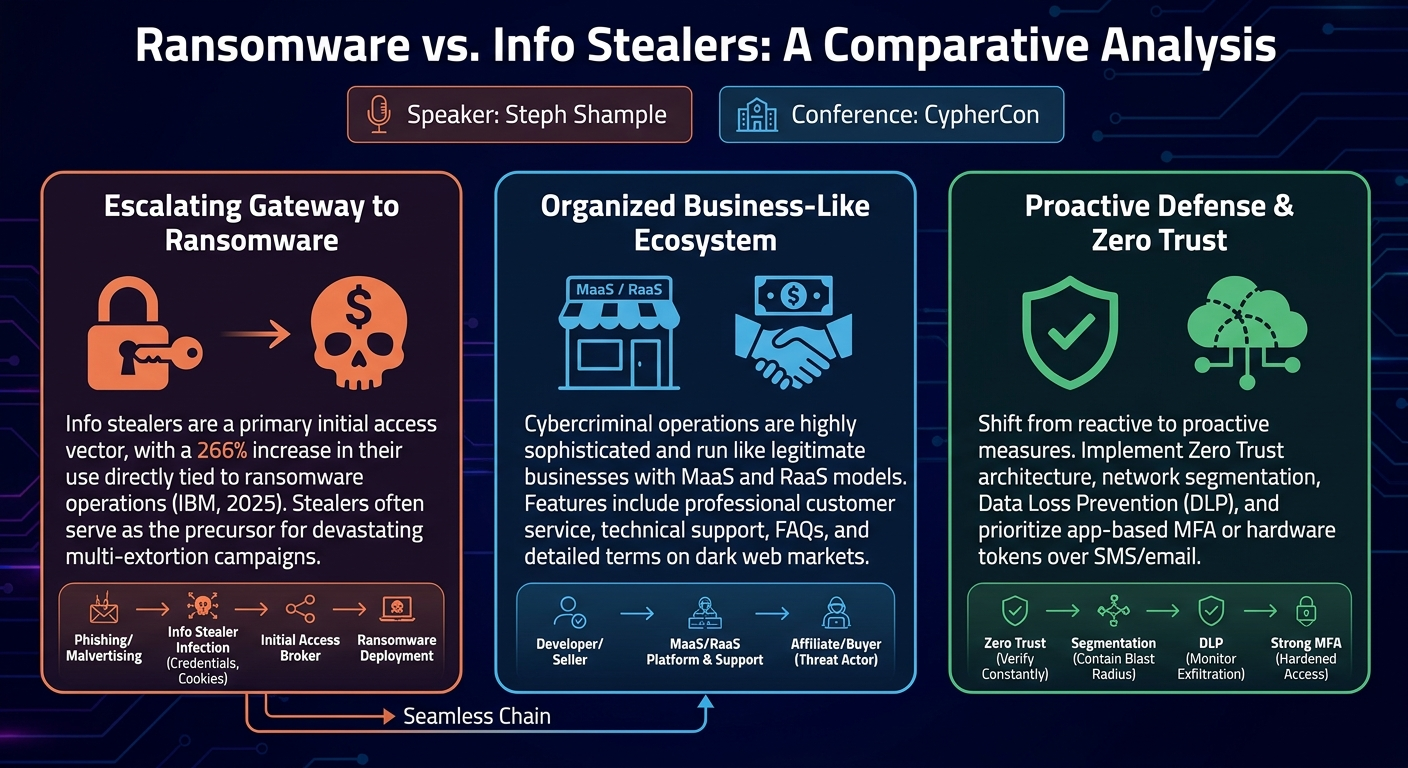
- Info Stealers as a Primary Initial Access Vector: The most significant finding is the escalating role of info stealers as the initial foothold for ransomware attacks. Shample cited an IBM report from 2025 indicating a 266% increase in info stealer-related activity specifically tied to ransomware groups. This correlation demonstrates that observing ransomware operations now frequently necessitates tracking initial entry vectors, with info stealers being a dominant precursor.
- Widespread Credential Compromise: The sheer volume of compromised credentials is alarming. Projections for 2025 suggest roughly 2 billion credentials are actively circulating, impacting approximately half of the world's population. This proliferation of stolen data makes it easier for threat actors to "log in" rather than "hack in," circumventing traditional perimeter defenses.
- Diminishing Effectiveness of Traditional Security Controls: A concerning statistic revealed that over 54% of devices infected with info stealer malware had Endpoint Detection and Response (EDR) solutions in place, according to telecom reports. This indicates that traditional cybersecurity protections are becoming less effective against sophisticated info stealers, which are designed to evade detection and operate silently. Similarly, threat actors are actively selling kits to bypass Multi-Factor Authentication (MFA), rendering this crucial defense vulnerable.
- Highly Organized and Business-Like Cybercriminal Ecosystem: The talk extensively illustrated how cybercriminal operations, from info stealer sales to ransomware deployment, are run with the professionalism of legitimate businesses. This includes customer service, technical support, detailed terms of service, FAQs, and even reviews for sellers on dark web markets. Groups like Conti (despite its splintering) and LockBit exemplify this organized, entrepreneurial approach, with affiliates branching out or joining other groups, ensuring continuity of operations.
- Dominance of Multi-Extortion Ransomware Tactics: Ransomware groups have evolved beyond simple encryption. Double, triple, and even quadruple extortion tactics are now standard. This involves not only encrypting data but also threatening to leak it, launch Distributed Denial of Service (DDoS) attacks, and publicly humiliate victims (e.g., contacting clients, patients, or even filing SEC complaints, as seen with ALPHV/BlackCat). This pressure significantly increases the likelihood of payment.
- Target-Rich, Cyber-Poor Industries: Cybercriminals openly discuss targeting sectors like healthcare and education, which they identify as "target-rich, cyber-poor." These industries often hold vast amounts of sensitive data but lack adequate cybersecurity budgets and expertise, making them easier and more profitable targets.
These findings collectively paint a picture of a rapidly evolving and increasingly dangerous threat landscape where stealthy initial access through info stealers paves the way for high-impact, multi-faceted ransomware campaigns, challenging conventional cybersecurity defenses.
Technical Deep Dive
▶ Watch: Evolving ransomware extortion tactics: double, triple, quadruple (24:00)
The talk provided a comprehensive technical exploration of how info stealers operate, their evolution, and their role in facilitating modern ransomware attacks.
Info Stealers: Mechanism and Targets
An info stealer is malware specifically designed to surreptitiously exfiltrate sensitive information from compromised devices. Shample emphasized that these tools target a wide array of data crucial for subsequent malicious activities:
- Stored Credentials: Usernames and passwords, often saved in browsers or password managers.
- Authentication Tokens: Session cookies and other tokens that allow for session hijacking, bypassing the need for re-authentication and often Multi-Factor Authentication (MFA). This is a critical bypass mechanism.
- Browser Cookies: Used to maintain logged-in states, directly enabling MFA bypass.
- System Information: Details about the operating system, hardware, and installed software, which can aid in further exploitation.
- Cryptocurrency Wallets: Access to digital currency holdings.
- Credit Card Information: Stored credit card numbers, often found in browser autofill or specific applications.
- Other Sensitive Data: The speaker mentioned that info stealers can extract X.509 certificates and TLS session data, demonstrating their advanced capabilities to capture deeply embedded authentication artifacts.
The entry points for info stealers are diverse but familiar: phishing emails, malicious website redirects, fake software downloads, and increasingly, ad-tech and malvertising. Once executed, the malware embeds itself, extracts data, and exfiltrates it to a Command and Control (C2) server, often in mere seconds. This stolen data is then packaged and sold on dark web markets, Telegram, and Discord, serving as a commodity for fraud, direct access, or, most commonly, as an enabler for ransomware.
Evolution of Info Stealer Families (2006-2026)
Shample traced the lineage of info stealers, highlighting key families:
- Zeus (2006): Considered the Original Gangster (OG), Zeus inspired subsequent generations by pioneering credential theft from web forms and banking sessions.
- Raccoon Stealer 2.0: Notorious for compromising ChatGPT accounts in 2023.
- Redline Stealer: Frequently in the news, Redline uses the Flory Bunda executable and operates via Telegram channels. Despite a developer's arrest in March 2024, its infrastructure remains robust, demonstrating the resilience of these criminal enterprises.
- Lumma (LummaC2): Utilized by groups like Scattered Spider, Lumma relies on Unix IDs and IP addresses for tracking.
- H Lacu: Identified as a top stealer in terms of frequency and popularity for 2026, targeting credentials, cookies, VPNs, and crypto wallets.
- Vidar: Emerging as a threat to cloud environments, specifically targeting Azure and Google Cloud, often acting as a loader for multi-stage attacks.
- Rhadamanthys: Known for evading detection and being heavily sold as MaaS.
- Stealc: Primarily targets Single Sign-On (SSO) configurations and browser/plugin vulnerabilities.
- ACREED: A rapidly emerging and powerful stealer, particularly prevalent in Russian markets. It gained significant traction after LMA's decline, offering ease of use and also targeting SSO.
Ransomware: The Escalating Extortion Model
Ransomware has evolved significantly beyond simple data encryption. Shample detailed the progression of extortion tactics:
- Double Extortion: The most common model, where data is encrypted, and threat actors additionally threaten to exfiltrate and leak the stolen data if the ransom is not paid. Groups like LockBit, Clop, BlackCat (ALPHV), Royal, and ALPHV (BlackCat) are known practitioners.
- Triple Extortion: Adds a third layer of pressure, often starting with a DDoS attack to disrupt operations before encryption, or threatening to publicly shame the victim.
- Quadruple Extortion: Encompasses all previous tactics, with an added threat to directly contact and exploit the victim's clients, patients, or business partners, or even notify regulatory bodies. A notable example was ALPHV/BlackCat filing a US Securities and Exchange Commission (SEC) complaint against a victim who refused to pay, showcasing extreme brazenness.
The economics of ransomware are stark. The average payout in early 2026 ranged from $900,000 to $1 million, a decrease from $2 million in 2024, possibly reflecting improved defenses or a shift in victim payment behavior (only 25% of victims pay). However, the ultimate damage extends far beyond monetary loss, primarily impacting an organization's reputation and customer trust, which Shample highlighted as the most difficult aspect to recover from.
The Info Stealer-Ransomware Nexus
The speaker clearly articulated how info stealers feed ransomware. An info stealer compromises a device, extracts credentials and session tokens, and this data is then sold to initial access brokers (IABs). These IABs, in turn, sell access to ransomware groups, who use the pre-validated credentials to "log in" to victim networks, escalate privileges, move laterally, and eventually deploy their ransomware payload. This seamless chain demonstrates the critical role of info stealers in the modern ransomware kill chain. The payloads themselves also differ; info stealers are lightweight and fast, designed for stealthy data capture, while ransomware payloads are heavier, designed for encryption and disruption, often accompanied by the theft of highly sensitive documents like driver's licenses, passports, or even patient x-rays to amplify pressure.
Demo / Proof of Concept
▶ Watch: Ransomware economics and the 'pay or not pay' dilemma (26:00)
While the talk did not feature a live, interactive demo, Steph Shample effectively provided "proof of concept" through a series of cleaner screenshots from various dark web markets and Telegram channels. These visuals served to illustrate the highly organized, sophisticated, and accessible nature of the cybercriminal ecosystem, demonstrating how info stealer logs and ransomware tools are openly advertised, sold, and supported.
Shample showcased several compelling examples:
- Dark Web Market Offerings (2025): A screenshot from an unnamed dark web market from early 2025 explicitly showed "stealer logs" as a dedicated category for sale, alongside databases, games, source code, and doxes. This was highlighted as the first time info stealer logs had their own entry, underscoring their rising value as a commodity. The listings often detail what's being offered, providing specific categories to buyers.
- Verified Sellers and Reputation: The speaker pointed out listings from "verified sellers" on platforms like Darknet Army (a Russian-run market). Just like legitimate e-commerce, these actors build reputations, with "rack stacks" or reviews indicating tool quality and efficiency for specific targets (e.g., medical sector, government). Negative reviews, such as one complaining about "poor quality for cloud one and cloud 2 channels," were shown to be damaging to a seller's reputation, prompting them to work to restore trust. This emphasizes the business-like approach and focus on customer satisfaction within the criminal underground.
- Customization and "Holiday Shopping": Shample humorously, yet seriously, described the process as akin to "holiday shopping." Screenshots showed actors making specific requests, such as "Give me logs for the military, the government. Give me logs of people who are 55 and over. They're going to have more money. I'm not going to go after young people that are broke." Another example displayed a user asking for "preferably 100 gigs or more" of "private new stuff," explicitly stating they don't want "public" data. This illustrates the meticulous efforts criminals put into finding precise footholds and maximizing their profits.
- Initial Access Broker Advertisements: An example showed an initial access broker advertising their services, complete with a Telegram channel, "talks and session IDs," and offering "remote access credentials," "client records," "employee records," and "infrastructure management." This highlights the specialized roles within the ecosystem and the ease of contact for potential buyers.
- Redline Stealer Telegram Channel: A blurred screenshot of a Redline Stealer Telegram channel demonstrated its sophistication, offering features like "Visa one-time password mode," "PayPal," "capture mode," and "PIN mode," with the ability to set OTP durations (e.g., 2 minutes, 1 minute). This illustrates the fine-grained control and targeted capabilities of these tools, especially for financial applications.
- Ransomware-as-a-Service (RaaS) Support: The talk included screenshots from ransomware groups like LockBit (version 4.0/5.0) showing "terms of service" and "FAQs," providing instructions on "ways to buy Bitcoin" (using PayPal or bank transfers), and "how to contact us if you need assistance." Shample recounted personal observations of "polite and kind" interactions with Iranian actors offering help to victims struggling to make ransom payments. This extraordinary level of "customer service" underscores the professionalism and determination of these criminal enterprises to ensure payment.
- Templates and AI Assistance: The speaker mentioned the use of templates for phishing emails, now enhanced by AI for cleaner grammar and faster modification, enabling threat actors to target hundreds or thousands of PCs simultaneously.
These visual proofs provided concrete evidence of the operational realities within the dark web, showcasing how info stealers and ransomware are not just abstract threats but tangible, purchasable, and highly supported "products" in a thriving criminal economy.
Defensive Implications
▶ Watch: Proactive mitigations and defense strategies (44:00)
Steph Shample concluded her talk with a robust section on defensive implications, stressing that while 100% prevention might be impossible, fundamental security practices are more critical than ever, especially given the current threat landscape. The goal is to shift from reactive to proactive measures.
Here are the key recommendations for defenders:
- Continuous Monitoring and Early Anomaly Detection: Organizations must implement continuous monitoring capabilities to detect anomalies early. Shample emphasized the importance of fostering a culture where employees are encouraged to report anything "off" to IT, akin to "if you see something, say something" at airports. Early detection is crucial for mitigating damage.
- Robust Access Control and Multi-Factor Authentication (MFA):
- While actors are learning to defeat MFA, it remains an essential preventative factor.
- Prioritize app-based MFA (e.g., Duo, Authy) over less secure methods like SMS or email MFA, which are significantly easier to intercept.
- For individuals in highly sensitive positions (healthcare, finance, government), hardware tokens (e.g., YubiKeys) are strongly recommended as the most secure option, despite the added management overhead.
- Comprehensive User Training and Awareness:
- Humans remain the weakest link. User training is paramount to educate employees about common attack vectors like phishing, malicious websites, and fake downloads.
- Shample highlighted that threat actors specifically target "target-rich, cyber-poor" departments like HR and Finance because they often lack technical expertise and are more susceptible to social engineering.
- Cultivating an organization-wide security-focused culture where everyone understands their role in cybersecurity is vital.
- Tabletop exercises (e.g., ransomware incident response simulations) are highly recommended to prepare organizations for potential attacks, helping them define response protocols, identify key personnel, and make critical decisions under pressure.
- Zero Trust Architecture: Implementing a Zero Trust model is crucial. By continuously verifying users and devices and assuming no inherent trust, organizations can automatically kick out compromised sessions, preventing info stealers from maintaining persistent access through stolen tokens or cookies.
- Segmentation and Micro-segmentation: Network segmentation, and ideally micro-segmentation, is critical to contain the lateral movement (east-west movement) of ransomware once initial access is gained. This limits the blast radius of an attack, making it harder for ransomware to spread across the entire network.
- Data Loss Prevention (DLP): Employing DLP solutions helps monitor for unusual exfiltration spikes. Understanding what data is leaving the network, how, and where it's going (C2 destinations) is a vital metric for detecting info stealer activity and preventing sensitive data from falling into unauthorized hands.
- Regular Cookie Clearing: Simple yet effective, regularly clearing browser cookies can help invalidate stolen session tokens, forcing re-authentication and hindering session hijacking attempts.
Shample reiterated that these are foundational "basics" but are incredibly effective, especially during elevated periods of cyber activity. Proactive implementation of these measures well before an attack occurs is the most effective defense strategy.
Key Takeaways
- Info Stealers are the Gateway to Ransomware: Info stealers are not merely a nuisance but a primary initial access vector for ransomware groups, with a 266% increase in their use directly tied to ransomware operations.
- Traditional Defenses Are Being Bypassed: Common security controls like EDR and MFA are increasingly less effective against sophisticated info stealers, with over 54% of victims having EDR in place. App-based MFA and hardware tokens are superior alternatives.
- Cybercrime is a Highly Organized Business: The criminal underground operates with remarkable professionalism, offering MaaS/RaaS, providing "customer service," and engaging in meticulous planning and customization for their attacks, making them highly efficient and resilient.
- Humans Remain the Weakest Link: Social engineering and human error are consistently exploited by threat actors. Comprehensive user training, fostering a security-conscious culture, and conducting tabletop exercises are essential for strengthening the human firewall.
- Multi-Extortion Dominates Ransomware: Modern ransomware extends beyond data encryption, employing double, triple, and quadruple extortion tactics that include data leaks, DDoS attacks, and public shaming, significantly increasing pressure on victims.
- Proactive Measures are Non-Negotiable: Continuous monitoring, Zero Trust principles, network segmentation, Data Loss Prevention (DLP), and regular clearing of cookies are fundamental, proactive steps vital for mitigating the escalating threat of info stealers and ransomware.
About the Speaker(s)
Steph Shample is an Adjunct Professor with over 20 years of experience in cybersecurity. Her career began unconventionally as a military translator and linguist, where she couldn't even turn on a computer. However, during her work in counter-proliferation around 2009-2010 (a period coinciding with significant cyber events like Stuxnet), she became "obsessed" with the capabilities of remote malicious actors. Shample has an extensive background in observing the cybercriminal ecosystem, often "surfing" the dark web to understand actor motivations and tactics. She is a frequent speaker on the European circuit and made a rare appearance in the US at CypherCon, bringing a unique perspective forged through her diverse experience in government and academia.
Reviews
Dr. Zero (Offensive Security Researcher) — WEAK
An entry-level threat intel briefing treating old news like a revelation. Yes, info stealers feed Initial Access Brokers who feed ransomware groups—the entire industry has known this since the Conti leaks. If you read basic threat intel blogs, you already know everything in this talk.
Heather Calloway (CISO) — SOLID
A clear, well-evidenced briefing on how commodity info stealers now function as the primary supply chain for enterprise ransomware. While the threat intelligence is sharp, the defensive recommendations fall back on generic hygiene that won't move the needle for a mature security program.