Quantum Ready – A Framework for Enterprise Post Quantum Readiness
Walt Powell (Lead Field CISO)
Overview
Walt Powell, a Lead Field CISO and self-described "recovering CISO," presented a critical talk at CypherCon titled "Quantum Ready – A Framework for Enterprise Post Quantum Readiness." This session addressed the rapidly approaching threat that quantum computing poses to current cryptographic standards and outlined a pragmatic, actionable framework for enterprises to prepare. Powell underscored the urgency of this challenge, comparing it to a "new Y2K" but with significantly less predictability regarding its arrival and a far broader scope of necessary remediation.
Key moments
- 4:40 Quantum computers will break current encryption algorithms
- 10:00 JVG algorithm drastically shortens the Post-Quantum timeline
- 12:00 Mosca Model: why organizations must start preparing today
- 15:00 Introducing the Q Ready Framework for PQC readiness
- 31:00 Migrating TLS 1.3 and managing quantum-ready certificates
- 49:00 Immediate 'quick wins' for Post-Quantum Cryptography readiness
- 52:00 Q&A: Vendor readiness and critical risk trade-off decisions
Quantum Ready – A Framework for Enterprise Post Quantum Readiness
Speakers: Walt Powell, Lead Field CISO
Conference: CypherCon
YouTube: https://www.youtube.com/watch?v=pPj574LoM74
Overview
Walt Powell, a Lead Field CISO and self-described "recovering CISO," presented a critical talk at CypherCon titled "Quantum Ready – A Framework for Enterprise Post Quantum Readiness." This session addressed the rapidly approaching threat that quantum computing poses to current cryptographic standards and outlined a pragmatic, actionable framework for enterprises to prepare. Powell underscored the urgency of this challenge, comparing it to a "new Y2K" but with significantly less predictability regarding its arrival and a far broader scope of necessary remediation.
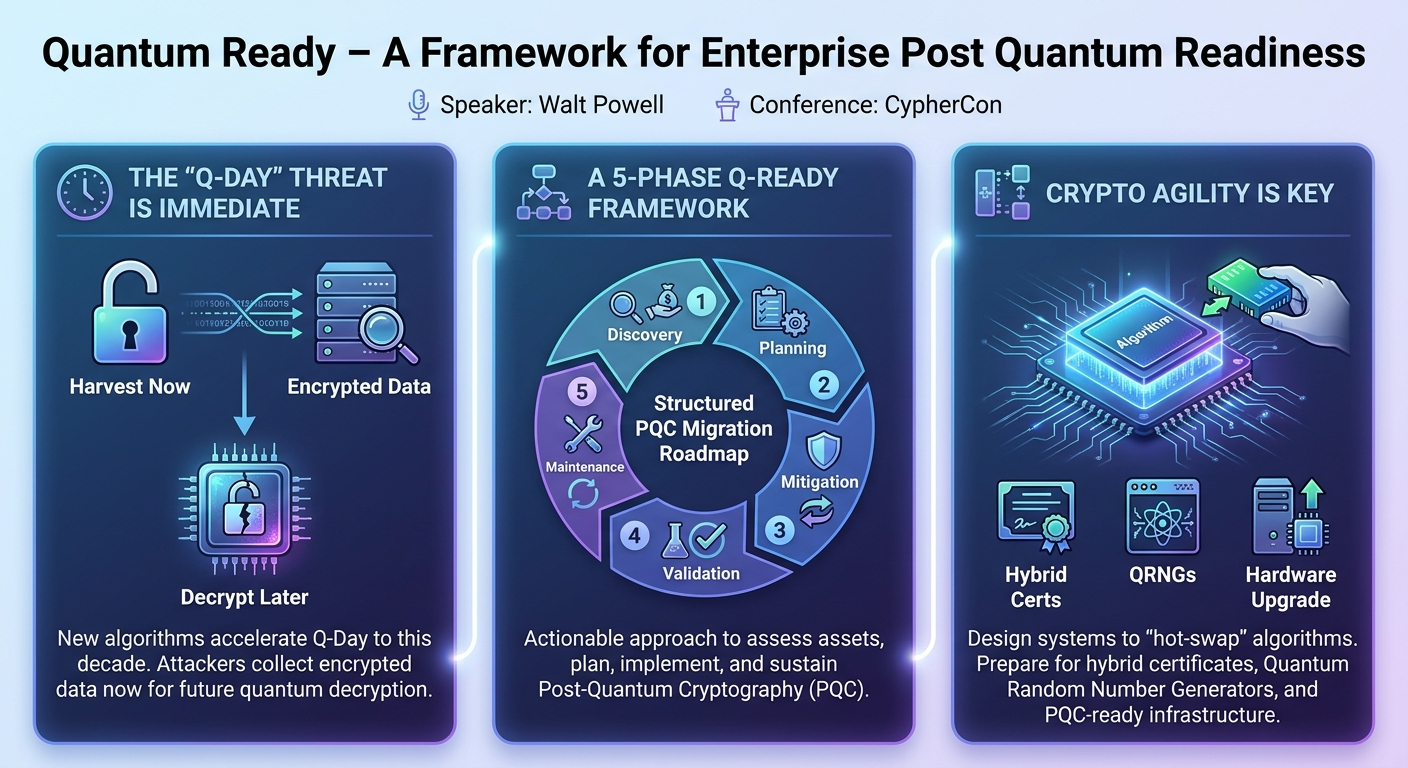
The core message of the talk revolved around the impending Q-Day, the moment when quantum computers become powerful enough to break or severely weaken existing encryption. Powell highlighted that this isn't a distant future problem, but one demanding immediate attention due to the "harvest now, decrypt later" threat, where nation-states are already collecting encrypted data with the intent to decrypt it once quantum capabilities mature. The complexity of replacing ubiquitous encryption across all enterprise systems necessitates a structured approach, which Powell provides through his "Q-Ready Framework."
This talk is crucial for any organization relying on modern cryptography for data security, which, in essence, is every organization. It moves beyond theoretical discussions of quantum computing to provide concrete steps and a strategic roadmap for assessing current cryptographic postures, planning for migration to Post-Quantum Cryptography (PQC), and implementing the necessary changes to ensure long-term confidentiality and integrity of digital assets in a quantum-threatened world.
Background
▶ Watch: Quantum computers will break current encryption algorithms (4:40)
Classical computers operate using bits, which are electronic switches representing either a 0 or a 1. They excel at sequential tasks. Quantum computers, however, leverage quantum states, such as a trapped electron or a photon, creating qubits that can exist in a superposition of both 0 and 1 simultaneously. This fundamental difference allows quantum computers to perform computations vastly faster for specific problem sets, particularly those involving massive parallel processing or pattern recognition within "wild fields of possible answers." While not suited for everyday tasks like web browsing, their power lies in specialized, highly computational problems, including breaking cryptography.
The primary algorithms threatening current encryption are Shor's algorithm and Grover's algorithm. Shor's algorithm is designed to break asymmetric encryption, such as RSA and Elliptic Curve Cryptography (ECC), which are foundational to secure handshakes in protocols like TLS (used in web browsing, email, and most internet communication) and VPNs. If a quantum computer can run Shor's algorithm at scale, all communications secured by these asymmetric methods become vulnerable. Grover's algorithm, on the other hand, targets symmetric encryption, like AES. It doesn't break it outright but effectively halves its key strength. For example, a 128-bit AES key would be reduced to the equivalent of a 64-bit key, making it susceptible to brute-force attacks by quantum computers.
Initial estimates suggested that breaking RSA-256 would require approximately one million error-corrected qubits. While current quantum computers operate in the hundreds or low thousands of qubits (e.g., Rensselaer University tested Shor's on 8-bit RSA with a few hundred qubits), the architecture for a million qubits already exists, exemplified by Microsoft's chip designs. The critical turning point, dubbed Q-Day, is when such a machine becomes powerful enough. Best guesses initially placed Q-Day around 2035. However, a significant development in the past month (prior to the talk) introduced the JVG algorithm. This new algorithm proposes offloading classical computing tasks to classical machines, drastically reducing the quantum resources needed. Researchers hypothesize that the JVG algorithm could break RSA encryption using as few as 5,000 noisy (not even error-corrected) qubits. This discovery fundamentally shifts the timeline, potentially bringing Q-Day to the end of the current decade, if not sooner.
This accelerated timeline, combined with the "harvest now, decrypt later" threat—where adversaries like nation-states are already collecting encrypted data to decrypt in the future—means that organizations with long-lived confidentiality requirements (e.g., critical infrastructure, DoD, healthcare, PII) must act now. The speaker introduced the Mosca Model, a Canadian mathematician's formula to determine when to start PQC remediation: (Confidentiality Requirement Length) + (Remediation Time) = Time until Q-Day. If the sum of an organization's data confidentiality needs and its estimated remediation time (often 5+ years for large enterprises) exceeds the time until Q-Day, they are already behind. This highlights that PQC readiness is not a "next year" problem but a "today" problem. Existing guidance from bodies like NIST (e.g., Special Publication 1800-38) provides some direction but lacks a comprehensive, actionable framework, which prompted the development of the Q-Ready framework.
Key Findings
▶ Watch: Mosca Model: why organizations must start preparing today (12:00)
The talk unveiled several critical findings regarding the quantum threat and enterprise preparedness:
- Accelerated Q-Day Timeline: The most significant finding is the dramatic shift in the estimated arrival of Q-Day. Previously thought to be around 2035, the emergence of algorithms like the JVG algorithm, which potentially requires only 5,000 noisy qubits (compared to 1 million error-corrected qubits for Shor's), could bring the ability to break RSA encryption to the end of this decade. This drastically shortens the window for enterprise remediation.
- Immediate Threat of "Harvest Now, Decrypt Later": Nation-states are already collecting vast amounts of encrypted data, storing it in anticipation of future quantum decryption capabilities. This means organizations with long-lived confidential data (e.g., patient records, critical infrastructure blueprints, PII, financial data) are already exposed, as data encrypted today could be decrypted within its useful lifespan.
- Widespread Enterprise Unpreparedness and Lack of Visibility: A major hurdle is the widespread lack of awareness and visibility within organizations regarding their cryptographic assets. Many enterprises, even Fortune 10 companies, struggle to identify where encryption is used, what cipher suites are employed, and what key strengths are in place. This foundational lack of discovery makes any remediation effort daunting.
- Mosca Model Dictates Urgency: The practical application of the Mosca Model demonstrates that many organizations are already behind schedule. If an organization has a 5-year confidentiality requirement and a 5-year remediation plan, they need to start today if Q-Day is 10 years away. For longer confidentiality needs or remediation times, the exposure window is already open.
- The Q-Ready Framework as an Actionable Solution: Recognizing the inadequacy of existing high-level guidance, Walt Powell developed the Q-Ready Framework. This framework provides a structured, 15-step, five-phase approach (Discovery, Planning, Mitigation, Validation, Maintenance) to guide enterprises through the complex process of achieving post-quantum readiness, making the NIST guidance actionable.
- The Imperative of Crypto Agility: Given the uncertainty surrounding the long-term security of current PQC candidates, the concept of crypto agility is paramount. Organizations must implement solutions that allow for easy "hot-swapping" of cryptographic algorithms and libraries, rather than hardcoding them, anticipating the need for future algorithm replacements.
- Complex Interdependencies and Stakeholder Engagement: PQC migration is not merely a technical problem but an organizational one. It impacts every part of the business, requiring the engagement of diverse stakeholders (IT, security, DevOps, systems, non-IT departments, CFO). Establishing a cross-functional PQC steering committee and appointing a dedicated PQC Czar (a lead responsible for marshaling the effort) are critical for success.
Technical Deep Dive
▶ Watch: Introducing the Q Ready Framework for PQC readiness (15:00)
The technical challenges and proposed solutions for Post-Quantum Cryptography (PQC) readiness are multifaceted, spanning from fundamental algorithm changes to significant infrastructure overhauls.
Quantum Computing Fundamentals and Threat Algorithms:
At its core, quantum computing exploits quantum mechanical phenomena like superposition (a qubit can be 0, 1, or both simultaneously) and entanglement to perform calculations. Unlike classical bits, which are either 0 or 1, qubits exist in a probabilistic state. This allows quantum computers to explore multiple possibilities concurrently. However, quantum states are fragile, leading to noisy qubits that require extensive error correction, making early quantum machines slow. Despite this, their ability to find patterns in vast datasets makes them uniquely suited to break modern cryptography.
The two primary algorithmic threats are:
- Shor's Algorithm: This algorithm targets asymmetric encryption schemes like RSA and Elliptic Curve Cryptography (ECC). These are used for key exchange and digital signatures in protocols like TLS 1.2/1.3, VPN IKE handshakes, and code signing. Shor's algorithm can factor large numbers or solve discrete logarithm problems, rendering these schemes insecure. The original estimate for breaking RSA-256 was one million error-corrected qubits.
- Grover's Algorithm: This algorithm targets symmetric encryption like AES. It doesn't break symmetric keys but effectively reduces their strength by half. For instance, an AES-128 key would have the security equivalent of a classical 64-bit key, making it vulnerable to brute-force attacks by quantum computers. This necessitates a move to stronger symmetric keys, such as AES-256 and robust hashing algorithms like SHA-512.
Post-Quantum Cryptography (PQC) Algorithms:
NIST has been leading the charge in standardizing PQC algorithms. The primary candidates selected or under consideration largely rely on lattice algebra, a mathematical approach involving finding the shortest vector in a high-dimensional lattice.
- Crystals-Kyber (ML-KEM): This is a Key Encapsulation Mechanism (KEM), designed to replace RSA and ECC for asymmetric key exchange (e.g., TLS handshakes). It is computationally fast but requires a larger key space, leading to increased memory consumption.
- Crystals-Dilithium, Falcon, SPHINCS+: These are signature algorithms, intended to replace current digital signature schemes used in applications like DNSSEC, message authentication, and code signing.
- NIST also has a non-lattice-based backup, mentioned as HQC (likely referring to HQC), in case unforeseen weaknesses are found in lattice-based cryptography. This highlights the ongoing research and the need for crypto agility.
Crypto Agility:
A core principle for PQC migration is crypto agility. This means designing systems and applications to easily swap out cryptographic algorithms without requiring extensive re-engineering. This involves:
- Avoiding hardcoding: Cryptographic algorithms should not be hardcoded directly into applications.
- Leveraging libraries: Developers should point to cryptographic libraries (e.g., OpenSSL and BoringSSL already support PQC algorithms) that can be updated.
- Firmware updates: Hardware manufacturers should design devices that can receive firmware updates to support new PQC algorithms, rather than requiring full hardware replacement. This is crucial as PQC algorithms may evolve and new ones may be introduced or existing ones broken.
Implementation Challenges and Solutions:
- TLS Migration:
- TLS 1.3 Requirement: Implementing PQC within TLS largely requires migrating to TLS 1.3. While technically possible on TLS 1.2 with "kludgy beta patches," it's not recommended. Many organizations still struggle with legacy applications that prevent migration from older TLS versions (e.g., 1.1 or 1.2).
- Workarounds: For systems unable to migrate to TLS 1.3, reverse proxies (e.g., QuSecure for on-prem, F5, or Zscaler for cloud-based solutions) can terminate PQC communication and re-establish classical connections on the backend. However, this is considered a band-aid solution.
- Certificate Management:
- Hybrid vs. Dual Certificates:
- Hybrid Certificates: Contain both a classical and a PQC algorithm, sharing the same root of trust. This allows for negotiation with parties that are not yet PQC-ready. Many commercial CAs (e.g., DigiCert) offer hybrid certificates today. Microsoft CA, with Server 2025 Cardinal edition, will support hybrid CAs through 2038.
- Dual Certificates: Involve two separate certificates, one classical and one PQC, each with its own root of trust.
- Automated Certificate Lifecycle Management (CLM): The browser consortium's move to shorten TLS certificate lifecycles (from 386 days to 200, then 100, and eventually 47 days by 2029) mandates automated CLM. Organizations must integrate PQC considerations into their CLM automation (e.g., with tools like Venafi) to avoid re-work when rebuilding CAs for hybrid PQC support.
- Key Generation:
- Quantum Random Number Generators (QRNGs): Current key generation relies on pseudo-random number generators (PRNGs), which, while statistically random to classical computers, may contain patterns detectable by quantum machines. QRNGs generate truly random keys by leveraging quantum states, making them more resistant to quantum attacks. Hardware Security Modules (HSMs) from vendors like Thales already offer QRNG integration. Cloud providers are expected to incorporate QRNGs into their Key Management Services.
- Quantum Key Distribution (QKD):
- BB-84 Protocol: QKD uses fiber optic overlay networks to exchange keys using quantum states, following the BB-84 protocol (named after Bennett and Brassard, 1984). It leverages Schrödinger's uncertainty principle to detect eavesdropping: any attempt to measure the quantum state of the photons (i.e., open the packet) will alter it, alerting the communicating parties.
- Niche Application: QKD is primarily suited for highly secure, short-run, dedicated fiber optic links, such as ISP backbones or DoD applications, rather than general enterprise use.
- VPNs:
- Dual Encryption: VPNs use asymmetric encryption for the IKE handshake and symmetric encryption for the IPsec tunnel.
- PQC for IKE: The IKE handshake requires PQC algorithm replacement.
- Symmetric Upleveling: The IPsec tunnel needs strong symmetric encryption like AES-256 and robust hashing (SHA-512).
- Perfect Forward Secrecy (PFS): Enabling PFS is a prerequisite for PQC in VPNs, which can be a "non-starter" if partners on the other end are unwilling or unable to configure it.
- Hardware Upgrade: Running PQC algorithms can be memory-intensive, potentially requiring new VPN concentrator hardware.
- ZTNA Consideration: Organizations with extensive VPN deployments should evaluate migrating to Zero Trust Network Access (ZTNA) solutions as a strategic alternative, offloading the PQC burden to specialized providers.
- IoT and Embedded Systems:
- Discovery Challenges: Identifying cryptographic usage in Industrial Control Systems (ICS), Operational Technology (OT), and IoT devices is exceptionally difficult due to specialized protocols and vendor lock-in.
- Memory Constraints: Many embedded devices have very limited memory, making them unable to run memory-intensive PQC algorithms. This will likely necessitate widespread hardware replacement rather than software upgrades.
Discovery Tools:
To address the initial challenge of identifying cryptographic assets, tools for Cryptographic Bill of Materials (C-BOMs) are emerging, often built by the same groups behind Software Bill of Materials (S-BOMs, e.g., CycloneDX). Examples include university-developed tools like PQC.com, built on Zeek (Bro), for network-level discovery. These tools require integration with telemetry from endpoints, networks, storage, and CI/CD pipelines.
Demo / Proof of Concept
▶ Watch: Immediate 'quick wins' for Post-Quantum Cryptography readiness (49:00)
While the talk itself did not feature a live, interactive demonstration, Walt Powell referenced several instances of quantum computing capabilities and architectural advancements that serve as proofs of concept for the impending quantum threat and the feasibility of PQC.
He highlighted that Shor's algorithm has been successfully tested in a limited capacity. Specifically, he mentioned that students at Rensselaer University, utilizing a quantum computer with "a couple hundred qubits," were able to run Shor's algorithm against an 8-bit RSA key. This demonstrates that the core principle of breaking asymmetric encryption with quantum computers is proven, albeit not yet at the scale required for real-world cryptographic challenges.
Furthermore, Powell pointed to the architectural readiness for more powerful quantum machines. He referenced a Microsoft chip design capable of handling one million qubits, which is the estimated requirement for breaking RSA-256. This indicates that while the physical realization of such a powerful machine is still in progress, the conceptual and design hurdles for massive qubit counts are being addressed.
The most significant theoretical "proof of concept" discussed was the JVG algorithm. Although not yet tested or run in practice, its theoretical reduction of qubit requirements (from one million error-corrected to potentially 5,000 noisy qubits) drastically alters the timeline and feasibility of quantum attacks. This algorithmic breakthrough serves as a stark warning and a strong impetus for immediate PQC readiness.
In essence, the "demo" presented by the speaker was a narrative one, drawing upon existing research and theoretical advancements to underscore the reality and immediacy of the quantum threat, rather than showcasing a real-time technical demonstration.
Defensive Implications
▶ Watch: Q&A: Vendor readiness and critical risk trade-off decisions (52:00)
The quantum threat demands a proactive and comprehensive defensive strategy, encompassing immediate actions, a structured framework for migration, and ongoing maintenance.
Immediate "Quick Wins" (Things to do Today):
- TLS 1.3 Migration Strategy: Develop and execute a plan to migrate all systems to TLS 1.3. Identify legacy applications that cannot migrate and establish a robust exception process, evaluating the risks of using "band-aid" solutions like reverse proxies.
- Symmetric Encryption Audit: Review all symmetric encryption usage. Ensure all data at rest, payment systems, and VPN IPsec tunnels use at least AES-256 and strong hashing algorithms like SHA-512. Critically, investigate key wrapping practices, especially in cloud environments, to ensure that the keys themselves are not wrapped in vulnerable asymmetric algorithms.
- Establish PQC Steering Committee: Form a cross-functional committee with stakeholders from IT, security, DevOps, systems, and even non-IT departments. This committee will guide the overall PQC strategy, foster collaboration, and articulate the business case for investment.
- Appoint a PQC Czar: Designate a high-level individual (e.g., CISO, CIO, CRO, or a smart technical architect with executive gravitas) to marshal the entire PQC initiative. This person will drive policy, secure resources, and ensure coordination across the organization.
- Vendor Engagement: Immediately integrate PQC readiness questions into procurement and third-party risk management questionnaires. Ask vendors about their PQC roadmaps, timelines for PQC-ready products, and what is required for PQC compatibility with currently purchased items. This helps plan hardware refresh cycles to align with natural depreciation.
- PQC Discovery Tooling Proof of Concept: Begin evaluating and piloting tools for cryptographic asset discovery. This includes exploring Cryptographic Bill of Materials (C-BOM) tools (e.g., those from the CycloneDX group), open-source options like PQC.com (built on Zeek/Bro), or commercial solutions. Understand what telemetry is available and what agents/containers might be needed for comprehensive coverage.
Long-Term Strategic Implementation (Q-Ready Framework):
The Q-Ready Framework provides a structured, multi-phase approach:
- Phase 1: Discovery:
- Inventory Cryptographic Assets: Use C-BOM tools and other discovery mechanisms to identify every instance of encryption within the organization (endpoints, network, storage, applications, CI/CD pipelines).
- Assess Risk: Evaluate identified cryptographic assets based on algorithm strength, key length, data sensitivity, and confidentiality requirements (e.g., long-lived PHI, PII).
- Prioritize Remediation: Order migration efforts based on risk, focusing first on high-risk, long-confidentiality data.
- Phase 2: Planning:
- Compensating Controls: Before direct PQC migration, explore whether sensitive data can be moved, obfuscated, masked, or simply not transmitted to reduce exposure.
- Build PQC Center of Excellence & Test Plan: Create a dedicated technical team to test PQC algorithms for interoperability, memory constraints, latency, and other potential issues. This hands-on testing will inform the practical order of migration.
- Mitigation Plan: Based on discovery and testing, develop a detailed plan outlining the order of application and system migrations.
- Stakeholder Engagement & Funding: Secure executive buy-in and budget (7-8 figures for large enterprises) by clearly articulating the risk and necessity. Bake PQC language into procurement and third-party contracts to align with natural asset lifecycles.
- Success Metrics: Define clear metrics (e.g., migration rate, reduction in handle risk) to track progress and justify investment.
- Phase 3: Mitigation (Implementation):
- Algorithm Replacement: Implement NIST-selected PQC algorithms like Crystals-Kyber (ML-KEM) for asymmetric key exchange and appropriate signature algorithms.
- Crypto Agility: Ensure all new implementations leverage libraries (e.g., OpenSSL, BoringSSL) and support firmware updates to facilitate future algorithm swaps.
- TLS & Certificate Upleveling: Migrate to TLS 1.3 and implement hybrid certificates from CAs that support PQC. Rebuild offline CAs with PQC capabilities (e.g., Microsoft Server 2025 Cardinal). Automate certificate lifecycle management to handle shortened lifespans.
- Secure Key Generation: Implement Quantum Random Number Generators (QRNGs) for stronger key material, either through HSMs (e.g., Thales) or cloud key management services.
- VPN Strategy: Uplevel symmetric encryption in IPsec tunnels, implement PQC for IKE handshakes, enable Perfect Forward Secrecy, and consider migrating to ZTNA solutions.
- IoT/OT/ICS Remediation: Plan for significant hardware replacement for memory-constrained IoT/OT devices that cannot support PQC algorithms via software updates.
- Phase 4: Validation:
- Testing: Rigorously test all deployed PQC solutions for interoperability, performance, and functionality.
- Event Management & Incident Response: Develop new processes for monitoring, alerting, and responding to PQC-related events (e.g., non-PQC-ready services coming online). Train IR teams on identifying these issues.
- Auditing: Prepare for future auditing against emerging PQC frameworks (e.g., updated NIST SP 1800-38).
- Phase 5: Maintenance:
- Ongoing Crypto Agility: Continuously monitor the cryptographic landscape and be prepared for future algorithm replacements.
- Certificate & Key Management: Maintain automated certificate lifecycle management and manage the eventual deprecation of classical choices in hybrid certificates.
- Organizational Readiness & Training: Implement continuous training for end-users, DevOps, SecOps, and executives to ensure ongoing awareness, skill development, and executive sponsorship. Educate board members on the strategic importance and investment required for PQC.
Key Takeaways
- Q-Day is Closer Than You Think: The emergence of algorithms like JVG means the quantum threat to current encryption could materialize by the end of this decade, not 2035.
- "Harvest Now, Decrypt Later" Threat is Real: Adversaries are already collecting encrypted data today, planning to decrypt it with future quantum computers. Organizations with long-lived confidential data must act immediately.
- Crypto Agility is Paramount: Implement solutions that allow for easy "hot-swapping" of cryptographic algorithms, as PQC standards will likely evolve, requiring future migrations.
- Comprehensive Discovery is the First Step: You cannot secure what you do not know you have. Enterprises must invest in tools and processes to build a Cryptographic Bill of Materials (C-BOM) for all assets.
- This is an Enterprise-Wide Effort: PQC readiness requires a cross-functional PQC Steering Committee and a dedicated PQC Czar to coordinate efforts across IT, security, procurement, and business units.
- Budget and Hardware Upgrades are Inevitable: Expect significant financial investment (seven to eight figures) for software upgrades, new PQC-ready hardware (especially for IoT/OT), and rebuilding certificate authorities.
About the Speaker(s)
Walt Powell is a Lead Field CISO, describing himself as a "recovering CISO" who leads a team of similar professionals focused on cutting-edge security challenges. He is the author of a book on quantum cryptography, which was released in the month preceding his CypherCon talk (February). His work involves helping organizations understand and address complex, emerging threats like the quantum computing challenge to enterprise security.
Reviews
Dr. Zero (Offensive Security Researcher) — WEAK
A Field CISO rehashes Mosca's theorem and 'harvest now, decrypt later' for an audience that apparently slept through the last decade of cryptography. It's a consulting framework full of steering committees and vendor name-drops, offering nothing new to anyone who actually reads.
Heather Calloway (CISO) — SOLID
This session outlines a pragmatic, phased framework for enterprise Post-Quantum Cryptography (PQC) readiness, moving past the usual theoretical panic. Powell correctly frames PQC not as an immediate technical emergency, but as a multi-year procurement and lifecycle management problem that requires immediate structural planning.