“DLP: Didn’t Live uP” “Legacy DLP fell short but DSPM can help it live up to its promise
Ward Balcerzak
Overview
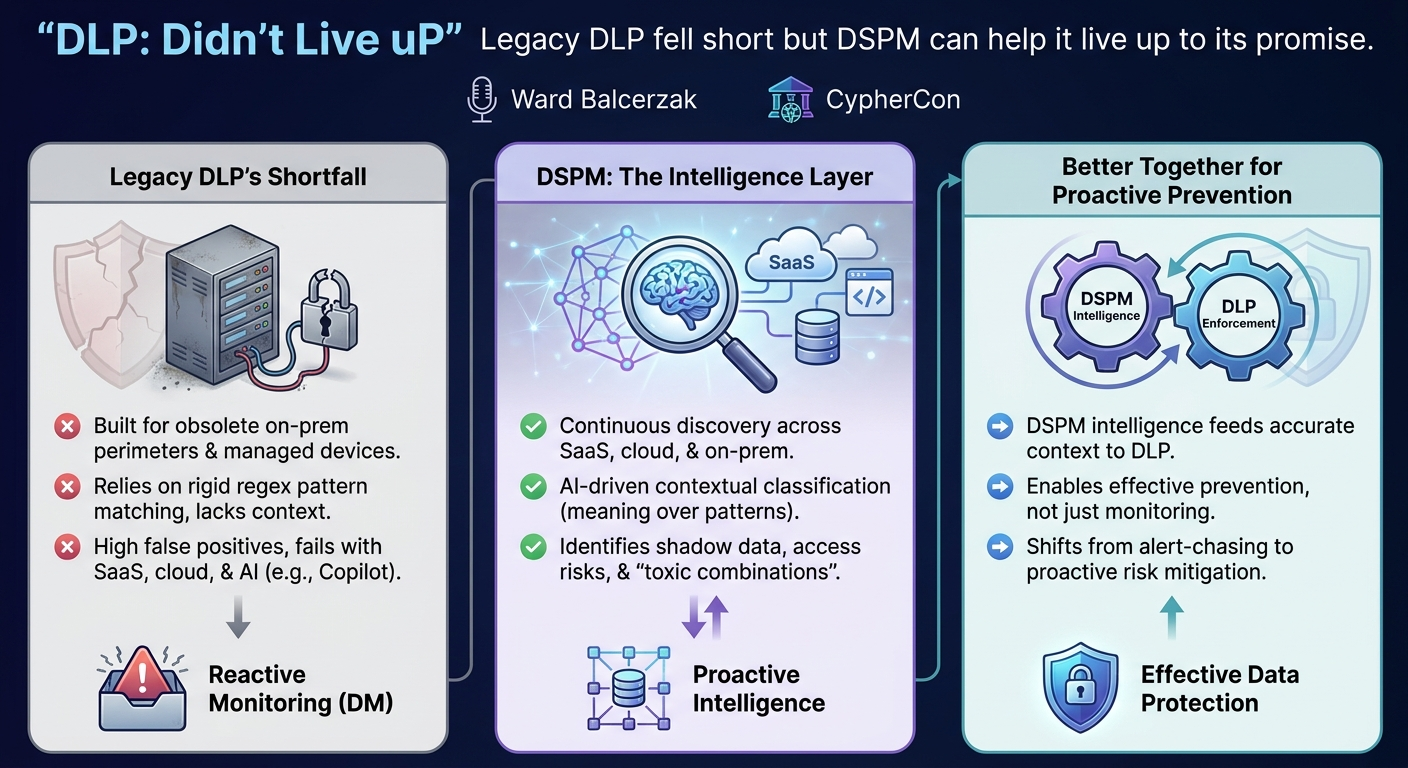
In his CypherCon talk, "DLP: Didn’t Live uP,” Ward Balcerzak, Field CISO at Sentra, delivers a critical yet constructive analysis of traditional Data Loss Prevention (DLP) technologies. Balcerzak argues that while DLP was once heralded as the panacea for data security, its conventional implementations have largely failed to meet their ambitious promises, leaving organizations vulnerable to modern data challenges. He provocatively rebrands DLP as "Data Loss Monitoring (DM)" for many organizations, highlighting their inability to achieve true prevention due to inherent limitations.
Key moments
- 2:05 DLP's past failures resonate with audience
- 5:06 The painful reality of traditional DLP
- 8:08 Traditional DLP fails modern cloud/AI environments
- 12:00 Introducing DSPM: discovery, classification, access
- 16:00 DSPM's context-aware data classification using AI
- 20:00 How DSPM and DLP work better together
- 21:50 Practical steps to implement DSPM in your program
- 26:40 Q&A: Addressing data classification complexity
DLP: Didn’t Live uP” “Legacy DLP fell short but DSPM can help it live up to its promise
Speakers: Ward Balcerzak, Field CISO, Sentra
Conference: CypherCon
YouTube: https://www.youtube.com/watch?v=7YOT1pveyho
Overview
In his CypherCon talk, "DLP: Didn’t Live uP,” Ward Balcerzak, Field CISO at Sentra, delivers a critical yet constructive analysis of traditional Data Loss Prevention (DLP) technologies. Balcerzak argues that while DLP was once heralded as the panacea for data security, its conventional implementations have largely failed to meet their ambitious promises, leaving organizations vulnerable to modern data challenges. He provocatively rebrands DLP as "Data Loss Monitoring (DM)" for many organizations, highlighting their inability to achieve true prevention due to inherent limitations.
The core of Balcerzak’s presentation lies in identifying the fundamental shortcomings of legacy DLP in the face of today's complex, distributed data landscape. He attributes these failures to a lack of comprehensive data visibility, over-reliance on rigid pattern matching, limited contextual awareness, and an inability to adapt to the rapid proliferation of SaaS, cloud storage, APIs, and AI tools like Copilot. To address these critical gaps, Balcerzak champions the emerging field of Data Security Posture Management (DSPM) as the essential intelligence layer that can not only revitalize DLP but also enable a truly effective data protection program. This talk is crucial for security leaders and practitioners grappling with outdated data security strategies, offering a pathway to proactively identify, classify, and secure sensitive data in an increasingly dynamic and threat-laden environment.
Background
▶ Watch: DLP's past failures resonate with audience (2:05)
The journey of Data Loss Prevention (DLP) began over two decades ago, with early pioneers like Tablus and Vontu (later acquired by Symantec and RSA, respectively) promising a utopian vision where sensitive data would be automatically prevented from leaving an organization's control. Vendors painted a picture of "unicorn and fairyland" scenarios: preventing data exfiltration, offering high-fidelity policies out of the box, reducing risk without business disruption, simplifying tuning, and ensuring compliance. However, as Ward Balcerzak highlights, the reality has consistently fallen short of these lofty promises.
Balcerzak, drawing from over two decades of experience building data security programs at major corporations like Allstate and Fidelity, succinctly outlines the painful realities faced by practitioners. Instead of seamless prevention, many organizations experience the "CEO from closing on an M&A" scenario, where critical business operations are inadvertently blocked by overzealous or misconfigured DLP policies, leading to urgent, late-night overrides. The promised "high-fidelity policies" often translate into a deluge of false positives and, paradoxically, false negatives, meaning legitimate data leaks still occur. Tuning these systems is far from simple, often resulting in complex regex patterns spanning "pages worth" for a single data type, like a driver's license. This complexity leads to "angry users, angry customers, and angry executives," and auditors often find DLP implementations to be more of a "joke" than a robust control. Balcerzak even shared his personal experience of telling auditors, "I don't do DLP. I do DM (Data Loss Monitoring)," because prevention was unattainable.
The fundamental struggles of traditional DLP stem from several core limitations. Firstly, a severe lack of data visibility: legacy DLP tools were not designed to look at data at rest across diverse environments. They typically relied on rudimentary pattern matching, which, while capable of identifying specific data elements like nine-digit social security numbers, struggled with contextual understanding. This limited context meant that a nine-digit string could be a phone number, a social security number without dashes, or something entirely benign. Consequently, traditional DLP "couldn't keep up with the business." As organizations rapidly adopted AI and Copilot technologies, the static, rule-based nature of DLP became a bottleneck, forcing security teams to revert to monitoring rather than prevention to avoid slowing down business operations.
Crucially, traditional DLP was architected for an obsolete IT landscape: on-prem data centers, managed user devices, Exchange servers, and clearly defined network perimeters. This "magical" past is a stark contrast to today's reality. The modern data problem, as Balcerzak emphasizes, is characterized by the pervasive use of SaaS applications (often including shadow SaaS), distributed cloud storage, and the extensive reliance on APIs for data movement. Furthermore, the proliferation of production data in dev and test environments, combined with the explosive growth of AI and Copilot, has rendered traditional DLP largely ineffective. A prime example is Microsoft Copilot interacting with sensitive data stored in 0365 environments, which many organizations erroneously consider part of their "perimeter" but fail to adequately monitor for internal data exposure. Without knowing "what your data was," legacy DLP became a blind spot in the face of these evolving threats.
Key Findings
▶ Watch: Traditional DLP fails modern cloud/AI environments (8:08)
Ward Balcerzak’s central argument is that while traditional DLP has "failed us," the underlying promise of data loss prevention remains vital. The key finding is that a new approach, Data Security Posture Management (DSPM), is not a replacement for DLP but rather the crucial "intelligence layer" that enables DLP to finally "live up to its promise." DSPM addresses the fundamental visibility and context gaps that plagued its predecessor.
The main contributions and discoveries highlighted by Balcerzak regarding DSPM include:
- Comprehensive Data Discovery: DSPM begins with continuous, holistic data discovery across all environments—on-prem, cloud, and SaaS. This capability is paramount for identifying "shadow data" like forgotten S3 buckets or old SharePoint sites from 2019 that still hold sensitive information and open access. This continuous scanning capability reveals data repositories organizations "had no clue was there."
- Contextual Data Classification: Beyond simple tags like "public, internal, restricted," DSPM performs deep data classification to understand "what the heck is that data." It identifies specific data types, such as a W2 or an I9 form instead of just "PII," or a schematic for an "airplane cockpit telemetry" instead of merely "CUI." This emphasis on "meaning over patterns" leverages advanced AI, LLM (Large Language Models), and SLM (Small Language Models) to provide accurate context, overcoming the limitations of rigid regex and reducing false positives. For instance, it can differentiate "Georgia" as a state, a name, or a country, or distinguish a social security number from other nine-digit strings like phone numbers.
- Access Governance: Crucially, especially in the age of Copilot and AI, DSPM identifies "who has access" to sensitive data. Balcerzak illustrates this with the common problem of users sharing SharePoint links with "anyone with the link" internally. While seemingly innocuous, this practice exposes data to Copilot, which can then make it accessible to a much wider audience, bypassing traditional security controls. DSPM provides the visibility needed to understand and mitigate these access risks.
- Reduction of Noise and False Positives: By providing accurate, data at rest intelligence before data moves, DSPM dramatically reduces the "noise" and false positives that overwhelm traditional DLP. Instead of tuning rules and chasing alerts in real-time as data "flies out the door," DSPM enables proactive policy enforcement based on a clear understanding of data sensitivity and context, leading to more effective prevention.
- "Better Together" Synergy: Balcerzak stresses that DSPM and DLP are complementary, not competing, solutions. DSPM focuses on continuous discovery, identification, classification, ownership, and age of data to inform. DLP, specifically in its modern iterations, then leverages this intelligence to perform the actual "P" (prevention) – stopping data from leaving via email, USB, or cloud channels. This synergy enables a more robust and defensible data protection program, leading to "fewer angry executives."
These findings collectively present DSPM as the critical missing piece in the data security puzzle, offering a path to move from reactive "data loss monitoring" to proactive "data loss prevention."
Technical Deep Dive
▶ Watch: DSPM's context-aware data classification using AI (16:00)
The technical exposition of Balcerzak's talk meticulously dissects the limitations of traditional DLP and contrasts them with the capabilities of modern DSPM. He begins by deconstructing the architecture and assumptions inherent in legacy DLP deployments.
Traditional DLP: An On-Premise Legacy
Balcerzak points out that traditional DLP was fundamentally designed for an on-prem world. Its mechanisms were built around:
- Defined Network Perimeters: The concept of a secure internal network where data resided and was controlled.
- Managed User Devices: Corporate-issued laptops and desktops, where agents could monitor and control data movement.
- Email and Web Gateways: Solutions integrated with on-premise Exchange or similar systems to inspect outbound communications.
- Pattern Matching with Regex: The primary method for identifying sensitive data involved complex regex patterns. While powerful for specific structures (e.g., nine digits for an SSN), this approach is prone to false positives (e.g., phone numbers mistaken for SSNs) and false negatives (e.g., intellectual property that doesn't conform to a specific pattern). Balcerzak cites an example of a "pages worth" regex for a driver's license policy, highlighting its unwieldiness and maintenance burden.
- Limited Context: Without deeper understanding, traditional DLP struggles to differentiate between "Georgia" as a state, a person's name, or a country, leading to inaccurate classifications. It primarily focused on identifying "data elements" rather than understanding "data types" or their broader significance.
- Lack of Data at Rest Visibility: A critical failing was its inability to comprehensively scan and classify data at rest across all repositories. This meant organizations often didn't know what sensitive data they possessed or where it was located before it attempted to move.
The Modern Data Problem: Beyond the Perimeter
The contemporary IT landscape has rendered these legacy assumptions obsolete, creating significant challenges for traditional DLP:
- SaaS Proliferation: Organizations increasingly rely on third-party SaaS applications, many of which are adopted without IT oversight (shadow SaaS). Traditional DLP agents cannot inspect data within these environments.
- Cloud Storage and APIs: Data now resides in highly distributed cloud storage (e.g., S3 buckets, SharePoint Online) and moves extensively via APIs. Legacy DLP was not built to integrate with or monitor these dynamic, API-driven data flows.
- Dev/Test Environments: It's a common, yet problematic, practice for production data to seep into dev and test environments, often with less stringent security controls. Traditional DLP often lacks visibility into these spaces.
- AI and Copilot: The emergence of AI tools like Microsoft Copilot presents a novel challenge. Copilot, when integrated with platforms like 0365, can access and process vast amounts of internal data. If sensitive data resides in 0365 or SharePoint sites that are shared broadly (e.g., "anyone internally with the link"), Copilot can effectively expose that data to a wider audience than intended, bypassing traditional perimeter-based DLP.
DSPM: The Intelligence Layer for Modern Data Security
Balcerzak positions DSPM as the essential "intelligence layer" that rectifies these shortcomings by focusing on three core pillars:
- Continuous Data Discovery: DSPM continuously scans and maps all data repositories, whether on-prem, in cloud storage, or within SaaS applications. This includes identifying "shadow data" like forgotten S3 buckets or old, open-access SharePoint sites. This addresses the fundamental question: "Where is your data being stored?"
- Advanced Data Classification and Context:
- Meaning Over Patterns: Unlike regex, DSPM leverages AI, LLM (Large Language Models), and SLM (Small Language Models) to understand the meaning of data, not just its patterns. This allows it to classify data more accurately, differentiating a generic "PII" from a specific "W2" or "I9 form," or identifying intricate "CUI" schematics.
- Contextual Sensitivity: It considers the surrounding context to determine true sensitivity. For example, a nine-digit number is only an SSN if accompanied by other identifying information (a "toxic combination"), not just any nine-digit string. This significantly reduces false positives.
- Data Lineage: DSPM tracks data lineage, understanding how data moved (e.g., from production to dev environments) and its current location.
- Semi-structured Data: It extends classification beyond structured and unstructured data to include semi-structured data like video and audio files (e.g., call recordings containing credit card numbers or PII).
- Data Age: DSPM also considers the age of data, helping organizations enforce data retention policies and identify stale, potentially risky data.
- Access Governance and Risk Assessment: DSPM identifies "who has access" to specific sensitive data. This is critical for understanding exposure, especially in cloud and SaaS environments where default sharing settings or misconfigurations can lead to broad internal or external access. It highlights risks associated with seemingly innocuous sharing practices, like internal SharePoint links that Copilot can then leverage.
By providing this comprehensive, continuous intelligence about data location, classification, context, and access, DSPM transforms data security from a reactive, rule-based approach to a proactive, informed strategy. It's the "new way" to identify data repositories, understand their contents and sensitivity, and "let the technology do the heavy lifting" to feed accurate intelligence to other security controls, including DLP.
Demo / Proof of Concept
▶ Watch: How DSPM and DLP work better together (20:00)
Ward Balcerzak explicitly stated at the outset of his talk that his presentation would not include any live demonstrations or elegant scripts. He clarified that the session was intended as a "high-level, advisory type conversation" rather than a technical deep dive into specific tools or a practical proof of concept. Therefore, no demonstration of DSPM or DLP in action was provided during this talk.
Defensive Implications
▶ Watch: Q&A: Addressing data classification complexity (26:40)
The insights shared by Ward Balcerzak offer profound defensive implications for organizations struggling with data security in the modern era. The core message is a call to action to move beyond the limitations of traditional DLP by integrating DSPM capabilities, thereby enabling a truly proactive and defensible data protection program.
For Security Leaders:
- Resource Optimization: One of the most significant implications is the potential to reduce the need for large "armies" of security engineers and analysts. Balcerzak noted his past data security teams comprised "23 individuals doing data security" at Fidelity and "36 individuals" at Allstate, with a substantial portion of their time dedicated to tuning DLP rules and chasing false positives. DSPM, by automating data discovery, classification, and contextual analysis, significantly reduces this manual burden, freeing up valuable human capital for more strategic security initiatives.
- Budget Justification: In an era where executives question the efficacy of security investments, DSPM offers a clear return by providing concrete visibility into data risks and demonstrating compliance.
- Strategic Program Development: Leaders can build a data protection program they "can stand behind," confidently addressing auditors (e.g., for CMMC compliance) about where sensitive data resides and how it's protected.
For Practitioners:
- Reduced Headaches and Alert Fatigue: The shift from reactive Data Loss Monitoring (DM) to proactive Data Loss Prevention (DLP), powered by DSPM, means fewer false positives and less "chasing alerts." This translates directly into less stress, more effective work, and, as Balcerzak humorously puts it, the ability to "keep your hairline" and "sleep at night."
- Enhanced Efficacy: Practitioners gain a powerful intelligence layer that provides accurate context about data sensitivity and access, allowing them to configure DLP policies that are precise and effective, rather than overly broad or easily bypassed.
Actionable Defensive Strategies:
Balcerzak outlines a clear, three-step advisory for implementing a modern data security program:
- Audit Your Coverage (Gap Analysis):
- Understand all data repositories: This starts with an honest assessment of where data is stored, including identifying potential blind spots like inaccurate CMDBs. As Balcerzak notes, many organizations have multiple CMDBs, none of which are fully trusted.
- Identify existing security controls: What tools are currently in place, and what are their coverage gaps?
- Close the Visibility Gap:
- Identify Data Repositories: Use technology (DSPM) to automatically discover all data storage locations across on-prem, cloud, and SaaS.
- Scan and Classify: Let DSPM perform the heavy lifting of scanning these repositories, identifying "what the heck's in there," and classifying its sensitivity with context (e.g., differentiating an SSN from a phone number, or a W2 from generic PII). This step reveals the "uncomfortable truth" that most organizations find "a ton of data they had no clue was there."
- Implement Intelligence-Driven Prevention:
- Feed DLP with DSPM: The accurate intelligence gathered by DSPM (data location, classification, context, ownership, access, age) should directly inform and enhance DLP solutions. This allows DLP to perform true "prevention" rather than just monitoring.
- Proactive Risk Mitigation: By understanding data at rest before it moves, organizations can remediate risks, enforce data retention policies, and adjust access controls, significantly reducing the likelihood of a data breach.
Organizational Collaboration:
Balcerzak also stresses the importance of cross-functional engagement:
- Partner with Privacy and Legal: These teams are "golden children" for data security, especially in regulated industries. Understanding their concerns and enabling their compliance efforts (e.g., for PII regulations) is paramount.
- Engage HR: HR often holds significant internal sensitive data, making them a crucial partner.
- Consultative Approach: Security professionals must adopt a consultative mindset, engaging with business units to understand their practices and demonstrate how security measures enable, rather than hinder, their operations.
Hybrid Classification Approach:
For data classification, Balcerzak advocates for a hybrid approach:
- Programmatic Tools: Leverage AI, LLM, and SLM-powered DSPM tools for automated, scalable classification, especially for "toxic combinations" of data elements.
- Human Oversight: Maintain a "trust but verify" human element in the classification process. While AI is powerful, it's "not to the point yet where any enterprise should fully trust that capability by itself."
- User Input: Acknowledge that users creating data (especially intellectual property) often have the best initial understanding of its sensitivity, but this needs to be augmented and validated by programmatic tools, particularly at scale.
By embracing these defensive implications, organizations can transform their data security posture from reactive firefighting to strategic, intelligence-led prevention, ultimately safeguarding sensitive information more effectively in the complex modern landscape.
Key Takeaways
- Traditional DLP has failed to deliver on its promises: Legacy DLP was designed for an on-prem world and struggles with modern challenges like SaaS, cloud storage, APIs, and AI (Copilot), often leading to false positives and Data Loss Monitoring (DM) instead of true prevention.
- DSPM is the essential intelligence layer for modern data security: Data Security Posture Management (DSPM) provides continuous data discovery, deep contextual classification (using AI/LLM/SLM for "meaning over patterns"), and access governance across all data repositories, including shadow IT.
- DSPM and DLP are "better together": DSPM provides the foundational intelligence (where data is, what it is, who has access) that enables DLP to be truly effective at prevention, reducing false positives and ensuring more accurate enforcement.
- Proactive data security is achievable and necessary: Organizations can move from reactive alert chasing to proactive risk mitigation by leveraging DSPM to understand their data at rest before it's exposed or exfiltrated.
- Strategic implementation requires a multi-faceted approach: Success involves auditing current coverage, using technology to close visibility gaps, letting DSPM feed DLP, and fostering collaboration with privacy, legal, and HR teams.
- Automation reduces the burden on security teams: DSPM significantly reduces the need for large teams of engineers to manually tune rules and chase alerts, optimizing resources and improving overall program efficacy.
About the Speaker(s)
Ward Balcerzak is a highly experienced professional in the field of data protection, boasting over two decades of expertise. Hailing from Oshkosh, Wisconsin, Balcerzak has a rich background in building and leading data security programs for prominent organizations. His career includes significant roles at Oshkosh Corporation, Allstate, and Fidelity, where he was responsible for establishing comprehensive data security initiatives.
Currently, Balcerzak serves as a Field CISO at Sentra, a role that places him on the vendor side of the industry, though he emphasizes his focus is on advisory and technical discussions rather than sales. He is also the host of "Guardians of the Data," a podcast dedicated to exploring various topics in data security through conversations with industry leaders and experts. Throughout his career, Balcerzak has been deeply involved with DLP technologies, giving him a unique and critical perspective on their evolution and challenges.
Reviews
Dr. Zero (Offensive Security Researcher) — HARD PASS
Ward Balcerzak gets on stage to tell us legacy DLP is dead—a revelation that would have been groundbreaking a decade ago. What follows is a completely demo-free vendor pitch for DSPM, heavily seasoned with AI buzzwords. It's a marketing deck masquerading as a CISO advisory session.
Heather Calloway (CISO) — SOLID
Balcerzak correctly diagnoses legacy DLP as a headcount sink that functions more like data loss monitoring than prevention. He positions Data Security Posture Management (DSPM) as the necessary intelligence layer to make prevention viable. It's a competent, if vendor-aligned, primer on modernizing a data protection program that will resonate with any leader funding teams to tune regex.