What happens if you handed Them the Keys: Moving from Assumed Breach to Assumed Insider
Will Bonk
Overview
In his CypherCon talk, "What happens if you handed Them the Keys: Moving from Assumed Breach to Assumed Insider," Will Bonk, a Red Team Consultant at CrowdStrike, challenges the conventional cybersecurity mindset of assumed breach. For over a decade, security professionals have operated under the premise that external attackers will eventually penetrate defenses, focusing efforts on detection and response post-initial access. Bonk argues that this paradigm is rapidly becoming obsolete, replaced by an even more insidious threat: the assumed insider.
Key moments
- 2:15 Shifting from Assumed Breach to Assumed Insider mindset
- 4:00 Deepfake employee scenario: A new insider threat
- 7:30 The 'Assumed Insider' paradigm explained: Burglar hired
- 9:00 Adversary tactics: Malware-free operations and KVM switches
- 16:00 AI's role in evolving adversary attacks and data exfiltration
- 19:00 Recommendations for defending against assumed insider threats
- 22:00 Crucial: Treat developers as Tier Zero/Domain Admins
What happens if you handed Them the Keys: Moving from Assumed Breach to Assumed Insider
Speakers: Will Bonk, Red Team Consultant, CrowdStrike
Conference: CypherCon
YouTube: https://www.youtube.com/watch?v=VfUQMnBmU_c
Overview
In his CypherCon talk, "What happens if you handed Them the Keys: Moving from Assumed Breach to Assumed Insider," Will Bonk, a Red Team Consultant at CrowdStrike, challenges the conventional cybersecurity mindset of assumed breach. For over a decade, security professionals have operated under the premise that external attackers will eventually penetrate defenses, focusing efforts on detection and response post-initial access. Bonk argues that this paradigm is rapidly becoming obsolete, replaced by an even more insidious threat: the assumed insider.
Bonk posits that adversaries, particularly sophisticated nation-state actors, have evolved their tactics to bypass traditional perimeter and endpoint defenses entirely. Instead of "breaking in," they are now "being hired." This new attack vector leverages deepfake technology, stolen identities, and advanced social engineering to infiltrate organizations as seemingly legitimate employees. Once embedded, these operatives gain direct, privileged access, rendering traditional breakout time metrics irrelevant and making detection significantly more challenging.
The talk serves as a critical call to action, urging the cybersecurity community to fundamentally rethink its defensive strategies. By moving from a reactive "assume breach" posture to a proactive "assume insider" mindset, organizations must prepare for scenarios where the threat actor is not just inside the network, but is a trusted member of staff, actively contributing code, managing infrastructure, and holding the "keys to the kingdom." This shift necessitates a re-evaluation of hiring practices, CI/CD pipeline security, and the treatment of developer access.
Background
▶ Watch: Shifting from Assumed Breach to Assumed Insider mindset (2:15)
For many years, the cybersecurity industry has rallied around the concept of assumed breach. This foundational principle acknowledges the inevitability of an attacker compromising an organization's perimeter. Consequently, defense strategies have heavily focused on defense-in-depth, deploying technologies like Endpoint Detection and Response (EDR), implementing rigorous network segmentation, and developing threat hunting playbooks to detect and mitigate threats once they've gained initial access. The analogy often used is that of a burglar attempting to pick a lock or throw a rock through a window; defenses are designed to detect these entry attempts and prevent further lateral movement.
However, as Bonk highlights, the effectiveness of these traditional defenses has inadvertently pushed adversaries to innovate. Defenders have become so proficient at hardening external perimeters that attackers are now seeking entirely new avenues of infiltration. This evolution has led to a significant shift from "hacking networks" to "hacking people," particularly targeting human resources and the hiring process itself.
CrowdStrike's Global Threat Report data underscores this change, revealing that 82% of detections were entirely malware-free, indicating a prevalence of hands-on keyboard activity rather than the deployment of traditional malicious executables. While metrics like the fastest recorded breakout time (27 seconds for government, 29 minutes for e-crime) highlight the speed of lateral movement post-initial access, Bonk stresses their irrelevance in an assumed insider scenario. If the attacker is already inside, legitimately hired, and has been handed the keys, breakout time ceases to be a meaningful metric. This new threat landscape is exemplified by groups like Famous Chollima from North Korea, who are actively creating deepfake personas and even using AI coding agents to maintain their cover and perform their "jobs" effectively within target organizations, as reported by justice.gov and fbi.gov. The very fabric of trust, as encapsulated by the CIA triad (Confidentiality, Integrity, Availability), is exploited when legitimate access becomes the vector for disclosure, destruction, or alteration. Matthew Monte's quote, "Access. There is always someone with legitimate access and a means to use it," perfectly articulates the core vulnerability that the assumed insider model exploits.
Key Findings
▶ Watch: The 'Assumed Insider' paradigm explained: Burglar hired (7:30)
Bonk's talk unveils several critical findings that collectively define the new landscape of the assumed insider threat:
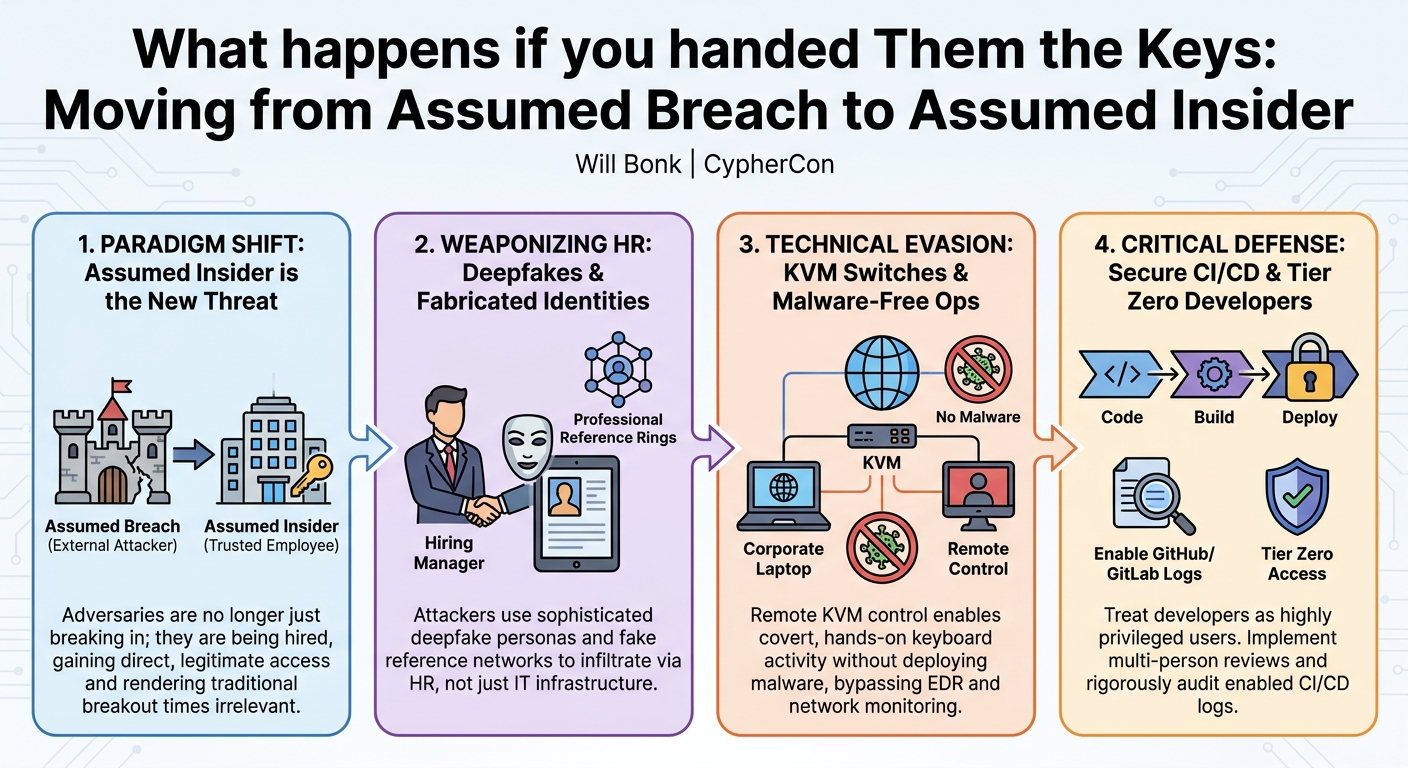
- The Rise of Deepfake Personas and Sophisticated Social Engineering: Adversaries are no longer relying on simple phishing. Instead, they are crafting elaborate deepfake personas, complete with fabricated digital histories (e.g., flawless GitHub profiles created by manipulating commit timestamps), to successfully navigate the hiring process. These personas are supported by professional reference rings—networks that provide seemingly legitimate endorsements for candidates they've never met—effectively "hacking human resources" rather than traditional IT infrastructure.
- KVM Switches as a Covert Remote Access Tool: A cornerstone of the assumed insider's technical evasion is the use of KVM (Keyboard Video Mouse) switches. While traditionally used in data centers for local control of multiple servers, adversaries are now employing these devices remotely. A laptop, shipped to a US-based "laptop farm" (often rows of company-issued devices associated with different stolen identities), is physically connected to a KVM. This allows an attacker, potentially located in countries like Russia or North Korea, to remotely control the target machine as if they were physically present, generating legitimate hands-on keyboard activity that is virtually indistinguishable from a genuine employee's work. This technique bypasses traditional remote access detection mechanisms and eliminates the need for malware.
- Malware-Free Operations and Legitimate Tools: The talk emphasizes that 82% of observed detections are malware-free. The assumed insider minimizes their footprint by using legitimate software like TeamViewer or AnyDesk for initial remote access to the KVM-controlled machine, or even more directly through the KVM itself. Their primary mode of operation is direct, interactive control, committing code, attending stand-ups, and performing all expected duties, making their activities appear entirely benign and legitimate.
- AI's Accelerating Role in Attacks: AI is not just for creating deepfakes. Bonk highlights its broader implications:
- AI Coding Agents: Sophisticated adversaries like Famous Chollima are using AI to generate code, ensuring the "employee" performs their duties competently enough to maintain their cover and continue collecting a salary.
- Polymorphic Attacks (Black Mamba): Referencing the "Black Mamba" paper and its real-world application by Fancy Bear within six months, Bonk illustrates how AI can be used to dynamically alter attack patterns. This involves benign Python code accessing Hugging Face APIs or other Large Language Models (LLMs) to polymorphically change attack vectors as they execute, making static signature-based detection ineffective.
- Echo Leak Vulnerability: Bonk describes Echo Leak, a vulnerability he and his team have observed in internal tests. This involves injecting LLM prompts into image tags within emails, even those sent to spam. When an organization's co-pilot or similar AI assistant processes these emails, it can inadvertently ingest the malicious prompts, potentially leading to data exfiltration by manipulating the LLM's output.
- CI/CD Pipelines as a Primary Target: Given that assumed insiders are often hired into development roles, the CI/CD pipeline becomes a critical attack surface. Developers typically possess extensive access, often akin to "domain admin" privileges, allowing them to directly influence production environments. Bonk points out a significant oversight: GitHub and GitLab logs, crucial for auditing code changes and deployments, are often disabled by default, creating a blind spot for organizations.
Technical Deep Dive
▶ Watch: Adversary tactics: Malware-free operations and KVM switches (9:00)
The shift to an assumed insider model fundamentally changes the technical landscape of cyberattacks, moving beyond traditional network exploitation to sophisticated identity and access manipulation. Bonk illustrates the new adversary infrastructure using a Mermaid.js diagram, outlining the workflow:
- Target Acquisition and Persona Creation: Adversaries identify high-value targets. Instead of direct infrastructure reconnaissance, they focus on creating compelling deepfake personas. These personas are designed to appear as highly qualified candidates for roles requiring significant access, such as senior DevOps engineers. Their digital footprint, including GitHub histories, is meticulously crafted, sometimes by manipulating commit timestamps to show continuous, flawless work, as Bonk notes. This social engineering targets Human Resources (HR) departments, essentially "hacking HR" rather than the network.
- Leveraging Professional Reference Rings: To circumvent background checks, adversaries utilize professional reference rings. These are organized services or networks that provide glowing, but entirely fraudulent, references for the deepfake personas. Bonk compares these to a "WeWork" model, where a central entity can vouch for individuals they've never met, providing a critical layer of legitimacy to the fabricated identity.
- The "Laptop Farm" and KVM Switches: Once a deepfake persona is successfully hired, the target company ships a corporate laptop to a US-based location. This location is often part of a larger "laptop farm," a physical setup (as depicted in justice.gov reports) where rows of company-issued laptops, each tied to a different stolen identity and deepfake persona, are managed. The crucial technical element here is the KVM (Keyboard Video Mouse) switch. Instead of traditional remote desktop protocols or VPNs, which can leave digital footprints, these laptops are connected to KVM switches. An attacker, potentially operating from a geographically distant location (e.g., Russia or North Korea), remotely controls the KVM. This allows them to interact with the target laptop as if they were physically sitting in front of it, providing direct, low-level control of the keyboard, mouse, and video output. This method generates entirely legitimate user activity, making it extremely difficult for EDR or network monitoring solutions to distinguish between a genuine employee and a remote attacker. The goal is to avoid dropping any "payload" that could be detected, as Bonk states, "the best payload is the one you never have to actually drop."
- Malware-Free Operations and Covert Exfiltration: The assumed insider's operations are characterized by being malware-free. They perform their "job" by committing code, participating in meetings, and utilizing legitimate applications. Data exfiltration, if desired, also occurs through legitimate channels or by leveraging their trusted access. The financial impact is not only stolen salaries but also potential intellectual property exfiltration by nation-state actors and the creation of W-2 tax fraud for the stolen identities used.
- AI-Driven Attack Evolution:
- Polymorphic Attacks (Black Mamba): Bonk references the "Black Mamba" PLC paper, which describes how AI can enable polymorphic attacks. This involves an initial access using benign Python code that interacts with Large Language Models (LLMs) or Hugging Face APIs. The LLM then dynamically generates or modifies subsequent attack stages based on the environment, allowing the attack to constantly change its signature and evade detection. Fancy Bear's rapid adoption of this concept highlights its immediate real-world threat.
- Echo Leak Vulnerability: Bonk provides a concrete example of an AI-driven vulnerability his team has observed: Echo Leak. This attack vector leverages the integration of AI co-pilots (e.g., Microsoft Copilot) into enterprise environments. An attacker sends emails containing specially crafted image tags that embed malicious LLM prompts. Even if these emails land in spam, if the co-pilot processes them (e.g., to summarize inbox content), it can inadvertently ingest these prompts. This can lead to the co-pilot executing unintended commands or exfiltrating data by being prompted to summarize or process sensitive information in a way that benefits the attacker. This represents a novel form of prompt injection leveraging a seemingly innocuous email component.
- CI/CD Pipeline as a Tier Zero Target: Developers, particularly those in DevOps roles, have extensive access to critical systems, including source code repositories, build servers, and deployment pipelines. Bonk emphasizes that this access often equates to "domain admin" level privileges within the development and production lifecycle. A critical technical oversight he highlights is that GitHub and GitLab logs, which track code changes, merges, and deployments, are often disabled by default. This creates a significant blind spot, making it challenging to audit an assumed insider's malicious code commits or unauthorized deployments. Treating developers as "Tier Zero" assets, similar to domain administrators, becomes paramount for securing the CI/CD pipeline.
Demo / Proof of Concept
▶ Watch: Recommendations for defending against assumed insider threats (19:00)
While the talk itself did not feature a live, interactive demonstration or a formal proof of concept in the traditional sense, Will Bonk did reference real-world examples and internal testing experiences. He explicitly stated that his talk was more about "what is happening in our industry" and a conceptual shift rather than a technical showcase. However, he did mention that the Echo Leak vulnerability, involving LLM prompt injection via email image tags, is "something that I've been doing We've been doing on internal tests here for a while," indicating that CrowdStrike's red team has successfully demonstrated this attack vector in controlled environments. The talk's focus was on articulating the threat landscape and strategic implications, drawing upon observations from active threat intelligence and offensive security engagements.
Defensive Implications
▶ Watch: Crucial: Treat developers as Tier Zero/Domain Admins (22:00)
The shift to an assumed insider mindset demands a fundamental re-evaluation of an organization's defensive posture, extending beyond traditional technical controls to encompass human resources and development operations. Bonk outlines several critical recommendations:
- Enhanced HR and Hiring Process Security:
- Deepfake Detection Training: Hiring managers and HR personnel must be trained to identify sophisticated deepfakes. Bonk referenced specific tells, such as the "three fingers in front of the face" anomaly that was recently seen in deepfake videos. This requires continuous education as deepfake technology evolves.
- Security Awareness for HR: Just as employees are trained against phishing, HR departments need specific awareness campaigns about the tactics used by assumed insiders, including the use of professional reference rings and the signs of fabricated digital identities.
- Robust CI/CD Pipeline Auditing and Security:
- Multi-Person Review: Implement a mandatory "more than one person review" policy for all code commits, especially those destined for production or sensitive development environments. This introduces a critical human control point.
- Granular Access Control: Audit what specific individuals or roles can "actually touch production and what can actually touch dev." Implement strict least privilege principles within the CI/CD pipeline.
- Enable and Review Logs: Crucially, Bonk highlights that GitHub and GitLab logs, which track changes and activity within code repositories, are often disabled by default. Organizations must enable these logs and establish processes for their regular review and analysis to detect anomalous activity from even legitimate accounts.
- Treat Developers as Tier Zero Assets:
- Bonk stresses that developers, particularly those in DevOps roles, possess an extensive range of access that often equates to "domain admin" privileges within their scope. Consequently, they should be treated as Tier Zero assets, subject to the highest level of security scrutiny and controls. This includes stricter access management, regular audits of their permissions, and potentially enhanced monitoring for their activities on critical systems.
- Prioritize Identity Protection:
- Identity Protection is no longer an optional security measure; it is a "must." This encompasses multi-factor authentication (MFA) everywhere, robust identity governance, continuous monitoring for anomalous login patterns, and proactive detection of compromised credentials or identities. Given that the assumed insider leverages stolen or fabricated identities, protecting and verifying genuine identities becomes paramount.
- Mindset Shift:
- The overarching implication is the necessity of a fundamental shift in thinking. While assumed breach was the correct answer a decade ago, organizations must now embrace assumed insider. This means designing defenses and operational security with the premise that an attacker already has legitimate access to critical systems and data, forcing a focus on internal detection, segmentation, and least privilege from within. The question changes from "how do I keep them out?" to "how do I defend if somebody does have access to my pipelines?"
Key Takeaways
- The "Assumed Insider" is the New Threat Paradigm: Organizations must shift their mindset from assuming external breaches to assuming that an attacker could already be inside, operating as a legitimate employee with legitimate access.
- Deepfakes and AI are Weaponizing HR: Adversaries are using sophisticated deepfake personas, fabricated digital histories, and professional reference rings to infiltrate organizations through the hiring process, requiring enhanced HR security awareness and deepfake detection training.
- KVM Switches Enable Covert, Malware-Free Operations: Remote KVM control allows attackers to operate corporate laptops from distant locations, emulating local user activity without deploying malware, making detection extremely challenging for traditional EDR and network monitoring.
- CI/CD Pipelines are Critical Attack Vectors: Developers often possess "Tier Zero" access within CI/CD environments. Organizations must implement rigorous code review, granular access controls, and crucially, enable and actively monitor GitHub/GitLab logs (which are often disabled by default).
- AI Accelerates and Polymorphs Attacks: Beyond deepfakes, AI is being used for coding agents and polymorphic attacks (e.g., Black Mamba), and novel vulnerabilities like Echo Leak demonstrate how LLM prompt injection can be achieved via seemingly innocuous email components for data exfiltration.
- Prioritize Identity Protection and Developer Security: Robust identity protection (MFA, governance, monitoring) is essential. Developers must be treated as highly privileged users with stringent security controls, reflecting their extensive access to critical infrastructure and intellectual property.
About the Speaker(s)
Will Bonk is a Red Team Consultant within CrowdStrike's services division, focusing on offensive security engagements for external clients. His work encompasses a broad spectrum of activities, from subtle adversary emulation to more overt internal assumed breach testing. Bonk brings a diverse background to his role, having started his career pulling cables, progressing through sysadmin and blue team roles, and gaining experience as a penetration tester before ultimately specializing in red teaming. Outside of his professional life and participation in CTFs like Hack The Box, Will enjoys hiking with his family and is passionate about coffee. His talk reflects his deep experience across both offensive and defensive security, offering a unique perspective on evolving threat landscapes.
Reviews
Dr. Zero (Offensive Security Researcher) — SOLID
Bonk outlines the DPRK IT worker playbook that is currently bypassing every EDR on the market by utilizing US-based laptop farms and IP KVMs. It's a highly relevant threat intel briefing that correctly identifies the death of 'breakout time' as a useful metric. The threat model is spot on, even if the mitigation advice mostly boils down to turning on GitLab logs and hoping HR spots a deepfake.
Heather Calloway (CISO) — MUST SEE
An essential briefing on how nation-state actors are bypassing technical perimeters by fraudulently hiring into remote engineering roles. It correctly identifies that our most critical vulnerability right now is the gap between HR background checks and IT access provisioning.