An Introduction to Software Defined Radios - Beyond Flipper Zero
Will McCardell
Overview
In his CypherCon talk, "Beyond Flipper Zero, an introduction to software defined radios," Will McCardell, a Lead Offensive Security Engineer on Praetorian's IoT team, demystifies the world of radio frequency (RF) communication for security professionals and hobbyists. The presentation serves as a crucial bridge for those familiar with the basic RF capabilities of devices like the Flipper Zero, guiding them towards the more expansive and powerful realm of Software Defined Radios (SDRs). McCardell’s work at Praetorian involves making IoT devices "misbehave," a mission that inherently relies on a deep understanding of their underlying communication protocols.
Key moments
- 0:00 Talk introduction and legal disclaimer
- 4:15 Radio basics: electromagnetic waves and key terms
- 8:00 SDR vs. hardware radios & recommended starter kits
- 11:00 PortaPack: next-level Flipper Zero applications
- 14:00 Essential SDR learning resources and software tools
- 22:00 Decoding real-world data: meters, planes, pagers
- 26:30 Universal Radio Hacker for signal analysis and replay
- 29:00 Q&A: LinkedIn spam on pagers, security jamming
An Introduction to Software Defined Radios - Beyond Flipper Zero
Speakers: Will McCardell, Lead Offensive Security Engineer, Praetorian
Conference: CypherCon
YouTube: https://www.youtube.com/watch?v=eugNlCzlIxs
Overview
In his CypherCon talk, "Beyond Flipper Zero, an introduction to software defined radios," Will McCardell, a Lead Offensive Security Engineer on Praetorian's IoT team, demystifies the world of radio frequency (RF) communication for security professionals and hobbyists. The presentation serves as a crucial bridge for those familiar with the basic RF capabilities of devices like the Flipper Zero, guiding them towards the more expansive and powerful realm of Software Defined Radios (SDRs). McCardell’s work at Praetorian involves making IoT devices "misbehave," a mission that inherently relies on a deep understanding of their underlying communication protocols.
This talk is particularly significant because it empowers attendees to move beyond superficial interactions with RF signals to truly understand, analyze, and even manipulate them. For security practitioners, this capability is invaluable for identifying vulnerabilities in wireless systems, from smart home devices to critical infrastructure components. By highlighting the versatility and analytical power of SDRs, McCardell not only expands the technical toolkit of his audience but also underscores the often-overlooked security implications of pervasive wireless communication.
Background
▶ Watch: Talk introduction and legal disclaimer (0:00)
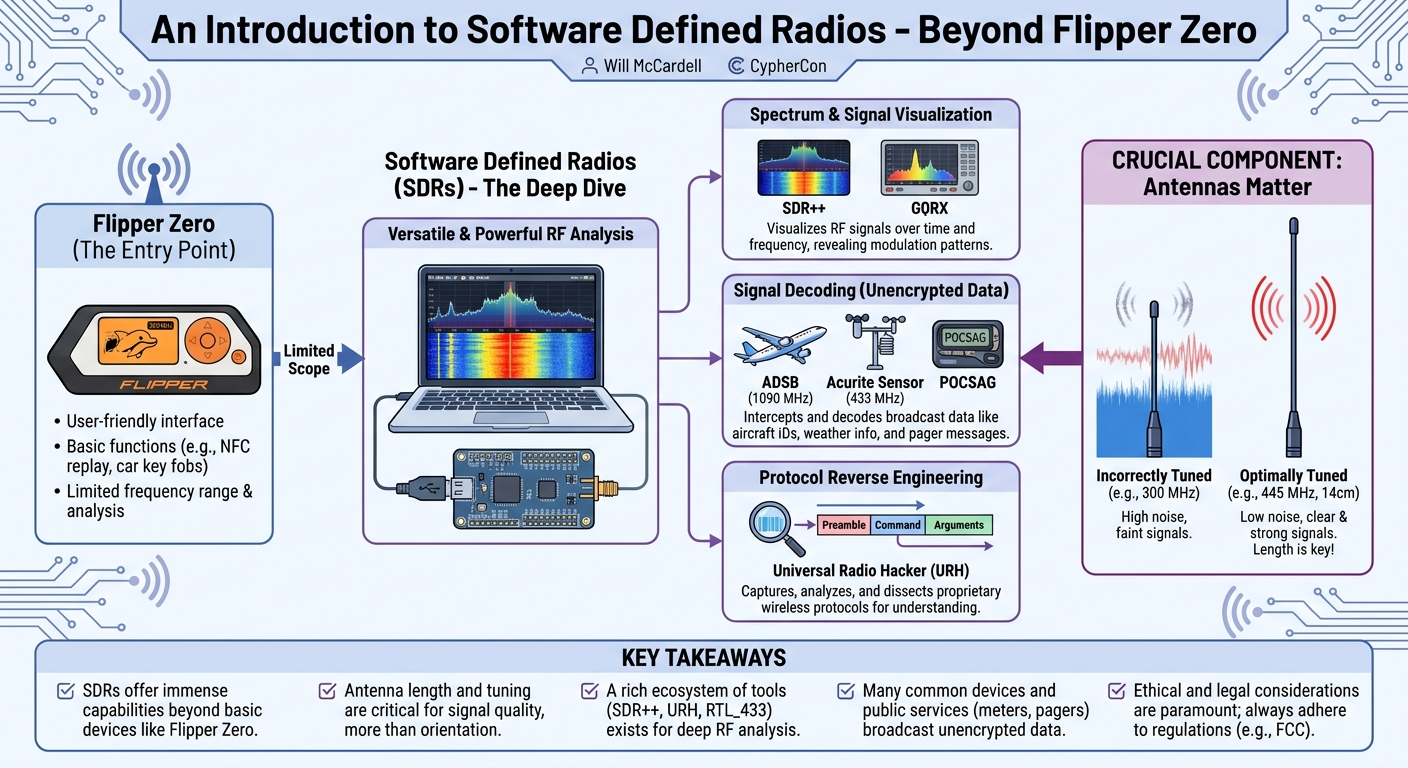
The journey into radio frequency hacking often begins with accessible tools, and for many, the Flipper Zero has served as an engaging entry point. McCardell acknowledges its utility as a "really great introduction to radios," noting its user-friendly interface and "cute dolphin" mascot. The Flipper Zero simplifies complex RF interactions, allowing users to perform basic functions like NFC replays or interacting with car key fobs within a limited frequency range. However, its small orange and black screen, limited buttons, and reliance on add-on boards for broader frequency interaction quickly reveal its constraints for serious RF analysis.
McCardell emphasizes that radios, at their core, are "the closest thing to magic that exists in the world," enabling actions at a distance through electromagnetic waves. Understanding these waves requires familiarity with several key concepts. Demodulation is the process of extracting raw information from the shape of a radio wave, akin to turning electrical pulses in a copper wire into digital signals. Decoding then transforms this raw information into something legible, like ASCII text. Bandwidth defines the range of frequencies an SDR can perceive simultaneously, while gain refers to the amplification of a signal, crucial for analyzing minute transmissions. The speaker highlights a fundamental truth in RF: "the signal is the data and the data is the signal," unlike wired connections where data is merely carried by a signal.
Antennas are paramount for both receiving and transmitting data. The Flipper Zero, for instance, uses a PCB antenna etched directly onto its circuit board. The efficiency of an antenna is intrinsically linked to its physical length and shape, which should correspond to the wavelength of the target frequency (e.g., quarter-wave or half-wave designs). While longer antennas are theoretically ideal, practical constraints often lead to shorter, extensible designs like whip antennas or dipoles.
The distinction between hardware-defined radios and Software Defined Radios (SDRs) is central to the talk. Hardware radios are highly specialized, tuned for specific frequencies, offering superior signal quality but limited flexibility. SDRs, conversely, are "great for messing around" due to their versatility across many frequencies, though they generally produce a noisier signal. This flexibility, combined with a rich ecosystem of software tools, makes SDRs indispensable for exploration and security research. McCardell also opens with a critical caveat: "Don't be an idiot." Transmitting radio signals often requires a license, and the FCC is adept at tracking unauthorized transmissions, making low-power listening the generally legal and safer starting point for hobbyists.
Key Findings
▶ Watch: SDR vs. hardware radios & recommended starter kits (8:00)
McCardell's presentation underscores that SDRs represent a significant leap beyond the capabilities of entry-level devices like the Flipper Zero, offering unparalleled versatility for exploring the wireless spectrum. While SDRs might not match the pristine signal quality of dedicated hardware radios, their flexibility and the extensive software ecosystem available make them ideal for "messing around" and conducting in-depth security research.
A primary finding is the accessibility of various SDR platforms for different budgets and skill levels. The RTL-SDR is highly recommended as a starting point, costing around $50 for a full kit and excelling at sub-gigahertz communications—a range similar to the Flipper Zero but with far greater analytical depth. For those seeking more advanced capabilities, the HackRF (a hobbyist staple, though 14 years old with a new version anticipated) offers both transmit and receive functionality. The BladeRF steps up further, uniquely capable of simultaneous transmit and receive operations, making it suitable for more complex RF interactions. McCardell also introduces the PortaPack, a custom module for the HackRF that transforms it into a portable, Flipper-like device with a dedicated UI and pre-built applications, albeit with increased noise.
The talk reveals a wide array of practical applications for SDRs, moving beyond simple signal replay to genuine data interception and analysis:
- Airplane Tracking: SDRs can intercept ADSB and Mode S signals at 1090 MHz, revealing aircraft identifiers, altitude, speed, and destination, often visualized through tools like dump1090.
- Environmental Monitoring: Tools like RTL_433 can decode signals from common household devices, such as Acurite weather sensors and smart meters (gas, electric, water) operating on ISM bands like 433 MHz and 915.05 MHz, providing insights into energy consumption or local weather conditions.
- Paging Systems: The POCSAG decoder can intercept and display messages from legacy paging systems still used in hospitals and other facilities, often revealing internal alerts, personal information (PHI/PII), and even unexpected "LinkedIn spam."
- Protocol Reverse Engineering: Advanced tools like Universal Radio Hacker (URH) enable users to capture, analyze, and reverse-engineer proprietary wireless protocols, such as those used by a fireplace remote, identifying command structures and enabling potential replay attacks.
- "Less Legal" Transmissions: McCardell briefly touches on more audacious uses, including manipulating specific streetlights in France, embedding images in spectrograms (à la Aphex Twin), and even jamming signals (with a strong warning against illegal activities).
These findings collectively demonstrate that SDRs are not just passive receivers but active platforms for deep exploration, analysis, and interaction with the wireless world, making them indispensable tools for anyone interested in wireless security.
Technical Deep Dive
▶ Watch: Essential SDR learning resources and software tools (14:00)
The core of McCardell's talk lies in dissecting the technical underpinnings of Software Defined Radios and the diverse toolkit available for their exploitation. He starts with a practical guide to selecting an SDR, recommending the RTL-SDR as the most accessible entry point. This compact device, often available as a full kit for around $50, is ideal for sub-gigahertz (sub-GHz) communications, making it suitable for many consumer and IoT devices. For those needing more advanced capabilities, the HackRF, while an older design, remains popular among hobbyists, offering both transmit and receive functions. It typically comes with an ANT500 extendable antenna. The BladeRF is presented as a higher-end option, notable for its ability to transmit and receive simultaneously, a feature less common in more affordable SDRs. Bridging the gap between a raw SDR and a Flipper Zero-like experience, the PortaPack is highlighted as a custom module that adds a portable UI to the HackRF, pre-loaded with various demodulation and decoding applications, though its on-board electronics can introduce additional noise.
Antennas are critical components, and McCardell dedicates significant attention to their role. He explains that the efficiency of an antenna is directly related to its physical length matching the wavelength of the target frequency, often designed for quarter-wave or half-wave resonance. Practical examples include common whip antennas and dipole kits, which are often extendable to tune for specific frequencies. A compelling demonstration illustrates this point: monitoring a 462.2 MHz signal, an antenna tuned for 300 MHz showed significant noise and weaker signals (yellow haze). In contrast, a 14 cm antenna tuned for 445 MHz yielded a much cleaner, deeper blue background with stronger, clearer signals (red lines), even when slightly obstructed or horizontal, proving that correct antenna length dramatically improves signal quality over mere physical orientation.
The talk delves into the software ecosystem for SDRs, starting with waterfall viewers and spectrum analyzers like SDR++ and GQRX. These tools visually represent signal strength over time across a frequency band, using colors to denote power: red for strong signals, yellow for moderate, and blue for noise or absence of a signal. McCardell presents a real-world example of a medevac helicopter's transmission at 462.2 MHz, showcasing how distinct patterns in the waterfall graph (faint signals, strong consistent signals, slightly offset triplets) reveal the underlying modulation, which can then be demodulated and decoded by the intended receiver.
Specific decoding tools are then introduced:
- RTL_433: Originally designed for the RTL-SDR, this tool excels at decoding signals from common devices operating on ISM bands (Industrial, Scientific, and Medical), particularly 433 MHz. Examples shown include Acurite weather sensors and smart meters (gas, electric, water) transmitting on 915.05 MHz. The output provides clear, structured data like device IDs, temperatures, and energy consumption.
- Dump1090 & ADSB: For aviation enthusiasts and security researchers, dump1090 monitors the 1090 MHz frequency for aircraft transmissions. It decodes both older Mode S (ground-station initiated) and newer ADSB (automatic broadcast) signals, providing detailed information such as aircraft identifiers, company (e.g., Menard's), altitude, and flight paths.
- POCSAG: This tool decodes messages from paging systems, which surprisingly remain in use, especially in hospitals. McCardell demonstrates how POCSAG can reveal sensitive internal alerts (e.g., "building management system alert, check internal IP address") and even unexpected content like "LinkedIn spam" sent via email-to-pager gateways. The talk includes a command-line example for decoding local pager traffic, noting that signals from Hartford, Wisconsin (an hour away) were successfully intercepted.
For deeper analysis and reverse engineering, McCardell highlights Universal Radio Hacker (URH). URH allows users to capture signals, analyze their structure, decode them, and potentially replay them (with legal authority). He illustrates its power with a fireplace remote example: URH can capture multiple transmissions, identify repetitive packets (e.g., the same command sent nine times for redundancy), and then attempt to parse the signal into components like preambles, commands, and arguments. This capability is crucial for understanding proprietary protocols and crafting custom signals.
Finally, McCardell touches upon more advanced tools: SDR Angel, described as a "powerful Swiss Army knife" with a "weirdest UI," and the GNU Radio Companion. The latter is an extremely flexible, drag-and-drop graphical interface that generates Python code for complex signal processing workflows. While powerful, its steep learning curve is evident in an example showing a surprisingly intricate workflow just to listen to a basic radio station.
For further learning, McCardell recommends the SIG ID wiki for identifying signal sounds, greatscottgadgets.com for in-depth math of radios, and radioreference.com for listing registered radio stations and transmitters by county, allowing legal listening to unencrypted public service traffic.
Demo / Proof of Concept
▶ Watch: Decoding real-world data: meters, planes, pagers (22:00)
Throughout the presentation, Will McCardell incorporated several compelling demonstrations and proof-of-concept examples to illustrate the practical applications of Software Defined Radios.
One key demonstration highlighted the critical role of antennas. Using SDR++ to monitor a 462.2 MHz frequency, he compared signal reception with three different antenna setups. An antenna tuned for 300 MHz showed a high noise floor and faint signals. Switching to a 14 cm antenna specifically designed for 445 MHz dramatically reduced noise and amplified signals, turning previously yellow indications into strong red lines. Even when this optimally tuned antenna fell off a window and had to transmit through a wall in a horizontal position, it still outperformed the incorrectly tuned antenna, underscoring that proper antenna length is far more crucial than its physical orientation.
The power of decoding tools was showcased with RTL_433. McCardell presented output demonstrating the interception and decoding of data from common household devices, including Acurite weather sensors around his home and facility, displaying real-time temperature readings. Crucially, he also showed how RTL_433 could decode signals from local smart meters (both gas and electric) operating at 915.05 MHz, revealing individual meter identifiers and their current energy usage, providing a direct example of publicly broadcast, unencrypted data.
For aviation tracking, the talk featured examples from SDR Angel and dump1090. SDR Angel was used to visualize a plane belonging to "Menard's company" flying around Dane County's airport, with all its identifying information openly transmitted. A separate interface for dump1090 demonstrated tracking a Southwest Airlines plane near Milwaukee, illustrating the wealth of information available about commercial flights.
The decoding of POCSAG (paging system) messages provided a striking example of potentially sensitive data being broadcast. McCardell displayed decoded pager traffic, including an alert from a facility's building management system instructing recipients to check an internal IP address—a clear security concern. Perhaps more surprisingly, the decoded messages also included "LinkedIn spam," demonstrating how even modern communication can sometimes route through legacy, unencrypted systems. Signals from Hartford, Wisconsin, an hour away, were successfully captured, highlighting the range of these transmissions.
Finally, McCardell introduced Universal Radio Hacker (URH) as a tool for deeper protocol analysis. He walked through a hypothetical workflow for reverse-engineering a fireplace remote. The URH interface showed captured signals from the remote, demonstrating how URH can identify repetitive transmissions (e.g., a command sent nine times for reliability) and begin to parse the signal into distinct components like the preamble, command structure, and arguments. While the deep dive into URH was truncated due to time constraints, the demonstration clearly conveyed its capability to capture, analyze, and dissect proprietary wireless protocols, paving the way for potential replay attacks or custom signal generation.
Defensive Implications
▶ Watch: Q&A: LinkedIn spam on pagers, security jamming (29:00)
The insights shared by Will McCardell have profound implications for defensive security strategies, particularly in a world increasingly reliant on wireless communication. The talk fundamentally highlights the transparency of the RF spectrum; much of what we assume to be private or secure communication is, in fact, openly broadcast and easily intercepted with readily available SDRs.
Firstly, defenders should recognize SDRs as essential tools for situational awareness within their own environments. By actively scanning relevant frequency bands, organizations can identify unauthorized devices, rogue transmissions, or unexpected data leakage. This includes mapping out all wireless devices in an enterprise or critical infrastructure setting, from building management systems to IoT sensors, to understand their communication patterns and potential vulnerabilities.
The pervasive existence of unencrypted transmissions for critical data is a significant concern. McCardell's examples of smart meters broadcasting energy usage, hospital pagers revealing internal alerts and even Protected Health Information (PHI), and facility management systems shouting internal IP addresses into the ether, underscore a widespread lack of basic security hygiene. Defenders must audit their wireless devices and protocols, prioritizing encryption for any data that could be sensitive or exploited. This extends to public service communications like police and medevac transmissions, which, if unencrypted, can be legally monitored and potentially reveal operational details.
Furthermore, the ability of SDRs to facilitate protocol reverse engineering (e.g., using URH for a fireplace remote) means that proprietary wireless protocols can no longer be considered "security by obscurity." Attackers can analyze these protocols to understand command structures, identify authentication weaknesses, or discover replay vulnerabilities. Defenders should assume that any custom wireless protocol is susceptible to reverse engineering and implement robust cryptographic measures rather than relying on proprietary obscurity. This is particularly relevant for home security systems and automotive key fobs, which have historically been targets for such attacks.
The talk also implicitly warns against the dangers of jamming attacks. While McCardell explicitly warns against illegal transmission, the fact that hobbyist-level SDRs can be used for jamming (even if "really bad" with a Flipper Zero) means that organizations relying solely on wireless signals for critical functions (e.g., alarms, remote controls) must consider the resilience of their systems against denial-of-service attacks. Implementing wired backups or frequency-hopping spread spectrum (FHSS) technologies can mitigate some of these risks.
In essence, SDRs provide defenders with the means to think like an attacker in the RF domain. Understanding how these tools work allows security teams to proactively identify and mitigate wireless vulnerabilities, moving beyond a superficial understanding to a deep, analytical approach to securing the electromagnetic spectrum.
Key Takeaways
- SDRs are powerful and versatile tools: Beyond the Flipper Zero, Software Defined Radios (SDRs) like the RTL-SDR, HackRF, and BladeRF offer extensive capabilities for exploring, analyzing, and interacting with the wireless spectrum.
- Antenna selection is paramount: The length and tuning of an antenna are critical for signal reception and quality, often outweighing physical orientation or proximity. Proper antenna choice significantly reduces noise and enhances signal clarity.
- A rich ecosystem of tools exists for RF analysis: Software like SDR++, GQRX, RTL_433, dump1090, POCSAG, and Universal Radio Hacker (URH) enables detailed capture, demodulation, decoding, and reverse engineering of various wireless protocols.
- Many common devices and public services transmit unencrypted data: Smart meters, weather sensors, hospital pagers, building management systems, and even some public safety communications often broadcast sensitive or exploitable information in cleartext, posing significant security and privacy risks.
- Universal Radio Hacker (URH) is a key tool for protocol analysis: URH empowers users to capture, analyze, and dissect proprietary wireless protocols, identifying command structures and enabling potential replay attacks or custom signal generation.
- Ethical and legal considerations are crucial: While SDRs offer immense analytical power, transmitting radio signals without proper licensing is illegal, and responsible use is paramount to avoid legal repercussions and potential interference.
About the Speaker(s)
Will McCardell is a Lead Offensive Security Engineer at Praetorian, specializing in the Internet of Things (IoT) domain. His work primarily involves exploring and exploiting vulnerabilities in various devices, often focusing on making them "misbehave." His expertise lies in understanding the intricate communication protocols and underlying technologies that govern IoT devices, allowing him to conduct in-depth security assessments and identify potential attack vectors.
Reviews
Dr. Zero (Offensive Security Researcher) — SOLID
This is a 101-level SDR tutorial built to graduate script kiddies from a $170 toy to actual radio analysis. It's a perfectly competent regional con talk covering RTL-SDRs, dump1090, and Universal Radio Hacker. There isn't a single drop of novel research here, but as a primer for the Flipper crowd, it does exactly what it needs to.
Heather Calloway (CISO) — SOLID
This is a capable introduction to software-defined radios for technical practitioners. For a CISO, the takeaway isn't the tooling—it's the reality that legacy facility tech and building management systems routinely broadcast internal IP addresses and sensitive telemetry in cleartext directly into our parking lots.