How To Deal Dr*gs (not actually, right?!)
Connor
Overview
Connor's CypherCon talk, provocatively titled "How To Deal Dr\gs (not actually, right?!)", delves into the intricate and often sophisticated operational security (OPSEC) practices employed by darknet drug vendors. Despite the sensational title, the speaker quickly clarifies that the presentation is purely educational, disclaiming any endorsement or encouragement of illegal activities. Originally conceived with a live demo component for purchasing items from the dark web, legal counsel necessitated a shift to a detailed, theoretical exploration of vendor methodologies, emphasizing the severe legal risks involved.
Key moments
- 0:00 Talk introduction and critical legal disclaimer
- 4:00 Essential hardware and software for a darknet vendor
- 11:30 Drug sourcing and darknet market pricing strategies
- 22:00 Critical stealth packaging and shipping methods
- 38:00 Why successful darknet vendors ultimately fail
- 42:30 Law enforcement's relentless methods and opsec challenges
- 50:50 Applying darknet opsec lessons to enterprise cybersecurity and Q&A
How To Deal Dr\*gs (not actually, right?!)
Speakers: Connor
Conference: CypherCon
YouTube: https://www.youtube.com/watch?v=V2aTOZ00fck
Overview
Connor's CypherCon talk, provocatively titled "How To Deal Dr\*gs (not actually, right?!)", delves into the intricate and often sophisticated operational security (OPSEC) practices employed by darknet drug vendors. Despite the sensational title, the speaker quickly clarifies that the presentation is purely educational, disclaiming any endorsement or encouragement of illegal activities. Originally conceived with a live demo component for purchasing items from the dark web, legal counsel necessitated a shift to a detailed, theoretical exploration of vendor methodologies, emphasizing the severe legal risks involved.
The core of the talk transcends mere technical descriptions, offering a deep dive into the mindset, tools, and strategies that illicit operators use to maintain anonymity and evade law enforcement. Connor meticulously breaks down the technical stack, logistical challenges, and human factors that contribute to, or ultimately undermine, a darknet drug operation. The presentation serves as a compelling case study, drawing parallels between the rigorous OPSEC required for such enterprises and the cybersecurity principles applicable to legitimate organizations, highlighting critical lessons for defenders.
Background
▶ Watch: Talk introduction and critical legal disclaimer (0:00)
The phenomenon of darknet markets gained significant traction around 2011 with the launch of Silk Road by Ross Ulbricht, establishing a foundational blueprint for subsequent marketplaces. This model, characterized by access via Tor, payments in cryptocurrency, an escrow system to secure transactions, and a robust feedback and review system for vendor reputation, mirrored early e-commerce platforms like eBay or Amazon. Following Silk Road's eventual takedown and Ulbricht's arrest (though later pardoned), numerous markets such as AlphaBay, Agora, Evolution, and Dream Market emerged, all largely adhering to this established framework.
The problem these markets address is the demand for anonymous, illicit trade, circumventing traditional law enforcement surveillance and financial tracking. Vendors seek to operate with complete deniability, isolating their illegal activities from their personal identities. This necessitates an extreme level of operational security (OPSEC), encompassing everything from hardware procurement and software configuration to communication protocols and physical logistics. The talk explores why this problem persists and how darknet actors continuously evolve their methods in response to increasing law enforcement pressure, creating an ongoing cat-and-mouse game that offers unique insights into adversarial tradecraft.
Key Findings
▶ Watch: Drug sourcing and darknet market pricing strategies (11:30)
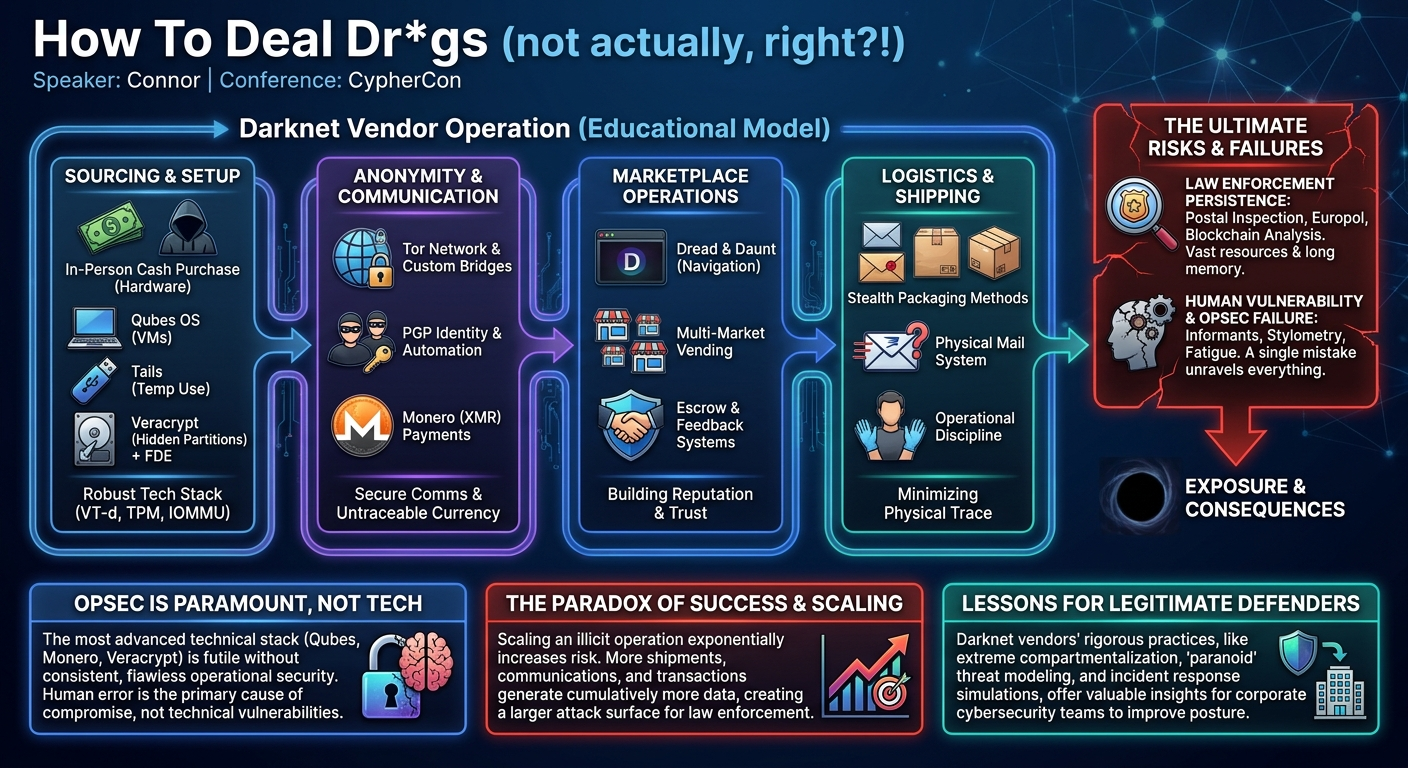
The central finding of Connor's talk is a stark paradox: while darknet vendors often employ highly advanced technical and operational security measures, their ultimate downfall frequently stems from seemingly minor OPSEC failures and the inherent human element. The speaker illustrates that despite sophisticated tech stacks, the relentless persistence and ever-evolving capabilities of law enforcement, coupled with the cumulative data generated by successful operations, inevitably lead to exposure.
Key discoveries and observations include:
- OPSEC Trumps Technology: The talk repeatedly emphasizes that the technical stack (e.g., Qubes OS, Veracrypt, Monero) is effective at maintaining anonymity on paper, but it's the consistent, flawless application of OPSEC that determines survival. Single mistakes, often seemingly trivial, are enough for law enforcement to unravel an entire operation.
- The Paradox of Success: Scaling an illicit business, while financially rewarding, directly correlates with increased risk. More shipments, communications, and transactions generate more data and patterns, providing law enforcement with a larger attack surface and more threads to pull. Those who last longest often aren't making significant money, while highly successful vendors inevitably get caught.
- Law Enforcement's Omnipresence and Persistence: Agencies like the Postal Inspection Service, Europol, and Interpol, alongside specialized blockchain analysis firms (e.g., Chainalysis, CipherTrace, Elliptic), possess vast resources, advanced intelligence-gathering techniques, and a long memory. They don't need to get lucky; they just need vendors to keep operating until a mistake is made.
- Human Vulnerabilities: Informants, stylometry (writing pattern analysis), and the inability to perfectly separate darknet and personal lives are consistently cited as primary vectors for compromise. The psychological toll and constant vigilance required are immense, making sustained, perfect OPSEC nearly impossible for individuals.
- Lessons for Defenders: Darknet markets, by necessity, often implement security practices (compartmentalization, rigorous vetting, incident response simulations) that rival or even surpass those of some legitimate corporations. This adversarial rigor offers valuable insights for blue teams and security professionals.
Technical Deep Dive
▶ Watch: Critical stealth packaging and shipping methods (22:00)
The technical foundation for a darknet vendor operation is built on layers of anonymity, encryption, and compartmentalization. Connor outlines a specific tech stack designed to maximize security and plausible deniability:
- Hardware Procurement:
- In-Person Cash Purchase: Laptops should be bought in person with cash, preferably from platforms like Craigslist or Facebook Marketplace, to avoid any digital trace linking the purchase to an individual.
- Specifications: A 64-bit system with VT-d (Virtualization Technology for Directed I/O), 16GB RAM, an SSD, and TPM (Trusted Platform Module) is recommended. VT-d is crucial for IOMMU (Input/Output Memory Management Unit) support, which enhances virtualization isolation.
- Tamper Resistance: Ordering online is discouraged due to the risk of tampering during transit, emphasizing the need for physical control over hardware. Webcams and microphones should be physically removed for extreme paranoia.
- Operating Systems & Encryption:
- Qubes OS: This free and open-source operating system is highly recommended. It uses virtualization to isolate all activities into separate virtual machines (VMs), or "cubes." This design significantly reduces the attack surface, as a compromise in one VM does not bleed into others, a critical advantage over single-point-of-failure systems like Tails. Qubes is preferred for running a "business" due to its robust isolation capabilities.
- Tails: While mentioned as a simpler option for one-off purchases, Tails (a live OS running off a USB, routing all traffic through Tor, and amnesic by design) is deemed less suitable for sustained vendor operations due to its single point of failure if compromised.
- Veracrypt: This free and open-source disk encryption software is essential. It creates virtual encrypted disks with a key feature: hidden partitions. This provides plausible deniability, as the existence of a hidden volume cannot be cryptographically proven when only the outer volume is mounted, appearing as random free space to law enforcement.
- Full Disk Encryption (FDE): Beyond Veracrypt, the entire SSD should be encrypted with strong passphrases.
- Anonymity Network & Browsing:
- Whonix: This operating system is specifically designed to run within Qubes OS and is split into two VMs:
- Gateway: A firewall that connects directly to the Tor network and routes all traffic, providing virtual separation from user applications.
- Workstation: Where user applications and interactions reside, including the Tor Browser.
- Tor Browser: While fundamental for accessing the dark web, Connor notes its limitations. Federal agencies are known to operate entry and exit nodes to spy on users. Therefore, using custom and unlisted Tor bridges is recommended for enhanced privacy.
- Darknet Navigation:
- Daunt: Described as a darknet "Google," it helps survey available markets and links.
- Dread: The "Reddit of the dark web," a prime starting point for vendor research and community interaction.
- Cryptocurrency:
- Monero (XMR): This privacy-focused cryptocurrency is strongly recommended for all payments due to its inherent untraceability. It has become the standard for modern darknet markets.
- Bitcoin (BTC) / Litecoin (LTC): While often used as an initial purchase currency, direct use is discouraged due to increasing KYC (Know Your Customer) regulations. The process involves buying BTC/LTC, converting it to XMR, sending it to a personal XMR wallet, and then to the market to break the chain of custody and maintain plausible deniability.
- Communication & Identity:
- PGP Identity: Vendors must create a Pretty Good Privacy (PGP) identity for encrypted communication with market staff and buyers. The Darknet Market Buyers Bible is cited as a key guide for setting this up.
- Automated PGP Communication: Automating certain PGP messages can streamline operations and reduce human error.
- Unique Identities: A memorable but secure vendor name that cannot be traced back to personal identity is crucial. Separate login usernames from display names on markets.
- Market Selection & Operation:
- Market Superlist: Dread hosts a "super list of markets" to help vendors choose stable, high-volume platforms.
- Multi-Market Vending: To mitigate the risk of exit scams (where market admins shut down and abscond with funds, like Evolution Market in 2015, which stole $12 million in Bitcoin), vendors are advised to operate on multiple markets.
- Escrow Systems: The talk reiterates the importance of the market's escrow system, which holds funds until buyers confirm receipt, ensuring trust in anonymous transactions.
This comprehensive technical framework highlights the significant effort darknet vendors invest in maintaining their anonymity, mirroring and sometimes exceeding the security rigor seen in legitimate enterprises.
Demo / Proof of Concept
▶ Watch: Law enforcement's relentless methods and opsec challenges (42:30)
The speaker explicitly states that the original plan for a live demonstration of purchasing items from the dark web was cancelled due to legal advice. As Connor puts it, attempting such an act "without some good legal authority behind you" could lead to "10 years in a federal prison."
Instead, the talk itself serves as a detailed conceptual walkthrough, illustrating the technical and operational steps a darknet vendor would undertake. While no actual demonstration occurred, the comprehensive narrative, including specific tool names, processes, and risk mitigation strategies, effectively functions as a theoretical proof of concept for the described illicit business model. The presentation's rich detail provides a mental "demo" of the entire process, from setting up the tech stack to packaging and shipping, as if one were following a step-by-step guide.
Defensive Implications
▶ Watch: Applying darknet opsec lessons to enterprise cybersecurity and Q&A (50:50)
Connor's talk, while focused on offensive tradecraft, yields profound defensive implications for cybersecurity professionals. The speaker explicitly draws parallels between the rigorous OPSEC of darknet vendors and best practices for legitimate organizations, often highlighting where corporations fall short.
- Extreme Compartmentalization:
- Never Mix Identities: The golden rule for vendors—never mix darknet activities with personal identities—is a critical lesson for corporate users. Organizations must enforce strict separation of work and personal accounts, devices, and networks to prevent cross-contamination and identity attribution.
- Least Privilege & Access Controls: Vendors limit who knows what to prevent arrests. Similarly, organizations need stringent access controls and the principle of least privilege to ensure employees only have access to resources absolutely necessary for their role. Connor notes that many organizations fail here, granting excessive access.
- Dedicated Hardware: The concept of using dedicated, untampered hardware for specific sensitive tasks (e.g., a "darknet laptop") can be applied to highly sensitive corporate roles or environments, using air-gapped systems or dedicated, hardened workstations.
- Robust Encryption Everywhere:
- Full Disk & Layered Encryption: The use of Veracrypt with hidden volumes and PGP for all communications underscores the need for comprehensive encryption at rest and in transit. Organizations should ensure full disk encryption, encrypted communications (e.g., secure messaging, VPNs), and data-at-rest encryption for sensitive information.
- Strong Passphrases: The emphasis on strong, unique passphrases for Veracrypt and other systems directly translates to corporate password policies.
- Advanced OPSEC & Threat Modeling:
- "Paranoid" Mindset: Vendors operate with extreme paranoia. Security teams should adopt a similar adversarial mindset, constantly questioning assumptions and anticipating potential attack vectors.
- Regular Tabletop Exercises: Vendors conduct "scenario simulations and response playbooks" for issues like non-delivery, quality complaints, and law enforcement seizures. Connor points out that many organizations struggle to conduct even annual tabletop exercises. This highlights the need for frequent, realistic incident response training that simulates diverse threats, including insider threats and supply chain attacks.
- Risk Assessments: Vendors perform detailed risk assessments for sourcing, pricing, and shipping. Security teams must conduct continuous risk assessments, factoring in supply chain vulnerabilities, geopolitical risks, and emerging threats.
- Supply Chain Security: The vendor's concern about tampering during laptop transit or the integrity of imported goods directly relates to securing the corporate supply chain from hardware to software.
- User Behavior & Awareness:
- Password Hygiene: Vendors use password managers and unique credentials. The speaker highlights that corporate users often reuse passwords, making them vulnerable to credential stuffing. Organizations must educate users on password managers and enforce strong, unique password policies.
- Communication Discipline: Vendors are advised to change writing patterns, avoid sharing identifying details, and even use misinformation. While not advocating for misinformation in a corporate context, this emphasizes the importance of secure communication channels, awareness of stylometry for insider threat detection, and caution against oversharing on social media.
- Informant Awareness: The significant threat posed by informants in the darknet world underscores the critical importance of insider threat programs in corporations. Employees who know sensitive information can be coerced or motivated to compromise an organization.
- Understanding Adversarial Persistence:
- Law Enforcement as a Metaphor: The relentless, long-memory pursuit by law enforcement serves as a powerful metaphor for advanced persistent threats (APTs). Defenders must understand that adversaries are patient, well-resourced, and will exploit any single point of failure over time.
- Data Footprint: Every action, every communication, every transaction creates data. Organizations must minimize their digital footprint and understand that even encrypted data, once decrypted on a recipient's machine, becomes potential evidence.
By studying the meticulous, albeit illicit, OPSEC of darknet vendors, cybersecurity professionals can gain valuable perspectives on adversarial thinking, identify common human vulnerabilities, and reinforce the fundamental principles that protect legitimate enterprises from persistent and sophisticated threats. The talk serves as a potent reminder that even the most motivated individuals, equipped with advanced technology, can be undone by a single lapse in operational discipline.
Key Takeaways
- OPSEC is Paramount: The most sophisticated technical stack is futile without flawless, consistent operational security. Human error, not technical vulnerabilities, is the primary cause of compromise for darknet operators.
- Law Enforcement's Relentless Pursuit: Agencies possess immense resources, advanced intelligence, and a long memory. They do not need luck; they simply need a single mistake or pattern to build a case, making long-term evasion nearly impossible.
- The Paradox of Success: Scaling an illicit operation increases risk exponentially. More transactions, communications, and data create more opportunities for law enforcement to identify and track individuals.
- Compartmentalization is Key: Strict separation of darknet (or sensitive corporate) activities from personal life, identities, and devices is non-negotiable. Any mixing creates an attributable link.
- Lessons for Legitimate Cybersecurity: The rigorous OPSEC, threat modeling, and incident response simulations employed by darknet vendors offer valuable insights for corporate security teams, highlighting areas where traditional enterprises may fall short (e.g., password reuse, tabletop exercise frequency, access controls).
- The Barrier to Escape is Non-Existent: Despite meticulous planning and advanced technology, the speaker concludes that the ability to evade law enforcement indefinitely is "almost non-existent," emphasizing the ultimate futility and severe consequences of engaging in such activities.
About the Speaker(s)
The speaker, identified as Connor, delivered this talk at CypherCon. In his introductory remarks, Connor clearly states that the opinions expressed are entirely his own and that for the purposes of the talk, he considers himself "unemployed," indicating that his views are not endorsed or approved by any employer. He mentions having previously made a LinkedIn post detailing how to set up and purchase meth off the dark web, which led to the conference organizers noting the presence of FBI agents at CypherCon, setting the stage for the talk's provocative nature. Connor's presentation style is confident and analytical, reflecting a deep understanding of both the technical and operational aspects of darknet activities.
Reviews
Dr. Zero (Offensive Security Researcher) — WEAK
Connor hyped up a live darknet purchase, panicked after talking to legal, and pivoted to delivering a book report on the Darknet Market Buyer's Bible. Repackaging Dread forum tutorials from 2015 into a 'defensive lessons' corporate talk is exactly the kind of edgelord theater that wastes everyone's time. If your ultimate takeaway from a darknet OPSEC deep-dive is 'use a password manager,' you shouldn't be on a conference stage.
Heather Calloway (CISO) — SOLID
This presentation successfully uses darknet vendor operations as a masterclass in operational security and applied threat modeling. Instead of stopping at sensationalist crime tourism, the speaker extracts concrete lessons on compartmentalization, insider threat management, and the limits of technical controls when human OPSEC fails. It's a highly effective way to frame the necessity of continuous incident simulations and rigorous access controls for a security organization.