Protecting Main Street from Malware: A Cyber Briefing for busy leaders
Karen Arthur
Overview
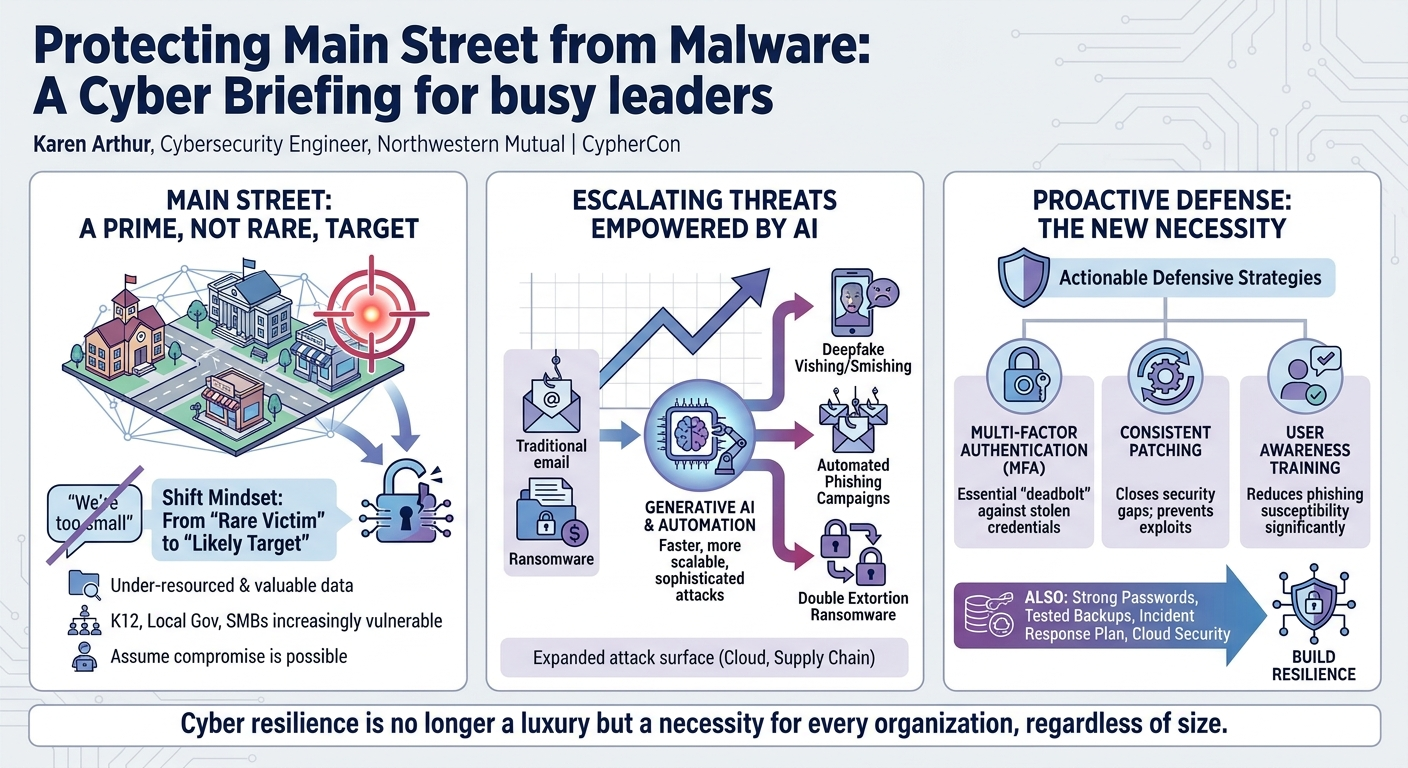
In "Protecting Main Street from Malware," Karen Arthur delivers a critical briefing on the escalating cyber threats faced by often-overlooked entities: K12 schools, local governments, and small-to-medium businesses. Arthur, a cybersecurity engineer at Northwestern Mutual and an incident response volunteer with the Wisconsin Cyber Response Team (CRT), highlights the alarming increase in cyber incidents targeting these "Main Street" organizations. The talk underscores that these entities, despite perceiving themselves as too small or insignificant to be targets, are increasingly vulnerable due to limited resources, understaffed IT departments, and the valuable data they possess.
Key moments
- 4:00 Humorous AI image generation fails for presentation graphics
- 9:00 Understanding common cyber attack types: phishing, ransomware, social engineering
- 17:30 Wisconsin CRT data: sharp increase in cyber incidents
- 22:00 K12 schools: surprising primary targets for cyber attacks
- 28:00 Critical preventative measures: patching, MFA, strong passwords, backups
- 36:30 Immediate actions during a cyber attack: don't panic, call for help
- 46:00 Q&A: Examples of current and seasonal phishing scams
Protecting Main Street from Malware: A Cyber Briefing for busy leaders
Speakers: Karen Arthur, Cybersecurity Engineer, Northwestern Mutual
Conference: CypherCon
YouTube: https://www.youtube.com/watch?v=4HyT0WkDkeQ
Overview
In "Protecting Main Street from Malware," Karen Arthur delivers a critical briefing on the escalating cyber threats faced by often-overlooked entities: K12 schools, local governments, and small-to-medium businesses. Arthur, a cybersecurity engineer at Northwestern Mutual and an incident response volunteer with the Wisconsin Cyber Response Team (CRT), highlights the alarming increase in cyber incidents targeting these "Main Street" organizations. The talk underscores that these entities, despite perceiving themselves as too small or insignificant to be targets, are increasingly vulnerable due to limited resources, understaffed IT departments, and the valuable data they possess.
The presentation, originally developed for non-technical city managers, is reframed for a technical audience, offering a foundational understanding of common attack types, threat actors, and, crucially, actionable defensive strategies. Arthur's goal is to equip both leaders and technical professionals with the knowledge to understand the threat landscape, implement effective preventative measures, and respond decisively when incidents occur. By sharing real-world data and insights from the Wisconsin CRT, the talk provides a stark reminder that cyber resilience is no longer a luxury but a necessity for every organization, regardless of size.
The core message resonates deeply: the assumption of being a "rare victim" is a fallacy; organizations must now operate under the assumption that they are "likely targets." This shift in mindset, coupled with practical advice on patching, multi-factor authentication, robust backups, and incident response planning, forms the bedrock of Arthur's guidance for securing vital community services and sensitive data against a rapidly evolving threat landscape.
Background
▶ Watch: Humorous AI image generation fails for presentation graphics (4:00)
The premise of "Protecting Main Street from Malware" stems from a stark reality: cyberattacks are no longer solely focused on large corporations or nation-states. Increasingly, adversaries are targeting smaller, often under-resourced public-facing entities such as K12 schools, local governments, healthcare providers, and communication companies. These organizations, collectively referred to as "Main Street," are perceived as softer targets with valuable data, making them attractive to a diverse range of threat actors.
Karen Arthur draws heavily on data and experiences from the Wisconsin Cyber Response Team (CRT), an organization composed largely of volunteers who provide rapid incident response and security assistance to state, local, tribal, and territorial entities. The CRT's observations reveal a sharp and concerning upward trend in cyber incidents. In 2024, the CRT supported 38 incidents, which surged to 65 in 2025, and continued to climb in early 2026. This dramatic increase is not unique to Wisconsin, reflecting global trends where Generative AI and automated tools are empowering adversaries, enabling faster and more scalable attacks. The attack surface is expanding rapidly, encompassing complex supply chains, pervasive cloud services, and sophisticated AI-enabled phishing campaigns.
A critical underlying factor contributing to the vulnerability of Main Street entities is a pervasive lack of funding and understaffed IT departments. Unlike their larger corporate counterparts, schools and municipalities often struggle to allocate sufficient budget and personnel to robust cybersecurity initiatives. This creates a "readiness gap," leaving them exposed to common vectors like phishing and outdated software. Furthermore, these organizations possess highly valuable and sensitive information—from student records and citizen data to intellectual property and critical infrastructure schematics—making them prime targets for data exfiltration and ransomware. The talk emphasizes that the traditional belief of "we're too small to be targeted" is a dangerous misconception that must be replaced with an proactive, "assume you're a target" mindset.
Key Findings
▶ Watch: Wisconsin CRT data: sharp increase in cyber incidents (17:30)
The talk presents several key findings, predominantly derived from the Wisconsin Cyber Response Team's (CRT) incident data and broader industry reports, highlighting the evolving threat landscape for "Main Street" organizations:
- Escalating Incident Volume: The CRT observed a significant increase in cyber incidents, rising from 38 in 2024 to 65 in 2025, with a continued upward trend into 2026. This indicates a general surge in attacks targeting public-facing entities.
- K12 Schools as Primary Targets: Surprisingly, K12 schools and other higher learning institutions are identified as the most frequently attacked sector. The U.S. Department of Education reports an average of five cyber incidents per week for school districts nationwide. Furthermore, 82% of K12 schools in the U.S. experienced some form of cyber incident between July 2023 and December 2024, often due to phishing and outdated software.
- Local Governments Under Siege: Local governments and municipalities experienced a 60% increase in incident response volume for the Wisconsin CRT from 2023 to September 2025. A 2024 Sophos report indicated that 51% of local governments nationwide suffered a ransomware attack in 2024.
- AI Empowers Adversaries: The advent of Generative AI and automated tools is making attacks faster, more scalable, and accessible to a wider range of threat actors. This includes advanced vishing (voice phishing) with AI bots and more convincing AI-enabled phishing campaigns.
- Expanding Attack Surface: The threat landscape is growing due to complex supply chains, widespread adoption of cloud services, and the proliferation of IoT devices. Third-party vendors are identified as a major weak point, particularly for schools that rely heavily on external services.
- The Fallacy of Smallness: A critical finding is the debunking of the belief that small organizations are safe. Attackers are actively seeking out under-resourced entities, exemplified by a tiny northern Wisconsin city that almost lost over $2 million in a wastewater treatment plant scam.
- Persistent Threat Vectors: Phishing remains the most common attack type, followed closely by ransomware, social engineering, and Denial of Service (DoS/DDoS) attacks.
- Cloud as a Major Target: Cloud intrusions saw a staggering 136% increase in the first half of 2025 compared to all of 2024, indicating attackers are heavily targeting organizations migrating to cloud environments.
- Malicious Insiders are Extremely Dangerous: Individuals with legitimate access who misuse or sell it pose a unique and potent threat due to their existing knowledge of internal systems and processes.
- Resiliency through Collaboration: CRT-affiliated entities demonstrate a higher level of overall resiliency, underscoring the importance of shared experience, information exchange, and building local capacity through collaborative efforts.
Technical Deep Dive
▶ Watch: K12 schools: surprising primary targets for cyber attacks (22:00)
The talk provides a comprehensive overview of prevalent cyberattack types and threat actors, offering technical insights into their methodologies and impact.
Attack Types:
- Phishing (and its variants): The most common attack vector, targeting individuals via email, text (smishing), or phone calls (vishing). The objective is to trick victims into clicking malicious links or divulging sensitive information. Arthur notes the increasing sophistication, including AI bots performing vishing attacks. Spear phishing is a highly targeted variant, using specific information to craft personalized and convincing pretexts.
- Ransomware: A type of malware that encrypts a victim's files, systems, or networks, demanding a payment (often in cryptocurrency) for a decryption key. A more dangerous evolution is double extortion, where threat actors first exfiltrate sensitive data and then encrypt it. They demand one ransom for decryption and a second ransom to prevent public disclosure or sale of the stolen data.
- Social Engineering: This tactic relies purely on human manipulation, requiring no technical skills. Attackers exploit tendencies to be helpful, building rapport through pretexting (creating believable scenarios) or baiting (offering something desirable). The effectiveness lies in getting targets to act outside their normal instincts.
- Denial of Service (DoS/DDoS): These attacks aim to overwhelm a server or network with excessive traffic, making it unavailable to legitimate users. A Distributed Denial of Service (DDoS) attack originates from multiple compromised sources, often orchestrated through botnets. The notorious Mirai botnet, whose source code was leaked in 2016, comprised up to 600,000 IoT devices (primarily cameras). Arthur highlights the danger of Ransomware-as-a-Service (RaaS) or Malware-as-a-Service (MaaS) models, where DDoS capabilities can be rented. A notable example cited is Cloudflare blocking a 5.6 terabit per second DDoS attack in January 2025.
Types of Attackers:
- Script Kiddies: Less experienced hackers who utilize open-source or purchased exploits. Their motivations are often curiosity rather than financial gain, and they typically leave poor tracks.
- Hacktivists: Motivated by ideology, politics, or social activism rather than financial profit. Their goals include revenge, disrupting organizations or countries, protesting events, or targeting rival groups.
- State-Sponsored Hackers (APTs - Advanced Persistent Threats): These are extremely dangerous, well-resourced groups often with virtually unlimited budgets, operating for strategic, political, military, or economic objectives. They may also target journalists or activists for intelligence gathering or to suppress dissent.
- Malicious Insiders: Individuals with legitimate access who intentionally misuse it or sell it for personal gain, revenge, or coercion. They are particularly dangerous due to their inherent knowledge of internal processes and security controls, enabling them to bypass existing defenses.
Defensive Measures (Technical Aspects):
The talk outlines several critical technical and procedural defenses:
- Patching Systems: Unpatched vulnerabilities are a primary entry point for attackers. A critical unpatched vulnerability in Microsoft SharePoint in July 2025 led to over 400 organizations globally being breached, including federal and state agencies. Consistent patching closes these security gaps.
- User Awareness Training: While not strictly technical, it's a crucial defense. Organizations like KnowBe4 have shown that consistent training can reduce phishing susceptibility from 33.1% to 4.1% in 12 months.
- Multi-Factor Authentication (MFA): Essential for preventing unauthorized access even if credentials are stolen. Arthur uses a "deadbolt on the door" analogy to explain defense in depth, where MFA acts as an additional, separate lock.
- Unique Password Policy: CISA now recommends 16-character passwords. The talk illustrates the exponential increase in cracking time: a 12-character password can take from three months to three billion years to crack, while a 16-character password extends this to 2,000 years to quadrillions of years, depending on complexity. Long, complex phrases are recommended for usability and security.
- Data Backup and Testing: Backups are only effective if they can be successfully restored. The concept of Recovery Point Objective (RPO) is introduced, with 24 hours being a common recommendation for K12 and municipalities, dictating how much data loss is acceptable.
- Incident Response (IR) Plan: Organizations need a well-defined and practiced plan for emergencies, akin to fire drills. This plan should be regularly reviewed to account for new architecture and needs.
- IT Resource Inventory: "You can't protect what you don't know about." A comprehensive inventory of all IT assets is fundamental for understanding potential attack surfaces and assessing the scope of a breach.
- Zero Trust Architecture: This is highlighted as the new standard, with Wisconsin's Strategic IT Plan listing it as an official objective. It operates on the principle of "never trust, always verify."
- Cloud Security: With cloud intrusions up 136% in H1 2025, understanding data residency, access controls, and having a robust Disaster Recovery (DR) plan for cloud resources is critical.
- Email Security Software: Investing in tools that evaluate for phishing and spoofing and can remove fraudulent emails is crucial. Implementing DKIM (DomainKeys Identified Mail) and DMARC (Domain-based Message Authentication, Reporting, and Conformance) adds further security against Business Email Compromise (BEC), a top threat vector.
Demo / Proof of Concept
▶ Watch: Immediate actions during a cyber attack: don't panic, call for help (36:30)
The talk "Protecting Main Street from Malware" did not feature a live technical demonstration or a proof of concept of an attack or defense mechanism. Instead, Karen Arthur opened her presentation with a humorous anecdote about her attempts to use ChatGPT for creating custom graphics for her title slide. This segment illustrated the current limitations and biases of Generative AI in understanding nuanced prompts, rather than serving as a technical demo of cybersecurity tools or exploits. The core of the talk focused on conveying information, statistics, and actionable advice rather than showcasing hands-on technical execution.
Defensive Implications
▶ Watch: Q&A: Examples of current and seasonal phishing scams (46:00)
The defensive implications for "Main Street" organizations are profound, demanding a multi-layered and proactive approach to cybersecurity. Karen Arthur's talk underscores that a shift in mindset from "rare victim" to "likely target" is the foundational step for any effective defense.
- Prioritize Basic Cyber Hygiene: The most critical implication is the absolute necessity of consistent and thorough patching systems. Unpatched vulnerabilities, as demonstrated by the Microsoft SharePoint incident impacting over 400 organizations, are easily exploited entry points. This must be a continuous, high-priority operational task.
- Empower Users Through Training: User awareness training is not merely a compliance checkbox but a vital defensive layer. With phishing susceptibility drastically reduced (from 33.1% to 4.1% in 12 months with training), investing in ongoing, engaging education for all employees transforms them from potential liabilities into the first line of defense. This includes training on recognizing smishing and vishing attempts.
- Implement Strong Access Controls: Multi-Factor Authentication (MFA) must be enabled wherever technically feasible. It provides a critical "deadbolt" against stolen credentials, which are often the initial vector for sophisticated attacks. Coupled with a unique password policy advocating for 16+ character complex phrases, MFA significantly raises the bar for attackers.
- Ensure Data Resiliency: Robust data backup and restore processes are non-negotiable. Organizations must not only back up their data but also regularly test these backups to ensure they are functional and meet defined Recovery Point Objectives (RPO), such as a 24-hour RPO for K12 schools and municipalities. This is crucial for rapid recovery from ransomware attacks.
- Develop and Practice Incident Response: A well-documented and regularly practiced incident response plan is essential. Just like fire drills, IT teams and leadership need to run through scenarios to ensure a coordinated and effective response during a crisis, preventing panic and preserving crucial forensic evidence. The Wisconsin CRT offers resources and assistance in developing these plans.
- Gain Visibility into IT Assets: Maintaining an accurate inventory of all IT resources is fundamental. "You can't protect what you don't know about." This visibility is critical for understanding the attack surface, identifying vulnerabilities, and assessing the scope of a breach.
- Adopt Modern Security Architectures: Organizations should explore and work towards implementing Zero Trust Architecture, recognized as the new standard by entities like the Wisconsin Division of Enterprise Technology. This architecture minimizes implicit trust and continuously verifies users and devices.
- Secure Cloud Environments: With the surge in cloud intrusions, organizations must understand where their data resides in the cloud, who has access, and how their Disaster Recovery (DR) plan extends to cloud resources. Proper configuration and monitoring of cloud environments are paramount.
- Strengthen Email Security: Investing in email security software that can detect and remove phishing and spoofing attempts is vital. Implementing standards like DKIM and DMARC helps combat Business Email Compromise (BEC), a common and financially damaging attack vector.
- Leverage External Expertise and Collaboration: Main Street entities, often under-resourced, should actively engage with organizations like the Wisconsin Cyber Response Team (CRT), the Internet Crimes and Complaint Center (IC3), and local fusion centers for incident response, information sharing, and guidance. This collaborative approach fosters greater resiliency.
- Implement Non-Technical Controls: Simple procedural controls, such as requiring two-person approval for significant changes or financial transactions, can act as effective deterrents against social engineering and Business Email Compromise (BEC) attempts.
During an active incident, defenders should not immediately turn off affected machines (to preserve memory artifacts) and should avoid tipping off attackers. Instead, the focus should be on documenting observations, contacting the IT department, cyber insurance, and relevant external support teams (like the CRT or IC3) immediately, and awaiting professional guidance before taking further action on compromised systems.
Key Takeaways
- Main Street is a Prime Target: K12 schools, local governments, and small entities are no longer safe from cyberattacks. They are increasingly targeted due to under-resourcing, valuable data, and perceived ease of compromise.
- Phishing Remains Dominant, Ransomware Escalates: Phishing in its various forms (smishing, vishing, spear phishing) is the most common initial access vector. Ransomware and double extortion attacks are escalating rapidly, particularly affecting local governments and healthcare.
- AI Empowers Adversaries: Generative AI and automated tools are making attacks faster, more sophisticated, and accessible to less experienced threat actors, significantly expanding the attack surface and making detection harder.
- Proactive Defense is Non-Negotiable: Essential defenses include consistent patching, robust Multi-Factor Authentication (MFA), strong unique password policies (CISA recommends 16+ characters), and comprehensive user awareness training to drastically reduce susceptibility.
- Resilience Requires Planning and Practice: Organizations must have tested data backups (meeting RPO objectives), well-defined and regularly practiced incident response plans, and secure cloud configurations with appropriate disaster recovery strategies.
- Collaboration and External Resources are Key: Under-resourced entities should leverage external support like the Wisconsin Cyber Response Team (CRT), IC3, and information-sharing networks to enhance their resiliency and access expert guidance during and after incidents.
About the Speaker(s)
Karen Arthur is a Cybersecurity Engineer at Northwestern Mutual, bringing a strong technical background to her role. Beyond her corporate responsibilities, she is a dedicated volunteer incident responder with the Wisconsin Cyber Response Team (CRT), actively assisting state, local, tribal, and territorial entities in navigating cyber crises. Arthur’s career path is notably diverse; she began in marketing, communications, and graphic design, transitioning later into IT, where she gained foundational experience as a desktop technician for a county sheriff's office. This varied background provides her with a unique perspective, allowing her to bridge the gap between technical complexities and the practical needs of non-technical leaders. She is also currently pursuing a master's degree, demonstrating her commitment to continuous learning in the rapidly evolving field of cybersecurity.
Reviews
Dr. Zero (Offensive Security Researcher) — WEAK
Karen Arthur brought a city council awareness briefing to a hacker con. The Wisconsin CRT incident data is mildly interesting, but telling a technical room at CypherCon to turn on MFA, watch out for phishing, and patch SharePoint is a waste of a speaking slot. This is a 101-level compliance checklist masquerading as a threat briefing.
Heather Calloway (CISO) — SOLID
This is a competent, sobering look at the reality facing target-rich, resource-poor environments like municipalities and K-12 schools. While the control recommendations are standard, the organizational context—operating without enterprise budgets or headcount—makes this a practical baseline for local government leaders. It’s not going to change how a Fortune 100 CISO operates, but it is exactly the briefing a city manager needs to hear.