The End of Click Rates: A New Era for Cybersecurity Awareness
Jake Wesenberg
Overview
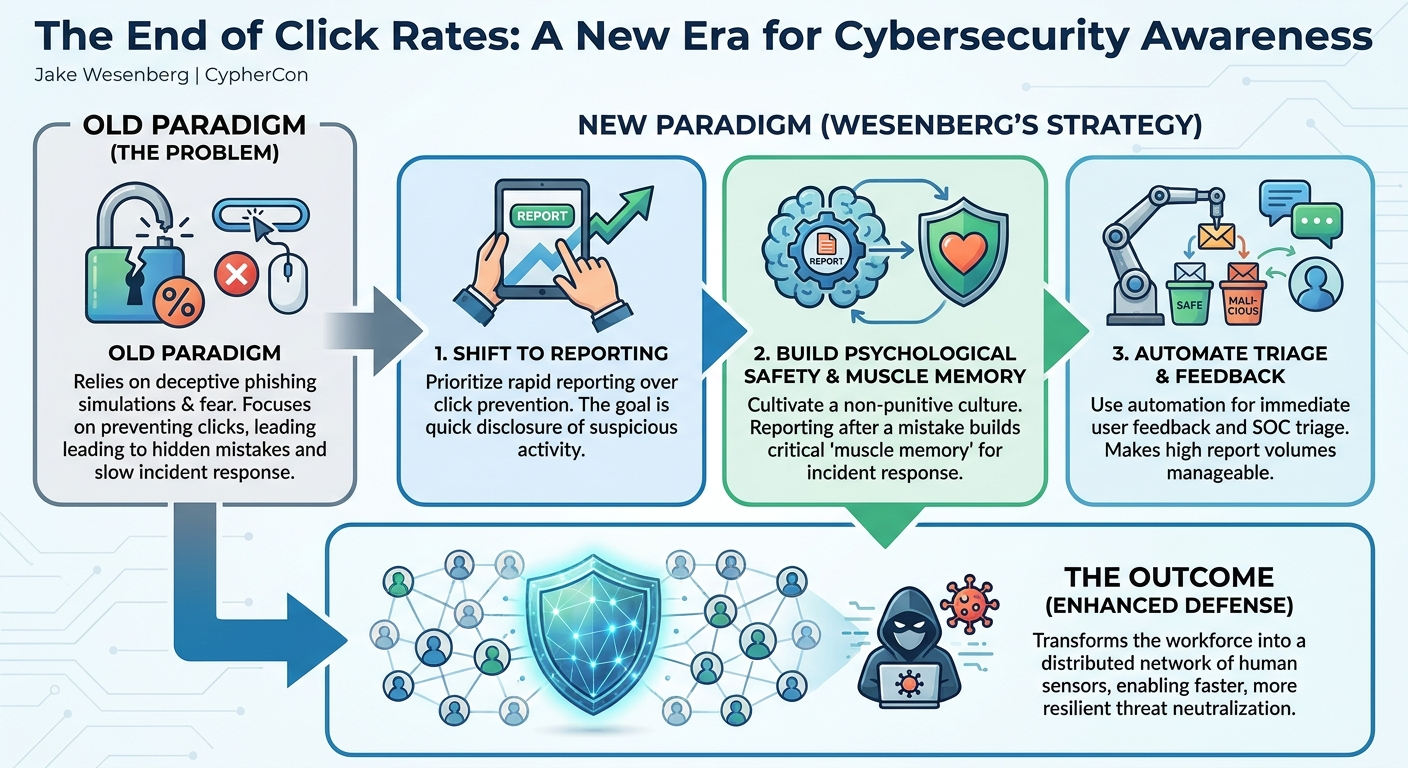
In a provocative and insightful talk at CypherCon, Jake Wesenberg declared "click rates are dead," heralding a new paradigm for cybersecurity awareness programs. Wesenberg, who has led a cybersecurity awareness program supporting over 150,000 individuals since 2020, challenges the conventional wisdom that measures security awareness success primarily through low click rates on simulated phishing emails. His core argument is that such metrics are fundamentally flawed, as they often rely on deception and foster a culture of fear, rather than empowering users to be effective allies in an organization's defense.
Key moments
- 2:00 Click rates are dead: new era for awareness
- 4:19 Reporting mistakes is the true measure of success
- 6:08 Real-world click rates are low with strong reporting
- 8:17 Intrinsic motivation and automation enable 'just report' policy
- 15:50 Users are allies, part of your security detection stack
- 18:40 Crucial metrics: post-click reporting and true positive simulations
- 26:20 Reinforcing gut instincts against AI-generated phishing
The End of Click Rates: A New Era for Cybersecurity Awareness
Speakers: Jake Wesenberg
Conference: CypherCon
YouTube: https://www.youtube.com/watch?v=kxYg0YlNp8I
Overview
In a provocative and insightful talk at CypherCon, Jake Wesenberg declared "click rates are dead," heralding a new paradigm for cybersecurity awareness programs. Wesenberg, who has led a cybersecurity awareness program supporting over 150,000 individuals since 2020, challenges the conventional wisdom that measures security awareness success primarily through low click rates on simulated phishing emails. His core argument is that such metrics are fundamentally flawed, as they often rely on deception and foster a culture of fear, rather than empowering users to be effective allies in an organization's defense.
Wesenberg's presentation advocates for a radical shift in focus: from preventing clicks to encouraging rapid and universal reporting of suspicious activities. This approach, he contends, not only builds essential "muscle memory" for incident response but also leverages the entire workforce as a distributed network of human sensors, dramatically enhancing an organization's overall security posture. The talk is framed as a potentially contentious viewpoint, with Wesenberg acknowledging, "you're either going to love this or hate it," and playfully suggesting, "if you love it, your boss is going to hate it," underscoring the significant departure from established practices it represents.
This article delves into Wesenberg's methodology, exploring the technical underpinnings, cultural shifts, and impressive results achieved by his program. It highlights how automation, intrinsic motivation, and a commitment to psychological safety can transform users from perceived liabilities into invaluable assets, ultimately leading to a more resilient and responsive security ecosystem.
Background
▶ Watch: Click rates are dead: new era for awareness (2:00)
The traditional approach to cybersecurity awareness, particularly concerning phishing, has long centered on phishing simulations. Organizations routinely send out mock phishing emails to their employees, meticulously tracking click rates—the percentage of users who interact with a malicious link or attachment. A low click rate is typically celebrated as a sign of a successful awareness program, often leading to punitive measures or remedial training for those who "fail" the simulation.
Wesenberg fundamentally challenges this paradigm, likening it to a deceptive trick. He uses the analogy of punishing children for eating cookies that were secretly mashed into their lunch, even after being told not to eat cookies before dinner. He argues that phishing simulations are inherently designed to deceive, creating an adversarial relationship between the security team and the users. This approach, he states, "simulates something that's meant to deceive you," making it difficult for users to understand that the security team is "helping" rather than "trying to trick you and make fun of you."
Furthermore, Wesenberg points out that many organizations already have multiple layers of defense, such as URL rewriting, proxies, endpoint defense, identity controls, MFA (Multi-Factor Authentication), and conditional access policies. If these controls are not in place, awareness is not the primary issue. The focus on click rates in simulations often overlooks the reality of modern defense-in-depth strategies. When a real malicious email makes it through, the critical action isn't just not clicking, but what happens after someone makes a mistake. The speaker emphasizes that the true risk emerges when a user clicks, downloads, or enters credentials, and then hides that mistake. This concealment allows dwell time for attackers, turning a minor incident into a potential catastrophe. The problem, therefore, is not the click itself, but the lack of immediate reporting and subsequent remediation.
Key Findings
▶ Watch: Real-world click rates are low with strong reporting (6:08)
Wesenberg’s talk presents several pivotal findings that underpin his "reporting is success" philosophy:
- Reporting as the Primary Metric: The core finding is that reporting — especially after a user has made a mistake like clicking a link or entering credentials — is the most critical indicator of a robust security awareness program. This shifts the focus from preventing initial missteps to building muscle memory for rapid incident response. His analogy of spilled milk on the carpet highlights this: immediate reporting allows for quick containment and remediation, preventing a much worse outcome days later.
- Dramatic Increase in Reporter Engagement: Through a deliberate shift away from punitive click-rate tracking and towards fostering psychological safety, Wesenberg's program saw a staggering increase in active reporters. The organization went from approximately 200 individuals who had ever reported an email to 50,000 people regularly reporting emails within four years. This demonstrates the power of intrinsic motivation and a non-punitive culture.
- Extremely Low Real-World Interaction Rates: By focusing on reporting and automated remediation, the organization achieved a real-world interaction rate with malicious mail that made it to mailboxes of less than 0.1%. This is significantly lower than typical simulation click rates, proving that robust reporting mechanisms actively mitigate risk by enabling rapid threat neutralization before widespread interaction.
- Automated Remediation and Reduced SOC Burden: A crucial element enabling the "just report" philosophy is extensive automation. The program built systems to provide immediate, automated feedback to users (e.g., "Thank you," "Malicious," "Spam," "Safe") and to automatically triage reported emails. This process reduced the percentage of reported messages requiring manual review by the SOC team to just 2% before full manual review became feasible, making the high volume of reports manageable.
- Users as Effective Detectors: The program successfully transformed users into an integral part of the security defense stack. Wesenberg cites a campaign where an attacker, having compromised a vendor account, sent legitimate-looking emails within existing threads to 500 people in batches of 50. Two users in the first batch reported the suspicious email within 10 seconds, preventing interaction from the remaining 48 in that batch and enabling the gateway to block the subsequent 450 emails. This real-world example vividly illustrates the power of a highly engaged, reporting-focused workforce.
- Minimal Impact from Email-Based Attacks: As a testament to the program's effectiveness, Wesenberg reports that in the previous year, out of more than a billion emails sent to the company, only one email resulted in someone having to fix something, and even that was a minor incident without major downtime. This statistic underscores the profound impact of a program that prioritizes user reporting and automated response.
Technical Deep Dive
▶ Watch: Intrinsic motivation and automation enable 'just report' policy (8:17)
Wesenberg's approach, while centered on human behavior, relies heavily on a sophisticated technical and process architecture to be scalable and effective for an organization of 150,000+ users. The "technical deep dive" here focuses on the systemic changes and automations implemented rather than specific code, as the speaker emphasizes tool agnosticism.
The foundational shift involves leveraging existing security infrastructure and building automations around the reporting mechanism. Initially, reported emails would simply go to a shared mailbox with no feedback to the user and a manual investigation process. This was unsustainable and demotivating. The technical transformation focused on:
- Automated User Feedback Loop:
- Working with engineers, the team built automations to send immediate, personalized responses to users upon reporting an email.
- These responses included a generic "Thank you" and more specific feedback based on automated analysis: "We think that might have been malicious," "We think that might have been just spam," or "It's probably safe. You can go back and interact with it."
- This immediate feedback loop was crucial for intrinsic motivation, making users feel their actions mattered and reinforcing the desired behavior. The goal was to build a steady, reinforcing dopamine response rather than the boom-and-bust cycle of extrinsic motivators like gift cards.
- SOC Integration and Automated Triage:
- To prevent overwhelming the SOC team with a massive influx of reported emails (especially with the "just report" mantra), significant automation was implemented for initial triage.
- The system was designed to automatically analyze reported emails, identifying common spam, known threats, or benign messages.
- The speaker mentioned that their system achieves a 10% true positive rate among reported emails. Crucially, they only began manually reviewing every reported email when automated systems could reduce the manual review burden to 2% of the total volume. This highlights the necessity of robust, automated filtering before human intervention, ensuring the SOC team's time is spent on genuine threats.
- This technical capability is what allows the security team to honestly tell users, "just report, nobody's going to mock you or be upset that you reported. You're not ruining anybody else's day. Automated systems are taking care of most of this for you."
- Real-World Click Rate Measurement:
- Leveraging URL rewriting and proxy logs, the team was able to accurately determine the organization's real-world click rate for malicious emails that bypassed initial filters.
- This metric, reported as less than 0.1%, provides a much more accurate picture of actual risk posture than simulation-based click rates. It demonstrates the effectiveness of layered defenses combined with user reporting.
- Post-Mistake Reporting Metrics:
- A key technical innovation was the ability to analyze raw data (specifically timestamps) to identify users who first clicked a malicious link in a simulation and then clicked the report button.
- While no vendor provides this "out of the box," the team used data analysis (initially in Excel, now potentially with AI tools) to compare click timestamps against report timestamps, accounting for the mean time to resolution of automated remediations.
- This metric is vital for proving that users are developing the desired muscle memory of reporting mistakes rather than hiding them.
- Adaptive Simulation Content:
- The program moved beyond generic phishing templates by using only emails that were reported as true positives in the real world for their simulations.
- This approach ensures that simulations are highly relevant and reflect actual threats that have bypassed initial gateway defenses. It also allows for comparison: "How many people interacted with that when it was a real attack?" versus "How many interacted with the simulation?" and "If it hadn't been reported, how long would that have dwelled in the environment?"
- Contextual, Just-in-Time Awareness:
- Beyond email reporting, the program integrated awareness with threat detection. A prime example is spam bombing, where a user is flooded with legitimate-looking but unsolicited emails (e.g., password resets, newsletter sign-ups) designed to obscure a single, truly malicious email.
- The system detects this flood and automatically sends a highly specific, contextual message to that user at the time of the attack. For instance, "Our service desk is not going to call you and ask to remote into your system without you opening a ticket. Watch for this for the next 2 days..."
- This method delivers "only the information that's needed, only to the people who need it, only at the time it's needed," making the awareness highly effective and minimizing productivity impact. It bypasses the need for generic training on caller IDs or specific questions, relying on the user's immediate context.
- Fuzzy Matching and AI in Defense:
- In response to the evolving threat landscape, including AI-generated attacks and more tailored spear phishing, Wesenberg notes the increasing reliance on vendor capabilities like fuzzy matching.
- These systems look for similarities rather than exact matches in email content, helping to detect variations of known threats or new, sophisticated campaigns generated by AI agents. This helps to counter the increased efficiency attackers gain from AI.
The overall technical strategy is to automate as much of the detection, feedback, and initial response as possible, freeing up human analysts for complex cases and empowering users to be the first line of defense through a streamlined, non-punitive reporting process.
Demo / Proof of Concept
▶ Watch: Crucial metrics: post-click reporting and true positive simulations (18:40)
While Jake Wesenberg's talk does not feature a traditional software demonstration or a live proof-of-concept of a specific tool, the entire presentation serves as a compelling proof of concept for his innovative cybersecurity awareness methodology. The "demo" is, in essence, the real-world success of his program at a large organization, evidenced by concrete metrics and impactful anecdotes.
The most powerful demonstration of this approach's efficacy is the transformation of user behavior and its direct impact on security posture:
- Scalability of Reporting: The growth from 200 initial reporters to 50,000 regular reporters over four years within an organization of over 150,000 people is a testament to the scalability and effectiveness of the "just report" philosophy, especially when backed by automated feedback. This demonstrates that a culture of reporting can be cultivated even in very large enterprises.
- Real-World Incident Response: The anecdote of the compromised vendor account illustrates the speed and effectiveness of human detectors. Two users reported a sophisticated, legitimate-looking phishing email within 10 seconds of receipt. This rapid action prevented 48 other immediate interactions and allowed automated systems to block the remaining 450 emails in the campaign. This isn't a theoretical exercise; it's a real-world incident where users, acting as "allies" and "detectors," directly mitigated a significant threat.
- Quantifiable Risk Reduction: The statistic that only one email out of more than a billion sent to the company last year required manual intervention for remediation, without causing major downtime, is the ultimate proof point. This demonstrates that a program centered on user reporting and automated response can drastically reduce the actual risk posed by email-borne threats, far beyond what traditional click-rate metrics might suggest.
In essence, the "proof of concept" is the lived experience and measurable success of Wesenberg's organization, showcasing that a psychologically safe, automation-driven, and reporting-focused awareness program can turn an entire workforce into a potent, distributed security sensor network.
Defensive Implications
▶ Watch: Reinforcing gut instincts against AI-generated phishing (26:20)
Wesenberg's talk offers profound implications for how organizations should structure their cybersecurity defenses and awareness programs. The core message is a call to action for defenders to re-evaluate their metrics, invest in automation, and fundamentally change their cultural approach to users.
- Shift from Click Rates to Report Rates: Defenders should de-emphasize phishing simulation click rates as the primary measure of awareness success. Instead, focus on reporting rates:
- Base report rate: How many users report any suspicious email.
- Post-mistake report rate: Critically, how many users report after they have already clicked a malicious link or entered credentials. This requires digging into raw data and correlating timestamps of clicks and reports. This metric indicates whether users are building the essential "muscle memory" of immediate disclosure.
- The "resiliency ratio" (click rate divided by report rate) can be an initial out-of-the-box metric, but the goal should be more granular, real-world reporting metrics.
- Invest Heavily in Automation and SOC Integration: To make a "just report" culture feasible, Security Operations Centers (SOCs) must be equipped with robust automations.
- Implement systems for automated triage and analysis of reported emails, providing immediate feedback to users and reducing the manual burden on analysts. The goal is to reduce manual review to a small percentage (e.g., 2% as achieved by Wesenberg's team) before full manual review of all reports becomes sustainable.
- This automation is critical for gaining SOC buy-in, as it ensures that increasing report volumes do not overwhelm them but rather enhance their efficiency by filtering out noise.
- Cultivate a Culture of Psychological Safety: The most crucial cultural shift is to eliminate the fear of punishment for making mistakes. Users must feel safe to report immediately, even if they've clicked or compromised credentials.
- Avoid public shaming, punitive remedial training, or sharing personally identifiable information (PII) about simulation failures outside the immediate awareness team.
- Frame all interactions as educational and supportive, emphasizing that security is a shared responsibility and users are "allies," not "liabilities."
- Leverage Users as "Human Sensors": Recognize that every employee, regardless of their role, can be an invaluable detector in the security stack.
- A large, engaged reporting base provides a distributed sensor network that can often detect sophisticated, targeted attacks faster than automated systems alone. The example of two users reporting a targeted vendor email in 10 seconds highlights this.
- Implement Contextual, Just-in-Time Awareness: Move away from generic, mandatory training that wastes productivity.
- Focus on delivering highly specific, relevant information to users only when and where it's needed. Examples include immediate alerts to users experiencing spam bombing or tailored messages based on observed threat patterns.
- Keep mandatory annual training as short as possible, focusing on simple, actionable instructions like "just report."
- Measure Real-World Risk, Not Just Simulation Performance: Utilize tools like URL rewriting logs to determine actual malicious email interaction rates that make it to user inboxes. This provides a more accurate assessment of the organization's true risk posture than simulation results. Simulation metrics should instead focus on the effectiveness of the awareness program itself (e.g., post-mistake reporting rates).
- Simplify Instructions: Instead of overwhelming users with a long list of red flags or "what not to do," empower them with a single, clear directive: "If something in your gut tells you this is off, just report it." This simplifies decision-making and reduces cognitive load, making security accessible to everyone regardless of their primary job function.
By adopting these defensive implications, organizations can build more resilient security postures, transforming their workforce from a perceived weak link into a powerful, active component of their cyber defenses.
Key Takeaways
- Shift from Click Rates to Reporting: De-emphasize phishing simulation click rates; instead, prioritize and measure the rate at which users report suspicious emails, especially after making a mistake.
- Foster Psychological Safety: Create an environment where users feel safe to report incidents immediately without fear of punishment or shaming, transforming them into "allies" rather than "liabilities."
- Automate for Scale: Implement robust automations for email analysis, user feedback, and SOC triage to manage high report volumes and provide immediate, reinforcing responses to reporters.
- Leverage Users as Detectors: Recognize the entire workforce as a distributed network of human sensors that can detect and report sophisticated threats more rapidly than technical controls alone.
- Deliver Contextual Awareness: Provide targeted, just-in-time security information to specific users based on real-world threats (e.g., spam bombing), minimizing productivity impact and maximizing relevance.
- Simplify the Message: Empower users with a clear, actionable directive: "If something feels off, just report it," rather than burdening them with complex lists of red flags.
About the Speaker(s)
Jake Wesenberg is a seasoned cybersecurity professional with a unique and diverse background. He has been leading a cybersecurity awareness program since 2020, currently supporting an extensive user base of over 150,000 individuals. Wesenberg describes his background as "eclectic," having previously worked as a tool and die apprentice, a production scheduler, and a bartender. This varied experience, spanning roles in small shops to large enterprises, likely contributes to his unconventional and user-centric approach to security awareness. He explicitly states his personal challenge against the "this is how we've always done it" mentality, a philosophy that clearly underpins his innovative arguments against traditional click-rate metrics in cybersecurity awareness.
Reviews
Dr. Zero (Offensive Security Researcher) — STRONG ACCEPT
I normally walk out of 'security awareness' talks, but Wesenberg actually built something useful. He threw out the useless vendor metric of phishing click rates and engineered an automated SOC pipeline that treats users like a distributed sensor network. Highly actionable for any defensive team.
Heather Calloway (CISO) — MUST SEE
Phishing click rates are a liability metric disguised as a security metric. Wesenberg correctly argues that our only goal should be driving down mean-time-to-report, especially after a user makes a mistake. This is a blueprint for the metrics you should be taking to your board.