IIoT: The “S” Still Stands for Security
Lance Lamont
Overview
In his compelling CypherCon presentation, "IIoT: The 'S' Still Stands for Security," Lance Lamont delivers a critical examination of the unique and often overlooked security challenges within Industrial Internet of Things (IIoT) environments. Far from a mere academic exercise, Lamont underscores the tangible, often catastrophic, consequences of inadequate security in industrial settings, drawing a stark contrast between consumer IoT and its industrial counterpart. His central thesis revolves around the "cost of a reboot," a metric that profoundly elevates the stakes in IIoT, transforming minor IT inconveniences into multi-million dollar, multi-week operational disasters.
Key moments
- 0:00 Introduction: IIoT, the S still stands for Security
- 6:00 Core difference: The extreme cost of an IIoT reboot
- 12:00 Acquisition risk: Badbox malware and pre-exploited devices
- 16:00 Configuration risk: Poland's Grid Wiper from default passwords
- 18:00 Operating risk: Infrastructure ransomware impacting Jaguar Land Rover
- 20:00 Monitoring risk: Spoofing data leading to invisible failures
- 22:00 Call to action: Defensive mindset for manufacturing cybersecurity
IIoT: The “S” Still Stands for Security
Speakers: Lance Lamont
Conference: CypherCon
YouTube: https://www.youtube.com/watch?v=4ZTd4SWXP6g
Overview
In his compelling CypherCon presentation, "IIoT: The 'S' Still Stands for Security," Lance Lamont delivers a critical examination of the unique and often overlooked security challenges within Industrial Internet of Things (IIoT) environments. Far from a mere academic exercise, Lamont underscores the tangible, often catastrophic, consequences of inadequate security in industrial settings, drawing a stark contrast between consumer IoT and its industrial counterpart. His central thesis revolves around the "cost of a reboot," a metric that profoundly elevates the stakes in IIoT, transforming minor IT inconveniences into multi-million dollar, multi-week operational disasters.
Lamont's talk is a vital call to action for security professionals, industrial operators, and decision-makers alike. He meticulously dissects the security landscape across the entire lifecycle of an IIoT "thing"—from acquisition and configuration to operation and monitoring—illustrating each stage with real-world incidents and vulnerabilities. By presenting a series of engaging, yet alarming, scenarios, he highlights how fundamental security lapses, such as pre-installed malware or default credentials, can lead to devastating outcomes like infrastructure-wide destruction, prolonged downtime, and significant economic losses.
The presentation emphasizes that despite technological advancements, the fundamental principles of security often remain neglected in IIoT, leading to an environment ripe for exploitation. Lamont’s analysis serves as a stark reminder that the "S" in IIoT truly stands for security, demanding a proactive, informed, and strategic approach to safeguard critical infrastructure and industrial operations from an increasingly sophisticated threat landscape.
Background
▶ Watch: Introduction: IIoT, the S still stands for Security (0:00)
The foundational premise of Lamont's talk is the critical distinction between consumer Internet of Things (IoT) and Industrial Internet of Things (IIoT). While both involve interconnected devices, the speaker argues that the line between them is often fuzzy, with devices like smart TVs or robot arms potentially fitting into either category depending on their context. A smart TV on an assembly line reporting widget counts, for instance, transitions from a consumer device to an industrial one. However, Lamont posits a clear differentiator: the cost of an unexpected reboot.
He illustrates this with a compelling analogy. A spontaneous Windows update causing a reboot on an office computer might lead to a few lost hours for an employee, or perhaps a missed sale for a business. While inconvenient, recovery is typically swift. In an industrial setting, however, the implications are vastly different. Lamont uses the example of a glass factory where molten glass continuously flows through pipes. An unexpected pump stoppage, even for an hour, could lead to the glass solidifying within the pipes. This isn't a problem solved by a simple restart; it necessitates dismantling the factory's infrastructure, replacing all affected pipes, and potentially weeks of downtime, costing millions of dollars. This extreme cost of downtime is precisely why industrial operators are often highly resistant to patching or updating systems, leading to environments where devices may run legacy software like Windows 3.1 or original, unpatched firmware for decades, simply "because it works." This creates a fertile ground for vulnerabilities, as systems designed without modern security considerations remain exposed.
Lamont structures his discussion around four key stages in the lifecycle of an IIoT device, or "thing": acquiring the thing, configuring the thing, operating the thing, and monitoring the thing. He asserts that recent security incidents have occurred in each of these areas, demonstrating that vulnerabilities are not confined to a single phase but rather permeate the entire operational chain, from initial procurement to ongoing oversight. This holistic perspective is crucial for understanding the multifaceted security challenges inherent to IIoT environments.
Key Findings
▶ Watch: Acquisition risk: Badbox malware and pre-exploited devices (12:00)
Lance Lamont's talk reveals several critical findings that underscore the pervasive and unique security challenges within the IIoT domain:
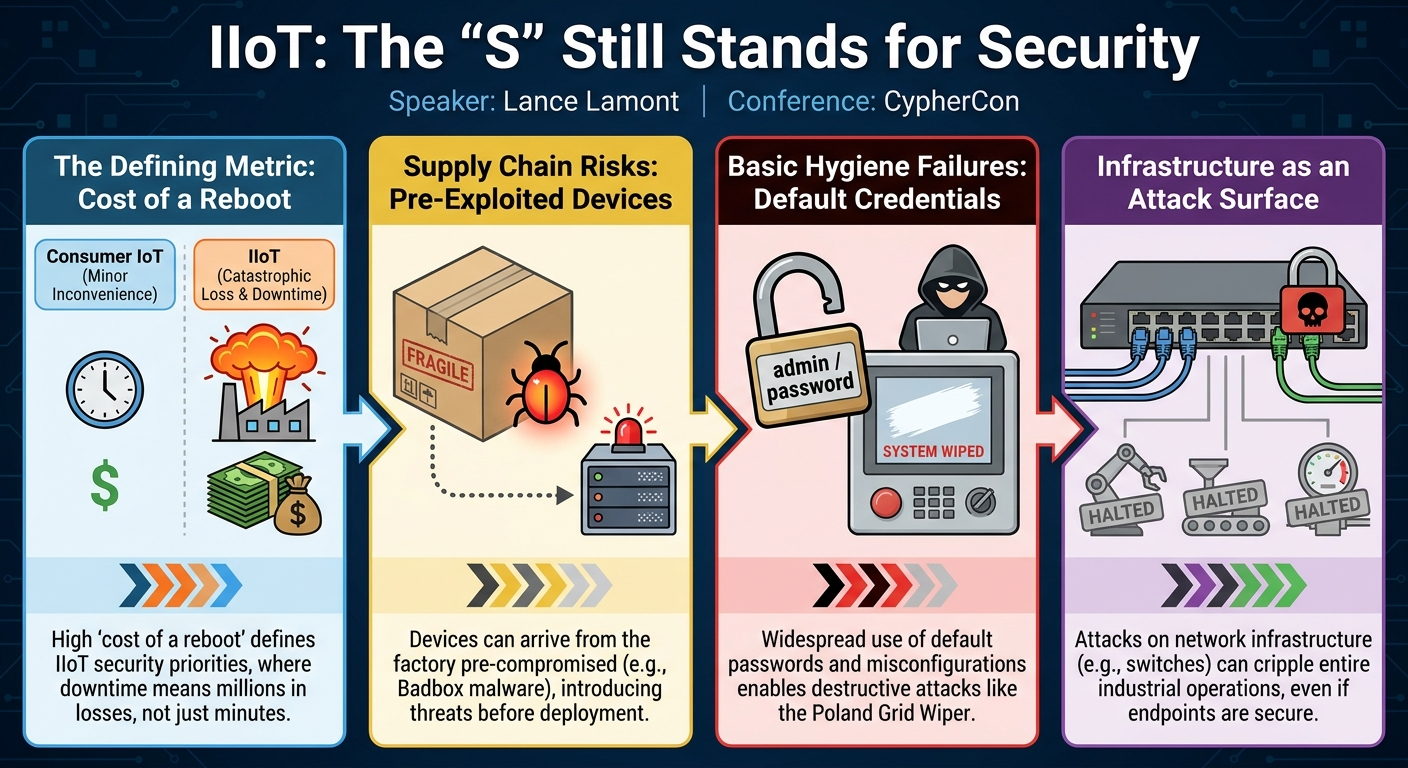
- The "Cost of a Reboot" as the Defining Metric: The most significant distinction between consumer IoT and IIoT is the financial and operational impact of downtime. In IIoT, a simple system interruption can escalate into multi-million dollar losses and weeks of halted production, fundamentally altering risk assessment and security investment priorities. This high cost directly contributes to the reluctance to patch or update, leaving legacy systems vulnerable.
- Pervasive Supply Chain Vulnerabilities: The initial acquisition of IIoT devices presents a significant risk. The phenomenon of Badbox malware demonstrates that devices can arrive from the factory pre-compromised or designed to install malware upon first connection to the internet. This introduces adversaries into the network before any defensive measures can be applied, highlighting a critical supply chain security gap.
- Widespread Misconfiguration and Default Credentials: A staggering number of IIoT deployments, particularly in critical infrastructure, suffer from basic security failures. EPA water sector audits revealed that out of 1,062 drinking water systems, approximately 100 had devices with critical or high-risk vulnerabilities, over 200 had externally visible open portals, and 40 required no credentials to modify settings. This widespread negligence is a primary vector for attacks like the Poland Grid Wiper incident, where default passwords facilitated destructive operations.
- Infrastructure as a Critical Attack Surface: Security for IIoT extends beyond individual devices to the underlying network infrastructure. Ransomware attacks targeting network switches and communication systems can bring down entire industrial operations, even if the IIoT endpoints themselves are "secure." The Jaguar Land Rover incident, causing weeks of shutdown and billions in economic impact, exemplifies how infrastructure-level compromise can cripple manufacturing.
- Invisible Failures and Data Spoofing: One of the most insidious threats is the ability of attackers to manipulate operational data, creating an illusion of normal operation while destruction or compromise occurs behind the scenes. This "man-in-the-middle" capability, exemplified by Stuxnet and the Poland Grid Wiper attack, means operators cannot solely rely on control panel readouts, necessitating independent verification and secondary data sources.
- Manufacturing as a Prime Target: The manufacturing sector is disproportionately affected by cyberattacks, accounting for almost 30% of reported incidents in 2025 (projections based on current trends). A significant portion of these attacks occur in North America, underscoring the immediate and growing threat to industrial economies.
These findings collectively paint a picture of an IIoT landscape fraught with both fundamental and sophisticated security challenges, demanding a comprehensive and context-aware defensive strategy.
Technical Deep Dive
▶ Watch: Configuration risk: Poland's Grid Wiper from default passwords (16:00)
Lamont dissects the security landscape of IIoT by examining vulnerabilities and attack vectors across the entire lifecycle of industrial devices, illustrating each with specific technical details and real-world incidents.
Acquiring the Thing: Supply Chain Compromise
The initial stage of device acquisition introduces significant supply chain risks. Lamont highlights Badbox, a pervasive threat involving smart devices, primarily Android-based, shipped from the factory either pre-exploited with malware or containing a script designed to install malware upon the device's first connection to the internet. This means an organization can purchase seemingly new hardware that is inherently compromised, becoming a silent participant in botnets for DDoS attacks, facilitating account takeovers, or generating illicit ad revenue for the attackers. The scale of this problem is substantial, with well over a million devices identified as infected. Technically, these devices bypass traditional endpoint security measures because the compromise occurs before the device is even deployed or managed by the end-user. Mitigation strategies involve strict procurement policies: exclusively using Play Protect certified devices, sourcing from official marketplaces, and rigorously avoiding off-brand devices often found by "sorting by cheapest" on platforms like Amazon or Alibaba, which are prime sources for such compromised hardware.
Configuring the Thing: Default Credentials and Misconfigurations
Even if a device is securely acquired, its configuration phase often introduces critical vulnerabilities. Lamont cites recent EPA water sector audits (2024) of 1,062 drinking water systems. These audits uncovered alarming statistics: nearly 100 systems had devices on the network with critical or high-risk vulnerabilities, over 200 had externally visible open portals, and, most egregiously, 40 systems had devices that did not even require credentials to modify settings. This exposes critical infrastructure to trivial compromise.
The Poland Grid Wiper incident serves as a stark example of the devastating consequences of poor configuration. This attack, primarily identified in December, impacted numerous systems across Poland's energy sector, including PLCs (Programmable Logic Controllers) and network switches. The post-mortem consistently highlighted the use of default passwords and default accounts as the primary entry vector. The attackers’ intent was purely destructive: they logged into devices, installed custom firmware (described as an array filled with 'FF's) designed to cause infinite reboots, and then performed factory resets on network infrastructure, effectively blinding and destroying devices. This "wiper" attack disabled and destroyed numerous devices, demonstrating how basic configuration flaws can enable sophisticated, destructive campaigns.
Operating the Thing: Infrastructure Ransomware and Network Attacks
The operational phase of IIoT devices is vulnerable to attacks that target not just the endpoints but the underlying network infrastructure. Lamont emphasizes that attackers don't necessarily need to exploit the IIoT device itself; compromising the network infrastructure can be equally effective. He refers to infrastructure ransomware, where the goal is to disable or encrypt critical network components like network switches, thereby preventing communication between industrial control systems.
The Jaguar Land Rover security incident in August provides a compelling case study. This incident resulted in a four-week shutdown of operations, directly costing Jaguar nearly £50 million per week and an estimated £1.9 billion impact on the British economy. This highlights that if an attacker can exploit or disable the network, they can effectively bring an entire company to a halt, regardless of the individual security posture of the IIoT devices connected to it. The interconnected nature of IIoT means that a single point of failure in the infrastructure can cascade into widespread operational paralysis.
Monitoring the Thing: Data Spoofing and Invisible Failures
Finally, the monitoring of IIoT devices presents a unique challenge: the risk of data spoofing and invisible failures. Lamont recounts how, during the same Poland Grid Wiper attack, the adversaries were not only destroying hardware but also actively spoofing data back to the main control interfaces. They injected false data that indicated "everything is operating acceptably" even as the PLCs and other backend hardware were being destroyed. This creates an extremely dangerous scenario where operators perceive a "green light" status on their dashboards while critical systems are failing or being compromised.
This concept is historically exemplified by Stuxnet, where centrifuges were destroying themselves while readouts falsely indicated normal operation. Technically, this is a man-in-the-middle attack, where attackers intercept and modify data packets flowing across the network. The speaker notes that proof-of-concept code exists (referenced from another CypherCon talk by Chris Hanson) that can modify network values in real-time, demonstrating the feasibility of such sophisticated data manipulation. The implication is that operators cannot solely trust the device's self-reported status; secondary data sources and out-of-band monitoring are essential to confirm successful operation and detect these invisible failures. Furthermore, any interaction with these devices always carries the potential for data exfiltration, where sensitive operational or proprietary data can be siphoned off the network through compromised connections.
Demo / Proof of Concept
▶ Watch: Monitoring risk: Spoofing data leading to invisible failures (20:00)
While Lance Lamont's presentation did not include a live demonstration or a new proof of concept developed by him, he critically referenced the existence of such capabilities. Specifically, he mentioned attending an earlier CypherCon presentation where individuals, including Chris Hanson, showcased proof-of-concept code capable of modifying values going across a network in real-time. This demonstration directly validates the technical feasibility of data spoofing and man-in-the-middle attacks within IIoT environments, which Lamont discussed as a core component of "invisible failures" seen in incidents like Stuxnet and the Poland Grid Wiper attack. The existence of such tools underscores that the manipulation of operational data is not merely theoretical but a practical and achievable attack vector for sophisticated adversaries.
Defensive Implications
▶ Watch: Call to action: Defensive mindset for manufacturing cybersecurity (22:00)
The insights from Lamont's talk provide a clear roadmap for strengthening IIoT security, demanding a shift from traditional IT security paradigms to a more context-aware and risk-prioritized approach.
- Secure Device Acquisition and Supply Chain Integrity:
- Strict Procurement Policies: Implement rigorous vendor vetting processes. Prioritize suppliers committed to security best practices and transparent supply chains.
- Certified Devices: Mandate the use of devices certified by reputable bodies (e.g., Play Protect certified for Android-based IIoT) and purchase exclusively from official, trusted marketplaces. Avoid "cheapest" options from unverified sources.
- Initial Device Inspection: Implement procedures to inspect newly acquired devices for signs of tampering or pre-installed malware before connecting them to the network.
- Robust Configuration Management:
- Mandatory Credential Changes: Enforce immediate changes of all default usernames and passwords upon device deployment. Use strong, unique credentials.
- Secure Baselines: Develop and enforce secure configuration baselines for all IIoT devices, disabling unnecessary services, ports, and protocols.
- Regular Audits: Conduct frequent security audits, similar to the EPA water sector audits, to identify misconfigurations, open portals, and devices operating without credentials.
- Network Segmentation: Implement strong network segmentation (e.g., using VLANs or firewalls) to isolate IIoT devices and control systems from enterprise networks and the internet. This limits the blast radius of a compromise.
- Strengthening Operational Resilience:
- Infrastructure Security: Recognize that network infrastructure (switches, routers, firewalls) is a critical attack surface. Implement robust security measures, including patching, secure configurations, and access controls for these components.
- Ransomware Prevention & Response: Develop comprehensive strategies for preventing ransomware attacks, including advanced endpoint detection and response (EDR), strong backups, and well-rehearsed incident response plans specifically tailored for Operational Technology (OT) environments.
- Patch Management for Legacy Systems: Acknowledge the challenge of patching legacy IIoT systems. Develop a risk-based patching strategy, utilizing compensating controls (e.g., micro-segmentation, intrusion detection systems) where direct patching is impossible or too risky.
- Enhanced Monitoring and Verification:
- Secondary Data Sources: Do not solely rely on device-reported status. Implement out-of-band monitoring and integrate secondary data sources (e.g., physical sensors, independent network traffic analysis, process historians) to verify operational integrity.
- Anomaly Detection: Deploy Intrusion Detection Systems (IDS) and Security Information and Event Management (SIEM) solutions specifically tuned for OT protocols and behaviors to detect unusual traffic patterns or deviations from normal operating parameters.
- Visibility into OT Networks: Gain deep visibility into IIoT network traffic and device communications to identify potential man-in-the-middle attacks or data spoofing attempts.
- Strategic Investment and Risk Management:
- Prioritize Investments: Allocate security resources based on the "cost of a reboot" and the potential impact of a compromise. High-cost, critical systems demand the highest level of protection.
- Continuous Education: Regularly train IT and OT staff on emerging IIoT threats, secure practices, and incident response protocols. Foster a culture of security awareness.
- Incident Response Planning: Develop and regularly test incident response plans specifically for IIoT/OT environments, considering the unique challenges of industrial operations, such as safety, environmental impact, and physical damage.
By adopting these defensive postures, organizations can significantly reduce their exposure to the severe and often destructive consequences of IIoT cyberattacks.
Key Takeaways
- The "Cost of a Reboot" is the Defining Factor for IIoT Security: Unlike consumer IoT, downtime in industrial settings can lead to catastrophic financial losses and operational disruption, necessitating a fundamentally different approach to security investment and risk tolerance.
- Supply Chain Security is Paramount: Devices can be compromised at the point of manufacture (e.g., Badbox malware), underscoring the need for rigorous vendor vetting, certified hardware, and avoiding unverified sources to prevent pre-exploited devices from entering the network.
- Fundamental Security Hygiene Remains a Major Weakness: Widespread use of default credentials and unpatched critical vulnerabilities, as highlighted by EPA water sector audits and the Poland Grid Wiper incident, provides easy access for adversaries to critical infrastructure.
- Network Infrastructure is a Critical Attack Surface: Attacks targeting network components, such as ransomware against switches, can cripple entire industrial operations even if endpoints are individually secure, as demonstrated by the Jaguar Land Rover incident.
- Don't Trust Device Readouts Alone: The threat of data spoofing and invisible failures (e.g., Stuxnet, Poland Grid Wiper) necessitates implementing secondary data sources and out-of-band monitoring to independently verify operational status and detect sophisticated man-in-the-middle attacks.
- Strategic Security Investment is Essential: Given the high stakes, organizations must strategically prioritize security investments based on the potential impact and "cost of a reboot" for specific assets, alongside continuous staff training and robust incident response planning tailored for OT environments.
About the Speaker(s)
Lance Lamont is a security professional who presented "IIoT: The 'S' Still Stands for Security" at CypherCon. While specific details about his title or company were not provided in the transcript or metadata, his presentation demonstrates a deep understanding of the unique challenges and critical importance of security within Industrial Internet of Things (IIoT) environments. His ability to articulate complex technical issues through compelling real-world stories and analogies, such as the glass factory example, suggests extensive experience in industrial control systems, cybersecurity, and risk management. Lamont's engaging presentation style, incorporating audience interaction and humor, highlights his passion for educating and informing the security community about these often-overlooked yet highly critical areas.
Reviews
Dr. Zero (Offensive Security Researcher) — WEAK
This is an OT Security 101 awareness session dressed up as a threat briefing. The speaker brings zero original research to the stage, opting instead to recycle public EPA reports, decade-old analogies, and a proof-of-concept borrowed from another presenter at the exact same conference. If you've been in industrial security for more than ten minutes, this is a complete waste of your time.
Heather Calloway (CISO) — SOLID
Lamont frames industrial security around a single, highly effective metric: the cost of a reboot. While the underlying vulnerabilities—default credentials and unpatched controllers—are old news, the translation of technical debt into downtime economics makes this a useful tool for bridging the IT and OT divide.