IAM? OMG! Avoiding Common Pitfalls in Identity and Access Management
Rebecca Jones
Overview
In her CypherCon talk, "IAM? OMG! Avoiding Common Pitfalls in Identity and Access Management," Rebecca Jones, an experienced IAM analyst in critical infrastructure, unpacks the complexities and common missteps in establishing and maintaining robust Identity and Access Management (IAM) programs. This presentation serves as a critical guide for organizations of all sizes, from small businesses to large enterprises, aiming to strengthen their security posture, streamline operations, and enhance user experience. Jones, drawing from over two decades in the tech industry, highlights that while IAM is foundational to modern cybersecurity, it is often misunderstood, poorly implemented, or neglected, leading to significant vulnerabilities and operational inefficiencies.
Key moments
- 2:00 Introduction to IAM and speaker background
- 6:00 Benefits of a strong Identity and Access Management program
- 10:00 Key pitfalls: Selecting IAM methodology and tools
- 16:00 Pitfall: Dangers of over-customizing IAM solutions
- 18:00 Pitfall: Managing 'special snowflake' access requests
- 23:45 Speaker's take on AI's role in IAM
- 26:40 Q&A: Treating IAM as a product, not a project
- 28:40 Q&A: IAM challenges with frequent company reorganizations
IAM? OMG! Avoiding Common Pitfalls in Identity and Access Management
Speakers: Rebecca Jones
Conference: CypherCon
YouTube: https://www.youtube.com/watch?v=xszsNIOcEsQ
Overview
In her CypherCon talk, "IAM? OMG! Avoiding Common Pitfalls in Identity and Access Management," Rebecca Jones, an experienced IAM analyst in critical infrastructure, unpacks the complexities and common missteps in establishing and maintaining robust Identity and Access Management (IAM) programs. This presentation serves as a critical guide for organizations of all sizes, from small businesses to large enterprises, aiming to strengthen their security posture, streamline operations, and enhance user experience. Jones, drawing from over two decades in the tech industry, highlights that while IAM is foundational to modern cybersecurity, it is often misunderstood, poorly implemented, or neglected, leading to significant vulnerabilities and operational inefficiencies.
The talk is particularly relevant in today's threat landscape, where compromised identities are a primary vector for cyberattacks. Jones emphasizes that a well-designed IAM program is not merely a technical implementation but a strategic imperative that touches every aspect of an organization's security, compliance, and productivity. By dissecting the journey from conceptualizing an IAM program to its daily administration, she provides actionable insights into selecting appropriate methodologies, evaluating tools, managing customization, and fostering a user-friendly environment. Her practical advice, tempered with a healthy skepticism towards overhyped solutions like AI in its current state, makes this a valuable resource for both seasoned IAM professionals and those new to the field.
Rebecca Jones's presentation at CypherCon underscores the often-invisible but crucial role of IAM in protecting an organization's digital assets. Her candid discussion about the challenges, from dealing with misleading sales pitches to navigating organizational resistance to standardized access, resonates deeply with practitioners. The talk ultimately empowers attendees to build more resilient and efficient IAM frameworks, transforming what can be a daunting endeavor into a manageable and strategic advantage.
Background
▶ Watch: Introduction to IAM and speaker background (2:00)
Identity and Access Management (IAM) forms the bedrock of an organization's cybersecurity strategy, governing who can access what resources, under what conditions, and for how long. At its core, IAM encompasses two primary functions: identity management, which ensures the correct identification and lifecycle management of users (employees, contractors, customers, devices), and access management, which dictates the authorization and authentication mechanisms for these identities to interact with systems, applications, and data. Without a well-defined IAM program, organizations face a myriad of challenges, including heightened security risks from unauthorized access, compliance failures, increased operational costs due to manual processes, and a degraded user experience.
Historically, access control was often managed in a decentralized and ad-hoc manner, leading to inconsistent policies, "access sprawl," and a lack of visibility into who had what permissions. This fragmentation makes it difficult to enforce the principle of least privilege, where users are granted only the minimum access necessary to perform their job functions. The absence of a centralized IAM strategy often results in employees accumulating excessive permissions over time, a significant contributor to insider threats and a critical vulnerability if an account is compromised. As Jones points out, coming from an environment where "everybody had local admin on their computer" is a stark example of a dangerous insider threat vector that IAM aims to mitigate.
The growing complexity of IT environments, with the proliferation of cloud services, mobile devices, and remote work, has only intensified the need for robust IAM. Organizations must manage identities and access across diverse platforms, often requiring integration with various applications, directories, and authentication sources. Compliance mandates, such as GDPR, HIPAA, and industry-specific regulations, further necessitate comprehensive auditing and reporting capabilities, which are difficult to achieve without a structured IAM program. Jones highlights that a strong IAM program delivers "enhanced compliance and auditability," "reduced operational costs" by minimizing "bleed," and improved user experience by simplifying access. However, the path to achieving these benefits is fraught with pitfalls, many stemming from a fundamental misunderstanding of IAM's strategic importance and the technical nuances involved in its implementation.
Key Findings
▶ Watch: Key pitfalls: Selecting IAM methodology and tools (10:00)
Rebecca Jones's talk meticulously outlines several critical pitfalls that organizations commonly encounter when developing and administering an IAM program, along with pragmatic strategies to avoid them. Her key findings revolve around the necessity of a holistic and well-informed approach, emphasizing that successful IAM is less about acquiring the flashiest tools and more about understanding organizational needs and applying sound principles.
Firstly, a foundational pitfall is not knowing what an IAM program is or needs to be for a specific organization. Jones underscores that a generic, off-the-shelf approach rarely works. Companies must understand their unique operational context, how access is utilized, and the scale of their user base before even considering solutions. This often leads to purchasing products that are ill-suited, too complex, or simply ignored, as exemplified by the company that bought a product "that didn't work" and was subsequently abandoned.
Secondly, the talk highlights the danger of choosing the incorrect methodology or tool. Many organizations gravitate towards popular methodologies like role-based access control (RBAC) without fully assessing if it aligns with their structure. Jones warns that RBAC can be problematic for companies with many "one-person roles" or those that frequently re-organize, leading to constant breakage and access issues. Furthermore, tool selection is often flawed, driven by misleading sales pitches rather than thorough technical investigation. The "flashiest and loudest tools" often have significant gaps or poor integration capabilities, which can cripple an IAM program.
Thirdly, Jones identifies over-customization as a seemingly beneficial but ultimately detrimental practice. While tailoring a tool to specific needs might appear advantageous, it frequently leads to a loss of out-of-box reporting features, breaks during vendor updates, creates one-way or fragile connectors, and severely complicates future migrations to new products. This customization debt can render a system unmanageable and inflexible, trapping an organization with an outdated or unsupported solution.
Finally, the talk addresses the organizational challenge of "everyone is a special snowflake" and the lack of proper stewardship. When individual users demand unique access that deviates from standardized roles or departments, it creates significant administrative overhead and undermines the scalability and auditability of the program. Coupled with this, the absence of dedicated access stewards—departmental authorities responsible for approving access requests—can lead to the IAM team being overwhelmed or making uninformed access decisions, further compromising security and efficiency. Jones advocates for thinking at a "department or function level" to categorize users effectively and ensuring managers are trained and empowered to make appropriate access decisions.
Technical Deep Dive
▶ Watch: Pitfall: Managing 'special snowflake' access requests (18:00)
The technical nuances of IAM are central to understanding and avoiding the pitfalls Rebecca Jones describes. A robust IAM program is not just about logging in; it's a sophisticated interplay of identity lifecycle management, authentication, authorization, and auditing. Identity management ensures that user identities are accurately provisioned, maintained, and deprovisioned across systems. This includes details like names, email addresses, and departmental affiliations. Access management, on the other hand, dictates what these authenticated identities can actually do.
One of the core technical challenges lies in selecting the right access methodology. Jones briefly touches upon the vast landscape of methodologies, emphasizing that what works for one company might not for another. Role-Based Access Control (RBAC) is a popular choice, where permissions are assigned to roles, and users are assigned to roles. For example, all "Accountants" might be assigned the "Accounting Role," which grants access to specific financial applications. While seemingly efficient, Jones highlights its weaknesses: "It's great for roles. It's not good for companies that have a lot of one-person roles." Furthermore, RBAC can become a nightmare for organizations that frequently reorganize or change job titles and codes, as these changes can "break everything," leading to widespread access loss if not meticulously managed and synchronized with HR systems. This points to the need for a more stable attribute to base access on, such as departmental function rather than dynamic titles.
The selection of IAM tools is another critical technical decision. Jones warns against the deceptive promises of sales teams, urging thorough technical investigation beyond flashy presentations. She stresses the importance of integrations – how well an IAM tool connects with existing applications, directories (like Microsoft Entra ID), and cloud services. Non-integrated items inevitably become manual processes, leading to "manual entry prone to errors," "lost in the shuffle," and significant time sinks (e.g., "two and a half hours a day is spent manually giving access to this one niche program"). Effective integration, ideally using APIs or standardized protocols, frees up IAM teams for more strategic work.
Customization, while often presented as a strength, carries significant technical debt. When developers deeply customize an IAM tool, they might be bypassing or modifying the vendor's core architecture. This can lead to:
- Loss of reporting features: Custom fields or logic might not be included in out-of-box reports, making auditing and compliance difficult. Jones states these customized fields "won't" pull into standard reports and "you usually can't filter on those either."
- Fragile updates: Vendor updates (e.g., "Microsoft farts out an update") can break custom code, connectors, or modified functionalities, causing system instability or complete failure.
- One-way connectors: Custom-built connectors might only allow data flow in one direction (e.g., updates flow into the IAM system but not back to the source, or vice-versa), leading to data inconsistencies or requiring manual reconciliation. The worst-case scenario is when a broken custom connector "decides to null all of the information you have in your system," highlighting the critical need for robust rollback capabilities.
- Vendor lock-in and migration difficulty: Heavily customized solutions become incredibly difficult to migrate when a company decides to "sunset that tool." All that custom logic and data might not be transferable, forcing a complete rebuild of access structures, such as department and function data, from scratch.
To mitigate the "special snowflake" problem, Jones advocates for a shift in mindset: instead of granting individual exceptions, categorize users based on department or function level. This approach creates more manageable access groups, reducing the administrative burden and improving consistency. For instance, instead of granting unique access to the "Supreme Overlord of Pewaukee," categorize them under a broader "Department of Supreme Overlords of Southeastern Wisconsin." This requires a careful balance to avoid excessive granularity, which could revert to a "one person, one role" scenario. Analyzing historical organizational charts is a practical technical step to understand past flows and predict future needs, informing the design of stable access groups.
Finally, the discussion on AI touches upon its current technical limitations in IAM. While AI offers potential for automation and anomaly detection, Jones cautions against over-reliance. She emphasizes that AI is an "imperfect tool" and requires human oversight and expertise. Users of AI for tasks like report generation or data analysis must "spot check" its output, as it can produce "all wrong" results. This reinforces the need for strong foundational IAM knowledge and human validation, rather than blind trust in automated systems.
Demo / Proof of Concept
▶ Watch: Speaker's take on AI's role in IAM (23:45)
The transcript for Rebecca Jones's talk, "IAM? OMG! Avoiding Common Pitfalls in Identity and Access Management," does not describe a live technical demonstration or a proof of concept. Her presentation focuses on theoretical concepts, common pitfalls, and best practices within the realm of Identity and Access Management, drawing from her extensive industry experience. The content is delivered as a structured discussion of problems and solutions, rather than an interactive showcase of tools or techniques.
Defensive Implications
▶ Watch: Q&A: IAM challenges with frequent company reorganizations (28:40)
Rebecca Jones's insights provide a robust framework for defensive security teams and IAM professionals to fortify their organizations' access controls. The core defensive implication is the urgent need to view IAM as a continuous, strategic program rather than a one-off project.
- Strategic IAM Program Design: Defenders must prioritize understanding their organization's unique operational needs before selecting methodologies or tools. This involves a thorough assessment of existing access patterns, regulatory requirements, and future growth plans. Avoid generic solutions; instead, design an IAM program that aligns with the business, focusing on least privilege and segregation of duties from the outset.
- Rigorous Tool Evaluation: Security teams must move beyond vendor hype. When evaluating IAM solutions, demand real demos with test accounts, engage directly with vendor engineers, and consult peer networks for unbiased feedback. Prioritize tools with strong, well-documented integration capabilities with existing systems (e.g., HR, directories, cloud platforms) to minimize manual processes and reduce the attack surface created by disconnected access points. A lack of integration translates directly to manual errors and security gaps.
- Minimize Customization Debt: Over-customization introduces significant security and operational risks. Defenders should advocate for adopting out-of-the-box functionalities wherever possible. If customization is unavoidable, it must be meticulously documented, regularly reviewed, and tested against vendor updates. Prioritize tools that meet core requirements with minimal modification to ensure maintainability, future compatibility, and reliable reporting for audit purposes. This also makes the organization more agile in pivoting to new products if the current one is sunset.
- Standardize Access with Roles and Functions: To combat the "special snowflake" phenomenon, security teams should work with business units to define clear, function-based roles and departmental access groups. This reduces the complexity of managing individual permissions, enhances consistency, and simplifies auditing. Regularly review and update these roles to reflect organizational changes, but aim for stability by basing them on core functions rather than volatile job titles.
- Empower Access Stewards: Decentralize access approval by establishing and training access stewards within each department. These individuals, with their intimate knowledge of departmental needs, are best positioned to approve or deny access requests. This offloads the IAM team, ensures more accurate access provisioning, and reinforces accountability at the business unit level. Provide clear guidelines and regular training for stewards on security best practices and compliance requirements.
- Continuous Program Evolution and Visibility: IAM is never "done." Defenders must establish processes for continuous monitoring, auditing, and adaptation of the IAM program. Regularly review access rights, conduct entitlement reviews, and monitor for unusual activity. Fight for visibility by providing regular status reports to leadership, demonstrating the program's value in terms of security posture, compliance adherence, and operational efficiency. As Jones advises, "Squeak the loudest" to ensure IAM is treated as an ongoing product with a lifecycle, not just a project.
- Skepticism Towards Emerging Technologies (e.g., AI): While emerging technologies like AI offer potential, defenders must approach them with a critical eye. Integrate AI as a tool to augment human capabilities (e.g., anomaly detection, automation of routine tasks), but never as a replacement for human expertise and validation. Always "spot check" AI outputs, especially concerning critical security decisions or data analysis, to prevent errors from becoming vulnerabilities.
By diligently implementing these defensive strategies, organizations can build a resilient, adaptable, and secure IAM foundation that protects against internal and external threats, ensures compliance, and supports business objectives.
Key Takeaways
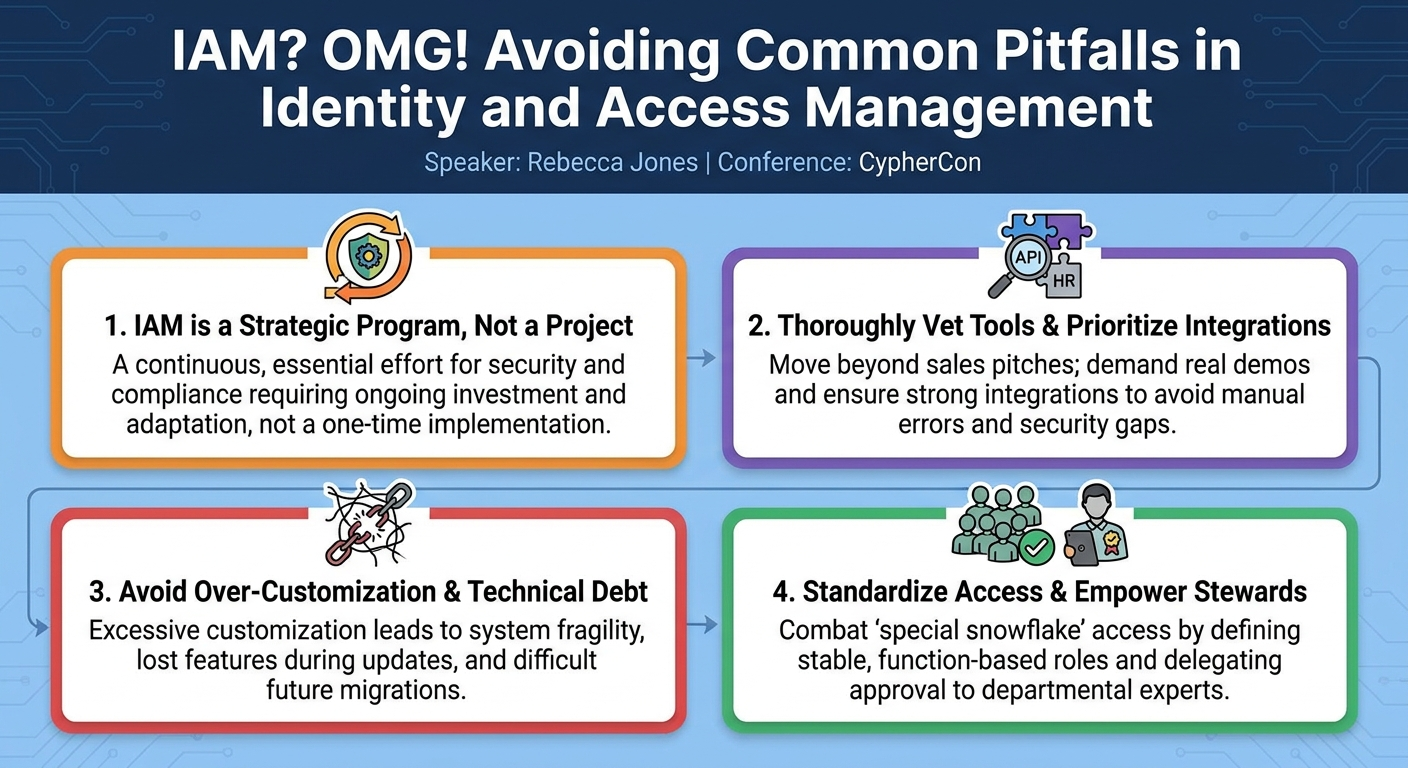
- IAM is a Strategic Program, Not a Project: A robust IAM framework is a continuous effort essential for security, compliance, and operational efficiency, requiring ongoing investment and adaptation, not just a one-time implementation.
- Understand Your Company's Unique Needs: Before selecting any methodology or tool, thoroughly analyze how your organization utilizes access, its structure, and its scale to avoid purchasing ill-fitting or overly complex solutions.
- Thoroughly Vet IAM Tools and Prioritize Integrations: Don't rely solely on sales pitches; demand real demos, test accounts, and consult with engineers and peers. Strong integration capabilities are crucial to avoid manual processes, errors, and significant time sinks.
- Avoid Over-Customization to Prevent Technical Debt: Excessive customization leads to lost reporting features, fragility during updates, difficult migrations, and vendor lock-in. Prioritize tools that meet core needs out-of-the-box.
- Standardize Access with Roles/Functions and Empower Stewards: Combat "special snowflake" access by categorizing users based on stable departmental functions. Delegate access approval to trained departmental stewards to improve accuracy and reduce administrative burden.
- Maintain Vigilance and Adaptability: The cybersecurity landscape is fluid. Continuously monitor, audit, and be prepared to evolve your IAM program. Approach emerging technologies like AI with informed skepticism, always validating their outputs with human expertise.
About the Speaker(s)
Rebecca Jones is an experienced IAM Analyst specializing in critical infrastructure. With over 20 years in the tech industry, she brings a wealth of practical knowledge to the field of Identity and Access Management. Beyond her professional role, Rebecca is deeply involved in the cybersecurity community. She is an organizer for CypherCon and SecretCon, and is the founder of BSides Milwaukee, demonstrating her commitment to fostering knowledge sharing and community building within the industry. An active speaker, mentor, and marathon runner, Rebecca's diverse background and hands-on experience make her a credible and insightful voice on the complexities of IAM.
Reviews
Dr. Zero (Offensive Security Researcher) — SOLID
This is a necessary dose of reality for anyone buying identity governance solutions, stripped of the usual vendor marketing bullshit. It doesn't drop any novel engineering, but it accurately diagnoses exactly why enterprise access control usually devolves into a broken, over-customized nightmare. Solid operational hygiene, even if it's mostly IAM 101.
Heather Calloway (CISO) — SOLID
Jones delivers a grounded, unsentimental look at why enterprise IAM programs fail. It’s a highly competent reminder that identity is an ongoing operational capability, not a one-time capital project. I'd make my IAM engineering directors watch this before they pitch our next vendor integration.