Cyber Tabletop Exercises: Choose your Adventure
Omar A. Rivera Merced
Overview
In the dynamic and often unpredictable landscape of cybersecurity, preparedness is paramount. Omar A. Rivera Merced's talk, "Cyber Tabletop Exercises: Choose your Adventure," delivered at CypherCon, dives deep into the often-overlooked architectural and planning dimensions of tabletop exercises (TTXs). While many discussions around TTXs focus on the execution of injects and immediate responses, Rivera Merced spotlights the critical "behind the scenes" work required to engineer truly realistic and impactful scenarios. His presentation serves as a vital guide for organizations seeking to move beyond generic, "off-the-shelf" exercises and cultivate a robust, adaptive incident response capability.
Key moments
- 2:00 Engineering realism into tabletop exercises
- 6:00 Accounting for multinational and regional differences
- 8:00 Tailoring scenarios for different organizational roles
- 14:00 Building trust and not ambushing leadership
- 18:00 Using customized AI videos for emotional response
- 22:00 Making teams uncomfortable now for legendary performance
- 22:40 Real-world examples of good and bad exercises
Cyber Tabletop Exercises: Choose your Adventure
Speakers: Omar A. Rivera Merced, Cyber Incident Response Specialist, Evertec
Conference: CypherCon
YouTube: https://www.youtube.com/watch?v=xtaQO7ZFwWI
Overview
In the dynamic and often unpredictable landscape of cybersecurity, preparedness is paramount. Omar A. Rivera Merced's talk, "Cyber Tabletop Exercises: Choose your Adventure," delivered at CypherCon, dives deep into the often-overlooked architectural and planning dimensions of tabletop exercises (TTXs). While many discussions around TTXs focus on the execution of injects and immediate responses, Rivera Merced spotlights the critical "behind the scenes" work required to engineer truly realistic and impactful scenarios. His presentation serves as a vital guide for organizations seeking to move beyond generic, "off-the-shelf" exercises and cultivate a robust, adaptive incident response capability.
Rivera Merced, drawing from his extensive experience as a US Navy veteran and a cyber incident response specialist in the payments processing sector, argues that effective TTXs must be meticulously tailored to an organization's unique threat context, regulatory environment, technological stack, and even geopolitical nuances. He emphasizes the need to engage a diverse array of stakeholders—from incident responders and legal counsel to communications teams and executive leadership—each with their distinct "character class" and perspective. The core message is clear: a security event does not wait for an organization to be prepared, making it imperative to practice for real scenarios that challenge every facet of the enterprise, not just its technical defenses.
This talk is crucial for any organization looking to mature its cybersecurity posture. It provides actionable insights into designing exercises that foster genuine learning, expose hidden vulnerabilities in processes and communication, and build trust across disparate teams and regions. By advocating for a "choose your adventure" approach, Rivera Merced encourages security professionals to act as Dungeon Masters, crafting intricate, native scenarios that force teams to respond to pressure and uncertainty, ultimately making them "legendary when it counts."
Background
▶ Watch: Engineering realism into tabletop exercises (2:00)
The increasing frequency and sophistication of cyberattacks underscore the critical need for organizations to be prepared. However, as Omar A. Rivera Merced highlights, many traditional approaches to cyber tabletop exercises (TTXs) fall short of adequately preparing teams for the chaos and complexity of a real incident. The prevailing focus often lies on the technical execution of injects and immediate incident response actions, neglecting the foundational planning and architectural considerations that dictate an exercise's effectiveness. Rivera Merced aptly frames this challenge with the analogy of a "Dungeon Master's call" – an incident is in motion, and the crucial questions are: who answers, what do they know, and what do they decide? Because, as he states, "a security event doesn't wait till you're prepared or not. It just happens."
The problem Rivera Merced addresses is the gap between theoretical incident response plans and practical, real-world execution. Organizations often grapple with a multitude of factors that complicate incident handling, including stringent regulatory requirements (e.g., PCI, FISMA, GDPR), tight notification windows (e.g., Federal Reserve Bank's 36 hours, SEC's 72 hours), and the necessity for legal and communications reviews. Beyond compliance, a significant challenge lies in understanding the organization itself – its unique technology stack, specific industry context (e.g., fintech, manufacturing, healthcare), and often overlooked geopolitical context.
Furthermore, many organizations operate across multiple regions or countries, leading to significant operational maturity gaps and legal variations. Headquarters might have robust policies, but satellite offices could operate with different standards, unclear escalation paths, or even cultural tendencies to "sweep things under the rug" to avoid perceived blame. These complexities are rarely accounted for in generic TTX scenarios, leading to exercises that feel "off-the-shelf" rather than "native to their world." The talk emphasizes that true preparedness requires a deep understanding of these internal and external pressures, moving beyond simply simulating a ransomware attack to practicing for scenarios that are genuinely probable and impactful given the organization's specific threat landscape.
Key Findings
▶ Watch: Tailoring scenarios for different organizational roles (8:00)
Omar A. Rivera Merced's presentation distills several critical findings for engineering effective and realistic cyber tabletop exercises:
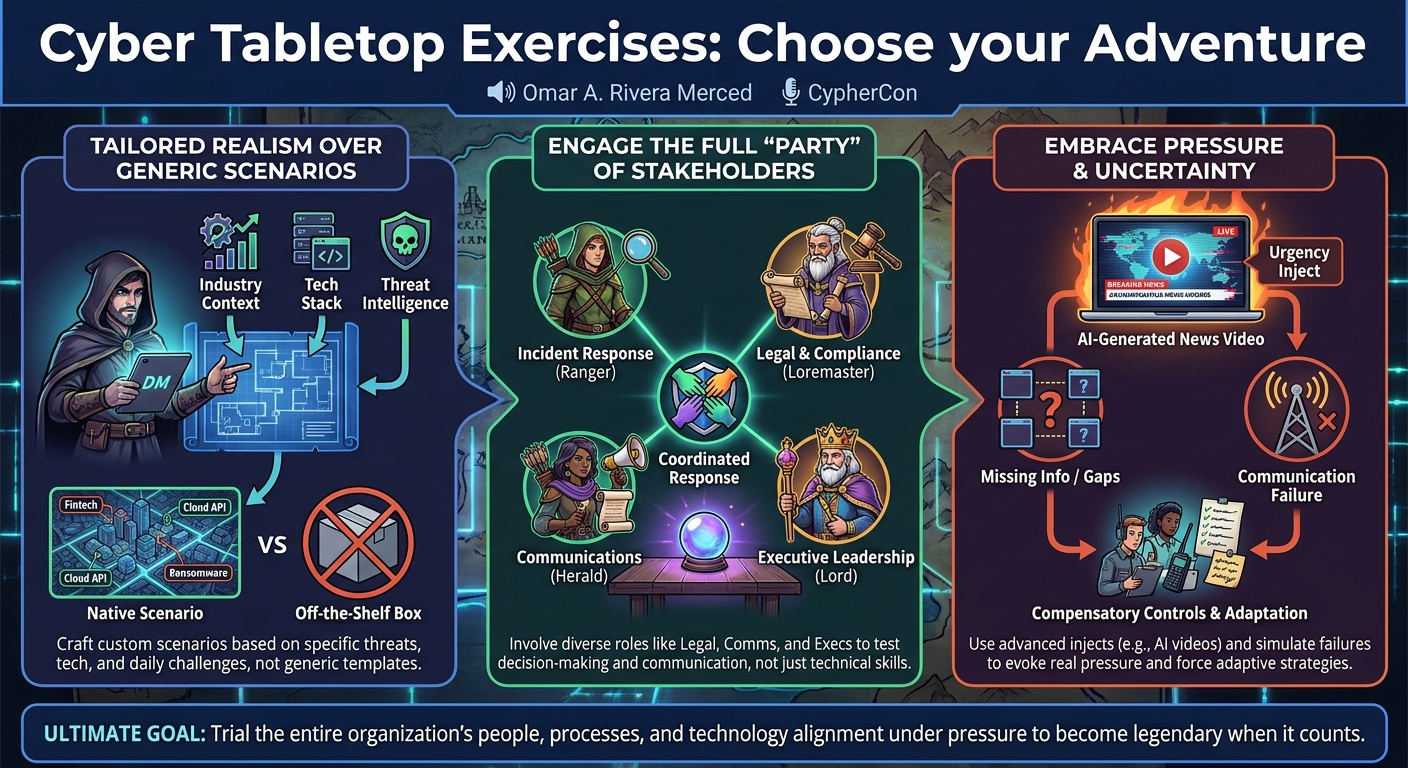
- Tailored Realism is Paramount: Generic, "off-the-shelf" scenarios are largely ineffective. Exercises must be tempered to the industry (e.g., fintech, healthcare), the organization's specific technology stack, and its unique threat context. This requires performing threat modeling and asking internal teams about their daily challenges to ensure the scenario feels "native to their world."
- Holistic Stakeholder Engagement is Essential: Effective incident response involves more than just technical teams. Rivera Merced advocates for including diverse "character classes" in exercises:
- Incident Response (Ranger): For detection and immediate action.
- Legal & Compliance (Loremaster): To navigate regulatory requirements (e.g., PCI, FISMA, GDPR, SEC materiality), assess business impact, and manage cyber insurance.
- Communications (Herald): To handle public statements, media responses, and customer notifications, especially in the context of vendor risk management.
- Executive Leadership (Lord): To understand total exposure, make strategic decisions, and articulate the incident's impact in their language, addressing questions like "what is the business impact?"
- Multinational Operations Introduce Critical Complexity: Organizations with satellite offices or global footprints face unique challenges due to geopolitical context, legal variations, and operational maturity gaps. Different regions may have varying notification requirements (e.g., GDPR vs. SEC), unclear escalation paths, or a lack of consistent telemetry and log sources. Exercises must account for these disparities to expose potential communication breakdowns and compliance failures.
- Leadership Engagement Requires Strategic Planning: Ambushing leadership with a difficult scenario can be counterproductive. It's crucial to align with the point of contact, address risks in a way that makes sense to them, and provide advance notice of themes and topics. This builds trust and ensures leadership is receptive to the exercise's findings, fostering an environment where challenging discussions (e.g., around AI implementation risks) can occur constructively.
- Emotional Engagement and Uncertainty Enhance Learning: To overcome participant complacency, exercises should integrate elements that evoke an emotional response and simulate real-world uncertainty. Rivera Merced highlights the use of customized AI videos (e.g., generated news segments) to make scenarios feel more urgent and real. Additionally, purposely introducing gaps of information (e.g., lost firewall logs due to maintenance) or simulating failures in primary communication channels (e.g., a Microsoft Teams compromise) forces teams to develop compensatory controls and adaptive strategies.
- **Tabletops are a Trial of the Party, Not Just Defenses:** The ultimate finding is that a tabletop exercise is not solely about testing technical defenses. Instead, it's a "trial of your party across roles, across regions, across pressure, across uncertainty." The goal is to align people, processes, and technology in motion, identifying where communication breaks down, where policies are unclear, and where operational gaps exist.
Technical Deep Dive
▶ Watch: Building trust and not ambushing leadership (14:00)
The "technical deep dive" in Rivera Merced's approach to tabletop exercises shifts from analyzing specific attack vectors to dissecting the engineering and architecture of the exercise itself. This involves a meticulous design process that integrates various technical and operational dimensions to maximize realism and learning.
A core technical aspect is the precise integration of regulatory compliance into scenarios. Organizations must navigate complex frameworks like PCI, FISMA, and GDPR. The talk specifically calls out critical notification timelines: the Federal Reserve Bank requires notification within 36 hours, while SEC notifications mandate reporting within 72 hours for material incidents. Crafting scenarios that directly test these timelines forces legal and communications teams to assess the "materiality" of an incident—a concept that, as Rivera Merced notes, can be vague and requires careful framing in exercise questions. This also necessitates simulating the internal review processes involving legal counsel and communications for public statements.
Understanding the organization's technology stack is fundamental. Rivera Merced emphasizes that scenario development should resemble a penetration tester's approach, building a "pattern of life" on the target. This means understanding the specific systems, applications, and infrastructure an organization uses (e.g., identifying if a company operates primarily in fintech or manufacturing). This technical context informs the probability of specific threats, making a generic "ransomware attack" less likely if the organization's architecture doesn't present a clear attack surface for it.
Crucially, the talk addresses operational maturity gaps, particularly in multinational corporations. Satellite offices may lack the sophisticated telemetry and log sources present at headquarters. This directly impacts incident detection and response capabilities. Rivera Merced challenges designers to consider "what are the escalation paths?" and "who commands when the captain is awake?" if crucial log sources aren't implemented or security tools (like EDR or SIM) aren't able to capture necessary data. The technical implication is that exercises must expose these monitoring and detection blind spots, pushing teams to identify compensatory controls.
To facilitate technical exercises, Rivera Merced advocates for an artifact vault. This involves creating realistic digital artifacts for security teams to analyze. Examples include:
- Logs and captures from EDR (Endpoint Detection and Response) or SIM (Security Information and Event Management) systems. He specifically mentions tools like Cybereason, Sigil, QRadar, and Defender XDR as sources for such artifacts.
- Authentic-looking phishing emails (referred to as "fishing room letters").
- Simulated service desk tickets or user reports, as these are often the initial points of contact for security events.
A significant technical innovation highlighted is the use of customized AI videos. These are not merely decorative but serve as powerful injects to simulate real-world media coverage, such as a breaking news segment about the cyberattack. This forces participants to contend with public perception and formulate media responses under pressure, directly testing their communications strategy and approval workflows. The AI-generated video acts as a highly realistic, emotionally charged stimulus that transcends traditional text-based injects.
Finally, the technical design must account for communication resilience. Rivera Merced stresses the importance of having primary and secondary channels of communication. If, for instance, a primary communication platform like Microsoft Teams is compromised, teams must have alternate channels or even personal phone numbers to maintain coordination. This tests the robustness of incident communication protocols beyond the assumed availability of core IT services, aligning with Murphy's Law by planning for worst-case scenarios where critical infrastructure may be degraded.
In essence, the "technical deep dive" is about applying an engineering mindset to the exercise itself, ensuring that every component—from regulatory triggers to simulated logs and AI-driven media injects—is meticulously crafted to stress-test the organization's entire incident response ecosystem.
Demo / Proof of Concept
▶ Watch: Making teams uncomfortable now for legendary performance (22:00)
While the talk did not feature a live, interactive technical demonstration in the traditional sense, Omar A. Rivera Merced showcased and elaborated on a highly effective proof of concept for creating realistic and emotionally engaging exercise injects: customized AI videos.
Rivera Merced played a brief, professionally produced AI-generated news segment during his presentation, simulating "breaking news from CypherCon 2026" about a sophisticated cyber attack. This served as a direct demonstration of how such media can be integrated into a tabletop exercise. The core idea behind this innovation is to overcome participant apathy; as Rivera Merced notes, "once people know it's an exercise, they just don't take it seriously."
The customized AI videos work by generating realistic news segments that report on the simulated cyber event. This technique is designed to:
- Evoke an emotional response: By mimicking real-world media coverage, the inject creates a sense of urgency and gravity, making participants feel the pressure of a genuine crisis. Rivera Merced shared an anecdote where such a video "rattled" a company that had recently experienced a real cyber event, prompting more focused and authentic discussion.
- Test media response strategies: The video forces teams to immediately consider how they would structure their public communications, who would draft the statement, and how it would be approved. It shifts the mindset from "this is just an exercise" to "we have to get through this."
- Enhance realism and immersion: Beyond just news segments, the concept extends to other forms of customized media and injects that make the scenario feel more tangible and pressing.
In addition to AI videos, the talk implicitly "demonstrated" the concept of an artifact vault by listing specific tools and types of data that can be used. Although not shown in real-time, the mention of generating logs and captures from EDR and SIM systems (like Cybereason, Sigil, QRadar, and Defender XDR), crafting realistic phishing emails, and simulating service desk tickets illustrates the practical components of a robust technical exercise environment. These artifacts provide tangible evidence for security teams to "chew on," simulating the investigative work required during an actual incident. The overall "demo" was a conceptual and illustrative one, focusing on the innovative methods to enhance the realism and impact of the exercise design itself.
Defensive Implications
▶ Watch: Real-world examples of good and bad exercises (22:40)
Omar A. Rivera Merced's insights offer profound defensive implications for organizations aiming to harden their cybersecurity posture beyond mere technical controls. The core takeaway is that effective defense is not just about technology, but about the preparedness, alignment, and resilience of the entire organization.
- Proactive Regulatory and Process Alignment: Defenders must thoroughly understand their organization's regulatory requirements (e.g., PCI, FISMA, GDPR) and associated notification timelines (e.g., Federal Reserve Bank's 36 hours, SEC's 72 hours). This knowledge should drive the creation and regular review of incident response plans, ensuring that legal and communications reviews are built into every declaration and public statement process. Exercises should specifically stress-test these timelines and decision points, particularly around concepts like materiality.
- Holistic Stakeholder Engagement: Security teams should actively champion the involvement of non-technical departments—legal, compliance, communications, and executive leadership—in tabletop exercises. This fosters a shared understanding of roles and responsibilities during an incident, preventing silos and ensuring that all facets of an event (technical, legal, reputational, financial) are managed cohesively. Defenders should proactively educate these groups on cyber risks and their potential impact.
- Contextualized Threat Intelligence and Scenario Planning: Instead of relying on generic scenarios, defenders should invest in robust threat intelligence specific to their industry (e.g., fintech, healthcare) and organization's technology stack. This allows for the development of highly realistic and probable scenarios that directly address the most relevant threats, making exercises more impactful and directly applicable to defensive strategies.
- Addressing Operational Gaps in Distributed Environments: For multinational organizations, defenders must actively identify and mitigate operational maturity gaps across satellite offices and regions. This includes ensuring consistent implementation of telemetry and log sources, standardized security tools (EDR, SIM), and clear, universally understood escalation paths. Exercises provide an invaluable opportunity to uncover where these gaps exist and where "things fall through the cracks" due to lack of visibility or cultural tendencies to downplay issues.
- Building Resilient Communication Channels: Incident response plans must include primary and secondary communication channels, anticipating scenarios where primary systems (e.g., Microsoft Teams) might be compromised. Defenders should ensure out-of-band communication methods (e.g., personal phone numbers, alternative platforms) are established and practiced, adhering to Murphy's Law by preparing for critical communication failures.
- Strategic Leadership Engagement and Trust Building: Defenders should approach leadership engagement strategically, aligning with points of contact and framing risks in terms of business value. Providing advance notice of exercise themes and topics helps build trust, making leadership more receptive to uncomfortable findings (e.g., risks of AI implementation) and fostering an environment where security is seen as a strategic partner, not just a cost center.
- Leveraging Advanced Inject Techniques: Incorporating innovative injects like customized AI videos can significantly enhance the realism and emotional impact of exercises. This prepares teams for the intense pressure of public scrutiny and media response, allowing them to practice formulating statements and managing public perception in a high-fidelity simulation.
- Focus on Process and People, Not Just Technology: Ultimately, the defensive implication is to shift the focus of preparedness from solely testing technical controls to evaluating the entire "party"—the cross-functional team, its processes, and its ability to operate under pressure and uncertainty. Exercises should identify weaknesses in communication flow, decision-making, and inter-departmental collaboration, which are often more critical than individual technical vulnerabilities.
By adopting these defensive implications, organizations can transform their tabletop exercises from mere compliance checkboxes into powerful tools for continuous improvement, fostering a culture of readiness that can effectively navigate the complexities of modern cyber threats.
Key Takeaways
- Tailor Exercises to Your Unique Context: Generic scenarios are ineffective. Exercises must be "native to their world," customized to the organization's specific industry, technology stack, threat intelligence, and daily challenges to ensure realism and relevance.
- Engage All Organizational "Character Classes": Incident response is a team sport. Involve legal, compliance, communications, and executive leadership alongside technical teams to test regulatory requirements, public relations, and strategic decision-making in addition to technical response.
- Account for Global and Regional Disparities: For multinational organizations, thoroughly assess and integrate geopolitical context, legal variations, and operational maturity gaps in satellite offices to expose potential breakdowns in communication, escalation paths, and policy adherence.
- Strategically Engage Leadership: Avoid ambushing executives. Build trust by aligning with key stakeholders, framing risks in their language, and providing advance notice of exercise themes to foster constructive dialogue and ensure buy-in for findings.
- Embrace Realism with Advanced Injects and Uncertainty: Utilize innovative tools like customized AI videos to evoke emotional responses and simulate real-world pressure. Purposefully introduce gaps of information or communication failures to test compensatory controls and adaptive problem-solving.
- Tabletops Test the "Party," Not Just Defenses: The primary goal of an exercise is to trial the organization's collective ability across roles, regions, pressure, and uncertainty. Focus on identifying and improving communication flows, decision-making processes, and overall organizational alignment, rather than solely validating technical security controls.
About the Speaker(s)
Omar A. Rivera Merced is a highly experienced cybersecurity professional with a strong background in both military and civilian sectors. He is a proud US Navy veteran, where he honed his skills at the Joint Cyber Analysis Course (JCAC) and served at Fort Meade, Maryland, a hub for national security and cyber operations.
In his civilian career, Omar serves as a Cyber Incident Response Specialist within the Cyber Threat Intelligence Unit at Evertec, a leading payments processing and technology solutions company based in Puerto Rico. His role involves actively responding to cyber incidents and leveraging threat intelligence to bolster organizational defenses. Beyond his primary role, Omar also contributes to the cybersecurity community by side-questing as an advisory board member at the Security Research Group, collaborating with fellow veterans on security research initiatives. His diverse experience underpins his practical and comprehensive approach to designing effective cybersecurity tabletop exercises.
Reviews
Dr. Zero (Offensive Security Researcher) — WEAK
This is TTX 101 dressed up in Dungeons & Dragons cosplay. If your enterprise still needs to be reminded to invite the general counsel to an incident response drill, you don't need a CypherCon talk, you need a new CISO. It stretches one decent trick—using AI deepfakes to rattle executives—into a full presentation.
Heather Calloway (CISO) — SOLID
A rare, pragmatic guide to building incident response exercises that actually test institutional readiness rather than just technical detection. Worth your security leadership's time, especially if your current tabletops are predictable compliance exercises that let your executive team off the hook.