WarGames for Defenders: Playing Threats with MITRE ATT&CK Navigator
Thomas Freeman
Overview
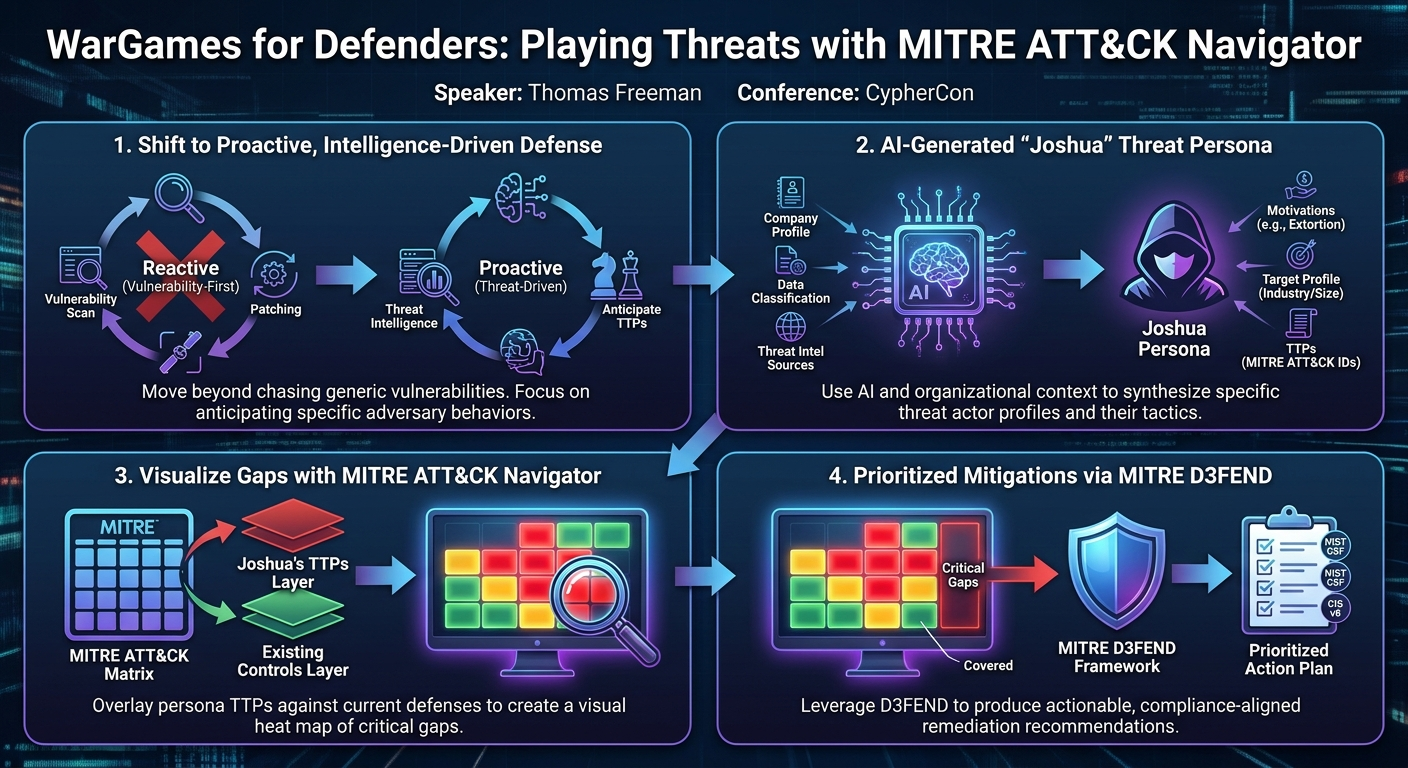
In his compelling CypherCon talk, "WarGames for Defenders: Playing Threats with MITRE ATT&CK Navigator," Thomas Freeman introduces a transformative approach to cybersecurity strategy, shifting from reactive vulnerability management to proactive, threat-driven defense. Drawing inspiration from the classic 1983 film WarGames, Freeman demonstrates how organizations can leverage artificial intelligence and the MITRE ATT&CK framework to build sophisticated threat actor personas, map their tactics, techniques, and procedures (TTPs), and identify critical gaps in their security posture. This methodology aims to empower defenders to anticipate and counter specific threats, rather than merely responding to generic vulnerabilities.
Key moments
- 0:00 Introduction: MITRE ATT&CK's impact on security programs
- 5:05 Challenging the definition of risk vs. severity
- 10:30 Proactive defense: Forcing attackers out of comfort zones
- 16:30 Creating a threat actor persona using AI
- 20:50 Tip: Reducing AI hallucinations in prompts
- 40:00 Visualizing threat actor TTPs with ATT&CK Navigator
- 45:00 AI-generated mitigation recommendations and dual wins
WarGames for Defenders: Playing Threats with MITRE ATT&CK Navigator
Speakers: Thomas Freeman, Director of Fractional CISO Services and CISO Advisory Services, Ghostscale
Conference: CypherCon
YouTube: https://www.youtube.com/watch?v=kXxhPdCyg6I
Overview
In his compelling CypherCon talk, "WarGames for Defenders: Playing Threats with MITRE ATT&CK Navigator," Thomas Freeman introduces a transformative approach to cybersecurity strategy, shifting from reactive vulnerability management to proactive, threat-driven defense. Drawing inspiration from the classic 1983 film WarGames, Freeman demonstrates how organizations can leverage artificial intelligence and the MITRE ATT&CK framework to build sophisticated threat actor personas, map their tactics, techniques, and procedures (TTPs), and identify critical gaps in their security posture. This methodology aims to empower defenders to anticipate and counter specific threats, rather than merely responding to generic vulnerabilities.
Freeman, with his extensive background spanning 25 years in IT, including roles in security administration, programming, penetration testing, and CISO advisory services, brings a wealth of practical experience to the subject. His talk is particularly relevant for security leaders, practitioners, and anyone struggling with the overwhelming volume of vulnerabilities and the challenge of prioritizing defensive efforts effectively. By focusing on the actual threats an organization faces, this approach promises to optimize security investments, improve incident response capabilities, and enhance overall cyber resilience, moving beyond theoretical risks to address real-world adversary behavior.
Background
▶ Watch: Introduction: MITRE ATT&CK's impact on security programs (0:00)
The traditional cybersecurity worldview, as Freeman explains, often begins and ends with vulnerability management. Organizations typically receive extensive lists of vulnerabilities from tools like Tenable Nessus, categorized by severity (critical, high, medium, low). However, Freeman challenges this perspective, asserting that a high-severity vulnerability does not inherently equate to high risk. He meticulously distinguishes between vulnerability severity (measured by systems like CVSS, which primarily assesses exploitability likelihood) and risk (defined as likelihood multiplied by impact). A server holding publicly available comic books, for instance, might have critical vulnerabilities, but its breach would carry minimal impact, thus posing a low risk. Conversely, a low-severity vulnerability on a system containing sensitive data like Controlled Unclassified Information (CUI) could present catastrophic risk if exploited.
To bridge this gap, Freeman advocates for data classification, categorizing data by sensitivity (e.g., confidential, internal, public, top secret) and mapping it to specific assets. This allows organizations to understand the true impact of a breach on those assets, transforming raw vulnerability data into actionable risk intelligence. However, even with improved risk assessment, the defense remains largely reactive. Freeman uses a basketball analogy to illustrate this: a defender who constantly reacts to an opponent's fakes will always be a step behind. A more effective strategy involves understanding the opponent's preferred tactics, techniques, and procedures (TTPs) and forcing them out of their comfort zone, dictating the play. This proactive mindset is precisely what the MITRE ATT&CK framework enables.
The MITRE ATT&CK framework provides a globally accessible knowledge base of adversary TTPs based on real-world observations. It maps out the entire lifecycle of an attack, from reconnaissance to impact, detailing the various ways adversaries achieve their objectives. The problem arises when trying to apply this vast framework to a specific organization; understanding which TTPs are most relevant and how to prioritize defense against them remains a significant challenge. This is where Freeman's "WarGames" concept comes into play, leveraging AI to tailor the ATT&CK framework to an organization's unique threat landscape.
Key Findings
▶ Watch: Proactive defense: Forcing attackers out of comfort zones (10:30)
The central discovery and contribution of Freeman's talk is the innovative methodology for creating a "Joshua" threat actor persona using artificial intelligence (specifically Claude Co-work, or its equivalent like Copilot Co-work). This persona is not a generic threat profile but a dynamically generated, highly specific composite of real-world adversaries targeting an organization's industry, size, and data types. By feeding the AI with contextual information like company profiles, data classification registers, and a curated list of threat intelligence sources (CISA, CrowdStrike, Unit 42, Cisco Talos, Mandiant), the AI can synthesize a detailed scouting report on the most probable attackers.
This Joshua persona then becomes the single driving force for an organization's entire security program. Instead of chasing every vulnerability, security teams can focus their efforts on defending against the specific TTPs associated with Joshua. The key findings include:
- AI-Driven Persona Generation: AI can effectively compile recent threat intelligence (e.g., last 90 days) from various sources to create a tailored threat actor persona, detailing motivations (e.g., financial extortion via double extortion ransomware), primary groups (e.g., Akira, Medusa, Scattered Spider), target industries, and specific TTPs.
- Proactive TTP Mapping: The generated persona includes a comprehensive inventory of TTPs, explicitly mapped to MITRE ATT&CK IDs (e.g., T1078 for Valid Accounts), allowing for precise identification of adversary behaviors.
- Visual Gap Analysis with ATT&CK Navigator: By importing the Joshua persona's TTPs into the MITRE ATT&CK Navigator, organizations can visually identify their defensive gaps. Overlaying layers representing current controls, past penetration test results, or vulnerability scan data creates a heat map that clearly shows where defenses are strong (green), partial (yellow), or entirely missing (red).
- Actionable Mitigation Recommendations: Leveraging the MITRE D3FEND framework, the AI can generate prioritized mitigation recommendations directly tied to the identified TTP gaps. These recommendations are not only technically sound but also align with compliance frameworks like CIS Version 8 and NIST CSF 2.0, offering "dual wins" for both risk reduction and regulatory adherence.
- Program-Wide Impact: This threat-driven approach impacts every facet of a security program, from vulnerability management and risk assessments to policies, incident response (IR) plans, tabletop exercises, board reporting, and security awareness training. It ensures that security decisions are directly aimed at the most pertinent threats.
Technical Deep Dive
▶ Watch: Creating a threat actor persona using AI (16:30)
The technical core of Freeman's methodology revolves around the intelligent use of AI for context-aware analysis and the MITRE ATT&CK ecosystem for visualization and defense planning.
The process begins by setting up an AI project, preferably in a tool like Claude Co-work (or Copilot Co-work for M365 governance), and providing it with a rich set of context files. These files are crucial for tailoring the AI's output to the specific organization:
- Company Profile (e.g.,
Falcon Holdings company profile): Details about the company's size (e.g., 520 employees), revenue (e.g., $5 million/year), industry (e.g., manufacturing, real estate development, professional services), and infrastructure (e.g., hybrid). This allows the AI to narrow down relevant threat actors. - Data Classification Register (e.g.,
Falcon Holdings data classification register): Lists sensitive data types (CUI, PII, M&A data) and their locations (e.g., Azure SharePoint). This helps the AI identify "crown jewels" and potential impact. - Threat Intelligence Sources (e.g.,
Holdings threat intel sources): A curated list of reputable threat intelligence providers (e.g., CISA, CrowdStrike, Unit 42, Cisco Talos, Mandiant) that the AI should query for recent (e.g., last 90 days) adversary activity. - ATT&CK Navigator JSON Specification: A file guiding the AI on how to format the TTP output into a JSON layer compatible with the MITRE ATT&CK Navigator.
- Defend Preferences (e.g.,
Holdings defend preferences): Custom parameters or existing control registries that inform the AI's mitigation recommendations, allowing it to perform a gap analysis against current defenses.
With these context files loaded, the AI is given a series of prompts:
- Generate Joshua Threat Persona: The first prompt instructs the AI to read the context files, perform threat intelligence research, and compile a detailed persona for "Joshua." This persona includes the adversary's primary and secondary motivations (e.g., financial extortion via double extortion ransomware, opportunistic IP theft), attribution confidence, primary consulting groups (e.g., Akira, Punk Spider, Gold Sahara, Medusa ransomware-as-a-service, Scattered Spider), target profile, operational tempo, and most importantly, a TTP inventory with MITRE ATT&CK IDs. The AI can even infer TTPs based on known adversary patterns and the organization's specific vulnerabilities.
- Generate ATT&CK Navigator JSON Layer: A subsequent prompt converts the Joshua persona's TTP inventory into a JSON file specifically formatted for the MITRE ATT&CK Navigator. This file contains the selected TTPs, often color-coded (e.g., red for Joshua's TTPs).
- Defend Mitigation Recommendation: The final prompt utilizes the MITRE D3FEND framework to generate a mitigation recommendation report. This report analyzes the identified TTPs from the Joshua persona against the organization's existing controls (if a control registry is provided, "Mode B") or inferred controls from past assessments ("Mode A"). It then proposes specific defensive actions, mapped to MITRE D3FEND IDs (e.g., D3 manage), and cross-references them with compliance frameworks like CIS Version 8 and NIST CSF 2.0.
The MITRE ATT&CK Navigator is a critical visualization tool. It presents the entire ATT&CK matrix, allowing users to import JSON layers. By importing the Joshua persona layer, the TTPs most relevant to the organization are highlighted in red. Additional layers can be created and overlaid:
- Penetration Test Layers: JSON layers generated from previous pen test reports (e.g., 2024, 2025), highlighting TTPs that were successfully defended against (green) or exploited.
- Control Registry Layer: A JSON layer representing the TTPs covered by existing security controls.
The Navigator's "create layer from other layers" functionality is then used to perform gap analysis. For example, subtracting the "Control Registry Layer" from the "Joshua Persona Layer" reveals TTPs Joshua might use that are currently not addressed by existing controls. This generates a heat map where green indicates covered TTPs, yellow indicates partially covered, and red signifies a critical gap.
The generated reports from the AI, such as the Joshua persona and the Defend remediation report, provide detailed narratives, executive summaries, crown jewel analysis (e.g., M&A strategy and deal pipeline on Azure SharePoint), and a prioritized action list. These outputs are designed to be immediately actionable and provide clear justifications for security investments, directly linking defensive measures to specific, identified threats. The process emphasizes iterative refinement, with the speaker recommending prompt engineering techniques to reduce AI hallucinations by instructing the AI to "loop back through and review" its output for contradictions and weak answers.
Demo / Proof of Concept
▶ Watch: Visualizing threat actor TTPs with ATT&CK Navigator (40:00)
Thomas Freeman provided a live demonstration of his methodology using Claude Co-work and the MITRE ATT&CK Navigator, centered around a fictitious company called Falcon Holdings. Falcon Holdings is described as a parent company with 520 employees, a hybrid infrastructure, and subsidiaries in real estate development (Falcon Property Group), manufacturing (Ridgeline Manufacturing), and professional services (Summit Professional Services), handling client PII and M&A data.
The demo began by setting up a new project in Claude, named "WOPR Junior," referencing the computer from WarGames. Freeman then uploaded a series of context files from a GitHub repository, which included:
Falcon Holdings company profile.txt: Detailed the company's structure, size, revenue, and industry.Falcon Holdings data classification register.txt: Identified critical data assets and their classifications.Holdings threat intel sources.txt: Listed sources like CISA, CrowdStrike, Palo Alto Unit 42, Cisco Talos, Mandiant.Attack Navigator JSON specification.txt: Provided the structure for Navigator-compatible output.Holdings defend preferences.txt: Contained information about existing controls and preferences for mitigation.
Next, Freeman showed how a prompt, build_joshua_threat_persona.txt, would be fed to Claude. Although he didn't run it live due to time constraints, he presented the output: a comprehensive "Threat Actor Persona: Joshua for Falcon Holdings" report. This report, prepared for the CISO (named David Lightman, another WarGames reference), included:
- Persona Name: Joshua (a composite of Ransomware-as-a-Service (RaaS) affiliates and Initial Access Brokers (IABs)).
- Primary Motivation: Financial extortion via double extortion ransomware (data theft + encryption).
- Consultant Groups: Akira (including Punk Spider, Gold Sahara), Medusa RaaS, Scattered Spider elements.
- Target Industry: Manufacturing, financial holding companies, professional services.
- Target Profile: US-based mid-market ($50M-$500M revenue).
- Operational Tempo: Persistent, citing a 32% rise in global ransomware attacks in 2025, with manufacturing as the #1 targeted vector.
- Crown Jewels Analysis: Identified M&A strategy and deal pipeline on Azure SharePoint as critical, with Valid Accounts (T1078) via harvested credentials from executive accounts as a likely initial access path.
- TTP Inventory: A detailed list of MITRE ATT&CK TTPs, marked as "confirmed" or "inferred," that Joshua would likely use.
Following the persona generation, Freeman demonstrated the MITRE ATT&CK Navigator. He imported the joshua_navigator_layer.json file (generated by Claude) into a new Navigator session. This immediately visualized Joshua's TTPs across the ATT&CK matrix, highlighted in red.
To illustrate gap analysis, he then added other layers:
- Penetration Test Layer: He loaded a
pen_test_2024_navigator_layer.json(also generated by Claude from a simulated pen test report), which highlighted TTPs tested in green. This showed where Joshua's TTPs overlapped with successfully defended areas. - Control Registry Layer: He imported a
control_registry_navigator_layer.json, representing TTPs covered by Falcon Holdings' existing security controls.
Finally, Freeman created a "layer from other layers" in the Navigator, subtracting the control registry layer from the Joshua persona layer. This produced a visual heat map indicating:
- Green: TTPs covered by controls.
- Yellow: Partially covered TTPs.
- Red: Critical gaps where Joshua's TTPs were not addressed.
The demo concluded by showcasing the "Defend Remediate Recommendation Report" generated by Claude. This report, for "Mode B" (with an existing control registry), detailed critical and high-priority gaps, recommending specific mitigations (e.g., enforcing MFA on RMI VPN, testing RMI tape backups, encrypting RMI file servers, enforcing DMARC). Crucially, these recommendations were mapped to MITRE D3FEND IDs and cross-referenced with compliance frameworks like CMMC Level 1 and SOC 2 Type 1, demonstrating "dual wins" for both security posture improvement and compliance adherence.
Defensive Implications
▶ Watch: AI-generated mitigation recommendations and dual wins (45:00)
The "WarGames for Defenders" methodology profoundly reshapes how organizations should approach their cybersecurity defenses. By actively building and refining a Joshua threat actor persona, defenders move from a reactive stance to a highly proactive, intelligence-driven strategy. This shift has far-reaching implications across the entire security program:
- Prioritized Vulnerability Management: Instead of remediating every vulnerability, teams can prioritize those that map directly to Joshua's TTPs, especially those targeting crown jewels. This ensures that resources are allocated to address real, exploitable risks rather than theoretical ones.
- Targeted Risk Assessments: Risk assessments become more accurate and actionable. By knowing the specific TTPs Joshua employs, organizations can better assess the likelihood of an attack and the true impact on their classified data, leading to a more precise likelihood times impact calculation.
- Relevant Policies and Procedures: Security policies and procedures can be explicitly tailored to counter Joshua's TTPs. For example, if Joshua frequently uses Valid Accounts (T1078), policies around MFA enforcement and credential hygiene become critical.
- Effective Incident Response (IR) Plans and Tabletop Exercises: IR plans can be designed with Joshua's attack chains in mind, allowing for more specific detection, containment, and eradication strategies. The AI can even generate initial drafts for tabletop exercises based on Joshua's likely attack scenarios, ensuring that drills are realistic and relevant.
- Strategic Pen Testing and Purple Teaming: Penetration testing and red teaming efforts can be guided by the Joshua persona, ensuring that assessments simulate real-world threats rather than generic attacks. Purple teaming can then focus on validating defenses against these specific TTPs.
- Impactful Board Reporting: The executive summaries and clear visualizations from the MITRE ATT&CK Navigator provide a compelling narrative for board members. CISO's can report on specific threat actor capabilities, the organization's current defensive gaps against those threats, and the tangible "dual wins" (risk reduction and compliance) achieved by proposed remediations. This moves board discussions beyond abstract metrics to concrete threat intelligence.
- Engaging Security Awareness Training: Training programs can be customized to educate employees about the specific phishing tactics, social engineering techniques, or common vulnerabilities that Joshua might exploit. This makes training more relevant and effective, as employees understand why certain behaviors are risky in the context of a known adversary.
- Optimized Security Tooling: Organizations can evaluate their existing security tools and invest in new ones based on their ability to detect, prevent, or mitigate Joshua's TTPs. This ensures that security investments are directly aligned with threat reduction.
Ultimately, this approach transforms cybersecurity from a cost center into a strategic business enabler, allowing organizations to operate with confidence, knowing they are proactively defending against their most probable and impactful adversaries.
Key Takeaways
- Shift from Reactive to Proactive Defense: Move beyond generic vulnerability management to an intelligence-driven approach that anticipates specific threat actor TTPs.
- Leverage AI for Persona Generation: Utilize tools like Claude Co-work or Copilot Co-work to create a tailored "Joshua" threat actor persona, compiling real-world threat intelligence relevant to your organization.
- Distinguish Severity from Risk: Understand that CVSS scores measure severity/likelihood, while true risk combines likelihood with the impact of an exploit on classified data.
- Visualize Gaps with MITRE ATT&CK Navigator: Use the Navigator to map Joshua's TTPs and overlay existing controls or pen test results to visually identify critical defensive gaps.
- Generate Actionable Mitigation Strategies: Employ the MITRE D3FEND framework (with AI assistance) to produce prioritized remediation recommendations that offer "dual wins" for both risk reduction and compliance (e.g., CMMC, SOC 2).
- Integrate Threat Intelligence Across the Security Program: Let the Joshua persona drive decisions in vulnerability management, risk assessments, IR plans, board reporting, and security awareness training for a holistic and effective defense.
About the Speaker(s)
Thomas Freeman is the Director of Fractional CISO Services and CISO Advisory Services for Ghostscale. With over 25 years of experience in the IT industry, his background spans a wide array of disciplines, including security administration, programming (including work with Travelocity), web development, and directing penetration testing teams. Currently, he focuses on broader CISO services, guiding organizations in their security strategies. Freeman also has a significant background in education, having spent 20 years teaching, which influences his engaging and interactive presentation style. He is also involved with the Hardware Hacking Village at events like CypherCon, where his company Ghostscale creates hands-on projects like RFID readers and Morse code add-ons.
Reviews
Dr. Zero (Offensive Security Researcher) — SOLID
This is a prompt engineering tutorial wearing the skin of a defensive revolution. Automating MITRE ATT&CK Navigator JSON generation with Claude is a competent workflow for consultants, but it isn't novel threat intel.
Heather Calloway (CISO) — STRONG ACCEPT
Freeman bridges the gap between raw threat intelligence and board-level resource allocation by using LLMs to contextualize MITRE ATT&CK. It gives security leaders a scalable way to move their teams off the CVSS treadmill and onto threat-based prioritization. Worth your leadership team's time to understand how AI can streamline program gap analysis.