Securing the Perimeter: Credential Security Fundamentals
Shelby Palmersheim, Mathias Palmersheim
Overview
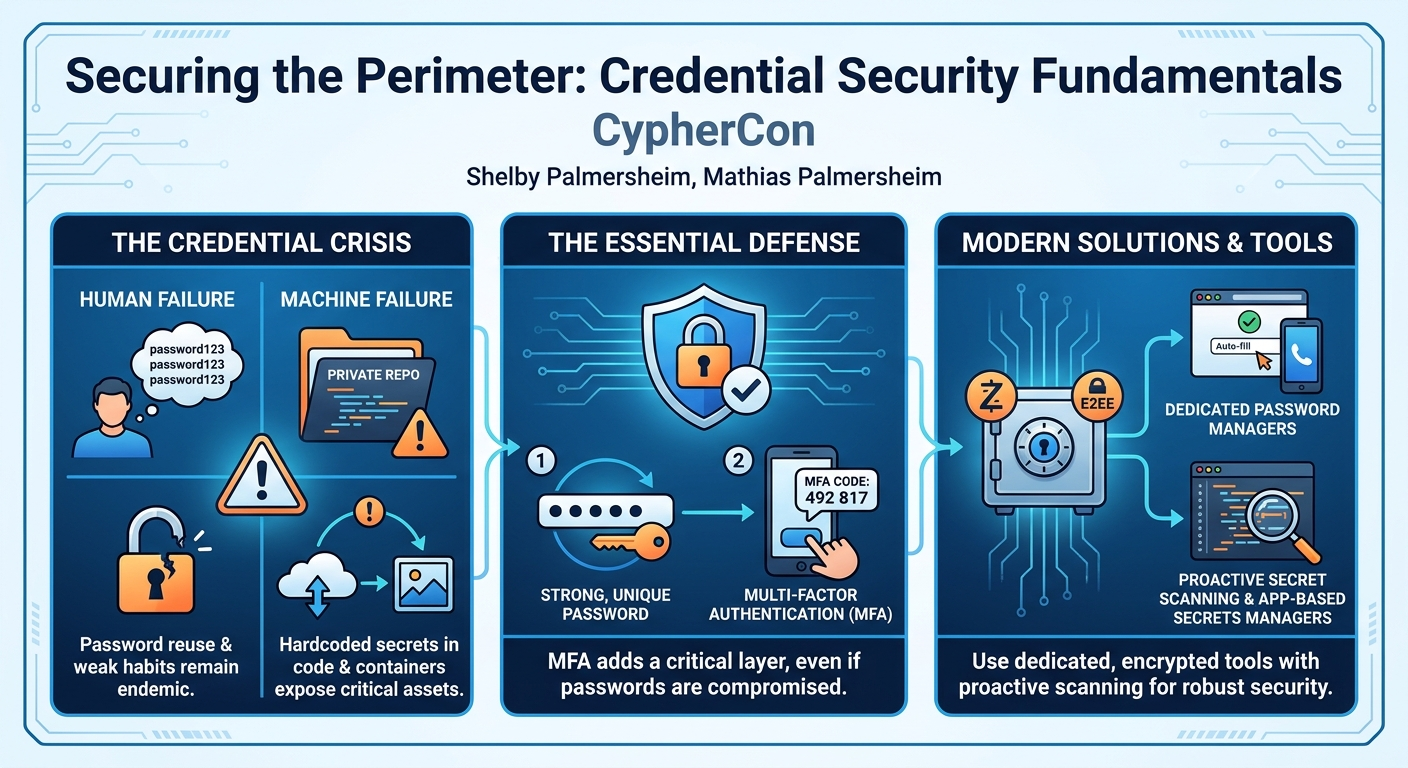
This talk, "Securing the Perimeter: Credential Security Fundamentals," delivered by Shelby and Mathias Palmersheim at CypherCon, delves into the critical yet often overlooked aspects of credential and secret management. The speakers emphasize that despite being a foundational topic, the principles of securing passwords and machine-generated secrets are frequently neglected, leading to significant vulnerabilities. The presentation serves as a comprehensive guide, identifying prevalent weak points in current practices, outlining crucial considerations for hardening information security, and introducing practical tools to foster success in robust credential management.
Key moments
- 2:00 Introduction, speakers, and talk agenda
- 3:45 Survey reveals common weak points in credential storage
- 6:20 Understanding secrets and their insecure storage in code
- 9:00 Key habits for stronger password and credential security
- 11:30 Criteria for choosing effective password and secrets managers
- 18:40 Utilizing secret scanners and types of secrets managers
- 22:00 Bitwarden resources, free trial, and community support
Securing the Perimeter: Credential Security Fundamentals
Speakers: Shelby Palmersheim, Technical Marketing Manager at Bitwarden; Mathias Palmersheim, Solutions Engineer at Victoria Metrics, Founder and President of Shift Systems
Conference: CypherCon
YouTube: https://www.youtube.com/watch?v=0Y0jMjbyx2U
Overview
This talk, "Securing the Perimeter: Credential Security Fundamentals," delivered by Shelby and Mathias Palmersheim at CypherCon, delves into the critical yet often overlooked aspects of credential and secret management. The speakers emphasize that despite being a foundational topic, the principles of securing passwords and machine-generated secrets are frequently neglected, leading to significant vulnerabilities. The presentation serves as a comprehensive guide, identifying prevalent weak points in current practices, outlining crucial considerations for hardening information security, and introducing practical tools to foster success in robust credential management.
The core message underscores the paramount importance of secure credentials as the initial and often sole line of defense against cyber threats. The Palmersheims highlight that the mishandling of both human-accessed passwords and machine-accessed secrets poses substantial cybersecurity risks, capable of leading to identity theft, severe financial loss, lateral movement within compromised networks, and privilege escalation. By dissecting common pitfalls and offering actionable solutions, the talk aims to empower individuals and organizations to elevate their security posture, making a compelling case for a renewed focus on these fundamental principles in an increasingly complex threat landscape.
Background
▶ Watch: Introduction, speakers, and talk agenda (2:00)
The pervasive issue of weak and insecure credential management forms the critical backdrop of this discussion. Shelby Palmersheim initiated this section by referencing a 2024 Bitwarden World Password Day survey, whose findings, though recent, reflect persistent, long-standing trends. Alarmingly, the survey revealed that a majority of individuals still rely on memory to store their passwords, a practice that inevitably leads to password reuse. This habit significantly amplifies risk, as a compromise in one service can grant attackers access to numerous other accounts. Furthermore, rudimentary methods like using "pen and paper" for password storage remain surprisingly popular, despite being inherently unscalable, prone to loss, and offering no digital protection. The trend towards adopting dedicated password management software, while slowly increasing, is not advancing at the pace required to mitigate these widespread vulnerabilities.
Beyond personal habits, the speakers highlighted several risky practices prevalent even in professional environments. These include the use of easily guessable, information-based or personal weak passwords (e.g., "season+year+special character"), insecure storage methods such as plain-text CSV files on desktops or sticky notes under keyboards (a common "MSP horror story"), and a widespread failure to enable Multi-Factor Authentication (MFA). The insecure sharing of passwords via unencrypted channels like text messages or email for shared workplace accounts further exacerbates these risks.
The talk then transitioned to common threat vectors that exploit these weaknesses. Phishing attacks trick users into divulging credentials on malicious sites. Credential stuffing leverages lists of compromised, reused passwords from data breaches to gain unauthorized access. Brute-force attacks systematically attempt common or leaked passwords. Ultimately, data breaches themselves are a primary source of credential exposure, necessitating vigilance and cleanup of compromised accounts.
Mathias Palmersheim expanded the scope to secrets management, defining secrets as sensitive information primarily accessed by machines rather than humans. These include critical assets like machine accounts, API keys for third-party services (e.g., GitHub, AWS, LLM providers), and database credentials for web applications. He presented sobering statistics from a GitGuardian survey, revealing that developers are equally—if not more—lax with secrets than users are with passwords. The survey found that a staggering 35% of private repositories scanned had secrets directly committed into Git history, making them permanently discoverable unless complex remediation steps are taken. Even more concerning, out of 15 million public images scanned by GitGuardian, 100,000 contained valid secrets, allowing attackers to pull an image and immediately gain access to services like AWS accounts. The talk also noted that AI tools, specifically mentioning Copilot, are not immune to this problem, with 6% of Copilot-enabled repositories showing evidence of secret leaks. This comprehensive overview painted a stark picture of the widespread and persistent challenges in securing both human and machine credentials.
Key Findings
▶ Watch: Understanding secrets and their insecure storage in code (6:20)
The talk underscored several critical findings that illuminate the pervasive vulnerabilities stemming from inadequate credential and secret management. Firstly, the data from the Bitwarden World Password Day survey definitively demonstrated that password reuse and weak password practices remain endemic across both personal and professional spheres. The reliance on memory or insecure physical storage for passwords, coupled with the slow adoption of dedicated password managers, directly translates into a heightened risk of account compromise through common attack vectors like phishing, credential stuffing, and brute-force attacks.
Secondly, the presentation highlighted the alarming prevalence of hardcoded secrets in software development pipelines, even within supposedly secure private repositories and publicly available container images. The GitGuardian survey statistics — 35% of private repositories containing committed secrets and 100,000 public images exposing valid credentials — reveal a systemic failure in developer practices. This problem is further compounded by the observation that AI coding assistants, such as Copilot, are not effectively preventing these leaks, as evidenced by secrets found in 6% of Copilot-enabled repositories. This means sensitive machine-accessed credentials, such as API keys and database passwords, are frequently exposed, creating direct pathways for attackers to achieve lateral movement, privilege escalation, and access to critical cloud infrastructure.
Thirdly, the speakers reinforced that password strength, characterized by length and complexity, is a primary determinant of an account's resilience against compromise. While acknowledging that no password is uncrackable given infinite time, the visual representation of password strength charts effectively conveyed that robust, random character strings significantly increase the computational effort required for attackers, thereby reducing the likelihood of a successful breach.
Finally, the discussion on "why your secrets manager matters" revealed that the mishandling of secrets leads to tangible and severe consequences beyond just security breaches. Mathias Palmersheim emphasized significant time loss due to forgotten rotations or synchronization issues between development environments, resulting in operational downtime. More critically, poor secret management directly amplifies breach severity, allowing attackers to pivot from an initial application compromise to broader system access. Furthermore, the financial implications extend to compliance failures, incurring penalties and reputational damage for organizations. These findings collectively paint a picture of a security landscape where fundamental errors in credential and secret management create foundational vulnerabilities, leading to widespread and costly security incidents.
Technical Deep Dive
▶ Watch: Key habits for stronger password and credential security (9:00)
The technical deep dive of the talk provided a comprehensive overview of both the defensive strategies and the tools available for robust credential and secret management. The core defensive habits advocated include: using unique passwords for every account, employing strong, complex passwords that are difficult to guess or brute-force, and critically, enabling Multi-Factor Authentication (MFA) wherever possible. MFA adds a vital layer of security, ensuring that even if a password is compromised, an attacker still requires a second factor to gain access.
A central theme was the recommendation for dedicated password managers over built-in browser solutions, which are often less secure and more vulnerable. Key features to look for in a dedicated password manager include:
- End-to-end encryption (E2EE) and a zero-knowledge architecture: These ensure that only the user can decrypt their data, protecting it even if the service provider's systems are compromised.
- MFA support: Securing the password manager itself with MFA.
- Platform and device compatibility: Ensuring accessibility across all user devices.
- Autofill and auto-capture functionality: Not only enhances user experience but also mitigates phishing risks by only autofilling on legitimate URLs.
- Secure sharing capabilities: Allowing teams to share credentials without resorting to insecure methods like plain text.
- Password generators: To effortlessly create strong, random, unique passwords.
- Open-source vs. proprietary considerations: Open-source solutions offer transparency for security-minded users to vet and audit the code.
- Backup and recovery options: Including account recovery, emergency access, and automated backups for disaster preparedness.
- Reputation and reviews: Crucial for vetting a tool that will store all sensitive data.
Shelby highlighted Bitwarden as a recommended solution, noting its open-source nature and comprehensive feature set, including the ability to store and autofill various sensitive data beyond just passwords, such as credit cards and identities. She also mentioned Bitwarden Send, a feature for securely sharing ephemeral links with controlled access and optional password protection, and Access Intelligence, an enterprise feature providing administrators with insights into organizational password hygiene, allowing them to mark critical applications and push alerts for risky items.
Mathias then shifted focus to secrets management for machine-accessed credentials. He introduced secret scanners as an essential first line of defense, designed to prevent secrets from ever reaching production environments. These tools integrate into editors, CI pipelines, or run as command-line utilities, identifying and blocking hardcoded secrets. Examples include:
- KICS (by Checkmarx, with a newer version called 2MS): Focused on Infrastructure as Code (IaC) tools like Terraform, OpenTofu, and Ansible.
- Gitleaks and Trufflehog: More generic secret scanners suitable for a wider range of programming languages.
- Snyk and SonarQube: Offer both secret scanning and vulnerability management, often integrating directly into developer editors to catch issues pre-commit.
He then differentiated between two main flavors of secrets managers:
- File-based secrets managers: These involve encrypted files synced across environments. While offering low overhead and no external service dependencies, they suffer from clunky user experience (UX) and syncing problems, leading to outdated secrets being deployed. Examples include Ansible Vault (excellent for Ansible-specific use cases but limited outside it), SOPS, and Akeyless.
- App-based secrets managers: These are preferred for their encrypted databases and web services, allowing for easier manipulation and rotation of secrets. They can be offered as SaaS or self-hosted solutions, often providing APIs and SDKs for broad integration. Mathias championed Bitwarden Secrets Manager and OpenBao as leading open-source options. He praised Bitwarden Secrets Manager for its exceptional human experience, end-to-end encryption (even within TLS), scalability, predictable pricing, and wide availability via Kubernetes operators, IaC tools (like Ansible), and a CLI. He specifically noted its SDK for custom integrations, ensuring secrets are accessible "pretty much everywhere you would need secrets."
The technical discussion highlighted that the combination of strong user practices, dedicated password managers, proactive secret scanning, and robust app-based secrets managers forms a comprehensive strategy for securing the perimeter from credential-based attacks.
Demo / Proof of Concept
▶ Watch: Utilizing secret scanners and types of secrets managers (18:40)
While the talk provided extensive technical details and recommendations, it did not include a live demonstration or proof of concept during the presentation itself. Mathias Palmersheim explicitly stated this limitation, mentioning, "If we had more time, I'd do a demo where I use Ansible to deploy it," referring to Bitwarden Secrets Manager. This indicates that a practical demonstration of deploying and managing secrets within an Infrastructure as Code (IaC) workflow using Ansible was a planned, but omitted, component due to time constraints.
However, the speakers did offer a tangible way for attendees to experience the discussed solutions firsthand. They highlighted that both the Bitwarden Password Manager and Bitwarden Secrets Manager offer a 7-day free trial. This allows individuals and organizations to "kick the tires," explore the features, and evaluate how the tools can integrate into their existing security practices. The availability of customer support and a community forum during this trial period further facilitates hands-on engagement and addresses any questions that might arise during the evaluation process.
Defensive Implications
▶ Watch: Bitwarden resources, free trial, and community support (22:00)
The detailed insights from "Securing the Perimeter: Credential Security Fundamentals" provide clear, actionable defensive implications for both individuals and organizations aiming to bolster their cybersecurity posture.
For individual users and employees, the primary defensive measures revolve around fundamental hygiene. It is imperative to adopt unique, strong, and complex passwords for every single account, eliminating the dangerous practice of password reuse. The length and randomness of a password are directly correlated with its resistance to cracking. Crucially, Multi-Factor Authentication (MFA) must be enabled on all available accounts, serving as a critical second layer of defense even if a password is compromised. Users should leverage a dedicated password manager (such as Bitwarden), prioritizing solutions with end-to-end encryption and zero-knowledge architecture. These tools not only generate and store strong, unique passwords but also offer autofill functionality that can help mitigate phishing attacks by only activating on legitimate URLs. Furthermore, individuals should be educated on securely sharing credentials, utilizing features like ephemeral, password-protected links instead of insecure methods like email or text messages.
For organizations and developers, the defensive implications extend to systematic integration of security into the development lifecycle and infrastructure management. Organizations must implement secret scanning tools (e.g., KICS, Gitleaks, Trufflehog, Snyk, SonarQube) across their entire development pipeline, from developer workstations (e.g., editor integrations) to CI/CD workflows. This proactive approach aims to prevent hardcoded secrets from ever reaching production environments or being committed into Git repositories, even private ones. Regular audits of container images are also essential to identify and remediate embedded secrets.
The adoption of a robust, app-based secrets manager (like Bitwarden Secrets Manager or OpenBao) is non-negotiable for securely storing, managing, and rotating machine-accessed credentials (API keys, database passwords, etc.). These solutions provide a centralized, auditable system with APIs and SDKs for seamless integration into various platforms, including Kubernetes and Infrastructure as Code tools like Ansible. Organizations should prioritize solutions that offer end-to-end encryption and a strong focus on user experience to encourage adoption. Furthermore, enterprise features like Bitwarden's Access Intelligence can provide administrators with crucial oversight into organizational credential hygiene, allowing them to monitor critical applications for weak or exposed passwords and enforce proactive changes. Finally, establishing comprehensive backup and recovery options for all credential and secret management systems is vital to ensure business continuity in the event of data loss or system failure. By implementing these layered defenses, organizations can significantly reduce their attack surface and mitigate the impact of credential-based breaches.
Key Takeaways
- Password Reuse is a Critical Vulnerability: The pervasive habit of reusing passwords, coupled with insecure storage methods like memory or pen and paper, creates a massive attack surface for credential stuffing and brute-force attacks.
- Secrets Management is Equally Flawed: A significant percentage of private repositories and public container images contain hardcoded secrets, providing direct access points for attackers to sensitive systems and cloud resources. AI coding assistants are not a panacea for this problem.
- Multi-Factor Authentication (MFA) is Essential: MFA adds a crucial layer of defense, making accounts significantly harder to compromise even if a password is stolen. It should be enabled everywhere possible.
- Dedicated Managers are Non-Negotiable: Relying on browser-based password managers or manual secret handling is insufficient. Dedicated password managers and app-based secrets managers with end-to-end encryption and zero-knowledge architecture are vital for enforcing strong, unique credentials and securely managing machine secrets.
- Proactive Secret Scanning is Key: Integrating secret scanning tools into development workflows (editors, CI/CD) is critical to identify and prevent hardcoded secrets from ever reaching production environments.
- Focus on Open Source and Robust Features: When selecting solutions, consider open-source options for auditability, and prioritize features like secure sharing, automated backups, and comprehensive platform compatibility to ensure widespread adoption and resilience.
About the Speaker(s)
Shelby Palmersheim, also known by her handle "Akaya," is a Technical Marketing Manager at Bitwarden, a role that aligns with her passion for credential security. She also serves as the Vice President at Shift Systems. Her prior experience includes working as a Vulnerable Machine Engineer at Offensive Security, a Content Development Manager at TryHackMe, and a Security Engineer at various local MSPs, providing her with a broad perspective on cybersecurity challenges from both offensive and defensive standpoints.
Mathias Palmersheim is a Solutions Engineer at Victoria Metrics and the founder and president of Shift Systems. Shift Systems develops Shiftmon, an observability product that leverages Victoria Metrics' capabilities to create an observability platform from a single Linux machine. Before his current roles, Mathias was an Site Reliability Engineer (SRE) at Offensive Security and a Cloud Engineer at several local MSPs, bringing a strong background in infrastructure, reliability, and cloud security to his insights on secrets management.
Reviews
Dr. Zero (Offensive Security Researcher) — HARD PASS
This is a Bitwarden sales pitch disguised as an HR awareness briefing. If you're at a hacker conference and need to be told not to commit AWS keys to public Git repos, you shouldn't have a badge. Absolute waste of a slot.
Heather Calloway (CISO) — PASS
This is a 101-level vendor pitch masquerading as a fundamentals talk. It recycles decades-old consumer advice about password reuse and ignores the reality of enterprise identity, SSO, and non-human access governance.