Cybersecurity’s new villain - Deep Fakes
Sankalp Kumar
Overview
In this insightful CypherCon talk, Sankalp Kumar, a software engineer specializing in network defenses and passionate about AI, delves into the escalating threat of deep fakes. The presentation meticulously dissects what deep fakes are, how they are created using advanced artificial intelligence, and the current state-of-the-art detection techniques employed to combat them. Kumar emphasizes the critical need for understanding the underlying machine learning principles to effectively grasp both the generation and detection of these sophisticated synthetic media.
Key moments
- 2:00 Talk agenda and speaker introduction
- 3:15 Real-world financial and geopolitical deepfake incidents
- 6:30 Technical explanation: attention layers and face-swapping
- 8:45 Generative Adversarial Networks (GANs) for realism
- 12:00 Detecting deepfakes: visual artifacts and physiological signs
- 13:50 Detecting deepfakes: ML and frequency domain analysis
- 16:20 Future detection: cryptography-based methods (PKI)
- 18:45 Q&A: Real-time deepfake deployment and PKI verification
Cybersecurity’s new villain - Deep Fakes
Speakers: Sankalp Kumar, Software Engineer, N/A
Conference: CypherCon
YouTube: https://www.youtube.com/watch?v=U_gXj0rLwJk
Overview
In this insightful CypherCon talk, Sankalp Kumar, a software engineer specializing in network defenses and passionate about AI, delves into the escalating threat of deep fakes. The presentation meticulously dissects what deep fakes are, how they are created using advanced artificial intelligence, and the current state-of-the-art detection techniques employed to combat them. Kumar emphasizes the critical need for understanding the underlying machine learning principles to effectively grasp both the generation and detection of these sophisticated synthetic media.
The talk highlights the profound and often devastating impact of deep fakes, moving beyond mere curiosity to illustrate real-world consequences ranging from massive financial fraud to nation-state-sponsored disinformation campaigns. Kumar provides compelling examples, such as a $25 million corporate transfer orchestrated via a deep fake video conference, underscoring the immediate and tangible risks these technologies pose to individuals, businesses, and even national security. As deep fake technology becomes more accessible and realistic, understanding its mechanisms and developing robust defenses is paramount for cybersecurity professionals.
Kumar's expertise, rooted in building security software for companies like McAfee and Juniper Networks, provides a robust framework for discussing network defenses against emerging AI threats. His passion for AI shines through as he demystifies complex concepts like Transformers and Generative Adversarial Networks (GANs), making the technical underpinnings of deep fake creation accessible to a broader audience. The talk ultimately serves as a crucial call to action, urging a proactive approach to identifying and mitigating the "new villain" in the cybersecurity landscape.
Background
▶ Watch: Talk agenda and speaker introduction (2:00)
The concept of manipulated images and videos is not new; tools like Photoshop have existed for decades, allowing skilled individuals to alter media. However, such manipulations traditionally required significant expertise and time, limiting their widespread impact. The advent of artificial intelligence, particularly in the realm of deep learning, has dramatically lowered this barrier to entry, ushering in an era where anyone can create highly realistic, synthetic media with relative ease. This proliferation of accessible, high-fidelity manipulation tools is the core problem addressed by Sankalp Kumar's talk.
Deep fakes, by definition, are AI-generated synthetic images or videos designed to fool audiences into believing they are real. This capability has opened new avenues for malicious actors to engage in various nefarious activities, including sophisticated scams, extortion, and the manipulation of public perception. The problem is exacerbated by the continuous advancement of AI models, which are rapidly closing the gap between synthetic and authentic media, making visual detection increasingly challenging for the human eye.
Kumar establishes a foundational understanding of machine learning concepts, beginning with simple linear regression (y = mx + c) and progressing to neurons and fully connected neural networks. This pedagogical approach is crucial for demystifying the "black box" nature of AI, enabling a deeper comprehension of how deep fakes are created and, consequently, how effective countermeasures can be developed. He specifically highlights the attention layer and Transformers as pivotal advancements that have propelled deep fake technology to its current level of sophistication, allowing models to focus on critical features and generate highly convincing results. This background sets the stage for a detailed exploration of both the offensive capabilities and defensive strategies against this evolving threat.
Key Findings
▶ Watch: Technical explanation: attention layers and face-swapping (6:30)
Sankalp Kumar's talk unveils several critical findings regarding the nature, creation, and detection of deep fakes, positioning them as a significant and evolving cybersecurity threat.
Firstly, the talk clarifies that the remarkable quality and proliferation of modern deep fakes are largely attributable to two key advancements in AI: the attention layer and Transformers. The attention layer enables AI models to intelligently focus on specific, relevant parts of data—such as facial landmarks (eyes, nose, mouth) in an image—leading to significantly more accurate and realistic generations compared to earlier methods. Transformers, which leverage this attention mechanism, form the backbone of many state-of-the-art deep fake generation techniques.
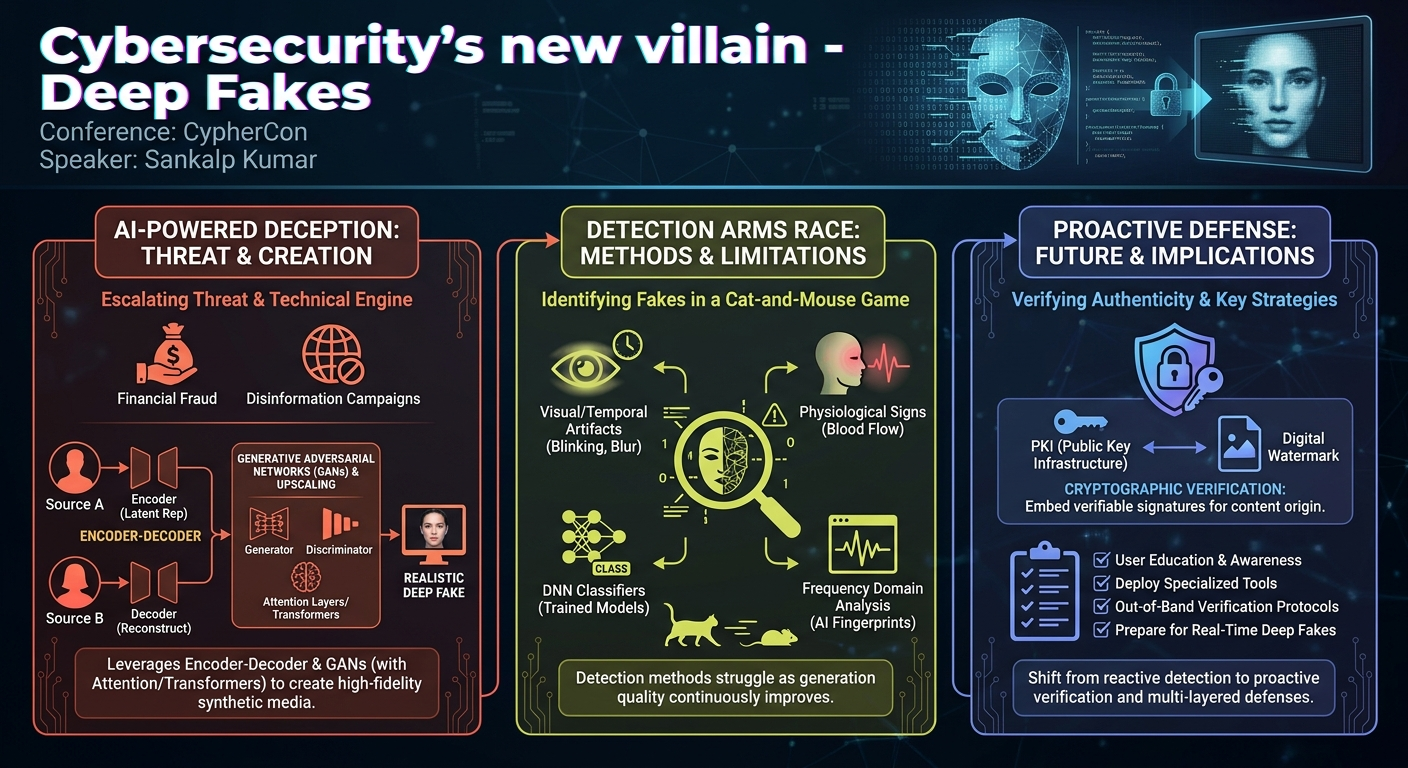
Secondly, Kumar details the two-pronged technical process behind deep fake creation. The core face-swapping mechanism relies on encoder-decoder networks, where an encoder learns to compress a person's face into a numerical latent representation, and a decoder learns to reconstruct a face from such a representation. By combining Alice's encoded face representation with Bob's decoder, a deep fake of Bob's face on Alice's body can be generated. To enhance realism and image quality, these generated fakes are then refined using Generative Adversarial Networks (GANs). GANs involve a competitive interplay between a generator (creating fakes) and a discriminator (identifying fakes), continuously improving the synthetic media through processes like GAN upscaling until it becomes indistinguishable from real content.
Thirdly, the presentation outlines the current landscape of deep fake detection techniques, categorized into several approaches. These include identifying visual and temporal artifacts (e.g., blurring, motion inconsistencies, unnatural blinking, missing details like the end of a chain), detecting subtle physiological signs (e.g., lack of natural blood flow variation, absence of unique human mannerisms), employing deep neural networks (DNNs) for automated classification of real versus fake media, and utilizing frequency domain analysis (e.g., Fourier Transform) to uncover unique "fingerprints" left by upsampling processes in deep fakes.
Finally, Kumar emphasizes that as deep fake generation models become increasingly sophisticated, current detection methods that rely on identifying subtle imperfections may become obsolete. He posits that future-proof defenses will likely necessitate cryptography-based methods, such such as Public Key Infrastructure (PKI) and digital watermarks, to verify the origin and authenticity of digital content. This highlights a shift from reactive detection of fakes to proactive verification of legitimate media, requiring widespread adoption and collaboration across industries.
Technical Deep Dive
▶ Watch: Detecting deepfakes: visual artifacts and physiological signs (12:00)
The technical prowess behind deep fakes is rooted in advanced machine learning, particularly deep learning architectures. Sankalp Kumar meticulously breaks down these components, starting with foundational concepts and building up to the sophisticated mechanisms that enable realistic synthetic media.
At its core, machine learning aims to find patterns and make predictions. Kumar begins with linear regression, represented by the equation y = mx + c. This simple model learns to draw a straight line through data points, using known x and y values to determine the slope (m) and y-intercept (c). Once m and c are learned during a training phase, new x inputs can predict y outputs. Building on this, neurons introduce non-linearity, representing more complex relationships by using matrices instead of simple m and c values. Connecting multiple neurons forms a fully connected neural network, capable of learning intricate patterns.
The true breakthrough for deep fakes, however, came with the attention layer and its integration into Transformers. The attention layer is a crucial mechanism that allows a neural network to focus on specific, relevant parts of its input data. For instance, when processing an image, the attention layer can direct the model's focus to critical facial landmarks like eyes, nose, and the distances between them. This selective focus enables the model to generate much more coherent and realistic output by prioritizing the most informative features, leading to the high-quality deep fakes we see today.
The creation of deep fakes, particularly face swapping, primarily leverages an encoder-decoder architecture. The process involves:
- Encoder: This network takes a person's face (e.g., Alice's) and compresses it into a numerical, high-dimensional representation called a latent representation or "hidden state." This effectively extracts the unique features of Alice's face into a compact numerical format. The same is done for another person (e.g., Bob).
- Decoder: This network learns to reconstruct a face from a latent representation. For face swapping, the key insight is to take Alice's latent representation (encoded features of Alice's face) and feed it into Bob's decoder. Since Bob's decoder has learned how to generate Bob's face from a latent representation, it will apply Bob's facial characteristics to Alice's underlying features, effectively putting Bob's face on Alice's head.
To make these generated faces even more realistic and indistinguishable from real images, Generative Adversarial Networks (GANs) are employed. A GAN consists of two competing neural networks:
- Generator: This network's goal is to create synthetic images that are as realistic as possible, aiming to fool the discriminator.
- Discriminator: This network's goal is to accurately distinguish between real images and the fake images produced by the generator.
These two networks engage in a continuous "cat and mouse" game, with the generator improving its fakes and the discriminator improving its detection capabilities. This adversarial training drives both networks to higher levels of performance.
A key component of GANs for deep fake quality improvement is GAN upscaling. This process enhances image resolution and detail by adding more pixels. It uses a kernel (a small matrix of numbers) that is moved over input pixels (e.g., A, B, C, D). During training, the GAN learns the optimal values within this kernel to expand the image and intelligently insert new pixels, thereby increasing quality. The discriminator provides feedback, guiding the generator to adjust these kernel values to produce more convincing, higher-resolution images.
Detecting deep fakes is a continuous arms race against these generation techniques. Kumar outlines several detection methods:
- Visual and Temporal Artifacts: These are direct observable clues. Visual artifacts include blurring around the swapped face area, inconsistent lighting, or unnatural facial features (e.g., the incomplete chain on Pope Francis's image). Temporal artifacts in videos involve motion inconsistencies or unnatural blinking patterns (as deep fake models sometimes fail to replicate natural human blinking).
- Subtle Physiological Signs: Live human beings exhibit subtle signs like variations in skin color due to blood flow, or unique micro-expressions. Current deep fake models often struggle to replicate these nuanced physiological cues accurately.
- Deep Neural Networks (DNNs) for Classification: A common approach is to train another machine learning model, typically a DNN, to act as a classifier. This DNN is fed a dataset of both real and known fake images, learning the distinguishing features to classify new inputs as "real" or "fake."
- Frequency Domain Analysis: This advanced technique involves transforming an image from its spatial domain (pixels and colors) into the frequency domain using a Fourier Transform. In the frequency domain, patterns related to how quickly colors and brightness change across an image become apparent. Natural images tend to have consistent low-frequency components (smooth transitions). Deep fakes, especially those generated with upsampling techniques, often exhibit distinct high-frequency patterns or "fingerprints." Kumar explains that the overlapping nature of the upsampling kernel can leave a specific, detectable pattern—like a "star" shape in the frequency analysis—that is indicative of AI generation.
- Cryptography-Based Methods (PKI/Watermarks): Acknowledging that AI generation will eventually overcome artifact-based detection, Kumar proposes cryptography as a more robust, long-term solution. This involves embedding a digital signature or watermark, secured by a private key, directly into the content at its source. Other parties can then use a corresponding public key to verify the content's origin and authenticity. This shifts the paradigm from detecting fakes to verifying legitimate content, requiring widespread adoption by content creators and platforms (e.g., OpenAI embedding watermarks in generated images) and client-side verification. In corporate settings, existing PKI infrastructure used for identity verification could be leveraged for real-time video communications.
Demo / Proof of Concept
▶ Watch: Detecting deepfakes: ML and frequency domain analysis (13:50)
While the talk includes compelling visual examples to illustrate deep fake artifacts—such as the image of Pope Francis with an unusual jacket and an incomplete chain, and a diagram showing abnormal blinking patterns in deep fake videos—Sankalp Kumar does not present a live technical demonstration or a proof of concept of deep fake generation or detection tools in action. The presentation focuses on explaining the underlying mechanisms and showcasing static examples to clarify concepts.
Defensive Implications
▶ Watch: Q&A: Real-time deepfake deployment and PKI verification (18:45)
The rise of deep fakes necessitates a multi-faceted defensive strategy for individuals, organizations, and the broader cybersecurity community. Based on Sankalp Kumar's insights, several key implications emerge:
- Enhanced User Education and Awareness: The most immediate defense is educating users about the existence and capabilities of deep fakes. Individuals must be trained to critically evaluate digital media, especially in high-stakes situations. Awareness campaigns should highlight common visual and temporal artifacts, such as unnatural blinking, blurring around facial edges, or inconsistencies in lighting and movement, as discussed by Kumar. Users should be inherently suspicious of unexpected or unusual requests, particularly those involving financial transactions.
- Deployment of AI-Powered Detection Tools: Organizations should integrate and utilize specialized deep fake detection software. Kumar mentions several real-world tools:
- Microsoft's detection tool: Focuses on analyzing visual artifacts like fading and blurring between frames.
- Fake Catcher: Developed to identify subtle physiological signs, such as unnatural blood flow patterns.
- Sensity AI: Employs ensemble methods, combining multiple detection techniques and taking a "vote" to determine the likelihood of a deep fake, improving accuracy.
- DARPA's Media Forensics: A comprehensive suite of tools for robust media authentication.
While these tools are valuable, defenders must acknowledge the ongoing arms race, as detection methods need continuous updates to keep pace with improving generation techniques.
- Implementation of Out-of-Band Verification Protocols: For critical communications, especially financial transfers or sensitive corporate decisions discussed in virtual meetings, organizations must establish strict out-of-band verification protocols. As demonstrated by the $25 million deep fake scam, relying solely on visual or auditory confirmation in a video call is no longer sufficient. Any request for significant action should be verified through a separate, trusted channel (e.g., a phone call to a known number, a secure messaging app) to confirm the identity of the requester.
- Advocacy for and Adoption of Cryptographic Verification: Kumar strongly advocates for cryptography-based methods like PKI (Public Key Infrastructure) and digital watermarking as the most robust long-term defense. Defenders should push for industry-wide adoption of standards where content creators (e.g., AI image generators like OpenAI, social media platforms) embed verifiable digital signatures into their media. This would allow users and systems to verify the origin and authenticity of content using public keys. In corporate environments, existing PKI used for identity and access management could be extended to authenticate participants in real-time video conferences, ensuring that the person on screen is indeed the legitimate individual. This requires collaboration across technology providers to create an open and interoperable framework.
- Preparation for Real-Time Deep Fakes: The talk confirms that real-time deep fakes, where an individual can manipulate their appearance and voice during a live webcam call, are already a reality. This poses a significant threat to virtual meetings and identity verification processes. Defensive strategies must account for this, potentially involving multi-factor authentication for meeting participants, continuous biometric analysis (if technically feasible and ethically permissible), and robust session integrity checks.
In essence, defending against deep fakes requires a proactive, layered approach that combines human vigilance, advanced technical detection, stringent verification protocols, and a forward-looking embrace of cryptographic authentication.
Key Takeaways
- Deep fakes are a significant and escalating cybersecurity threat, capable of orchestrating massive financial fraud (e.g., the $25 million corporate transfer) and widespread disinformation campaigns (e.g., Russia's "Doppelganger" operation).
- The proliferation and realism of deep fakes are driven by advanced AI architectures, specifically the attention layer and Transformers, which enable models to focus on critical features like facial landmarks during generation.
- Deep fake creation involves a two-stage process: encoder-decoder networks for core face swapping and Generative Adversarial Networks (GANs), including GAN upscaling, to enhance realism and image quality through adversarial training.
- Current detection methods include identifying visual and temporal artifacts (e.g., blurring, unnatural blinking, missing details), analyzing subtle physiological signs (e.g., lack of natural blood flow), employing deep neural networks (DNNs) for classification, and using frequency domain analysis (e.g., Fourier Transform) to reveal unique AI-generated "fingerprints."
- As deep fake generation improves, detection methods relying on imperfections will become less effective. The future of defense lies in cryptography-based methods such as PKI (Public Key Infrastructure) and digital watermarks to verify content origin and authenticity, requiring widespread adoption by creators and platforms.
- Defenders must implement rigorous out-of-band verification protocols for critical communications, educate users on deep fake awareness, deploy specialized detection tools, and prepare for the immediate threat of real-time deep fakes in virtual environments.
About the Speaker(s)
Sankalp Kumar is a software engineer with approximately seven years of experience in the field. His professional background includes building security software, having contributed to the development of Intrusion Prevention Systems (IPS) for McAfee and working as part of the security team at Juniper Networks. Kumar specializes in network defenses and holds a strong passion for artificial intelligence, which drives his interest in topics such as deep fakes and their implications for cybersecurity.
Reviews
Dr. Zero (Offensive Security Researcher) — WEAK
Sankalp spent 45 minutes explaining y = mx + c and the Pope's AI puffer jacket to a room full of hackers. This is an HR awareness video disguised as a conference talk, offering zero novel research or usable signal.
Heather Calloway (CISO) — SOLID
A competent, accessible primer on how deep fakes are generated and why visual detection is a losing game. The technical breakdown of GANs is interesting, but the real value is the conclusion: defending against synthetic media requires process engineering and cryptographic trust, not just better human observation.