Invisible Gateways: How Threat Actors Exploit IoT to Breach Organizations
Phillip Wylie
Overview
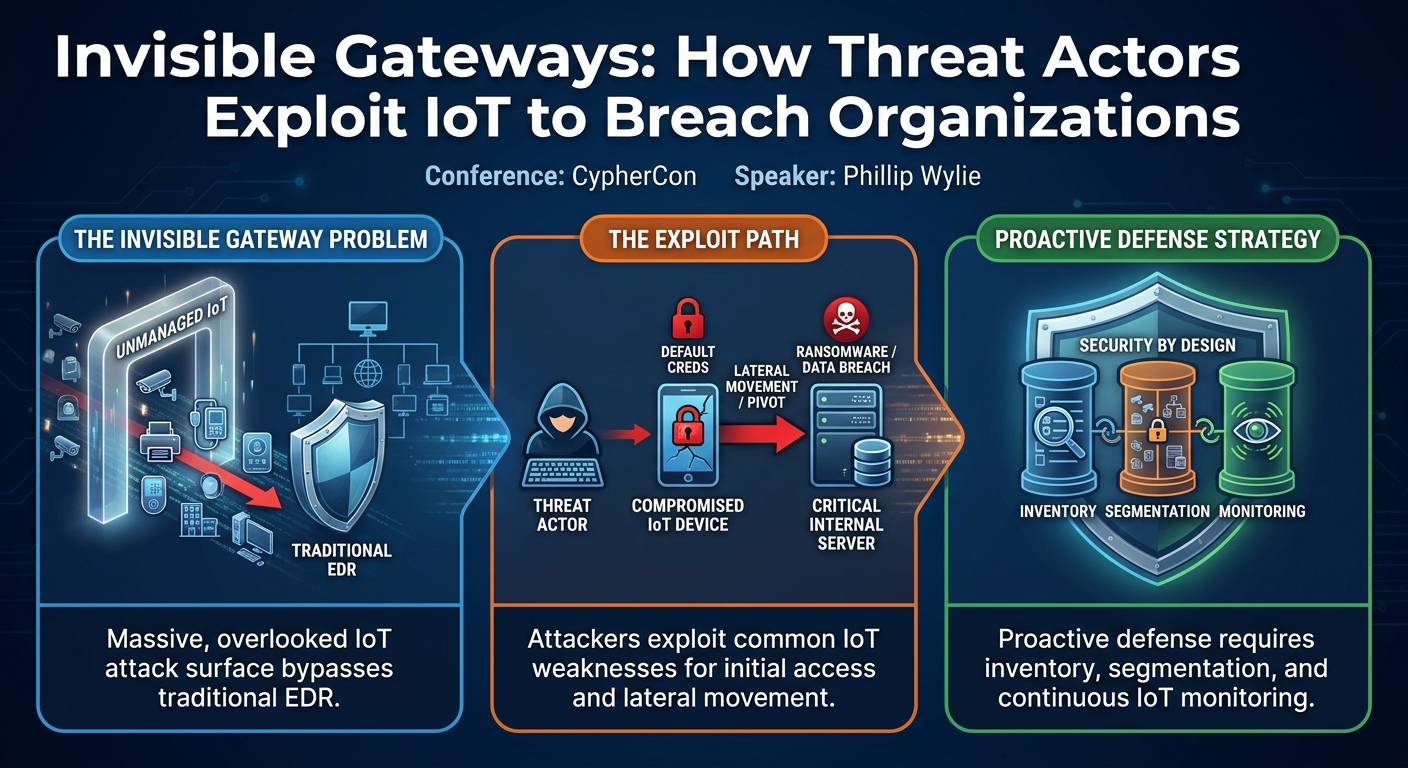
In his CypherCon talk, "Invisible Gateways: How Threat Actors Exploit IoT to Breach Organizations," Phillip Wylie, Chief Security Evangelist and Senior Consultant at Suzu Labs, sheds light on an increasingly critical and often overlooked attack vector: Internet of Things (IoT) devices. Inspired by real-world incidents like the Akira ransomware attack, Wylie argues that as traditional endpoint detection and response (EDR) systems become more sophisticated, threat actors are pivoting to less conventional entry points. IoT devices, once seen merely as convenience tools, have evolved into "invisible gateways" that sophisticated — and sometimes unsophisticated — attackers are actively exploiting to bypass established security controls and compromise enterprise networks.
Key moments
- 2:00 Talk inspiration: Akira ransomware and pentesting footholds.
- 4:50 Explaining IoT as an overlooked, invisible gateway for threats.
- 8:00 Common IoT misconfigurations: default credentials, weak segmentation.
- 10:50 Real-world case study: Akira ransomware exploiting security cameras.
- 18:00 How threat actors exploit ISO out-of-band management systems.
- 20:10 Immediate defense strategies: inventory, segmentation, changing defaults.
- 22:00 Practical recommendations and long-term security by design solutions.
Invisible Gateways: How Threat Actors Exploit IoT to Breach Organizations
Speakers: Phillip Wylie, Chief Security Evangelist and Senior Consultant, Suzu Labs
Conference: CypherCon
YouTube: https://www.youtube.com/watch?v=lOkcs5-E4qQ
Overview
In his CypherCon talk, "Invisible Gateways: How Threat Actors Exploit IoT to Breach Organizations," Phillip Wylie, Chief Security Evangelist and Senior Consultant at Suzu Labs, sheds light on an increasingly critical and often overlooked attack vector: Internet of Things (IoT) devices. Inspired by real-world incidents like the Akira ransomware attack, Wylie argues that as traditional endpoint detection and response (EDR) systems become more sophisticated, threat actors are pivoting to less conventional entry points. IoT devices, once seen merely as convenience tools, have evolved into "invisible gateways" that sophisticated — and sometimes unsophisticated — attackers are actively exploiting to bypass established security controls and compromise enterprise networks.
Wylie's presentation serves as a stark warning to organizations that have embraced IoT for its efficiencies without fully grasping its profound security implications. He meticulously details how these devices, ranging from security cameras and printers to medical equipment and building management systems, present an expanding and vulnerable attack surface. The core message is clear: the sheer volume, often unmanaged nature, and inherent security weaknesses of IoT devices make them prime targets for initial access, lateral movement, and ultimately, significant data breaches and ransomware attacks.
The talk not only dissects the current threat landscape, illustrating real-world attack techniques with compelling case studies, but also provides a comprehensive framework of practical defense strategies. Wylie emphasizes that organizations must adopt a proactive, security-by-design approach to IoT, integrating these devices into their overall cybersecurity posture rather than treating them as isolated, low-risk assets. His insights are crucial for any organization grappling with the pervasive deployment of IoT and seeking to fortify its defenses against evolving cyber threats.
Background
▶ Watch: Talk inspiration: Akira ransomware and pentesting footholds. (2:00)
The evolution of cyber warfare has seen a constant cat-and-mouse game between defenders and attackers. As traditional security measures, particularly endpoint detection and response (EDR) systems, have become more robust, threat actors have been forced to innovate, seeking new and less conventional routes into corporate networks. Phillip Wylie highlights that this shift has led attackers to focus on Internet of Things (IoT) devices, which have historically been an afterthought in enterprise security strategies.
Wylie draws parallels to early pentesting techniques, where gaining a foothold often involved exploiting physical access to devices like printers to extract credentials from configurations or using tools like Responder to intercept network traffic and perform pass-the-hash attacks. These methods, once common, are now being adapted and scaled by threat actors to target the burgeoning IoT landscape. The problem is exacerbated by organizations' rapid adoption of IoT for operational efficiencies, often without a corresponding investment in security. This rush has led to the deployment of devices that are frequently unmanaged, unmonitored, and often unpatchable at scale, creating an ever-expanding attack surface.
The statistics presented are alarming: over 75 billion IoT devices were projected for 2025, vastly outnumbering traditional endpoints like servers and workstations. Compounding this, 97% of organizations reportedly struggle with IoT security challenges, and a staggering 57% of IoT devices are vulnerable to medium-to-high severity attacks. Many of these devices, such as printers, cameras, and Baseboard Management Controllers (BMCs), are routinely ignored in security strategies, embodying an "out of sight, out of mind" mentality. This neglect means that while traditional IT infrastructure often benefits from hardened perimeters, monitored endpoints, regular patching, and centralized security controls, the "IoT reality" is one of bypassed security controls, unmanaged devices, irregular or non-existent updates, and distributed, often forgotten, assets.
Common IoT misconfigurations further illustrate the fundamental security gaps. These include the widespread use of default credentials (e.g., admin/admin, root/root) that are never changed, unencrypted communications via plain text protocols like HTTP, Telnet, and FTP instead of HTTPS or SSH, and missing or weak authentication mechanisms. Furthermore, many devices suffer from open management systems, known firmware vulnerabilities (often cataloged as CVEs), outdated components, weak or nonexistent network segmentation (allowing IoT devices direct access to corporate networks), and inadequate monitoring or logging. Even physical security is often neglected, with devices easily accessible for tampering. These fundamental weaknesses combine to make IoT devices an irresistible target for threat actors seeking an "invisible gateway" into an organization.
Key Findings
▶ Watch: Common IoT misconfigurations: default credentials, weak segmentation. (8:00)
Phillip Wylie's talk unequivocally establishes IoT devices as an overlooked and underestimated insider threat, serving as "invisible gateways" that sophisticated threat actors are actively exploiting to bypass traditional security controls. The core finding is that the very characteristics making IoT convenient – pervasiveness, connectivity, and often a lack of robust security oversight – transform them into critical entry points for attackers.
Wylie highlights several key discoveries and contributions:
- Ubiquity and Neglect: IoT devices are proliferating at an unprecedented rate, projected to reach over 75 billion by 2025. Despite this, they are routinely ignored in security strategies, with 97% of organizations struggling with their security and 57% vulnerable to medium-to-high severity attacks. This neglect makes them prime targets for attackers who capitalize on the fact that "most people aren't expecting a security camera to be a risk or a printer or other connected devices."
- Bypassing Traditional Defenses: As EDR and other endpoint protections improve, threat actors are demonstrating a clear pivot to IoT devices to gain initial access. These devices often operate outside traditional security boundaries, offering new entry points that extend beyond hardened perimeters and monitored endpoints.
- Real-World Attack Validation: Wylie provides compelling case studies that demonstrate successful and devastating exploitation of IoT devices:
- The Akira ransomware attack leveraged a Linux-based security camera as a pivot point after EDR systems blocked initial attempts. Attackers gained access to the camera, used SMB shares to move laterally, and encrypted internal servers. This illustrates the "invisible gateway" concept in action.
- Print Nightmare (CVE 2021-34527 and CVE 2021-1675), a critical Windows print spooler vulnerability, allowed remote code execution with system privileges. Wylie notes that printers are often unmonitored IoT attack vectors, with 61% of companies experiencing print-related data loss and 447,000+ printers globally estimated to be unsecured.
- Healthcare IoT exposure revealed that 82% of healthcare organizations experienced cyberattacks targeting IoT devices, costing an average of $346,250 per incident. Over 1 million medical IoT devices, including MRI machines and infusion pumps, are exposed globally, often running outdated operating systems and connected to critical networks without segmentation. The speaker even recounts a pentest where medical devices in ERs and operating rooms were connected to Wi-Fi.
- The Tomra ransomware attack impacted 82% of reverse vending machines within Tomra's IoT network, resulting in a $120 million cost and two months to restore operations.
- An older but significant case involved a Las Vegas casino breached via its HVAC system, demonstrating how building management systems can serve as corporate network entry points.
- iLO/BMC as Critical Targets: Wylie specifically calls out iLO (Integrated Lights-Out) and other Baseboard Management Controllers (BMCs) as highly critical targets. These out-of-band management systems, designed for remote server administration, can be exploited to intercept credentials, execute malicious code, replace firmware with backdoors (as seen with the iLO Bleed implant), and even gain direct memory access. They represent a powerful vector for persistence and privilege escalation, even when the main server OS is down.
These findings underscore a significant gap in enterprise security, where the rapid deployment of IoT has outpaced the implementation of adequate security controls, leaving a vast, vulnerable, and largely undetected attack surface.
Technical Deep Dive
▶ Watch: Real-world case study: Akira ransomware exploiting security cameras. (10:50)
The technical core of Wylie's presentation dissects the various stages of an attack leveraging IoT devices, from initial compromise to post-exploitation activities, and highlights specific vulnerabilities and attack tools. The overarching theme is how threat actors exploit common IoT weaknesses to circumvent traditional security measures.
The typical attack chain begins with reconnaissance, where attackers (or pentesters) scan and enumerate devices in the environment. This involves fingerprinting devices, identifying software versions, and checking for known exploits. Initial compromise then follows, often by exploiting default credentials (e.g., admin/admin, root/root), unpatched vulnerabilities (CVEs), or weak authentication mechanisms. Password stuffing and password reuse are also common, where credentials from previous breaches are tried against IoT devices, or system accounts with shared passwords across different devices are exploited. A critical point Wylie makes is the danger of password reuse, citing cases where passwords from ISO systems were reused in Active Directory environments, granting attackers wide-ranging access.
Once initial access is gained, attackers focus on lateral movement, using the compromised IoT device as a pivot point to access other corporate network segments. This is followed by establishing persistence to maintain access and exfiltration of sensitive data or deployment of further payloads, such as ransomware.
Wylie outlines specific Attacker TTPs (Tactics, Techniques, and Procedures):
- Initial Access:
- Credential Stuffing: Automated attempts to log in using stolen credentials.
- Firmware Exploitation: Exploiting vulnerabilities in device firmware.
- Physical Device Tampering: Direct manipulation of devices, though less scalable.
- Supply Chain Compromise: Injecting vulnerabilities before devices reach the organization.
- Post-Exploitation:
- Network Reconnaissance: Mapping the internal network from the compromised IoT device.
- Credential Harvesting: Stealing credentials from the device or network traffic it can access.
- Botnet Recruitment: Enrolling the device into a botnet for DDoS or other malicious activities.
- Data Exfiltration: Extracting sensitive information.
Several real-world case studies illustrate these TTPs:
- Akira Ransomware Attack: This attack exemplifies lateral movement and persistence. After EDR systems blocked initial attempts, attackers pivoted to a Linux-based security camera. From this camera, they were able to establish an SMB share connection to internal servers, subsequently encrypting their drives. This highlights how an unmonitored IoT device can become a launchpad for widespread network compromise.
- Print Nightmare: This vulnerability involved two critical Windows print spooler vulnerabilities: CVE 2021-34527 and CVE 2021-1675. These allowed remote code execution (RCE) with system privileges, affecting all Windows versions. Attackers could exploit the print spooler to install malicious drivers, gain system-level access, and use the printer as a pivot point for lateral movement. The fact that printers are often overlooked and wirelessly connected amplifies this risk, with 447,000+ printers globally estimated to be unsecured.
- iLO/BMC Systems and iLO Bleed Implant: Wylie dedicates significant attention to Integrated Lights-Out (iLO) and similar Baseboard Management Controllers (BMCs) (e.g., iDRAC for Dell). These systems provide out-of-band management, allowing administrators to manage servers remotely, even when the operating system is down. However, this power makes them critical targets. Attackers can intercept credentials used for iLO access, which can then be reused elsewhere due to poor password hygiene.
- The iLO Bleed implant is a specific, sophisticated threat. It affects Gen 8 and Gen 9 servers with iLO 4, and potentially earlier models. Even newer Gen 2 and iLO 5 systems can be affected via firmware downgrades. Its capabilities are extensive:
- Extract cleartext passwords from the server.
- Execute malicious code with system-level privileges.
- Replace iLO firmware with a backdoor version, providing persistent, stealthy access.
- Perform host-to-host iLO and iLO-to-host arbitrary code execution.
- Gain direct memory access (DMA) on systems, bypassing OS-level protections.
This demonstrates how a compromised BMC can provide deep, persistent, and highly privileged access that is difficult to detect and remove, even surviving OS reinstallation or system reboots. The fact that these systems are often managed using common system accounts increases the risk of password reuse leading to wider compromise.
These examples underscore that IoT devices are not merely isolated endpoints but integral components of the enterprise network, and their vulnerabilities can be leveraged to compromise the entire infrastructure.
Demo / Proof of Concept
▶ Watch: Immediate defense strategies: inventory, segmentation, changing defaults. (20:10)
While Phillip Wylie's talk did not feature a live, explicit demonstration or proof-of-concept during the presentation, his insights are deeply rooted in his extensive experience as an offensive security professional and pentester. He frequently references methodologies and techniques that he and his team at Suzu Labs have successfully employed in real-world engagements, such as using physical access to printers for credential harvesting, leveraging tools like Responder, and exploiting known iLO vulnerabilities. These anecdotes serve as practical validations of the attack vectors discussed, illustrating the feasibility and impact of exploiting IoT devices as "invisible gateways."
Defensive Implications
▶ Watch: Practical recommendations and long-term security by design solutions. (22:00)
Phillip Wylie provides a robust framework for defending against IoT-based attacks, emphasizing that organizations must treat these devices with the same, if not greater, rigor as traditional IT assets. The defensive strategy is broken down into immediate actions and long-term solutions, culminating in practical recommendations.
Immediate Actions:
- Inventory and Discovery: The foundational step is to know what you have. Organizations must perform comprehensive asset inventory and discovery to identify all IoT devices on their networks. Without a clear understanding of the device landscape, it's impossible to assess security posture or identify vulnerabilities. This includes keeping up-to-date records, similar to traditional IT systems, to track device versions and patch status.
- Network Segmentation: Isolate IoT devices from critical systems. Implementing network segmentation and micro-segmentation ensures that even if an IoT device is compromised, attackers cannot easily pivot to high-value assets. This limits the blast radius of an attack.
- Default Security: Immediately change all default credentials on IoT devices. Beyond this, Wylie recommends periodically rotating passwords, acknowledging that even custom passwords can be compromised through breaches and reused. The core principle is to apply the same robust security hygiene to IoT as to traditional IT devices.
- Monitoring: Implement IoT-specific security controls and monitoring. This includes active logging and anomaly detection to identify unusual behavior that might indicate a compromise, as many IoT breaches go undetected for months.
Long-Term Solutions (Security by Design):
- Integrate Security into Procurement and Lifecycle Management: Security considerations for IoT devices must begin at the procurement stage, not as an afterthought. Organizations should plan for patches and updates throughout the device's lifecycle. If a device reaches an end-of-life stage where it can no longer receive security updates, it should be replaced, just like any other outdated IT hardware.
- Zero Trust: Adopt a Zero Trust architecture for IoT devices. This means never trusting any device by default, regardless of its location. All devices, including IoT, must be authenticated, authorized, and continuously validated.
Practical Recommendations:
- Security Controls:
- Deploy IoT Security Platforms: Utilize specialized platforms that can identify default credentials, assist in password rotation, monitor for vulnerabilities, and provide visibility into IoT device behavior.
- Implement Micro-segmentation: Further refine network segmentation to isolate individual devices or small groups of devices, minimizing lateral movement.
- Use Certificate-Based Authentication: Move beyond passwords where possible, leveraging stronger certificate-based authentication for IoT devices.
- Enable Device-Level Encryption: Encrypt data at rest and in transit on IoT devices to protect sensitive information.
- Deploy Behavioral Analytics: Monitor device behavior for deviations from baselines, which can indicate compromise or malicious activity.
- Process and Governance:
- Establish IoT Security Policies: Develop clear, comprehensive security policies specifically for IoT devices, covering their deployment, management, and use.
- Create Device Lifecycle Procurement: Ensure policies are in place for the secure acquisition, deployment, maintenance (including patching), and eventual secure decommissioning of IoT devices.
- Implement Security Assessments: Regularly include IoT devices in vulnerability scanning, penetration testing, and security audits.
- Train Operational Staff: Educate IT and operational staff on IoT security best practices, risks, and incident response procedures.
- Plan Incident Response: Integrate IoT devices into the organization's overall incident response plan. This ensures that when an IoT device is compromised, there is a predefined process for detection, containment, eradication, and recovery. Wylie notes that this often involves adding to existing plans rather than creating entirely new ones, making the lift manageable.
By implementing these defensive strategies, organizations can transform their "invisible gateways" from security liabilities into managed and protected assets, significantly reducing their attack surface and enhancing their overall cybersecurity posture.
Key Takeaways
- IoT Devices are Critical Attack Vectors: IoT devices are no longer mere conveniences but represent a rapidly expanding and often unmonitored attack surface, actively exploited by threat actors to bypass traditional security controls.
- Traditional Security is Insufficient for IoT: Standard perimeter defenses and endpoint monitoring often fail to account for the unique characteristics and vulnerabilities of IoT devices, which are frequently unmanaged, unpatchable, and operate outside typical security boundaries.
- Common Misconfigurations Lead to Easy Exploitation: Default credentials, unencrypted communications, weak authentication, and unpatched firmware are prevalent issues that provide straightforward entry points for attackers, as evidenced by major ransomware incidents.
- Real-World Breaches Highlight Severe Impact: Case studies like the Akira ransomware attack, Print Nightmare, and healthcare IoT exposures demonstrate that compromised IoT devices can lead to lateral movement, data exfiltration, system-wide encryption, and significant financial and operational costs.
- Proactive Defense Requires Comprehensive Strategy: Effective defense against IoT threats demands a holistic approach, including rigorous asset inventory, robust network segmentation, strong credential management, continuous monitoring, and integrating security into the entire device lifecycle from procurement to decommissioning.
- Treat IoT with Equal (or Greater) Security Rigor: Organizations must elevate the security priority of IoT devices, applying the same, if not more stringent, security hygiene, policies, and incident response planning as they do for traditional IT assets, moving towards a Zero Trust model.
About the Speaker(s)
Phillip Wylie is a highly experienced and respected professional in the cybersecurity field, currently serving as the Chief Security Evangelist and Senior Consultant at Suzu Labs, a company specializing in pentesting and other cybersecurity services. With over a decade dedicated to offensive security and more than 22 years in the broader cybersecurity landscape, Wylie brings a wealth of practical knowledge and real-world experience to his presentations.
Beyond his consulting work, Phillip is an active voice in the cybersecurity community. He is a prolific podcaster, hosting "The Phillip Wylie Show" (formerly "The Hacker Factory podcast") and "Simply Offensive," and co-hosts "Cyber Hackcast." He is also the concept creator and co-author of "The Pentester Blueprint," a foundational book designed to guide aspiring pentesters through the prerequisites and initial steps of a career in offensive security. Before his career in IT and cybersecurity, Wylie had a unique past as a professional wrestler, even famously wrestling a 750lb bear in his early twenties. He also previously served as an adjunct instructor at Dallas College.
Reviews
Dr. Zero (Offensive Security Researcher) — WEAK
This is an awareness seminar masquerading as a threat briefing. We've been telling people to put their printers on a separate VLAN and change admin/admin since the Bush administration. Fills a slot at a regional IT expo, but it's a waste of breath at a real security con.
Heather Calloway (CISO) — SOLID
A practical, evidence-based reminder that threat actors are bypassing expensive EDR by pivoting through unmanaged hardware and out-of-band management interfaces. It doesn't break new conceptual ground, but it clearly ties neglected asset classes to specific ransomware campaigns. Worth your infrastructure lead's time to validate your network segmentation assumptions.