This Little Brite of Mine: Mobile Forensics for Fun and (Sometimes) Profit
Kaden Payne
Overview
In "This Little Brite of Mine: Mobile Forensics for Fun and (Sometimes) Profit," Kaden Payne takes the audience on an unconventional journey into the world of mobile forensics, demonstrating how powerful, typically restricted tools from Cellebrite are surprisingly accessible to the general public. The talk demystifies the capabilities of the Universal Forensic Extraction Device (UFED) platform, a suite of tools renowned for its ability to bypass mobile device security and extract vast amounts of data, usually reserved for law enforcement and intelligence agencies. Payne's presentation highlights that these sophisticated devices, even older generations, can be acquired for minimal cost through secondary markets, opening avenues for independent research, ethical data recovery, and even profit.
Key moments
- 2:30 What is Cellebrite and its UFED platform?
- 5:00 UFED Touch capabilities: PIN bypass, data extraction
- 6:50 Finding and buying Cellebrite UFEDs on a budget
- 10:40 Real-world examples of mobile forensics in action
- 12:05 Ethical and legal considerations for mobile forensics
- 14:40 Step-by-step demo of a UFED mobile extraction
This Little Brite of Mine: Mobile Forensics for Fun and (Sometimes) Profit
Speakers: Kaden Payne
Conference: CypherCon
YouTube: https://www.youtube.com/watch?v=nubuIHuzUIA
Overview
In "This Little Brite of Mine: Mobile Forensics for Fun and (Sometimes) Profit," Kaden Payne takes the audience on an unconventional journey into the world of mobile forensics, demonstrating how powerful, typically restricted tools from Cellebrite are surprisingly accessible to the general public. The talk demystifies the capabilities of the Universal Forensic Extraction Device (UFED) platform, a suite of tools renowned for its ability to bypass mobile device security and extract vast amounts of data, usually reserved for law enforcement and intelligence agencies. Payne's presentation highlights that these sophisticated devices, even older generations, can be acquired for minimal cost through secondary markets, opening avenues for independent research, ethical data recovery, and even profit.
Payne's core message revolves around the democratization of advanced forensic capabilities. By showcasing how he personally obtained multiple Cellebrite UFED units for as little as $20, he challenges the perception that such tools are exclusively within the reach of well-funded organizations. This accessibility carries significant implications, from empowering hobbyists and independent security researchers to raising critical questions about data privacy, secure device disposal, and the ethical responsibilities that come with wielding such potent technology. The talk serves as both an educational exposé on mobile forensics and a cautionary tale about the enduring presence of sensitive data on seemingly "wiped" or discarded devices.
Background
▶ Watch: What is Cellebrite and its UFED platform? (2:30)
The foundation of Payne's discussion lies with Cellebrite, an Israeli firm globally recognized for its mission to "power digital investigations." Cellebrite's primary objective is to enhance the ability of its global customers, predominantly public sector law enforcement and intelligence communities, to protect and save lives through advanced digital forensics. Secondarily, large enterprise organizations also leverage Cellebrite's solutions, albeit at an "obscenely large price tag." The company is particularly infamous within the cybersecurity community for its prowess in bypassing security mechanisms on mobile devices, a capability that often places it at the center of privacy debates.
Cellebrite's flagship offering is the UFED platform, which comes in several iterations to suit various operational needs. These include the UFED 4PC, a software-based solution; the UFED Touch 3, their latest generation of rugged tablets; and the UFED laptop, which offers similar functionality in a more portable form factor. Beyond these, Cellebrite provides the Inseyets platform, a Software-as-a-Service (SaaS) offering that, notably, includes an "unlock" feature designed to "access locked devices to locally extract critical information." Complementary tools like the Physical Analyzer for reporting and the Digital Collector for Windows and desktop forensics further extend Cellebrite's ecosystem. The company also delves into specialized areas such as crypto solutions, endpoint forensics, and legal e-discovery tools, cementing its position as a comprehensive provider in the digital investigation landscape. Payne specifically focuses on the UFED Touch Generation 1, an older but still highly capable device he acquired, illustrating that even legacy hardware from Cellebrite retains significant forensic power. This context underscores why the availability of these tools outside their intended market is a topic of considerable interest and concern.
Key Findings
▶ Watch: Finding and buying Cellebrite UFEDs on a budget (6:50)
Kaden Payne's talk unveils several compelling key findings regarding the accessibility and utility of Cellebrite UFED devices, fundamentally altering the perception of who can perform advanced mobile forensics.
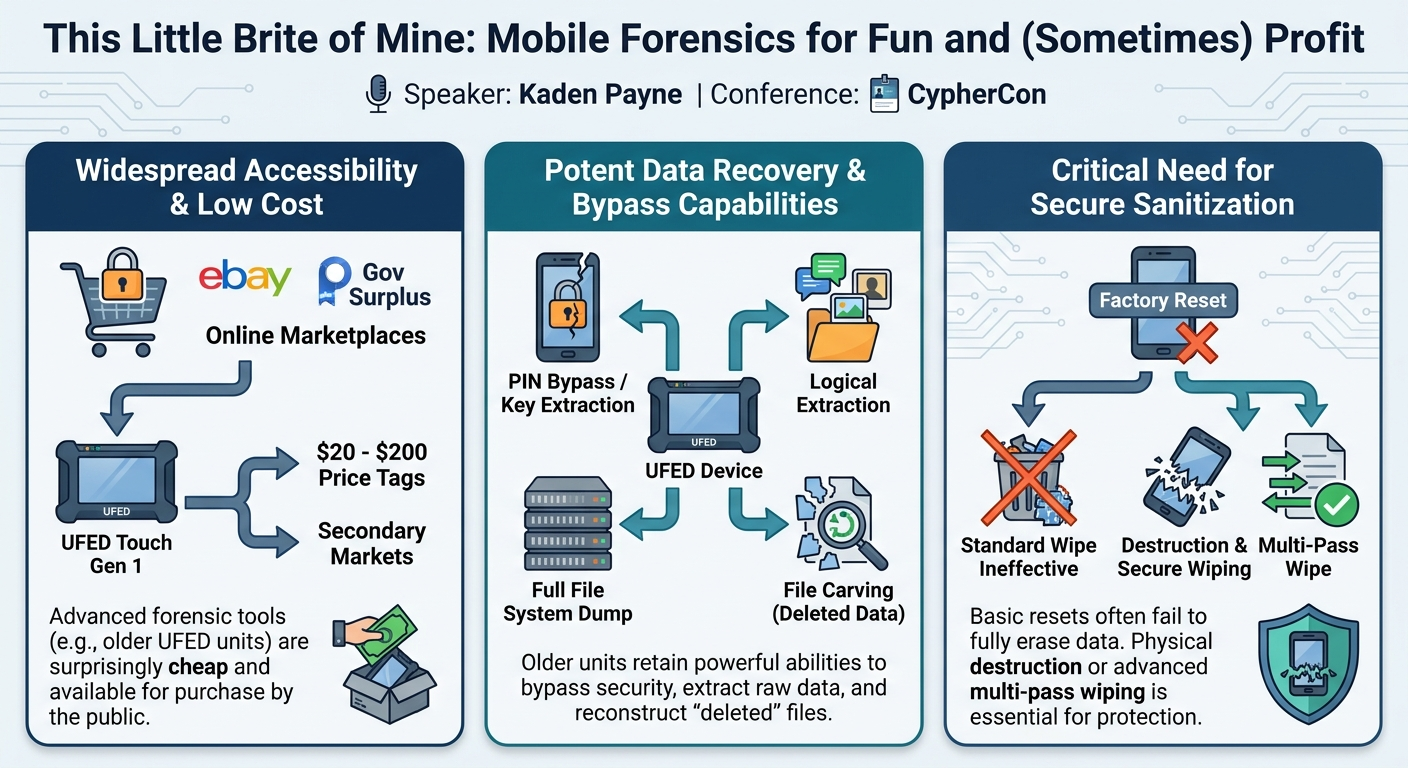
Firstly, a central discovery is the surprisingly widespread availability of Cellebrite UFED devices on the secondary market. Despite Cellebrite's apparent contractual restrictions against reselling their specialized equipment, the natural IT asset lifecycle ensures that these powerful tools frequently appear on platforms like eBay, Facebook Marketplace, OfferUp, and various government surplus auctions (e.g., GovDeals, Public Surplus, IronPlanet). Payne highlights that even newer Generation 2 units are being phased out and replaced, leading to a steady supply of older, yet still highly functional, devices entering the public domain.
Secondly, Payne demonstrates that these devices can be acquired for remarkably low prices. He recounts purchasing a UFED Touch Generation 1 from the Department of Public Safety in Arizona via Public Surplus for approximately $200. Even more strikingly, he secured a non-UFED "Touch" unit (commonly used in commercial settings for SIM swaps) for a mere $20 on Facebook Marketplace. This low entry barrier significantly democratizes access to tools traditionally reserved for well-funded organizations, enabling independent researchers and hobbyists to build their own mobile forensics capabilities.
Thirdly, the talk emphasizes that even older generations of Cellebrite UFEDs, like the Generation 1 Touch model, retain a vast array of powerful forensic capabilities. These aren't obsolete relics; they are still capable of performing logical extractions (calls, texts, pictures) and, crucially, full file system dumps. This means that even if a device is "old" or has an inactive license, it can still be a potent tool for data recovery and analysis, as evidenced by Payne's real-world examples of assisting a coworker in finding a lost phone's owner and recovering cherished memories for a grieving friend's family.
Finally, Payne touches upon the potential for "profit" through a "Costco bulk method" of resale. He showcases a listing for 427 individual Cellebrite Gen 2 units for approximately $3,000, breaking down to about $7 per unit. This illustrates a niche market where savvy individuals can acquire these devices in bulk and potentially resell them, further circulating these tools outside their intended channels. The speaker also notes that some units on the secondary market may still possess active licenses, which can provide ongoing support and updates if registered, adding further value to these unexpected finds. These findings collectively underscore a significant shift in the landscape of mobile forensics, where the tools of the trade are no longer exclusive to a select few.
Technical Deep Dive
▶ Watch: Real-world examples of mobile forensics in action (10:40)
The core of Cellebrite's offering, and the focus of Payne's technical exploration, is the UFED Touch platform, specifically the Generation 1 model he acquired. This device is not merely a data transfer tool; it's a sophisticated forensic workstation capable of deep-level data extraction and analysis. Its capabilities extend far beyond what a typical user might achieve through standard device backups or software.
One of the most significant features of the UFED Touch is its ability to extract device keys. These cryptographic keys are fundamental to the device's security, and their extraction can pave the way for deeper access and decryption of data. Coupled with this, the UFED can perform comprehensive logical extractions, dumping an extensive array of user data including calls, texts, and other messages. This data is then neatly organized and presented in user-friendly formats such as PDF and HTML reports, simplifying the review process for investigators.
Crucially, depending on the specific device and the UFED's license, the platform can bypass PIN codes entirely. This capability is a game-changer for accessing locked devices, a common hurdle in forensic investigations. The mechanism for this often involves exploiting vulnerabilities in the device's bootloader or operating system, sometimes leveraging specialized hardware adapters. Payne notes that some of the accessories included with UFED kits are colored yellow, indicating they contain firmware designed to force a phone into DFU (Device Firmware Update) or recovery mode, which can be an entry point for these bypass techniques.
Beyond logical data, the UFED Touch excels at performing raw file system dumps. This is a critical distinction, as it allows for the extraction of the entire file structure of the device, not just user-accessible files. A full file system dump is invaluable for recovering deleted information through a process known as file carving. File carving involves scanning the raw data for file headers and footers, reconstructing files even if their entries have been removed from the file system's allocation table. This means that data thought to be permanently erased can often be retrieved, highlighting a significant privacy implication.
The versatility of the UFED platform extends to other data sources as well. With the appropriate license, it can perform SIM card data extraction, retrieving contacts, messages, and other information stored directly on the SIM. Furthermore, the device supports bit-for-bit cloning of removable media like flash drives and SD cards, ensuring forensic integrity by creating an exact duplicate of the storage medium. Intriguingly, Payne mentions that certain drone models are also supported, allowing for the extraction of flight logs, GPS data, and media directly from drone storage, showcasing the evolving scope of digital forensics.
While powerful, the speaker also touched on some of the practical frustrations of working with the UFED Touch. He lamented Cellebrite's user interface design, specifically noting that the device forces users into a restricted user account and only supports extended display configurations, not mirroring. This means the primary program cannot be easily moved to an external monitor, creating an awkward workflow for presentations or multi-monitor setups. Despite these ergonomic quirks, the underlying technical capabilities of the UFED Touch Generation 1 remain robust, proving that even "crusty" older tech can still perform advanced forensic tasks.
Demo / Proof of Concept
▶ Watch: Ethical and legal considerations for mobile forensics (12:05)
Kaden Payne provided a straightforward yet effective video demonstration of the Cellebrite UFED Touch in action, illustrating just how simple it is to initiate a data extraction. The demo primarily focused on the user experience rather than the intricate technical details of the bypass mechanisms, emphasizing the "plug and play" nature of the device.
The process began with connecting a mobile device to the UFED Touch unit. Payne explained that the UFED is designed for ease of use, automatically detecting the connected device and presenting the user with a menu of options. For the demonstration, he walked through selecting a logical extraction, which is designed to pull user-level data such as pictures, contacts, and messages in a neatly formatted output. He showed the interface prompting the user to confirm the selection and then simply hitting "next."
Following this, the video depicted the UFED Touch beginning its extraction process. Payne humorously highlighted the often-overlooked aspect of digital forensics: the waiting game. He repeatedly emphasized the need to "wait" as the device communicates with the target phone, bypasses security (if applicable), and systematically extracts the data. This waiting period is a testament to the thoroughness of the extraction, which can involve deep dives into the device's memory and file system.
The demo then transitioned to showcasing a file system extraction, using a Nokia phone as the target. This more comprehensive extraction method retrieves the raw data directly from the device's storage. The video displayed the UFED Touch methodically copying all files from the Nokia phone, essentially creating a complete dump of its internal storage. Once the extraction was complete, the UFED would then process this raw data, making it available for further analysis, including file carving to recover deleted content.
Beyond these primary extraction types, Payne briefly mentioned that the UFED Touch is capable of other functions. These include interacting with SIM cards, performing bit-for-bit clones of removable devices like flash drives and SD cards, and even extracting data from certain drone models. The demo underscored that the specific functionalities available depend on the license associated with the UFED unit, which can vary when acquiring devices from the secondary market. Overall, the demonstration effectively conveyed the ease with which powerful forensic operations can be performed using Cellebrite UFED devices, highlighting their accessibility and operational simplicity.
Defensive Implications
▶ Watch: Step-by-step demo of a UFED mobile extraction (14:40)
The accessibility of Cellebrite UFED devices, as demonstrated by Kaden Payne, carries profound defensive implications for both individuals and organizations regarding mobile device security and data privacy. The fact that these powerful tools are readily available on secondary markets for minimal cost means that the capabilities previously thought to be exclusive to state-level actors or large enterprises are now potentially in the hands of a broader audience, including malicious actors or individuals with questionable ethics.
Firstly, the ability of UFEDs to perform logical and full file system extractions means that users should reconsider their assumptions about data deletion. Simply "deleting" photos, messages, or other sensitive files from a mobile device, or even performing a factory reset, is often insufficient to prevent forensic recovery. A full file system dump, combined with file carving techniques, can reconstruct seemingly erased data. This necessitates a more robust approach to data sanitization. For individuals, this might mean physically destroying old devices or utilizing advanced data wiping software that performs multiple overwrite passes, rather than simply relying on built-in reset functions.
Secondly, the UFED's capability to bypass PIN codes on a range of devices is a direct threat to the security of locked phones. While newer devices and operating systems have stronger encryption and security measures, older models or those with known vulnerabilities remain susceptible. This implies that if a device is lost or stolen, even with a PIN or pattern lock, its data may not be as secure as presumed if it falls into the hands of someone with a UFED. Users should employ the strongest available authentication methods, ensure their devices are updated to the latest OS versions, and consider remote wipe capabilities.
For organizations, the defensive implications are even more critical. Secure disposal policies for company-issued mobile devices must be re-evaluated. Simply wiping devices before resale or disposal is inadequate. Organizations should implement rigorous data sanitization protocols, potentially involving professional data destruction services or physical shredding of devices, especially those that handled sensitive corporate or client data. Furthermore, understanding the forensic capabilities of tools like UFEDs can inform the design of internal mobile security architectures, encouraging the adoption of full disk encryption and other technologies that make data extraction more difficult, even if the device itself is compromised.
Finally, Payne's discussion on the ethical considerations underscores a broader defensive implication: the need for increased awareness. Users need to understand that the digital footprint left on their devices is persistent. This awareness can drive more cautious behavior regarding what data is stored on mobile devices, how it's protected, and how devices are ultimately disposed of. The proliferation of UFEDs outside their intended secure channels serves as a stark reminder that the digital world offers few true secrets without proactive and robust defensive measures.
Key Takeaways
- Powerful Tools are Accessible: Cellebrite UFED devices, designed for law enforcement and intelligence, are readily available and affordable on secondary markets like eBay and government surplus auctions.
- Persistent Data: Even older UFED generations (e.g., Generation 1) retain significant forensic capabilities, including the ability to perform full file system dumps and recover "deleted" data through file carving.
- Bypassing Security: UFEDs can often bypass PIN codes and extract device keys, highlighting vulnerabilities in mobile device security, particularly on older or unpatched devices.
- Ethical Responsibility: The accessibility of these tools places a strong emphasis on ethical considerations when performing forensics, even on legally obtained devices, due to the inherent invasion of privacy.
- Enhanced Data Sanitization Needed: Individuals and organizations must adopt more robust data sanitization practices, such as physical destruction or professional wiping, beyond simple factory resets, to truly protect sensitive information on discarded mobile devices.
- Empowering Independent Research: The low cost and availability of UFEDs enable independent researchers and hobbyists to explore mobile forensics, fostering a broader understanding of device security and data recovery.
About the Speaker(s)
Kaden Payne is a cybersecurity enthusiast and self-proclaimed "absolute bamp" who enjoys exploring the fascinating world of technology and security, particularly in unconventional ways. While he modestly states he doesn't claim to be a forensics expert, his passion for "doing some pretty cool stuff" shines through his work. Payne spends an "obscene amount of white monster" and time on Facebook Marketplace, a habit that has led him to discover and acquire advanced forensic tools like Cellebrite UFEDs. Beyond his technical pursuits, he enjoys making music, playing guitar, and camping. Payne is also the author of a book on "vibe coding," which he describes as a "CypherCon pre-release." His talk at CypherCon exemplifies his spirit of curiosity and his knack for uncovering hidden opportunities in the cybersecurity landscape.
Reviews
Dr. Zero (Offensive Security Researcher) — WEAK
Payne bought a decade-old Cellebrite UFED Touch Gen 1 off government surplus and showed the audience how to click 'Next' in the GUI. It's a fun eBay haul, but there is absolutely zero novel research, reverse engineering, or technical depth here.
Heather Calloway (CISO) — SOLID
A practical demonstration of acquiring legacy Cellebrite forensic devices on the secondary market for under $200. While the presentation is informal, it serves as a stark, empirical reminder of why standard factory resets are inadequate for corporate mobile fleets.