So, You Want to be a Forensicator…
Catherine Ullman
Overview
In her compelling CypherCon talk, "So, You Want to be a Forensicator…," Catherine Ullman, known online as "investigator chick," delves into the intricate world of digital forensics. Responding to the frequent question of how one enters this specialized field, Ullman provides a comprehensive guide, distinguishing digital forensics from incident response and highlighting the critical skills and personality traits essential for success. The talk masterfully uses a real-world scenario involving a "missing moment" in log data to illustrate the deceptive simplicity of anti-forensic techniques and the profound necessity of deep, tenacious investigation.
Key moments
- 2:00 Introduction to digital forensics and talk agenda
- 4:00 The 'missing moment' story: a real-world forensic challenge
- 11:00 Locard's Exchange Principle and what digital forensics is
- 20:00 Training and job opportunities in digital forensics
- 31:00 Key personality traits for successful forensicators
- 39:00 Expectations vs. reality of daily forensics work
- 52:00 Q&A: The evolving future of digital forensics
- 57:00 Q&A: Handling anti-forensics tactics and missing evidence
So, You Want to be a Forensicator…
Speakers: Catherine Ullman
Conference: CypherCon
YouTube: https://www.youtube.com/watch?v=mL5LKiSL30I
Overview
In her compelling CypherCon talk, "So, You Want to be a Forensicator…," Catherine Ullman, known online as "investigator chick," delves into the intricate world of digital forensics. Responding to the frequent question of how one enters this specialized field, Ullman provides a comprehensive guide, distinguishing digital forensics from incident response and highlighting the critical skills and personality traits essential for success. The talk masterfully uses a real-world scenario involving a "missing moment" in log data to illustrate the deceptive simplicity of anti-forensic techniques and the profound necessity of deep, tenacious investigation.
Ullman, the Principal Technology Architect for Security at the University at Buffalo, draws upon her extensive 26-year career and unique experiences, including 28 years as a firefighter, to paint a vivid picture of the forensicator's role. She emphasizes that while technical acumen is important, attributes like curiosity, persistence, patience, and strong communication skills are paramount. This article explores Ullman's insights, offering a detailed look at the challenges, methodologies, and rewarding aspects of digital forensics, making a strong case for its enduring relevance in an ever-evolving threat landscape.
The presentation serves as both an educational primer for aspiring forensicators and a stark reminder for security professionals about the limitations of surface-level investigations. By dissecting a scenario where critical evidence is intentionally hidden, Ullman underscores the importance of a holistic approach to evidence collection and analysis, grounded in foundational forensic principles like Locard's Exchange Principle. Her practical advice, spanning training pathways, career opportunities, and the daily realities of the job, provides invaluable guidance for anyone considering a career in this vital cybersecurity domain.
Background
▶ Watch: Introduction to digital forensics and talk agenda (2:00)
The genesis of this talk stems from a recurring question Catherine Ullman encounters: "How do you get to do what you do?" While her specific role at the University at Buffalo is unique, the underlying desire for many is to understand the path into Digital Forensics and Incident Response (DFIR). Ullman clarifies that her focus for this presentation is specifically on digital forensics, a distinct but often conflated discipline with incident response. She sets the stage by immediately plunging into a practical, real-world scenario designed to expose the critical challenges faced by forensicators today—namely, the sophisticated tactics employed by attackers to evade detection and obscure their tracks.
Historically, incident response often directly led to deep forensic analysis. However, in today's complex threat landscape, a preliminary triage phase has become indispensable. This initial assessment helps determine the scope of an incident and what further information is required before committing extensive resources to a full forensic investigation. This evolution is partly due to the sheer volume and volatility of data, making immediate, full-system imaging impractical. The core problem this talk addresses is the inherent fragility of digital evidence, particularly logs, which attackers frequently target to create "missing moments"—periods where critical events vanish from expected records.
Ullman introduces Locard's Exchange Principle, a foundational concept from general forensics pioneered by French criminologist Edmond Locard (1877-1966). This principle, often summarized as "every contact leaves a trace," posits that it is impossible for an individual to interact with an environment without leaving some form of evidence of their presence, nor can they leave without carrying something away. While traditional forensics might involve destructive testing of physical evidence (like DNA samples), digital forensics traditionally demands non-alteration of evidence. However, Ullman highlights a modern tension: while the ideal is to make no changes, the necessity of triage in volatile situations often means some changes are unavoidable, necessitating meticulous documentation to preserve the chain of custody and maintain the forensically sound nature of the investigation.
Key Findings
▶ Watch: Locard's Exchange Principle and what digital forensics is (11:00)
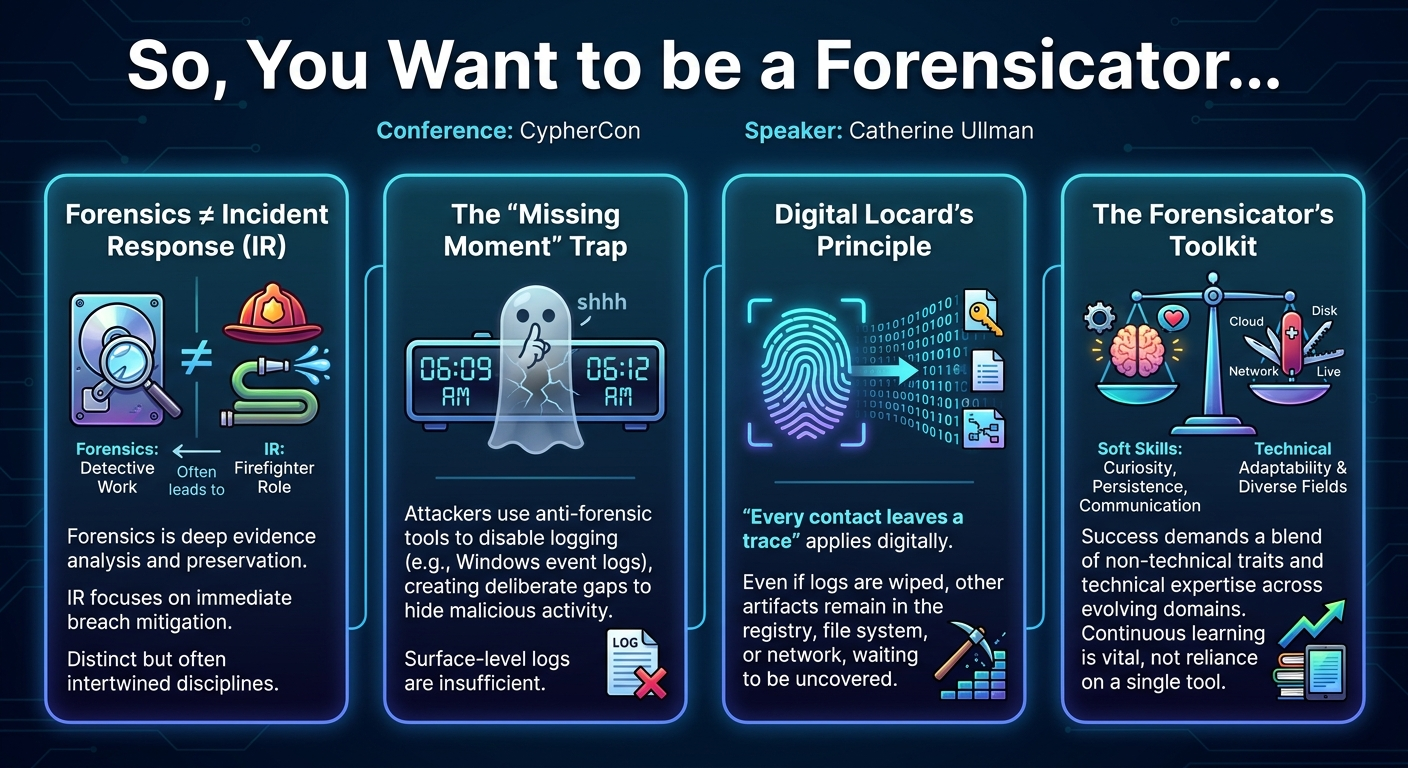
Ullman's talk reveals several critical findings that challenge conventional assumptions about digital investigations and underscore the evolving nature of the field. The central discovery, vividly illustrated through the "missing moment" scenario, is that Windows event logs, often considered a primary source of truth, are merely the "tip of the proverbial iceberg." Attackers possess sophisticated anti-forensic tools and techniques that can selectively disable or manipulate logging mechanisms, making crucial event data disappear entirely. This finding highlights a significant blind spot for entry-level analysts who might rely solely on these logs.
Despite these anti-forensic measures, Ullman reiterates the enduring truth of Locard's Exchange Principle in the digital realm: "every contact leaves a trace." Even if explicit log entries are suppressed, the underlying actions inevitably leave other forms of digital residue in places like the registry, file system metadata, or network artifacts. The challenge for the forensicator is to be curious, persistent, and tenacious enough to uncover these hidden traces.
The talk also clearly delineates the roles of digital forensics and incident response (IR). While often grouped as DFIR, Ullman emphasizes they are distinct: digital forensics is the detective work of collecting, analyzing, preserving, and examining evidence, whereas incident response is the firefighter role focused on identifying, managing, and mitigating breaches. While some individuals, like Ullman herself, perform both, many organizations separate these functions.
Furthermore, Ullman outlines the diverse landscape of digital forensics, moving beyond the traditional focus on disk images. She identifies key specializations:
- Disk-based forensics: Analyzing static disk images, typically post-incident or after initial triage.
- Live acquisition: Collecting volatile data (like running processes or memory) from active systems.
- Network monitoring and forensics: Analyzing network traffic for anomalies, data exfiltration, or command and control activity.
- Cloud forensics: A rapidly evolving and uniquely challenging area, complicated by the shared responsibility model and the ephemeral nature of cloud resources, often relying on cloud-provider-specific logs that may not always be comprehensive.
These findings collectively emphasize that effective digital forensics demands a multi-faceted approach, an understanding of anti-forensic tactics, and a deep commitment to uncovering hidden truths beyond superficial evidence.
Technical Deep Dive
▶ Watch: Key personality traits for successful forensicators (31:00)
The core of Ullman's technical deep dive is a compelling narrative of a "missing moment" – a scenario designed to simulate a real-world breach and demonstrate the sophistication of anti-forensic techniques.
The story begins with a new forensicator's first day on the job at a medium-sized company. An alert from "Joe from networking" signals unusual activity: a traffic spike around 6:10 AM from an on-prem web server (IP address 192.168.256.x) communicating with a suspicious Russian IP address (45.155.205.517). This outbound traffic from a web server is immediately flagged as anomalous.
The initial triage process involves checking for existing logging infrastructure. Fortunately, Sysmon is installed, and appropriate auditing is configured. The Windows event logs are exported for analysis. To synthesize the vast amount of Windows log data, the forensicator utilizes Eric Zimmerman's log2timeline, a powerful tool designed to consolidate various log sources into a chronological timeline. However, upon reviewing the timeline for the critical 6:10 AM timestamp, a startling discovery is made: nothing. There is a conspicuous gap in the logs between 6:09 AM and 6:12 AM, precisely when the suspicious activity occurred.
This "missing moment" prompts deeper investigation. A check of system services reveals an unusual entry: "service of doom." Ullman demonstrates how such a service can be created using the sc create command (e.g., sc create "Service of Doom" binpath="C:\badthing.exe" where badthing.exe is a renamed cmd.exe). Normally, the creation of a new service would generate an Event ID 7045 in the event viewer. The absence of this critical log entry in the timeline is the key indicator of anti-forensic activity.
Ullman then reveals the attacker's method for hiding this activity: the Phantom tool. Phantom is an ingenious utility that does not kill the Windows event log service itself, but rather targets and kills the underlying threads responsible for writing logs. By simply executing the phantom command at a command line, the attacker can temporarily halt logging. After creating the malicious service, the attacker can then restart the Windows event log service, which resumes logging as normal, leaving no record of the service creation during the "missing moment." This technique effectively creates a stealthy window during which critical actions can be performed without leaving a direct trace in the primary event logs.
This scenario powerfully illustrates that relying solely on Windows event logs is insufficient. The logs provide only a partial picture, and sophisticated attackers know how to manipulate them. This leads back to Locard's Exchange Principle: even if the expected evidence (the 7045 event) is absent, other traces must exist elsewhere in the system—in the registry, file system, or memory—waiting to be uncovered by a diligent forensicator.
Ullman further elaborates on the concept of a forensically sound investigation. While traditional forensics might involve destructive testing, digital forensics aims to preserve the original evidence. This is achieved through tools like write blockers, which prevent any modifications to the source drive while a forensic image (a bit-for-bit copy) is being created. However, she acknowledges that in volatile incident response situations, initial triage actions (like collecting live logs) inevitably cause some changes, emphasizing the critical need for meticulous documentation of every step to maintain the integrity of the chain of custody.
The technical discussion extends to the diverse types of digital forensics:
- Disk-based forensics: The traditional method, often performed on acquired images of hard drives, typically after an incident. Tools like EnCase, FTK (Forensic Toolkit), and X-Ways are commonly used here.
- Live acquisition: Collecting volatile data from a running system before it's powered down, useful for capturing memory contents or active processes that disappear on shutdown.
- Network monitoring and forensics: Analyzing network traffic, often using tools like Wireshark or dedicated network forensic platforms, to detect data exfiltration, command and control channels, or unusual communication patterns. This is also crucial for Data Loss Prevention (DLP).
- Cloud forensics: A rapidly growing and complex area. Unlike on-premise systems, cloud forensics deals with virtualized environments, shared responsibility models, and reliance on cloud provider logs (e.g., AWS CloudTrail, Azure Monitor). Ullman notes the distinction between the control plane (management interfaces) and the data plane (actual data storage and processing) within cloud environments, each presenting unique forensic challenges. Cloud logs may also be incomplete or ephemeral, adding another layer of difficulty.
Ullman also touches upon specialized tools and programs. She mentions Identity Finder (now Spirion) as a pre-DLP solution for identifying and protecting Category 1 data (sensitive data like social security numbers or passport information) on university systems. This tool's ability to scan systems and confirm the absence of such data was critical in a case where a physical desktop was stolen, allowing the university to confirm no sensitive data breach occurred.
The technical deep dive highlights that successful digital forensics is not just about knowing tools but understanding the underlying operating system mechanics, network protocols, cloud architectures, and, crucially, how attackers exploit and manipulate these systems to hide their tracks.
Demo / Proof of Concept
▶ Watch: Expectations vs. reality of daily forensics work (39:00)
While the talk did not feature a live, interactive "demo" in the traditional sense, the entire "missing moment" scenario served as a powerful, narrative-driven proof of concept. Catherine Ullman meticulously walked the audience through a simulated incident response and forensic investigation, effectively demonstrating:
- The initial detection of an anomaly: A suspicious traffic spike to a Russian IP address, originating from an internal web server.
- The application of standard forensic tools: Using log2timeline to process Windows event logs.
- The discovery of anti-forensic techniques: The critical gap in the timeline (6:09 AM to 6:12 AM) and the subsequent identification of the "service of doom."
- The mechanism of evasion: Ullman explicitly described and showed how the Phantom tool could be used to kill Windows event log service threads, thereby preventing the logging of the new service creation (Event ID 7045). She outlined the exact steps: run Phantom, create the service, restart the logging service.
This structured walkthrough, complete with screenshots of the anomalous network traffic, the log2timeline output showing the missing entries, and the sc create command, functioned as a highly effective demonstration. It concretely illustrated how attackers can subvert common logging mechanisms and why forensicators must possess the curiosity and persistence to look beyond the obvious. The scenario itself was the primary demonstration, showcasing both the problem and the technical means by which it was achieved and subsequently detected through deeper analysis.
Defensive Implications
▶ Watch: Q&A: Handling anti-forensics tactics and missing evidence (57:00)
The insights shared by Catherine Ullman carry significant defensive implications for organizations and security professionals. The primary takeaway for defenders is a sobering one: do not solely rely on readily available logs, especially Windows event logs, as the definitive source of truth. As demonstrated by the Phantom tool, attackers can and will manipulate logging mechanisms to create "missing moments." This necessitates a multi-layered logging strategy, including endpoint detection and response (EDR) solutions, network telemetry, and cloud-native logs, all correlated and monitored for anomalies.
Defenders must proactively implement and meticulously verify the configuration of comprehensive auditing and logging tools like Sysmon. However, this is only the first step. Organizations need to assume that logs can be compromised and train their security teams to recognize the signs of anti-forensic activity, such as unexplained gaps in timelines or missing expected event IDs (e.g., Event ID 7045 for service creation).
The emphasis on Locard's Exchange Principle means defenders should anticipate that even if direct log evidence is suppressed, other traces will exist. This implies a need for deeper forensic capabilities, including the ability to analyze registry hives, file system metadata, memory dumps, and network captures. Investing in tools like log2timeline, EnCase, FTK, or X-Ways, and training personnel in their use, is crucial for this deeper dive.
For organizations operating in hybrid or cloud environments, understanding the unique challenges of cloud forensics is paramount. Defenders must engage with their cloud providers to understand what logs are available, how long they are retained, and what level of detail they provide (control plane vs. data plane). Proactive cloud logging, coupled with centralized log management and analysis, is essential to detect and investigate incidents in these complex infrastructures.
Ullman's distinction between digital forensics and incident response also has practical implications. Organizations should consider whether their IR teams have adequate forensic capabilities or if a dedicated forensic team (internal or external) is needed. Internal teams, like the one Ullman leads, can be invaluable for protecting specific types of sensitive data (e.g., Category 1 data) and providing rapid, localized forensic support.
Finally, the talk highlights the critical importance of non-technical skills for defenders. Curiosity, tenacity, patience, and strong communication skills are not just desirable but essential. Defenders must be prepared for long, painstaking investigations, be able to withstand pressure from stakeholders, and effectively communicate complex technical findings to non-technical leadership. They must also be flexible, not becoming overly reliant on a single tool, as tools can fail or be ineffective against new evasion techniques. Cultivating an objective and unbiased investigative mindset is also vital to avoid rabbit holes and ensure accurate conclusions.
Key Takeaways
- Digital forensics is a distinct discipline from incident response, though often intertwined. Forensics is the "detective" work of evidence collection and analysis, while IR is the "firefighter" role of mitigation.
- Windows event logs are not always sufficient for investigations. Attackers use sophisticated anti-forensic tools like Phantom to create "missing moments" by temporarily disabling logging, underscoring the need for deeper analysis beyond superficial logs.
- Locard's Exchange Principle applies to the digital realm: "Every contact leaves a trace." Even if obvious logs are missing, other digital artifacts (registry, file system, network) will contain evidence, requiring tenacious investigation to uncover.
- Successful forensicators require a blend of strong non-technical and technical skills. Curiosity, persistence, patience, flexibility, objectivity, and excellent communication are as vital as understanding operating systems, file systems, networks, and cloud environments.
- Digital forensics is a diverse and evolving field, encompassing disk-based, live acquisition, network, and increasingly complex cloud forensics, along with specialized areas like OT and mobile forensics. Adaptability and continuous learning are crucial.
- Do not become overly reliant on a single tool. Forensicators must be flexible and familiar with a variety of tools, as any given tool can fail or be ineffective in specific scenarios.
About the Speaker(s)
Catherine Ullman, known by her online handle "investigator chick" (with a slight truncation on X/Twitter), is a highly experienced and respected figure in the cybersecurity community. She serves as the Principal Technology Architect for Security at the University at Buffalo (UB), where she has dedicated over 26 years of her career in various capacities, initially starting in a support role. This diverse background has equipped her with exceptional communication skills, particularly in translating complex technical concepts for non-technical audiences.
Beyond her university role, Ullman is an active speaker at conferences, a dedicated volunteer, and the organizer of BSides Rochester. She also brings a unique perspective to her security work, having served as a firefighter for 28 years, an experience she likens to incident response. Ullman is the author of "The Active Defender," a book aimed at helping new security professionals understand defensive strategies from an offensive mindset. Her personal journey into security is notable, as she began her career with a degree in music industry, highlighting that a non-traditional path can lead to significant success in the cybersecurity field.
Reviews
Dr. Zero (Offensive Security Researcher) — SOLID
This is a DFIR 101 career primer. Ullman has the scars to teach it, but if you've been doing IR for more than six months, you already know everything here. Good for students, but veterans should hit the hallway track.
Heather Calloway (CISO) — SOLID
A solid, foundational primer on the distinction between incident response and digital forensics. It is meant for junior analysts and aspiring practitioners, not the leadership team. For security executives, its value is as a reminder of why we must separate the firefighting of IR from the detective work of root cause analysis.