The Fallacy of a Safe Encryption Backdoor
Bill Bernard
Overview
In his compelling CypherCon presentation, "The Fallacy of a Safe Encryption Backdoor," Bill Bernard meticulously dismantles the long-held notion that governments or service providers can implement a "safe" and "repeatable" backdoor into encryption systems without compromising their fundamental security. Bernard frames this as not merely a technical challenge, but a deeply intertwined political and mathematical problem. He argues that the inherent complexities of cryptography, coupled with the conflicting interests of various stakeholders, render any attempt to create such a backdoor inherently flawed and dangerous.
Key moments
- 2:00 Introduction to the fallacy of a safe encryption backdoor
- 4:00 Encryption as foundation for security, its inherent difficulties
- 10:00 Three key players: governments, service providers, and public
- 18:00 The CALEA Act backdoor compromised by Salt Typhoon
- 22:00 Differentiating symmetric and asymmetric key encryption
- 26:00 Cipher mathematics, key sizes, and exponential complexity
- 34:00 Understanding how TLS uses both key types for security
- 40:00 Examining technical and logistical problems of backdoor proposals
The Fallacy of a Safe Encryption Backdoor
Speakers: Bill Bernard
Conference: CypherCon
YouTube: https://www.youtube.com/watch?v=6-vEKZhUYu8
Overview
In his compelling CypherCon presentation, "The Fallacy of a Safe Encryption Backdoor," Bill Bernard meticulously dismantles the long-held notion that governments or service providers can implement a "safe" and "repeatable" backdoor into encryption systems without compromising their fundamental security. Bernard frames this as not merely a technical challenge, but a deeply intertwined political and mathematical problem. He argues that the inherent complexities of cryptography, coupled with the conflicting interests of various stakeholders, render any attempt to create such a backdoor inherently flawed and dangerous.
The talk serves as a foundational "101 course" on encryption, designed to equip attendees with the knowledge to engage in informed discussions about a topic frequently debated in legislative bodies worldwide. Bernard highlights the persistent demands for access to encrypted data, driven by concerns ranging from national security and law enforcement to commercial interests. However, he systematically demonstrates that these demands, while understandable in their intent, are technically unfeasible to meet without introducing catastrophic vulnerabilities that would ultimately undermine the very security they seek to preserve.
Bernard's presentation is particularly timely given ongoing global debates about data access, surveillance, and privacy. By exploring the history of encryption, the mechanics of modern cryptographic systems, and the real-world implications of backdoors, he provides a critical perspective that challenges popular misconceptions. The core message is clear: the pursuit of a "safe" encryption backdoor is a dangerous illusion, one that threatens the privacy and security of all digital communications.
Background
▶ Watch: Introduction to the fallacy of a safe encryption backdoor (2:00)
Encryption stands as the bedrock of modern secure and private communications. From safeguarding sensitive banking transactions and personal photos to protecting proprietary business information, robust encryption is essential for maintaining digital trust. Bill Bernard emphasizes that encryption itself is a neutral tool, devoid of moral judgment, capable of protecting both legitimate and illicit activities. This neutrality, however, is precisely what concerns governments globally. They perceive the inability to access encrypted content as a significant impediment to law enforcement, counter-terrorism efforts, and national security, leading to persistent calls for "exceptional access" or backdoors.
Bernard underscores the profound difficulty of designing and implementing secure encryption. He points out that even highly vetted ciphers have been found flawed years after their adoption, or have succumbed to advancements in processing power, including the looming threat of quantum computing. The speaker stresses that encryption's effectiveness is tied to the duration for which data needs protection; an SSH session might only require protection for minutes, while a Social Security number demands protection for a century or more. The historical record, Bernard notes, suggests that no encryption solution has yet proven robust enough to withstand all forms of attack for such extended periods if sufficiently targeted.
A crucial part of Bernard's background exposition is defining secure private communications. This isn't just about scrambling data; it involves authentication (knowing who you're talking to), ensuring all parties use the same encryption (to prevent side-channel attacks from comparing different encrypted streams of the same content), preventing third parties from seeing plaintext, and ideally, making it difficult for third parties to even know who is communicating. He illustrates these concepts by detailing three primary groups with vested interests in the encryption debate:
- Governance: Governments exist on a spectrum from authoritarian, where privacy is anathema and surveillance is paramount, to highly permissive democracies. Even permissive governments recognize the legitimate need for law enforcement tools to combat crime, terrorism (citing the post-9/11 Patriot Act), and child exploitation. All governments, regardless of their political stripe, seek some level of access to encrypted data.
- Service Providers: Companies like Meta, Google, and Microsoft offer "free" cloud storage, social media, and other services. Their business model often relies on monetizing user data. Bernard highlights that these companies have a vested interest in accessing user content for AI training, ad targeting, and selling demographic information. He cites Google's acquisition of Reddit for AI data and Microsoft's use of GitHub data as examples. The speaker uses WhatsApp as a cautionary tale: while built with Signal's strong end-to-end encryption (E2EE) protocols, WhatsApp sometimes operates in a client-server mode where it can access user content, raising transparency and trust issues.
- The Public/Advocacy Groups: Organizations like the EFF (Electronic Frontier Foundation) and ACLU (American Civil Liberties Union) champion individual privacy and security. They argue that governments should not have access to private communications and that businesses should find alternative funding models. Bernard acknowledges the difficulty of this position in practice, noting that the "market" often doesn't decide in favor of privacy (e.g., the dominance of Facebook over open-source alternatives like Friendica, due to network effects).
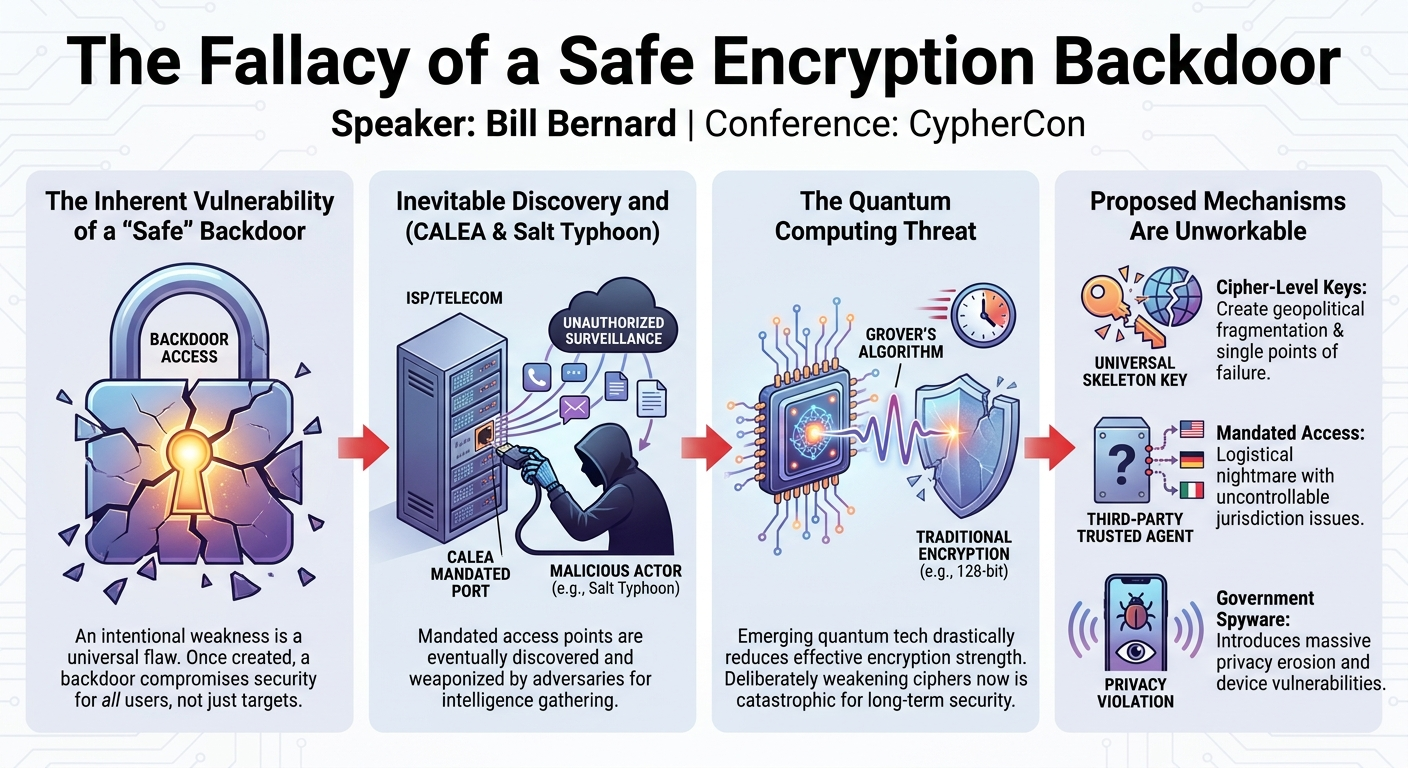
To illustrate the real-world danger of backdoors, Bernard revisits the Communications Assistance for Law Enforcement Act (CALEA) of 1994. Enacted in an era of nascent internet and bulky cell phones, CALEA mandated that telecommunications carriers build "backdoors" into their systems to facilitate lawful interception of calls and text messages. This mandate was later expanded to Internet Service Providers (ISPs) through subsequent surveillance acts. The speaker then brings this historical context to the present with the Salt Typhoon incident, which surfaced approximately a year and a half prior to the talk. Salt Typhoon, potentially linked to the Chinese government, was discovered to be exploiting the CALEA-mandated access points, granting them access to sensitive communications, including calls to military personnel. This real-world breach starkly contradicted the notion of a controlled, "safe" backdoor. Bernard notes the ironic timing: in December 2024, the FBI advised the public to use end-to-end encrypted solutions like Signal for secure communications, explicitly stating that foreign adversaries could read SMS messages and other unencrypted content, even as legislative efforts continued to push for backdoors into these very solutions. This contradictory stance from government bodies underscores the core fallacy Bernard addresses.
Key Findings
▶ Watch: Three key players: governments, service providers, and public (10:00)
Bill Bernard's presentation delivers several critical findings that collectively argue against the viability and safety of encryption backdoors:
- The Inherent Fallacy of "Safe" Backdoors: The central finding is that a truly "safe" and "repeatable" encryption backdoor is a conceptual impossibility. Any intentional vulnerability introduced into a cryptographic system inherently compromises its security for all users, regardless of the intended beneficiary.
- Technical Complexity and Risk: Encryption is a highly complex mathematical discipline. Introducing a backdoor requires fundamentally altering these intricate systems, a process that is exceedingly difficult to do without creating unintended and exploitable weaknesses. The history of cryptography is replete with ciphers thought secure that were later broken, demonstrating the profound challenge of building robust systems, let alone intentionally weakened ones.
- Geopolitical Intractability: A globalized digital world means that a backdoor created for one nation's law enforcement or intelligence agency immediately becomes a potential target and vulnerability for all other nations, including adversaries. Differing national interests make a universal, trusted backdoor standard unachievable and lead to a fragmented, insecure global internet.
- Real-World Exploitation is Inevitable: The Salt Typhoon incident, exploiting the CALEA backdoor designed for U.S. law enforcement, serves as a stark, real-world example. It conclusively demonstrates that backdoors, once created, will inevitably be discovered and exploited by malicious actors, often for purposes far beyond their original intent.
- The Looming Threat of Quantum Computing: The advent of quantum computing, specifically algorithms like Grover's algorithm, poses a significant future threat to current encryption strengths. These algorithms could drastically reduce the effective key space of existing ciphers, making deliberate weakening (via a backdoor) even more catastrophically dangerous and short-sighted.
- Market Failure in Privacy Protection: The "market will decide" argument often fails in the context of user privacy. Network effects and convenience often lock users into services that monetize their data, even if those users prefer more private alternatives. This highlights the need for strong technical protections and informed public discourse rather than relying solely on consumer choice.
- Proposed Backdoor Solutions Are Unworkable: Bernard systematically dissects various proposed backdoor mechanisms—cipher-level "skeleton keys," mandated third-party access, and government-sponsored spyware—and demonstrates that each introduces insurmountable technical, logistical, privacy, and performance challenges that render them impractical and ultimately detrimental.
Technical Deep Dive
▶ Watch: Differentiating symmetric and asymmetric key encryption (22:00)
Bernard begins his technical exposition by simplifying the complex world of encryption into two fundamental categories: symmetrical key encryption and asymmetrical key encryption.
Symmetrical Key Encryption utilizes a single key for both encrypting plaintext into ciphertext and decrypting ciphertext back into plaintext. Bernard likens this to a padlock where everyone needing access has a copy of the same key. The process is straightforward: Encryption Key + Plaintext --(Cipher)--> Ciphertext. Decryption is the reverse: Encryption Key + Ciphertext --(Cipher)--> Plaintext. Its primary advantage is speed, making it ideal for encrypting large volumes of data. This is why it's frequently used for session keys in secure communications. However, its major drawback is the secure distribution of the shared key, as giving "everyone the password" inherently introduces a security risk.
Asymmetrical Key Encryption, also known as public-private key encryption, employs a pair of mathematically linked keys: a public key and a private key. The public key can be freely shared, like a business card, and is used to encrypt messages for the key owner or to verify their digital signature. The private key, analogous to a house key, must be kept absolutely secret by its owner and is used to decrypt messages encrypted with the corresponding public key or to create digital signatures. The process for encryption involves: Recipient's Public Key + Plaintext --(Cipher)--> Ciphertext. Decryption uses: Recipient's Private Key + Ciphertext --(Cipher)--> Plaintext. This method is more secure because the private key is never shared, eliminating the key distribution problem inherent in symmetric encryption. Asymmetrical encryption also enables authentication, as a sender can sign a message with their private key, and the recipient can verify the authenticity using the sender's public key. The trade-off for this enhanced security and authentication is computational complexity, making it significantly slower than symmetric encryption.
The core of any encryption system lies in its ciphers, which Bernard describes as the "math engines" or formulas that transform data. He emphasizes that computers operate in base 2 (binary), using zeros and ones. The strength of an encryption key is directly related to its bit size, which defines the key space – the total number of possible keys. This relationship is exponential: 2 to the power of the number of bits. For example:
- 1 bit offers 2 possible states.
- 9 bits offer 2^9 = 512 possible combinations.
- A common 128-bit key yields approximately 3.4 x 10^38 combinations.
- A 256-bit key expands this to an astounding 1.15 x 10^77 combinations.
- Keys up to 4096 bits or even 8000 bits are used, creating an incomprehensibly vast key space.
This exponential growth is crucial because it dictates the time and resources required for a brute-force attack. For a cipher to be effective, it must meet several criteria:
- Consistency: The cipher must consistently produce the same ciphertext for the same key and plaintext every time.
- Avoid Collisions: Different key/plaintext combinations should ideally not produce identical ciphertext. Bernard provides a simple multiplication example (3\8=24, 2\12=24) to illustrate how collisions can weaken a cipher by providing multiple pathways to the same output.
The history of cryptography is littered with broken ciphers. Bernard highlights the Data Encryption Standard (DES), which, by the year 2000, was deemed insecure due to its small 56-bit key space. A temporary, albeit inelegant, solution was Triple DES (3DES), which essentially applied DES three times in a row. Other ciphers like RC4 have also been retired due to vulnerabilities. Bernard points out that TLS 1.3, ratified in 2018, defined only five specific cipher suites for secure internet communication. Yet, for backward compatibility, many systems still allow older, weaker TLS versions and ciphers to be used by default, creating significant security gaps that webmasters and administrators need to actively address.
Modern secure communication, such as connecting to an online bank, typically involves a hybrid approach leveraging both asymmetric and symmetric encryption:
- The client (your browser) sends its public key to the server.
- The server encrypts a fast, symmetric session key using the client's public key and sends this, along with its own public key, back to the client.
- The client decrypts the session key using its private key and validates the server's public key.
- Both parties now share a secret symmetric session key, which they use for rapid, encrypted communication for the remainder of the session.
- Crucially, these session keys are changed regularly to minimize the amount of data encrypted with a single key. This practice prevents attackers from accumulating enough data to find patterns and potentially brute-force the key, even if a small amount of data were to be compromised.
Bernard then addresses contemporary threats to encryption:
- Stealing the key: The easiest way to defeat encryption is to simply obtain the key, whether through malware, social engineering, or physical theft.
- Brute force / Pattern analysis: Directly guessing the key or analyzing patterns in encrypted data, especially if a session key is used for too long.
- Grover's Algorithm: This is a specific quantum algorithm that poses a theoretical threat to symmetric encryption. It suggests that a quantum computer could effectively reduce the key space of a symmetric cipher by a factor of the square root of the total possibilities. For instance, a 128-bit key could effectively be reduced to a 64-bit key from a brute-force perspective. This exponential reduction means that current "strong" encryption could become vulnerable to quantum attacks, making any deliberate weakening of ciphers through backdoors even more reckless.
Bernard concludes this section by outlining the two primary, yet deeply flawed, proposals for implementing backdoors:
- Backdooring the Cipher Itself ("Skeleton Key"): This involves building a universal "skeleton key" into the encryption algorithm. Bernard argues this is technically formidable (given the difficulty of building secure ciphers, let alone intentionally flawed ones) and politically unworkable. A U.S. skeleton key would inevitably be demanded by other nations, leading to a fragmented, insecure global internet with incompatible encryption standards.
- Adding a Third Party to the Conversation: This approach, technically simpler, involves mandating that a trusted third party (e.g., a government agency) be included in all encrypted communications. The "who secures the third party?" question immediately arises, along with massive logistical challenges regarding data storage, traffic, and international jurisdiction. Bernard highlights the absurdity of a scenario where communications across multiple countries would require multiple government entities to have access, leading to an unmanageable and privacy-eroding system.
- Government-Sponsored Spyware: The most concerning "solution" for Bernard is the mandatory installation of government-mandated spyware on devices. This wouldn't be a backdoor to encryption per se, but rather software that reads decrypted plaintext directly from the user's device. This approach raises severe privacy concerns, logistical nightmares (what happens when crossing borders?), and performance issues due to constant monitoring.
Demo / Proof of Concept
▶ Watch: Cipher mathematics, key sizes, and exponential complexity (26:00)
The talk "The Fallacy of a Safe Encryption Backdoor" by Bill Bernard is a theoretical and analytical discussion focused on the technical and political impossibilities of creating secure encryption backdoors. As such, the presentation did not include a live demonstration or a proof of concept. Bernard's objective was to explain the underlying principles and inherent flaws of such proposals, rather than to showcase their implementation or exploitation.
Defensive Implications
▶ Watch: Examining technical and logistical problems of backdoor proposals (40:00)
Bill Bernard's talk offers crucial defensive implications for individuals, organizations, and policymakers navigating the complex landscape of digital security and privacy:
For Individuals:
- Prioritize End-to-End Encrypted (E2EE) Solutions: Following the FBI's own advice, individuals should actively choose and use E2EE messaging applications like Signal for all sensitive communications. Be critical of services that claim encryption but may have client-server components or unclear data access policies, as exemplified by WhatsApp's varied implementation.
- Understand Service Provider Business Models: Recognize that "free" online services often come at the cost of personal data. Be aware that providers like Meta, Google, and Microsoft have a vested interest in accessing and monetizing your content, making them potential points of access for governments or malicious actors.
- Advocate for Privacy: Become informed about the technical realities of encryption and engage in public discourse. Support advocacy groups like the EFF and ACLU that fight for robust privacy protections and against legislative efforts to mandate backdoors.
For Organizations and Webmasters:
- Strictly Enforce Modern TLS Standards: Actively configure web servers and other network services to use only the strongest, most current encryption protocols, specifically TLS 1.3, and limit accepted cipher suites to those defined as secure. Proactively disable older, weaker TLS versions and ciphers (e.g., those from TLS 1.2 or earlier) that may be enabled for backward compatibility, as these represent significant vulnerabilities.
- Regularly Rotate Session Keys: Implement mechanisms to frequently rotate symmetric session keys during encrypted communications. This minimizes the amount of data encrypted with any single key, significantly reducing the window and opportunity for pattern analysis or brute-force attacks.
- Prepare for Post-Quantum Cryptography: Acknowledge the theoretical threat posed by quantum computing and algorithms like Grover's algorithm to current asymmetric and symmetric encryption standards. While not an immediate threat, organizations should begin to monitor advancements in post-quantum cryptography (PQC) and plan for eventual migration strategies to quantum-resistant algorithms.
Against Backdoor Proposals:
- Reject Cipher-Level Backdoors ("Skeleton Keys"): Understand that building a "skeleton key" into an encryption algorithm is technically fraught with peril and creates a single point of failure that, once discovered, compromises the security of everyone using that cipher globally. It also leads to geopolitical fragmentation and incompatible encryption standards.
- Resist Mandated Third-Party Access: Oppose proposals that require a third party (e.g., a government agency) to have access to encrypted communications. This introduces massive logistical challenges, creates new, highly attractive targets for attackers, and fundamentally erodes privacy without providing a truly secure solution. The "who secures the third party?" question is paramount.
- Oppose Government-Sponsored Spyware: Recognize that mandatory installation of government-developed spyware on devices is an extreme and invasive measure. It shifts the point of interception from encrypted data to plaintext on the user's device, leading to constant surveillance, significant performance overhead, and profound privacy violations.
Ultimately, the defensive implication is a reinforcement of the need for strong, uncompromised encryption as a fundamental building block of secure digital infrastructure. Any attempt to weaken this foundation, however well-intentioned, will inevitably lead to greater insecurity for all.
Key Takeaways
- A "safe" and "repeatable" encryption backdoor is a fallacy driven by a fundamental misunderstanding of cryptographic principles and the complex interplay of technical, political, and mathematical challenges.
- The inherent difficulty of designing secure ciphers means that intentionally introducing a "backdoor" inevitably creates an exploitable vulnerability for all, not just intended targets, as demonstrated by the history of broken ciphers like DES.
- Real-world incidents, such as the Salt Typhoon group exploiting CALEA-mandated backdoors for foreign intelligence purposes, prove that intended government access points will inevitably be discovered and weaponized by malicious actors.
- Governments and service providers have conflicting interests with the public regarding data access, but proposed "solutions" like cipher-level skeleton keys, mandated third-party access, or government-sponsored spyware introduce insurmountable security, privacy, and logistical problems.
- Defenders, including individuals and organizations, must prioritize the use and enforcement of robust, modern encryption standards like TLS 1.3 with strong cipher suites, actively disabling weaker, backward-compatible protocols.
- The advent of quantum computing and algorithms like Grover's algorithm poses a future threat to current encryption strengths, making any deliberate weakening through backdoors an even more perilous and short-sighted endeavor.
About the Speaker(s)
Bill Bernard is an experienced technologist and advocate for digital privacy and security, with a background spanning decades in the field. Although his current title and company were not specified in the talk metadata or transcript, he shared a personal anecdote of being a "web pioneer firewall administrator at Cisco PIX 515" around the year 2000, indicating a long and deep engagement with network security infrastructure. Bernard is passionate about educating the public on the technical realities of encryption, particularly in the context of ongoing legislative debates. His presentation style is designed to demystify complex cryptographic concepts for a general audience, empowering them to engage in informed discussions about privacy and surveillance. He offered to connect with attendees via provided URLs/QR code or in the Linux village at the conference.
Reviews
Dr. Zero (Offensive Security Researcher) — WEAK
A rehashing of the 1990s Crypto Wars dressed up as a modern CypherCon talk. Explaining symmetric versus asymmetric encryption to a hacker con audience in 2024 is a profound waste of a speaking slot.
Heather Calloway (CISO) — SOLID
This is a Crypto 101 policy primer wrapped in recent headlines. Bernard competently argues why government encryption backdoors fail, citing the recent Salt Typhoon exploitation of CALEA infrastructure, but the talk offers little new strategic material for security leadership.