TLS Winter (Certificate Lifetime Reduction) Is Coming
Anthony Ropson
Overview
In his CypherCon talk, "TLS Winter (Certificate Lifetime Reduction) Is Coming," Anthony Ropson addresses a critical shift in the landscape of TLS X.509 certificates for publicly facing websites. The talk highlights an impending and drastic reduction in certificate validity periods, mandated by the CAB Forum and supported by major browser vendors. This change, which will culminate in a maximum certificate lifetime of just 47 days by 2029, poses significant operational challenges for organizations worldwide.
Key moments
- 5:30 TLS certificate lifetimes reducing to 47 days by 2029
- 10:30 CAB Forum's reasons for shorter certificate lifespans
- 14:00 Understanding X.509 certificate structure and trust chains
- 20:00 Certificate Transparency: Avoid leaking internal domain names
- 21:30 Automating certificate management with the ACME protocol
- 25:00 Deep dive into ACME DNS and HTTP validation challenges
TLS Winter (Certificate Lifetime Reduction) Is Coming
Speakers: Anthony Ropson, PKI Specialist, [Employer Name Not Specified]
Conference: CypherCon
YouTube: https://www.youtube.com/watch?v=aZ4MR9podV0
Overview
In his CypherCon talk, "TLS Winter (Certificate Lifetime Reduction) Is Coming," Anthony Ropson addresses a critical shift in the landscape of TLS X.509 certificates for publicly facing websites. The talk highlights an impending and drastic reduction in certificate validity periods, mandated by the CAB Forum and supported by major browser vendors. This change, which will culminate in a maximum certificate lifetime of just 47 days by 2029, poses significant operational challenges for organizations worldwide.
Ropson, a professional working in the PKI space, provides a comprehensive overview of why this change is occurring, the historical context of certificate management pain points, and, crucially, how organizations can prepare. He emphasizes that manual certificate management, already a source of "P2 outages" due to forgotten expirations, will become entirely unsustainable. The core of his proposed solution lies in the widespread adoption and robust implementation of the ACME protocol for automated certificate issuance and renewal.
The article delves into the technical intricacies of X.509 certificates, the rationale behind the lifetime reduction, and the practical steps — including specific tools and architectural considerations — necessary for a smooth, albeit challenging, transition. Ropson's perspective, while acknowledging the security benefits of shorter-lived secrets, also conveys a candid assessment of the operational burden this decision places on IT infrastructure teams already grappling with complexity.
Background
▶ Watch: TLS certificate lifetimes reducing to 47 days by 2029 (5:30)
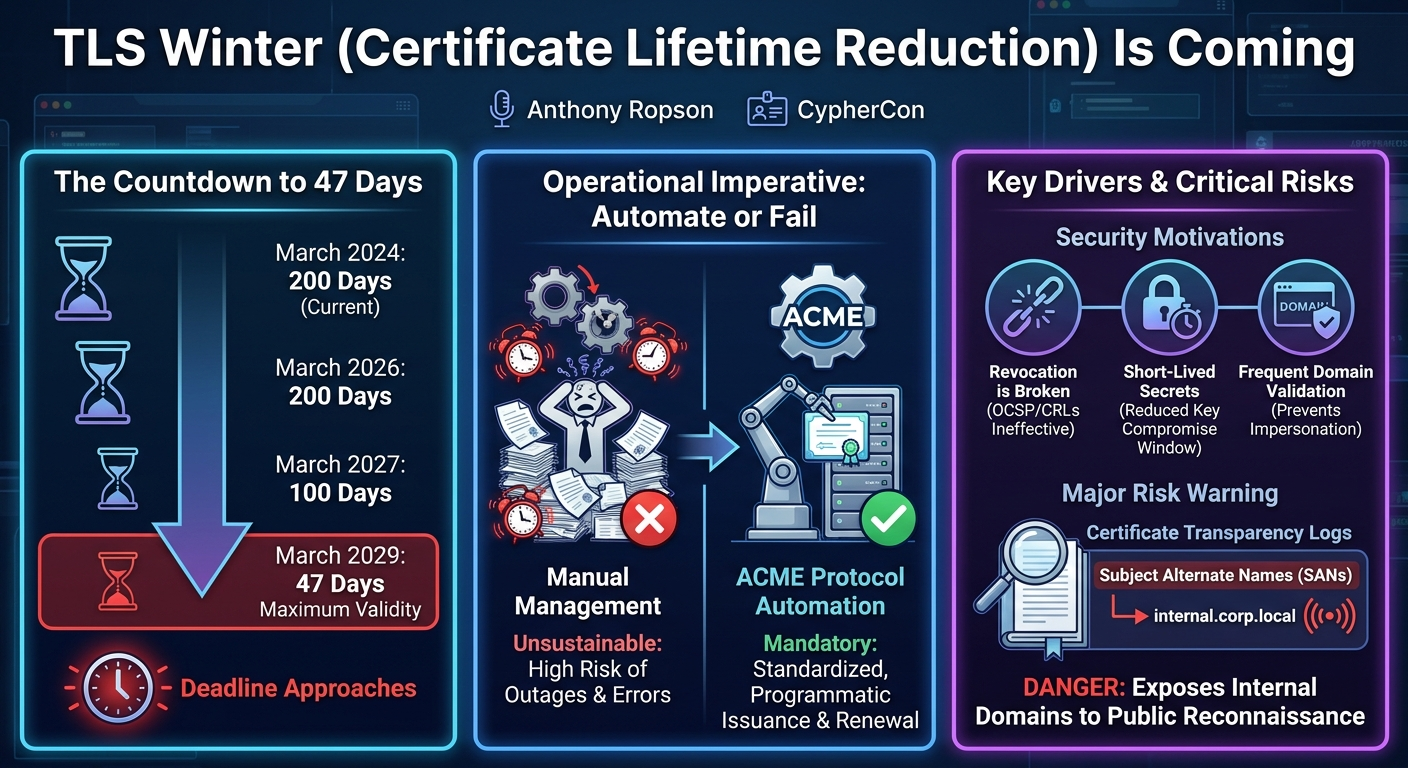
The security community has long grappled with the complexities of managing TLS X.509 certificates, a cornerstone of secure communication on the internet. Historically, publicly trusted certificates from Certificate Authorities (CAs) like DigiCert, Sectigo, or Google have typically been issued with validity periods of 13 months or a year. However, as Ropson details, this era is rapidly drawing to a close. A phased reduction in these lifetimes has already begun, impacting all publicly facing certificates.
The timeline for this reduction is aggressive and mandatory:
- March 2024: Validity reduced to 200 days (already in effect).
- March 15, 2026: Maximum validity further reduced to 200 days.
- March 15, 2027: Maximum validity reduced to 100 days.
- March 15, 2029: Maximum validity will be a mere 47 days.
It is important to note that this mandate only applies to publicly trusted certificates. Organizations managing their own internal PKI for intranet services can "breathe a little easier," as their internal certificates are not subject to these new restrictions.
Ropson acknowledges the controversy surrounding this decision within the industry, expressing his personal view that, while the underlying cryptographic principles are sound, the timing and operational impact of this change, especially amidst other significant shifts like the advent of post-quantum cryptography, add undue pressure to already complex IT environments. Despite the debate, the decision is final, driven by the major browser vendors and the CAB Forum, necessitating a proactive response from anyone responsible for e-commerce or public-facing web services.
The primary motivations cited by the CAB Forum for this drastic reduction are multifaceted and address long-standing security concerns:
- Revocation is Broken: The existing mechanisms for revoking compromised or misissued certificates, such as OCSP (Online Certificate Status Protocol) and CRLs (Certificate Revocation Lists), are often ineffective. Ropson points out that many vendor software implementations fail to properly check for revocations, and browsers frequently prioritize speed over thorough revocation checks. Shorter certificate lifetimes inherently limit the window of exposure for a compromised key or a misissued certificate, effectively acting as a "self-revocation" mechanism. This is a significant concern for large entities like Google or CloudFlare, who are prime targets for impersonation if a rogue certificate is issued in their name.
- Moving to Short-Lived Secrets: The broader security industry is trending towards the principle of short-lived secrets. A TLS certificate's private key, which can decrypt traffic to a website, traditionally resided on a system for a year or more. If compromised, this key could be exploited for an extended period. By reducing certificate lifetimes to 47 days, the validity of the associated private key is similarly constrained, significantly reducing the potential impact of a key compromise.
- Proving Domain Control: More frequent certificate renewals necessitate more frequent validation of domain control. Every 47 days, organizations will need to re-prove to the CA that they control the domain for which a certificate is being requested. This frequent re-validation acts as a strong check against impersonation and helps ensure that only legitimate domain owners can obtain certificates. This concept was notably pioneered by Let's Encrypt and is now being adopted across the industry.
Key Findings
▶ Watch: Understanding X.509 certificate structure and trust chains (14:00)
The talk's central revelation is the imminent and mandatory "TLS Winter," characterized by a severe reduction in the maximum validity period for publicly trusted TLS X.509 certificates. By March 15, 2029, these certificates will have a maximum lifetime of just 47 days, a dramatic decrease from the previous 13-month standard. This change, while controversial among PKI administrators due to its operational burden, is a firm directive from the CAB Forum and major browser vendors.
The rationale behind this shift is rooted in enhancing internet security by addressing critical shortcomings in the existing certificate ecosystem. Specifically, the move aims to mitigate the ineffectiveness of current certificate revocation mechanisms (OCSP, CRLs), align with the industry's push towards short-lived secrets by reducing the lifespan of private keys, and enforce more frequent domain control validation to prevent impersonation.
A crucial finding for organizations is that current manual certificate management practices are entirely unsustainable under the new 47-day regime. The talk emphatically states that robust automation is not just an advantage but a fundamental requirement for survival in this new landscape. The ACME protocol emerges as the quintessential technology for achieving this automation, offering a standardized, programmatic way to interact with CAs for certificate issuance and renewal.
Finally, Ropson underscores the importance of a deep understanding of certificate components – such as Subject Alternate Names (SANs), the notAfter field, and the implications of Certificate Transparency – to effectively implement and manage automated solutions and avoid common pitfalls, particularly in complex enterprise environments.
Technical Deep Dive
▶ Watch: Certificate Transparency: Avoid leaking internal domain names (20:00)
Understanding the fundamental components of X.509 certificates is paramount for navigating the upcoming changes. Ropson illustrates this by dissecting a hypothetical CypherCon certificate:
- Trust Chain: A certificate's trustworthiness is established through a chain. An end entity certificate (e.g., for CypherCon) is issued by an intermediate certificate authority (e.g., Let's Encrypt R12). This intermediate cert is, in turn, issued by a root certificate authority (e.g., ISRG Root X1). Operating systems and browsers contain pre-installed public keys for these trusted root CAs. If a certificate's chain can be validated back to a trusted root, the certificate is deemed valid.
- Signature Algorithms: Certificates employ cryptographic algorithms for integrity. The CypherCon example uses RSA with SHA-256, a robust standard. Ropson also highlights ECC (Elliptic Curve Cryptography) certificates as an efficient alternative, requiring fewer bytes for transmission, making them suitable for production environments.
- Subject Alternate Names (SANs): This is a critical field, as browsers primarily check SANs to verify if a certificate applies to a specific domain. While a single certificate can theoretically contain up to 100 SANs, Ropson strongly advises against this practice, recommending splitting them into smaller, more manageable groups (e.g., 25 SANs per certificate) for operational ease and improved security. The traditional Common Name (CN) field is often ignored by modern browsers and ACME clients, which may not even include it in issued certificates.
notAfterField: This timestamp, typically in UTC, dictates the exact moment a certificate expires. It is "regarded as gospel by all browsers," and exceeding this time will result in immediate "red error" warnings for users. Ropson stresses that this field is the absolute priority for any certificate monitoring system, with manual checks possible viabashor PowerShell using tools likeopenssl.- Certificate Transparency (CT): This mechanism requires CAs to log all publicly issued certificates to a global, auditable log. While beneficial for detecting misissued certificates, it means that all domain names listed on a public certificate become publicly known. Ropson issues a strong warning: do not include internal domain names (e.g.,
internal.corp.local) on publicly facing certificates, as this information will be broadcast to the entire internet, providing valuable reconnaissance for potential attackers. Examples of major organizations like Google and Microsoft inadvertently exposing internal server names via CT logs are cited.
The core solution for managing the reduced certificate lifetimes is the ACME (Automated Certificate Management Environment) protocol. Defined by an RFC, ACME is designed for full automation, aiming to eliminate human intervention in the certificate lifecycle.
- ACME Implementations: While Let's Encrypt is the most widely known CA utilizing ACME, many other major CAs, including Google and DigiCert, also provide ACME endpoints. Organizations can even set up internal ACME CAs.
- ACME Clients: A variety of clients exist to interact with ACME CAs:
- Certbot: Sponsored by the EFF, it's a popular choice, deployable in Docker, but has an "uneasy relationship" with Windows environments.
- Win-ACME and Posh-ACME: Recommended alternatives for Windows-based deployments.
- cert-manager: Specifically designed for Kubernetes environments.
- ACME Process Flow:
- Key Pair Generation: The ACME client generates a public/private key pair. The private key is a critical security control and must be securely stored and managed.
- Certificate Order: The client requests certificates for specified domains, which must be publicly resolvable. Ropson humorously warns against requesting
localhostcertificates from public CAs, as it could lead to interesting "black hat talks." - Challenges: To prove domain control, the CA issues challenges:
- DNS Challenge: The client is instructed to create a TXT record (e.g.,
_acme-challenge.yourdomain.com) containing a specific token. This requires the ACME client or its associated scripts to have programmatic access to the organization's DNS system. Ropson stresses the importance of locking down these credentials, ensuring they only have permissions to write to the_acme-challengesubdomain. - HTTP Challenge: The CA makes an HTTP GET request to a specific URL on the domain (e.g.,
http://yourdomain.com/.well-known/acme-challenge/). The ACME client must serve a file containing a signature derived from its private key and the challenge token. This challenge can be particularly tricky in enterprise environments with multiple web servers behind load balancers, requiring careful engineering to ensure the challenge response is consistently available. - Persistent DNS (Experimental): An emerging challenge type that links a DNS TXT record directly to the ACME account. While still experimental and with limited client support, it promises to reduce the frequency of DNS updates required for renewals, which could alleviate some operational burden.
Despite ACME's automation capabilities, Ropson cautions that some scripting will inevitably be required, particularly for pushing issued certificates out to various client endpoints after renewal and for setting up the challenge responses.
Demo / Proof of Concept
▶ Watch: Automating certificate management with the ACME protocol (21:30)
The talk does not include a live demonstration or a specific proof of concept. Instead, Anthony Ropson walks the audience through the structural components of a standard X.509 certificate using CypherCon's own certificate as a real-world example to illustrate key fields and concepts.
Defensive Implications
▶ Watch: Deep dive into ACME DNS and HTTP validation challenges (25:00)
The impending reduction in TLS certificate lifetimes to a maximum of 47 days by 2029 presents a fundamental shift in defensive strategy for organizations. Manual certificate management, a common source of outages, will become entirely untenable.
- Mandatory Automation: The most critical defensive implication is that automation of the certificate lifecycle is no longer optional; it is an absolute necessity. Organizations must transition away from manual renewal processes to automated solutions like the ACME protocol. This includes not only issuance but also the secure deployment of certificates to all relevant endpoints (web servers, load balancers, CDNs, etc.).
- Comprehensive Inventory and Monitoring: Defenders need a complete and accurate inventory of all public-facing certificates, including their issuance and expiration dates. Robust, automated monitoring of the
notAfterfield is paramount. Simple scripts usingopensslor PowerShell can serve as a starting point, but dedicated Certificate Lifecycle Management (CLM) tools will become increasingly valuable to prevent service outages due to expired certificates.
- Secure ACME Client Deployment: Implementing ACME clients requires careful security considerations:
- Private Key Protection: The private key generated by the ACME client is a high-value asset. It must be stored securely, ideally in a hardware security module (HSM) or a secure vault, and access must be strictly controlled and audited.
- Least Privilege for DNS Access: If utilizing the DNS challenge, the ACME client's credentials for interacting with the DNS system must adhere to the principle of least privilege. They should only have permissions to create or modify TXT records within the specific
_acme-challengesubdomain, preventing broader DNS manipulation. - Engineering for HTTP Challenges: For the HTTP challenge, defenders must engineer solutions that ensure the challenge response is consistently available across distributed environments, such as those with multiple web servers behind a load balancer. This might involve centralized challenge handling or rapid propagation of challenge files.
- Strict Separation of Internal and External PKI: The public nature of Certificate Transparency (CT) logs means that any domain name on a publicly issued certificate becomes publicly discoverable. Defenders must enforce strict policies to prevent the inclusion of internal network names, server hostnames, or other sensitive internal information on public certificates. This reduces the attack surface by denying attackers easy reconnaissance data about internal infrastructure.
- Architectural Assessment and Readiness: Organizations should conduct a thorough assessment of their existing infrastructure to identify any components that may not easily integrate with ACME clients or automated certificate deployment. This includes older operating systems (e.g., Windows versions with "uneasy" Certbot relationships), custom applications, and complex network configurations. Planning for necessary upgrades or workarounds is crucial.
- Incident Response Planning for Certificates: Even with automation, issues can arise. Defenders should establish clear incident response procedures for certificate-related failures, including rapid rollback mechanisms and manual override capabilities for emergency renewals.
Key Takeaways
- Publicly trusted TLS certificate lifetimes are undergoing a drastic reduction, culminating in a maximum validity of 47 days by March 15, 2029, making manual renewal processes entirely unsustainable.
- The ACME protocol is the essential technology for automating the entire certificate lifecycle, from issuance to renewal and deployment, to cope with the accelerated renewal cycles.
- Organizations must prioritize and invest heavily in robust automation solutions, secure ACME client deployments, and comprehensive certificate monitoring to prevent widespread service outages.
- Exercise extreme caution with Subject Alternate Names (SANs) on public certificates and strictly avoid including internal domain names, as Certificate Transparency logs expose this information to the public internet.
- Thoroughly understand the operational and security implications of ACME challenges (DNS and HTTP) and plan for their secure and reliable integration into complex enterprise network architectures.
- The transition to shorter certificate lifetimes will demand significant operational adjustments and engineering effort; early preparation and phased implementation are critical for success.
About the Speaker(s)
Anthony Ropson, known as Tony, is a professional working in the PKI space. He brings extensive experience from an employer that is widely recognized. While a strong advocate for the security benefits of TLS and cryptography, Ropson offers a candid and sometimes "spicy" perspective on industry decisions, emphasizing the practical challenges faced by PKI administrators. He clarifies that the views expressed in his talk are his own and do not necessarily reflect those of his employer.
Reviews
Dr. Zero (Offensive Security Researcher) — SOLID
A competent, necessary PSA about the CAB Forum's impending 47-day certificate limit. It's a real operational nightmare, but technically, this is just an explainer on ACME and X.509 basics we've known since Let's Encrypt launched a decade ago.
Heather Calloway (CISO) — MUST SEE
The CAB Forum's mandate to reduce public certificate lifetimes to 47 days by 2029 means human-driven certificate management is now a literal impossibility. This talk clearly outlines the impending operational cliff and correctly identifies automated ACME issuance as the only viable exit strategy. Mandatory reading for your infrastructure and PKI leadership.