The Quantum Shift: Assessing PQC on Your Network
Anita Nikolich
Overview
In "The Quantum Shift: Assessing PQC on Your Network," Anita Nikolich delivers a critical examination of the impending transition to Post-Quantum Cryptography (PQC) and its implications for network security. The talk, presented at CypherCon, highlights the urgent need for organizations to begin preparing for Q-Day, the anticipated arrival of stable, cryptographically relevant quantum computers, which could render current public-key encryption schemes vulnerable. Nikolich demystifies the hype surrounding quantum computing, grounding the discussion in practical steps and observable network behaviors.
Key moments
- 2:00 Understanding Q-Day and the 'Harvest Now Decrypt Later' threat
- 5:59 NIST's PQC algorithm selection and deprecation timeline
- 8:00 The goal of crypto agility for a seamless transition
- 15:00 Prioritizing PQC upgrades across devices, network, and data
- 18:00 Open-source tool for DIY PQC network assessment
- 23:00 Challenges in detecting PQC traffic with current IDS tools
- 25:00 Future roadmap: real-time PQC dashboards and attack detection
The Quantum Shift: Assessing PQC on Your Network
Speakers: Anita Nikolich
Conference: CypherCon
YouTube: https://www.youtube.com/watch?v=leSLC9GN_OA
Overview
In "The Quantum Shift: Assessing PQC on Your Network," Anita Nikolich delivers a critical examination of the impending transition to Post-Quantum Cryptography (PQC) and its implications for network security. The talk, presented at CypherCon, highlights the urgent need for organizations to begin preparing for Q-Day, the anticipated arrival of stable, cryptographically relevant quantum computers, which could render current public-key encryption schemes vulnerable. Nikolich demystifies the hype surrounding quantum computing, grounding the discussion in practical steps and observable network behaviors.
The core of Nikolich's presentation revolves around understanding current cryptographic postures and identifying the path toward crypto agility. She introduces a DIY methodology and an open-source tool, pqc.com, developed by her team at the National Center for Supercomputing Applications (NCSA) at the University of Illinois. This tool allows organizations to assess the adoption of hybrid and PQC algorithms on their networks, particularly focusing on SSH and TLS traffic. The talk underscores that while Q-Day may be 5-10 years away, the "harvest now, decrypt later" threat model necessitates immediate action for data requiring long-term confidentiality.
This article delves into the technical aspects of PQC migration, the challenges of network visibility, and the strategic implications for defenders. Nikolich's insights provide a roadmap for organizations to proactively inventory their cryptographic assets, understand their threat models, and begin the phased transition to quantum-resistant algorithms, emphasizing that early preparation is key to avoiding a chaotic, last-minute overhaul.
Background
▶ Watch: Understanding Q-Day and the 'Harvest Now Decrypt Later' threat (2:00)
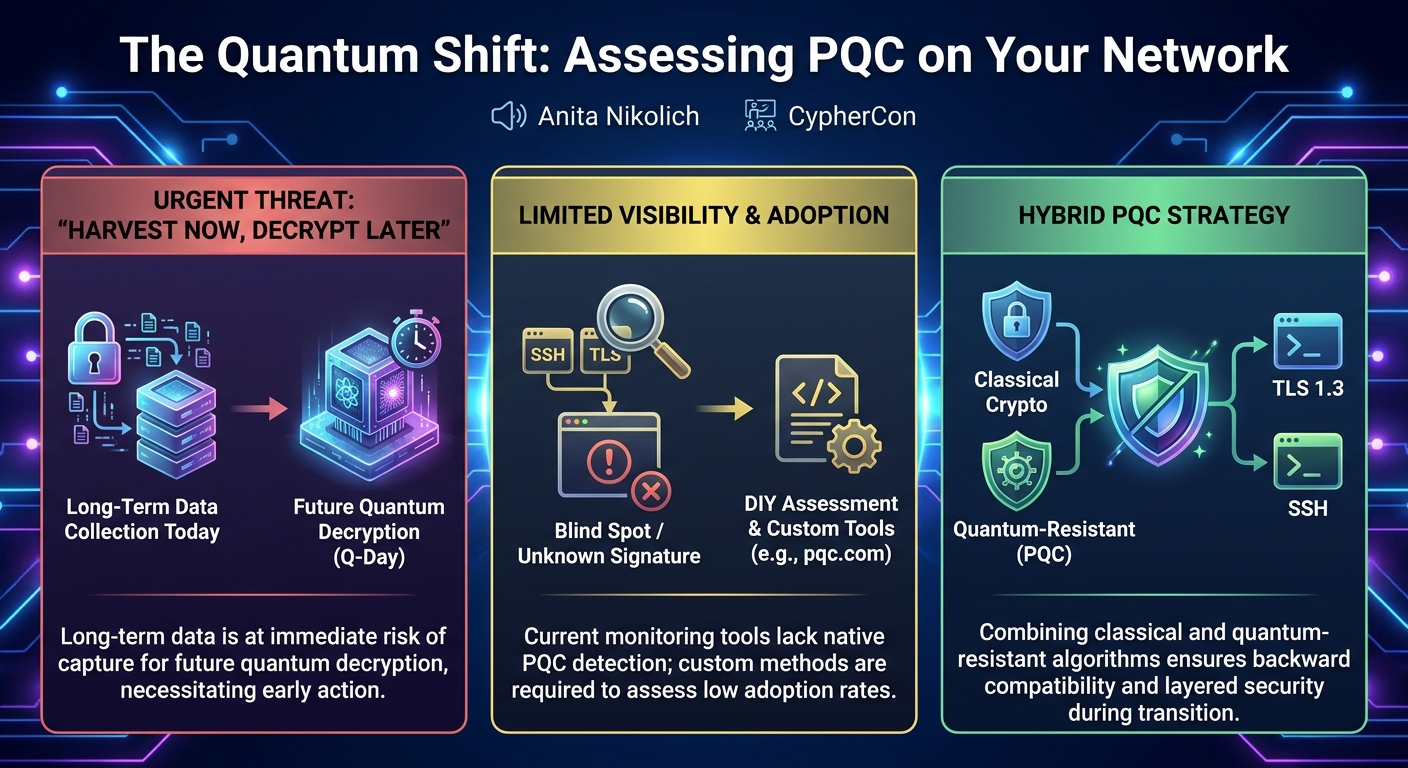
The advent of quantum computing presents a fundamental challenge to the cryptographic foundations of modern digital security. The concept of Q-Day, the point at which a stable, cryptographically significant quantum computer becomes available, is estimated to be 5-10 years away. While this may seem distant, the "harvest now, decrypt later" threat model dictates that adversaries are already collecting encrypted data today, anticipating that they will be able to decrypt it rapidly once quantum capabilities mature. This poses a significant risk to data requiring long-term confidentiality, including sensitive government, financial, and personal information. Even data in transit, protected by protocols like HTTPS, is susceptible to this long-term compromise.
The theoretical underpinning of this threat lies in algorithms like Shor's algorithm, developed by Peter Shor, which can efficiently factor large prime numbers. This capability directly undermines widely used public-key cryptography standards such as RSA, which relies on the computational difficulty of factoring large numbers for its security. Similarly, Elliptic Curve Cryptography (ECC), prevalent in Bitcoin and Apple Pay, is also vulnerable to quantum attacks. Recognizing this impending shift, the U.S. National Institute of Standards and Technology (NIST) initiated a multi-year process in 2016-2017 to solicit, evaluate, and standardize quantum-resistant algorithms. This global effort culminated in the selection of several finalists and initial standards, with a target of recommending widespread adoption for high-security systems by 2030 and potentially disallowing current crypto in secure government communications within 10 years.
Beyond the theoretical and standardization efforts, significant innovations are accelerating the quantum timeline. Research suggests that the number of qubits required for a stable quantum computer may be far lower than initially thought, potentially in the range of 10,000 to 20,000 instead of millions. Google's advancements in chip engineering are producing more reliable and scalable qubits, while experiments like the Northwestern-Madison project demonstrate the feasibility of running both classical and quantum signals over existing fiber optics without interference. These developments underscore that PQC is not a distant future concern but an immediate strategic imperative. The goal is to achieve crypto agility, enabling organizations to seamlessly replace and adapt cryptographic algorithms in protocols and applications without disrupting ongoing operations, a lesson learned from the decade-long struggle to deprecate and replace SHA-1 after its collision vulnerabilities became known.
Key Findings
▶ Watch: The goal of crypto agility for a seamless transition (8:00)
Anita Nikolich's research and presentation reveal several critical findings regarding the current state of Post-Quantum Cryptography (PQC) readiness and the challenges in assessing it.
Firstly, despite the impending threat of quantum computing, PQC adoption on live networks remains remarkably low. The project's assessment of the University of Illinois's WAN, including a supercomputing center (NCSA) and a global testbed (Fabric), found minimal to no PQC-compliant traffic. Specifically, total SSH PQC adoption for the university was less than 0.1% of handshake connections, and for the NCSA, it was less than 1%. The Fabric testbed, which hosts global network protocol testing, showed zero PQC connections in TLS traffic. This stark reality indicates a significant gap between the theoretical understanding of the quantum threat and practical implementation on operational networks.
Secondly, a significant barrier to accurate PQC assessment is the lack of native PQC signature support in widely used network monitoring tools. Nikolich highlights that current Long-Term Support (LTS) releases of Zeek (formerly Bro) and its paid counterpart do not yet incorporate the ability to identify PQC signatures within network handshakes. This forces organizations to employ more complex, manual methods, such as using optical taps to capture raw traffic and then custom-parsing it with scripts. This limitation means that current, off-the-shelf intrusion detection systems (IDS) and network analysis tools are largely blind to PQC adoption, potentially leading to an underestimation of existing PQC traffic or making it impossible to track migration progress.
Thirdly, the research identified user education and server-side readiness as major hurdles. While some client-side applications and operating systems (e.g., Firefox, Chrome, Apple iMessage/iOS, Android, AWS Secrets Manager) have started incorporating hybrid PQC support, server-side upgrades lag significantly. The speaker noted that the introduction of OpenSSH version 10, which defaults to a hybrid key exchange, generated confusion among users due to unexpected pop-ups. This indicates that even when PQC capabilities are introduced, a lack of awareness and coordinated server-side updates prevents widespread adoption, as both client and server must support the same hybrid or PQC algorithms for a successful handshake.
Finally, Nikolich's work underscores the importance of a DIY approach to PQC readiness, contrasting it with the expensive consulting services often promoted by vendors. The pqc.com project demonstrates that basic, open-source tools and a focused methodology can provide valuable insights into an organization's cryptographic asset inventory and PQC adoption rates. This empowers organizations to take initial steps without incurring exorbitant costs, focusing on easily observable network traffic as a starting point for a broader PQC migration strategy.
Technical Deep Dive
▶ Watch: Prioritizing PQC upgrades across devices, network, and data (15:00)
The technical core of "The Quantum Shift" revolves around understanding and detecting the presence of Post-Quantum Cryptography (PQC) and hybrid cryptography in network traffic. The speaker primarily focuses on SSH and TLS protocols, as these are the initial vectors for PQC adoption on networks.
The talk highlights the NIST-selected quantum-resistant algorithms, which are secure against both classical and future quantum computers, and are designed to interoperate with existing communication protocols. The key algorithms mentioned are:
- ML-KEM (Kyber): Primarily intended for TLS and HTTPS protocols, focusing on key encapsulation mechanisms.
- ML-DSA (Dilithium): A digital signature algorithm designed to replace ECDSA (Elliptic Curve Digital Signature Algorithm).
- SLH-DSA (SPHINCS+): Another digital signature algorithm, also intended to replace ECDSA.
These algorithms are being deployed in a hybrid mode, particularly ML-KEM, which combines a classical (e.g., ECDHE for TLS 1.3) and a PQC key exchange. This approach ensures backward compatibility and provides a layered defense, as the connection remains secure even if one of the cryptographic primitives is broken. For example, Cloudflare, a significant early adopter, uses TLS 1.3 with hybrid key exchange on its edge networks, protecting against the "harvest now, decrypt later" threat without requiring all origin servers to upgrade immediately.
The project detailed by Anita Nikolich, accessible at pqc.com, employs a practical, open-source methodology for assessing PQC readiness. The setup involves:
- Network Traffic Capture: The team at NCSA, a supercomputing center, utilizes an optical tap on their network WAN. This allows them to capture a copy of all network traffic without interfering with live operations. This is crucial because, as the speaker points out, existing Intrusion Detection Systems (IDS) like Zeek (formerly Bro) in their current LTS releases (as of the talk) lack the built-in signatures to identify PQC algorithms.
- Data Ingestion and Processing: The captured traffic, or more specifically the metadata, is processed. The NCSA setup typically generates Zeek logs in JSON format. These logs contain rich metadata about network connections, including details of cryptographic handshakes.
- Custom Scripting for PQC Detection: A Python script, available on pqc.com, is used to parse these JSON-formatted Zeek logs. The script's core function is to identify specific cryptographic signatures within the handshake phase of protocols like SSH and TLS. The script is regularly updated (every six months or so) with known strings or identifiers that indicate the use of hybrid or pure PQC approaches.
- The script specifically looks for cryptographic metadata from the handshake and key establishment phases. It does not analyze the internal data payload of packets, ensuring privacy and focusing solely on the cryptographic negotiation.
- For instance, an older SSH connection might show
ECDSA SHA-2andOpenSSH 7.4, indicating no PQC support. In contrast, a PQC-enabled connection would exhibit the identifiers for ML-KEM, ML-DSA, or SLH-DSA, often alongside a classical algorithm in a hybrid configuration.
- Analysis and Quantification: The script flags connections exhibiting PQC or hybrid signatures, providing a rough percentage of encrypted SSL/TLS and SSH traffic that is PQC-compliant. This quantifiable data is then used to inform IT leadership about the current state of adoption and areas of risk.
A significant technical challenge identified is the absence of PQC signature support in standard network monitoring tools. The speaker emphasized the need for Zeek/Bro developers to integrate these signatures into upcoming releases. Without this, organizations are forced into a more complex, DIY approach, potentially missing a significant portion of PQC traffic if they rely solely on their existing IDS. The team's roadmap includes developing their own dedicated packet parser to overcome this dependency on Zeek's evolving capabilities, allowing direct analysis of network traffic for PQC markers. This would enable more granular, real-time insights into PQC adoption and the potential detection of cipher downgrade attacks, where an adversary might attempt to force a connection back to a weaker, classical cryptographic algorithm.
Demo / Proof of Concept
▶ Watch: Challenges in detecting PQC traffic with current IDS tools (23:00)
While Anita Nikolich's talk did not feature a live, interactive demonstration in the traditional sense, the core of her presentation served as a detailed walkthrough of her team's Proof of Concept (PoC) and the open-source tool they developed, accessible at pqc.com. This tool and methodology represent a practical, DIY approach to assessing Post-Quantum Cryptography (PQC) readiness on an organization's network.
The PoC is based on the team's work at the National Center for Supercomputing Applications (NCSA) at the University of Illinois. Their methodology involves:
- Traffic Capture: Utilizing an optical tap on the university's Wide Area Network (WAN) to capture a copy of all network traffic. This step is critical because, as highlighted, standard network intrusion detection systems like Zeek (Bro) do not yet natively support the detection of PQC signatures in their current Long-Term Support (LTS) releases.
- Data Collection: Processing the captured traffic into Zeek logs, which are then output in JSON format. These logs contain rich metadata about network connections, including the details of cryptographic handshakes.
- Custom Scripting: Applying a Python script (available on pqc.com) to parse the JSON logs. The script is specifically designed to identify cryptographic metadata within the handshake and key establishment phases of protocols like SSH and TLS. It looks for specific strings or identifiers that denote the use of hybrid or pure PQC algorithms, such as those from the NIST finalists like ML-KEM (Kyber). The speaker showed a visual example of a non-PQC SSH handshake (e.g.,
ECDSA SHA-2,OpenSSH 7.4) versus what a PQC-compliant handshake would look like. - Analysis and Reporting: The script quantifies the adoption rate by counting the number of PQC-compliant handshakes versus total handshakes for specific protocols. This data, showing percentages of PQC adoption, is then used to inform IT leadership. The campus Security Operations Center (SOC) even integrates this data into their Splunk dashboards for ongoing visibility.
This pqc.com tool, although presented as a conceptual framework and workflow rather than a live software demo, effectively demonstrates a working solution for organizations to begin their PQC asset inventory. It underscores that valuable insights can be gained through open-source tools and a focused approach, without immediately resorting to expensive commercial solutions. The PoC's findings, revealing very low PQC adoption rates (<0.1% for SSH, 0% for TLS on a global testbed), directly illustrate the current state of unpreparedness and the urgent need for wider implementation of such assessment tools.
Defensive Implications
▶ Watch: Future roadmap: real-time PQC dashboards and attack detection (25:00)
The insights from "The Quantum Shift" provide critical guidance for network defenders, urging proactive measures to mitigate the looming threat of quantum computing. The most significant defensive implication is the need to address the "harvest now, decrypt later" threat model immediately. Data that requires long-term confidentiality (e.g., patient records, financial transactions, intellectual property, government secrets) is already at risk if secured only with classical cryptography. Defenders must prioritize identifying such data and accelerating its transition to quantum-resistant protection.
Here are key defensive implications:
- Cryptographic Asset Inventory and Risk Assessment: Defenders must undertake a comprehensive cryptographic asset inventory. This involves identifying all instances where public-key cryptography is used across hardware, firmware, operating systems, applications, and cloud services. This inventory should feed into a robust risk assessment process that considers the specific threat model for their organization, prioritizing migration efforts based on data sensitivity and the longevity of protection required. This aligns with NIST's guidance: inventory, threat model, risk assessment, and cost analysis.
- Focus on Network Protocols (SSH, TLS): The talk highlights that SSH and TLS are primary areas for early PQC adoption. Defenders should prioritize upgrading their network infrastructure and servers to support TLS 1.3 and hybrid key exchange. This is a relatively "low-hanging fruit" compared to overhauling entire systems. Cloudflare's strategy of using TLS 1.3 with hybrid PQC on their edge networks serves as a model for protecting data in transit without requiring immediate, full-stack upgrades.
- Client-Side and End-User Device Upgrades: Client-side devices and browsers (Firefox, Chrome, Apple iMessage/iOS, Android) are increasingly supporting PQC. Defenders should ensure that end-user devices are updated to versions that support hybrid key exchange. This is often the easiest and cheapest step to take, making it a high-priority, low-effort defensive measure. However, this must be coupled with user education, as seen with the confusion around OpenSSH version 10's default hybrid key exchange.
- Proactive Monitoring and Tooling: The lack of PQC signature support in current IDS tools like Zeek/Bro is a critical gap. Defenders must either pressure their IDS vendors to integrate PQC detection capabilities or develop custom solutions, as demonstrated by the pqc.com project. Implementing optical taps and custom parsers allows for direct observation of PQC adoption rates and helps identify non-compliant systems. This proactive monitoring is essential for tracking migration progress and identifying potential vulnerabilities.
- Beware of Cipher Downgrade Attacks: As organizations begin to deploy hybrid PQC, the risk of cipher downgrade attacks increases. Adversaries might attempt to force a connection to revert to a weaker, classical algorithm if both client and server support it. Defenders need to implement configurations that strictly enforce hybrid or PQC, disabling vulnerable classical fallbacks where possible, and monitor for any indications of such attacks. The roadmap for the pqc.com project includes detecting these attacks.
- Strategic Vendor Engagement: While Nikolich advocates for a DIY approach initially, defenders must also engage strategically with their third-party vendors and cloud providers. Understanding their PQC roadmaps and ensuring their services will support quantum-resistant cryptography is crucial, especially for critical infrastructure and data storage. The cryptographic bill of materials (CBOM) concept extends to understanding the crypto posture of all supply chain components.
In essence, the defensive posture against quantum threats requires a phased, data-driven approach. It begins with inventory and assessment, moves to prioritized upgrades of high-risk systems and low-hanging fruit, and is continuously monitored with specialized tools and vigilance against new attack vectors like cipher downgrades.
Key Takeaways
- Q-Day is coming (5-10 years), but "Harvest Now, Decrypt Later" is an immediate threat: Organizations must act now to protect data requiring long-term confidentiality, as adversaries are already collecting encrypted data for future decryption by quantum computers.
- PQC adoption is critically low despite growing urgency: Network assessments, such as those conducted by the pqc.com project, reveal adoption rates well under 1% for SSH and TLS, highlighting a significant gap between awareness and implementation.
- Current network monitoring tools lack PQC visibility: Existing IDS like Zeek/Bro do not natively support detecting PQC signatures, necessitating custom tools like optical taps and Python scripts for accurate assessment.
- Hybrid PQC is the current migration strategy: Combining classical and quantum-resistant algorithms (e.g., TLS 1.3 with ML-KEM) offers backward compatibility and layered security, crucial for a seamless transition without breaking existing systems.
- Prioritize PQC migration strategically: Focus on high-risk, long-lived data and "low-hanging fruit" like end-user devices, browsers, and network protocols (TLS, SSH) before tackling less urgent areas like data at rest.
- A DIY approach to PQC readiness is feasible and recommended: Open-source tools and internal efforts, as demonstrated by pqc.com, can provide valuable cryptographic asset inventories and adoption metrics without requiring expensive consulting services.
About the Speaker(s)
Anita Nikolich is a speaker with a background in networking, as she mentions during her talk. She is affiliated with the University of Illinois, specifically working with the National Center for Supercomputing Applications (NCSA). In her role, she leads a team that collaborates with the university's CIO and CISO to assess cryptographic asset inventories and Post-Quantum Cryptography (PQC) readiness. Her expertise spans network protocols, security, and the practical implementation challenges of emerging cryptographic standards. She is actively involved in developing open-source tools and methodologies to aid organizations in their transition to quantum-resistant cryptography.
Reviews
Dr. Zero (Offensive Security Researcher) — STRONG ACCEPT
Quantum computing hype is usually a vendor excuse to sell you expensive consulting hours. Nikolich cuts through the noise with a DIY, packet-level reality check on what PQC adoption actually looks like on the wire right now—spoiler: it's basically zero. This is a pragmatic, no-bullshit roadmap for defenders who need to stop reading NIST drafts and start parsing their own handshakes.
Heather Calloway (CISO) — SOLID
Nikolich provides a zero-hype, highly practical reality check on post-quantum cryptography migration. She proves that despite vendor noise, actual PQC adoption on live networks is practically zero, and standard network monitoring tools are currently blind to it. This is worth your infrastructure team's time to baseline your environment before you start paying consultants.