KEYNOTE: Cybersecurity lessons learned from working at an Alaskan ISP in the 90s
Bruce Potter
Overview
In a captivating keynote at CypherCon, Bruce Potter, CEO and founder of Turngate and a well-known figure in the cybersecurity community for founding the Shmoo Group and ShmooCon, took the audience on a nostalgic yet profoundly insightful journey. Titled "Cybersecurity lessons learned from working at an Alaskan ISP in the 90s," Potter's talk transcended a mere historical account, offering a vivid personal narrative of building the internet infrastructure in one of the most remote regions of the United States. His storytelling approach, rich with anecdotes and self-deprecating humor, served to illustrate universal truths about technology, community, and human ingenuity.
Key moments
- 2:00 Speaker introduction and talk overview
- 14:00 Genesis of Internet Alaska in the mid-90s
- 25:00 Internet Alaska becomes nation's largest ISP
- 28:00 High cost and congestion of Alaska's internet
- 37:00 Public pushes back against internet metering proposal
- 43:00 Billing catastrophe and market shift ended ISP
- 56:00 The ultimate lesson: people matter more than tools
KEYNOTE: Cybersecurity lessons learned from working at an Alaskan ISP in the 90s
Speakers: Bruce Potter
Conference: CypherCon
YouTube: https://www.youtube.com/watch?v=pS6GwQfzDtw
Overview
In a captivating keynote at CypherCon, Bruce Potter, CEO and founder of Turngate and a well-known figure in the cybersecurity community for founding the Shmoo Group and ShmooCon, took the audience on a nostalgic yet profoundly insightful journey. Titled "Cybersecurity lessons learned from working at an Alaskan ISP in the 90s," Potter's talk transcended a mere historical account, offering a vivid personal narrative of building the internet infrastructure in one of the most remote regions of the United States. His storytelling approach, rich with anecdotes and self-deprecating humor, served to illustrate universal truths about technology, community, and human ingenuity.
The core of Potter's presentation wasn't just about the early days of dial-up modems and nascent IP networks; it was a powerful call for introspection. By drawing parallels between the challenges and rapid evolution of the internet in the mid-1990s and today's accelerating technological shifts, particularly in areas like artificial intelligence and vulnerability discovery, Potter illuminated enduring lessons. He emphasized that "history rhymes," suggesting that understanding the past can provide critical foresight for navigating the future of cybersecurity. The talk ultimately highlighted the foundational importance of people, community, and adaptability over mere tools in driving technological progress and resilience.
Background
▶ Watch: Speaker introduction and talk overview (2:00)
To truly appreciate the context of building an Internet Service Provider (ISP) in Alaska in the mid-1990s, one must first understand the technological landscape of the era. As Potter vividly described, the early 90s were largely pre-digital. For most households, the pinnacle of technology was a VCR and a landline phone; news arrived via physical newspaper. Personal computers, if owned, were often rudimentary IBM PCs or even more niche devices like the Timex Sinclair. The concept of a global, interconnected network accessible from home was largely science fiction for the average person.
The internet itself was a vastly different beast. Backbone connections, such as those provided by large IP providers like UUNET, operated at speeds considered glacial by today's standards—around 45 megabits per second. America Online (AOL) existed, but as a walled garden, a curated online experience separate from the burgeoning global internet. Users would "dial in" to AOL, accessing its content and communities without truly being "on the internet" as we know it. The first true dial-up ISP, "The World" by Software Tool & Die in Boston, pioneered commercial internet access, often under "sketchy" legal circumstances, marking the tentative birth of public internet connectivity.
In Alaska, the situation was even more isolated. In 1990, internet access was almost exclusively confined to three entities: the State of Alaska (running IP, IPX, and AppleTalk networks for internal communications), the Department of Defense (due to Alaska's strategic importance), and the University of Alaska. The University of Alaska Fairbanks (UAF), in particular, boasted high-speed connections and powerful machines like the Cray YMP and Cray T3D at its Geophysical Institute, primarily funded by the oil industry for research purposes. Public internet access was virtually non-existent.
Early internet culture was a wild west of text-based interactions. Websites were rare; instead, users navigated FTP sites (for file transfer), Gopher sites (a menu-driven information retrieval system), and Usenet (a distributed bulletin board system for discussions on topics ranging from computers to illicit software). This era also saw the infamous "Eternal September" in 1993, when a massive influx of new users—unfamiliar with established netiquette—overwhelmed the existing communities, fundamentally altering the internet's social fabric. It was against this backdrop of limited access, nascent technology, and evolving online norms that Lance Ahern, inspired by an AT&T prediction of massive bandwidth growth, envisioned building Internet Alaska, an ambitious undertaking to connect the vast, remote state to the global network.
Key Findings
▶ Watch: Internet Alaska becomes nation's largest ISP (25:00)
Bruce Potter's narrative of Internet Alaska, while steeped in the specifics of 1990s technology, yields several profound lessons highly pertinent to contemporary cybersecurity:
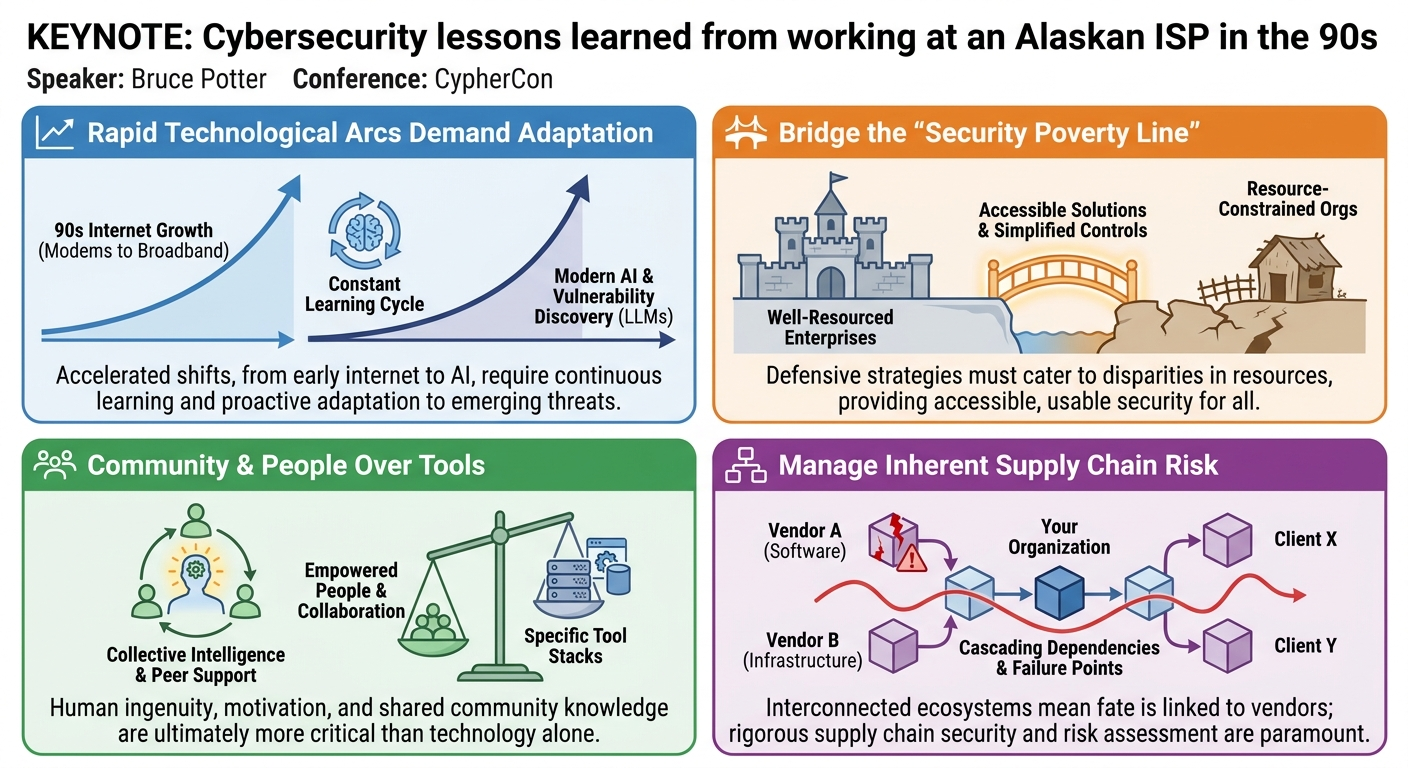
- Rapid Technological Arcs Demand Constant Adaptation: The internet's evolution in Alaska, from non-existent public access in 1993 to a highly connected state by 1998, represents an incredibly compressed technological arc. This mirrors today's rapid shifts, particularly with artificial intelligence. Potter highlighted how advanced challenges like vulnerability discovery and exploit development, once the domain of DARPA-funded Cyber Grand Challenges requiring supercomputers and millions of dollars, can now be approximated by a general-purpose Large Language Model (LLM) on a phone. This accelerated pace underscores the need for continuous learning and a proactive approach to emerging technologies in cybersecurity.
- The "Security Poverty Line" and Uneven Distribution of Resources: Potter emphasized that "the halves and halves not are unevenly distributed." Working in Alaska, he witnessed firsthand how people with limited access would eagerly embrace new capabilities. In cybersecurity, this translates to the security poverty line, where organizations or individuals lack the resources, knowledge, or maturity for robust security. Defenders must recognize this disparity; solutions need to be accessible, user-friendly, and applicable across a wide spectrum of capabilities, not just for well-resourced enterprises. Motivation to learn and adapt, regardless of current resources, is a critical factor.
- Community as a Force Multiplier: Potter's personal and professional journey, from a college dropout building an ISP to founding the Shmoo Group and ShmooCon, underscores the vital role of community. Early internet users gathered in Linux User Groups (LUGs), ham radio meetups, and even Amiga user groups to share knowledge. Today, conferences like CypherCon, Defcon, and ShmooCon serve the same purpose: providing platforms for learning, networking, and mutual support. In a field as dynamic as cybersecurity, collective intelligence, shared experiences, and peer learning are indispensable.
- Interconnectedness and Supply Chain Risk are Inherent: "Your fate is tied to other people whether you like it or not," Potter stated, illustrating how Internet Alaska was inextricably linked to ATU (Alaska Telephone Utility) as both a vendor and an investor. This fundamental interconnectedness is exponentially more complex in modern digital ecosystems. Potter cited recent examples like the Salesloft drift and Axios npm package hack (downstream from the triv hack) to highlight how dependencies create cascading risks. Understanding and managing the supply chain is no longer an option but a critical defense strategy, as individual organizations are rarely isolated.
- Embrace Not Knowing and Learn on the Fly: Potter openly admitted to "stumbling through" the process of building Internet Alaska, even joking about contemplating "stealing manuals off of linemen" to understand telecommunications networks. This candid acknowledgment highlights that in rapidly evolving fields, having all the answers is impossible. A willingness to learn, adapt, and iterate—even in the face of uncertainty—is paramount. This mindset fosters resilience and innovation, allowing individuals and organizations to navigate uncharted technical territory.
- People Matter More Than Tools: Perhaps the most enduring lesson is the primacy of the human element. Internet Alaska didn't succeed because of specific hardware; it succeeded because Lance Ahern and Matt Manhart had a vision and put their faith in a team of "misfits" – including Potter himself. These individuals, often untrained, disrupted an entire industry. In cybersecurity, this means prioritizing talent, fostering an environment of empowerment, and recognizing that human ingenuity, problem-solving, and collaboration are ultimately more critical than any specific tool or technology stack.
Technical Deep Dive
▶ Watch: High cost and congestion of Alaska's internet (28:00)
The technical challenges of establishing an ISP in 1990s Alaska were formidable, requiring ingenuity, resourcefulness, and a pioneering spirit. Potter detailed the evolution of connectivity and the specific infrastructure choices made by Internet Alaska.
The foundational technology for early internet access was the modem, which converted digital signals into analog sound waves for transmission over standard telephone lines, and then demodulated them back into digital at the receiving end. Modem speeds saw dramatic improvements throughout the decade, starting from incredibly slow 300 baud connections, progressing to 9600 baud, then 14.4k, 28.8k, 33.6k, and finally 56k. Potter noted that 28.8k was close to the theoretical upper bound for purely analog circuits, with faster speeds achieved through "trickery" involving digital components on the ISP's end. The iconic US Robotics Courier modem (often seen in its black, firmware-updatable form) was considered the gold standard, signifying a serious user.
A significant hurdle for early users was the lack of native TCP/IP stacks in operating systems. PCs at the time often shipped without the necessary software to speak the internet's language. This created a cottage industry for solutions, most notably Trumpet Winsock. This shareware TCP/IP stack for Windows, written by a single individual, became the de facto standard, powering "half the goddamn world in 1995." Tech support calls for ISPs often involved walking customers through the arduous process of installing Trumpet Winsock from a floppy disk.
Internet Alaska's infrastructure choices set it apart from early competitors. Potter contrasted their approach with PolarNet, a Fairbanks-based ISP that used a "duct tape and bailing twine" method, literally cracking open hundreds of individual Courier modems, mounting them sideways in MDF boards, and connecting them to custom-built power strips and an overwhelming number of POTS (Plain Old Telephone Service) lines. This led to practical issues, such as running out of copper in their building, and a memorable incident where a snowplow severed a 200-pair copper line, wiping out half of PolarNet's service.
In contrast, Lance and Matt of Internet Alaska aimed for a more advanced, scalable setup from the start. They deployed digital modems, specifically US Robotics rack-mountable units that housed four digital modems each and could connect directly to two T1 circuits. These modems then fed into terminal servers, with the Livingston Portmaster 2E being a key component. The Portmaster efficiently aggregated multiple serial lines from the modems and converted them into Ethernet traffic, dumping it onto the IP network. This sophisticated architecture was rare in the mid-90s, especially in Alaska. Their core network operations ran on minimal server hardware: one SPARCstation 20 and one Sun Ultra Enterprise 2, which Potter described as heroically overworked machines.
Connectivity to the lower 48 states was a critical and expensive bottleneck. Internet Alaska initially purchased two terrestrial T1s (each 1.544 Mbps, not 45Mbps as mentioned in the overview, that was backbone, T1s are much slower). These circuits, running to Seattle and Minneapolis, cost approximately $18,000 per month just for local loop charges, plus another $5,000 for IP transit. These connections were constantly saturated, as evidenced by their MRTG (Multi Router Traffic Grapher) charts, which were "just green" 24 hours a day. With 20,000 customers and 2,000 modems sharing just two T1s, users were simply "happy to be in the game," accepting high congestion.
The demand for better local connectivity led Internet Alaska to establish the Alaska Metropolitan Area Peering Point (AAP). Using a spare Cisco 2900 switch at the top of the Bank of America building in Anchorage, they invited other local ISPs to connect for free, allowing them to exchange local traffic without routing it all the way to the lower 48 and back. This significantly reduced latency (crucial for games like Quake) and saved long-haul circuit costs.
As the decade progressed, Internet Alaska also pioneered DSL (Digital Subscriber Line) in the state. Facing reluctance from the telco to offer DSL services, Internet Alaska innovatively purchased "alarm circuits with no load coils"—effectively raw copper lines—between their central office and customer premises. They then installed DSL modems on both ends, turning up the speed until errors occurred, then backing down to a stable, albeit variable, connection (e.g., 512K for $80/month). This "under the cover of darkness" approach eventually prompted the telco to offer DSL themselves, with Internet Alaska providing the IP backhaul.
Finally, Potter touched on the failed vision of ubiquitous home servers with the Whistle Interjet. This small, FreeBSD or NetBSD-based appliance aimed to let every household run its own email, web, and Usenet server. Internet Alaska, surprisingly, became one of the largest distributors of these devices, selling about 50 units (out of only 200 globally). The concept of individuals self-hosting all their services proved impractical, foreshadowing the eventual dominance of centralized cloud services.
The company's journey was not without its internal struggles, including a "catastrophic billing error" where the billing server completely failed, leading to months of unbilled customers and the need to "reconstitute billing" through manual efforts and negotiations. External pressures mounted as well, with the arrival of GCI cable internet offering significantly faster speeds, and the landing of new underwater fiber optic cables ending the state's bandwidth drought. The company was eventually acquired by ACS (which ATU became) in 2000, partly due to a new CEO's failure to pay the crucial telecommunications bills. Potter also recalled a political battle with Senator Ted Stevens, who proposed metering and taxing internet access, a move that Lance Ahern successfully thwarted by publicly demonstrating its prohibitive cost increase and mobilizing public outcry.
Demo / Proof of Concept
▶ Watch: Billing catastrophe and market shift ended ISP (43:00)
This keynote address was a retrospective storytelling session, not a technical demonstration. There was no live demo or proof of concept presented during the talk.
Defensive Implications
▶ Watch: The ultimate lesson: people matter more than tools (56:00)
Bruce Potter's journey through the early days of Internet Alaska, while historical, offers surprisingly relevant defensive implications for today's cybersecurity landscape:
- Anticipate and Adapt to Rapid Technological Arcs: The internet's explosive growth in the 90s serves as a stark reminder of how quickly technology can transform. Today, the rise of AI, particularly Large Language Models (LLMs), presents a similar, if not faster, arc of disruption. Defenders must proactively understand how these technologies can be leveraged for both offense and defense. The ability of LLMs to assist in vulnerability discovery and exploit development means the bar for sophisticated attacks is lowering, requiring organizations to accelerate their own defensive capabilities and understanding of AI's potential.
- Address the "Security Poverty Line" with Accessible Solutions: Recognizing that "the halves and halves not are unevenly distributed" is crucial. Many organizations, especially small to medium-sized businesses or non-profits, operate below a "security poverty line," lacking mature programs, dedicated staff, or substantial budgets. Defensive strategies must account for this. Instead of advocating for complex, enterprise-grade solutions, the security community should focus on developing and promoting accessible, easy-to-implement, and cost-effective controls that can significantly raise the baseline security posture for a broader range of entities. This includes simplified configuration, clear guidance, and leveraging open-source tools.
- Prioritize Community and Knowledge Sharing: Potter's emphasis on local user groups and conferences highlights the enduring power of community. In cybersecurity, this translates to actively participating in threat intelligence sharing groups, attending conferences like CypherCon, Defcon, and ShmooCon, and fostering internal and external collaboration. Collective defense is stronger than isolated efforts. Sharing lessons learned, emerging threats, and effective countermeasures allows the entire ecosystem to mature faster and build resilience against common adversaries.
- Implement Robust Supply Chain Security: The anecdote of Internet Alaska's fate being tied to ATU underscores the inherent interconnectedness of modern systems. Defenders must assume that their fate is linked to their vendors, partners, and downstream dependencies. This necessitates rigorous supply chain security practices: comprehensive vendor risk assessments, clear security clauses in contracts, continuous monitoring of third-party risk, and architectural designs that minimize blast radius in case of a third-party compromise (e.g., through strong segmentation and access controls). The "turtles all the way down" nature of dependencies means a single point of failure far up the chain can have catastrophic downstream effects.
- Cultivate a Culture of Continuous Learning and Adaptability: Potter's admission of "stumbling through" and learning on the job is a powerful lesson. The cybersecurity landscape changes too rapidly for anyone to have all the answers. Organizations should foster a culture that encourages continuous learning, experimentation, and a willingness to admit when knowledge gaps exist. Investing in training, promoting curiosity, and allowing security teams the space to research and test new approaches are vital. It's okay not to know everything, but it's not okay to stop learning.
- Empower People Over Tools: Ultimately, people, not technology, drive change and resilience. While advanced security tools are necessary, they are only as effective as the skilled individuals operating them. Defensive strategies should prioritize investing in human capital: hiring diverse talent, providing mentorship, and empowering security professionals to innovate and take initiative. Internet Alaska's success with a team of "misfits" demonstrates that passion, ingenuity, and trust can overcome resource limitations. Defenders should be encouraged to "go [expletive] some [expletive] up and make the world a better place" by applying their skills and challenging the status quo.
Key Takeaways
- Technological revolutions, from the early internet to modern AI, are characterized by incredibly rapid and often unpredictable shifts that demand constant adaptation and continuous learning from cybersecurity professionals.
- The "security poverty line" is a critical reality; effective defensive strategies must acknowledge and cater to the vast disparities in resources and security maturity across individuals and organizations.
- Community engagement, knowledge sharing, and collaborative learning through conferences and peer groups are indispensable for navigating complex and evolving cybersecurity challenges.
- Modern digital ecosystems are deeply interconnected; understanding and rigorously managing supply chain risks and third-party dependencies is paramount for organizational resilience.
- Embrace a mindset of continuous learning and adaptability, recognizing that it's impossible to have all the answers in a rapidly changing field; hands-on experience and learning on the fly are invaluable.
- Ultimately, the ingenuity, motivation, and empowerment of people are more critical drivers of innovation and effective security outcomes than any specific tool or technology stack.
About the Speaker(s)
Bruce Potter is a prominent figure in the cybersecurity community, currently serving as the CEO and founder of Turngate, a cybersecurity startup specializing in SaaS and AI audit, log analysis, and detection. His career spans various leadership roles, including CISO and CTO positions. Potter is perhaps best known as the founder of the Shmoo Group, a collective that conducted significant research in Wi-Fi and Bluetooth attack vectors and was responsible for releasing large Rainbow Tables. He is also the co-founder of ShmooCon, a highly regarded security conference, which he and his wife, Heidi, ran for 20 years. Potter describes himself as a "recovering cybersecurity professional" and a college dropout, emphasizing a background of learning through hands-on experience and collaborating with a diverse group of "misfits."
Reviews
Dr. Zero (Offensive Security Researcher) — SOLID
Bruce Potter doing what he does best—telling war stories about building real infrastructure with duct tape and US Robotics modems. It's a nostalgia trip masquerading as a keynote, but the operational scars are real and the parallels to modern supply chain rot hold up. Solid slot filler, even if it won't change your threat model tomorrow.
Heather Calloway (CISO) — SOLID
This is a nostalgic keynote that draws accurate high-level parallels between 90s ISP infrastructure and modern AI disruption. It’s an engaging conference opener, but it doesn't give a security leader new leverage for governance or program design. Your leadership team can skip it unless they want a well-delivered history lesson.