Closing Keynote: Rethinking the CIO and CISO Reporting Relationship
Tim Dickson, Reshad Alam
Overview
In this thought-provoking closing keynote at CypherCon, Tim Dickson, Chief Digital and Information Officer, and Reshad Alam, Chief Information Security Officer, from Regal Rexnord, challenge the long-standing organizational paradigm of the CISO reporting directly to the CIO. Their presentation, delivered with an engaging blend of humor and serious analysis, asserts that the traditional structure is increasingly ill-suited for the complex demands of modern enterprise security, particularly in the rapidly evolving landscape of Artificial Intelligence (AI).
Key moments
- 2:00 Speakers introduce topic: rethinking CIO/CISO reporting.
- 3:07 Audience poll on CISO reporting structure and AI concerns.
- 5:35 AI video contrasting CIO and CISO perspectives on AI.
- 8:00 Explaining why the CISO reporting line matters now.
- 9:48 Future models: CISO as peer, cybersecurity as strategic domain.
- 11:00 Practical approach: elevate CISO authority while retaining within IT.
- 14:45 Musical performance: "AI Paranoia" song about security concerns.
Closing Keynote: Rethinking the CIO and CISO Reporting Relationship
Speakers: Tim Dickson, Chief Digital and Information Officer, Regal Rexnord; Reshad Alam, Chief Information Security Officer, Regal Rexnord
Conference: CypherCon
YouTube: https://www.youtube.com/watch?v=-m0qSuKpA8g
Overview
In this thought-provoking closing keynote at CypherCon, Tim Dickson, Chief Digital and Information Officer, and Reshad Alam, Chief Information Security Officer, from Regal Rexnord, challenge the long-standing organizational paradigm of the CISO reporting directly to the CIO. Their presentation, delivered with an engaging blend of humor and serious analysis, asserts that the traditional structure is increasingly ill-suited for the complex demands of modern enterprise security, particularly in the rapidly evolving landscape of Artificial Intelligence (AI).
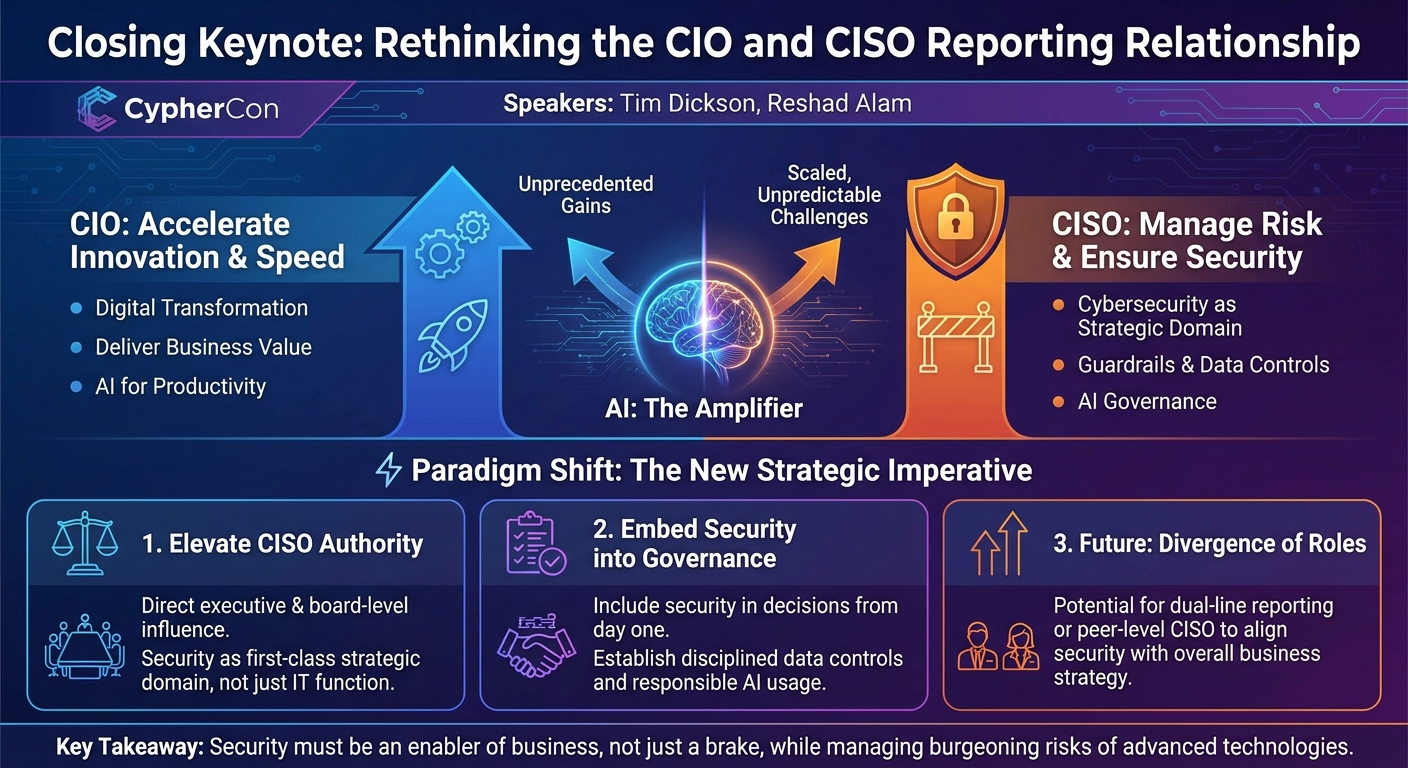
The core of their argument centers on the inherent conflict of interest that arises when the CISO, tasked with managing risk and ensuring security, reports to the CIO, whose primary directive is often to accelerate innovation and deliver business value at speed. This tension is magnified by AI, which promises unprecedented productivity gains but also introduces new, scaled, and often unpredictable security challenges. The speakers advocate for a fundamental rethinking of this reporting relationship, proposing that cybersecurity must evolve into a "first-class strategic domain" with direct executive and board-level influence.
This talk is crucial for any organization grappling with the convergence of digital transformation, AI adoption, and enterprise security. It provides a candid look at the practical challenges faced by security leaders and offers a vision for future organizational structures that better align security with overarching business strategy. By examining the current limitations and forecasting potential solutions, Dickson and Alam underscore the imperative for security to be an enabler of business, rather than merely a brake, while simultaneously managing the burgeoning risks of advanced technologies.
Background
▶ Watch: Speakers introduce topic: rethinking CIO/CISO reporting. (2:00)
The foundational context for this discussion is the pervasive and often unquestioned organizational structure where the Chief Information Security Officer (CISO) typically reports to the Chief Information Officer (CIO). This model emerged from a historical perception of cybersecurity as primarily an IT function, a subset of broader technology management. For decades, this arrangement largely sufficed, as security concerns, while important, were often framed within the operational boundaries of IT infrastructure and data management.
However, the nature of cyber threats has dramatically shifted. What was once confined to technical vulnerabilities has expanded to encompass sophisticated nation-state attacks, ransomware, supply chain compromises, and data breaches with far-reaching legal, financial, and reputational consequences. As Reshad Alam highlights, "the CISO function and what it brings, especially cybersecurity, has a different impact to the company than ever before. It's not only about IT, it does impact bottom line, the stakeholders, and the revenue of the company." This evolution means cybersecurity is no longer just an IT problem; it's a critical business risk that demands strategic oversight at the highest levels of an organization.
The advent of Artificial Intelligence (AI) serves as a significant accelerant to this re-evaluation. The speakers provocatively polled the audience on their excitement versus paranoia regarding AI, illustrating the dual nature of this technology. While CIOs like Tim Dickson envision AI as a "force multiplier for creativity, productivity, and speed," unlocking "new ways of solving problems, accelerating decisions," CISOs like Reshad Alam are compelled to "imagine every possible nightmare scenario." AI's ability to process vast amounts of data, make autonomous decisions, and integrate deeply into business processes means that a single AI implementation can scale an organization's security responsibility by an order of magnitude. The conflict between the CIO's drive for rapid innovation and the CISO's mandate for stringent risk management is therefore amplified, creating an urgent need to reconsider the structural underpinnings of enterprise security.
Key Findings
▶ Watch: AI video contrasting CIO and CISO perspectives on AI. (5:35)
The central finding presented by Tim Dickson and Reshad Alam is that the traditional CISO-to-CIO reporting relationship is fundamentally flawed and increasingly unsustainable in the face of modern cyber threats and transformative technologies like AI. This structure creates an inherent conflict of interest, where the CIO's imperative to "move fast" and deliver business value often clashes with the CISO's responsibility to "move slow" and manage risk. This tension, they explain, typically resolves in favor of the CIO, potentially compromising the organization's security posture.
The speakers advocate for a paradigm shift, asserting that cybersecurity must be recognized as a first-class strategic domain. It transcends mere IT operations and directly impacts an organization's bottom line, stakeholder trust, and overall revenue. The risks associated with digital transformation and AI governance are no longer confined to technical discussions but have become "board-level conversations," necessitating direct engagement from the CISO at the executive leadership team (ELT) and board levels.
While acknowledging that a complete structural overhaul might not be immediately feasible for all organizations, they posit that the future will inevitably bring a divergence of CIO and CISO roles. Tim Dickson candidly states, "CIOs and CISOs will most likely diverge... into a fundamentally different discipline. The future will most likely bring some sort of dual line reporting accountability. Reshad most likely will be my peer in a couple of years." This future state treats risk and cybersecurity as a standalone strategic domain, equal in stature to other critical business functions.
For the immediate term, they propose a practical and effective approach: retaining the CISO within IT to preserve strong operational alignment with technology, but crucially, elevating the authority of the CISO. This involves formally strengthening their decision-making power, embedding security directly into governance processes, and ensuring security is part of decisions from day one, not merely an afterthought. This temporary model aims to close the gap between accountability and influence, positioning security as a "true business enabler" while acknowledging the inevitable need for a more significant structural change down the line.
Technical Deep Dive
▶ Watch: Explaining why the CISO reporting line matters now. (8:00)
While the talk primarily focuses on organizational strategy rather than specific technical exploits or code, the underlying technical content revolves around the profound implications of Agentic AI on enterprise security posture and governance. The speakers articulate the dual nature of AI: a powerful tool for innovation and a significant amplifier of risk.
From the CIO's perspective, AI, particularly the concept of Copilots, is envisioned as a "massive moment" and a "force multiplier for creativity, productivity, and speed." Tim Dickson describes these AI systems as "500 incredibly eager digital interns who never sleep, never complain, and actually read the documentation," enabling organizations to "future-proof our business and empower our teams to win." This perspective highlights the technical capabilities of AI to automate tasks, accelerate data analysis, and augment human decision-making across various business functions. The technical promise is to unlock new efficiencies and drive rapid digital transformation.
Conversely, the CISO's perspective underscores the critical technical challenges and increased attack surface introduced by AI. Reshad Alam warns, "AI doesn't get tired, doesn't forget, and absolutely does not understand sarcasm, confidentiality, or the phrase, 'You probably shouldn't share that.'" This statement points to fundamental technical limitations of current AI models regarding contextual understanding, ethical reasoning, and data privacy. The analogy of "500 incredibly eager digital interns" also serves as a stark warning: if each "intern" can access, process, and potentially share sensitive data, the scale of potential data exposure and compliance risk grows exponentially. These Copilots will "touch data, context, and decisions that matter," meaning the CISO's responsibility effectively scales by the same factor.
The technical deep dive into AI's impact necessitates a robust framework of strong guardrails, disciplined data controls, and responsible AI usage. These are not merely buzzwords but critical technical and architectural requirements that stand "between game-changing capability and tomorrow's incident postmortem." Implementing these controls involves:
- Data Governance: Establishing clear policies for what data AI models can access, process, and store, including data classification, anonymization, and access control mechanisms.
- Model Security: Ensuring the integrity and confidentiality of AI models themselves, protecting against adversarial attacks, model poisoning, and unauthorized manipulation.
- Output Validation: Developing mechanisms to verify the accuracy, appropriateness, and security of AI-generated outputs, preventing the spread of misinformation or the inadvertent leakage of sensitive information.
- API Security: Securing the interfaces through which AI models interact with other enterprise systems, preventing unauthorized access or data exfiltration.
- Auditability and Logging: Implementing comprehensive logging and auditing capabilities to track AI model behavior, data access, and decision-making processes, crucial for incident response and compliance.
The technical implications of AI are not just about securing the AI itself, but understanding how its integration transforms the entire enterprise attack surface, demanding a proactive and deeply embedded security approach from the earliest stages of design and deployment.
Demo / Proof of Concept
▶ Watch: Practical approach: elevate CISO authority while retaining within IT. (11:00)
While Tim Dickson and Reshad Alam's presentation did not feature a traditional technical demonstration of a vulnerability exploit or a new security tool, they employed highly effective and creative methods to illustrate the core conflict and emotional tension central to their talk. These "demonstrations" served as powerful rhetorical devices to engage the audience and underscore their central thesis.
The first such demonstration was an AI-generated video designed to present the "same news" from two distinct perspectives: that of the CIO and that of the CISO. The CIO's segment, likely voiced and animated by AI, exuded boundless enthusiasm, framing AI as a transformative force for productivity and innovation, "unlocking new ways of solving problems, accelerating decisions." This portrayal captured the CIO's drive to leverage technology for business growth. In stark contrast, the CISO's segment, also AI-generated, adopted a tone of extreme caution and paranoia. It highlighted the inherent risks of AI, emphasizing that these "Copilots will touch data, context, and decisions that matter" and warning about the immediate scaling of security responsibility. This segment articulated the CISO's mandate to "imagine every possible nightmare scenario" to ensure the company's protection. The juxtaposition of these two AI-generated perspectives vividly demonstrated the tension and conflicts of interest that emerge from the CIO and CISO's differing priorities regarding new technologies.
The second, and perhaps most memorable, demonstration was a live musical performance by the speakers themselves. They performed an original song titled "AI Paranoia," complete with guitar and tambourine. The lyrics directly addressed the audience's anxieties about AI, incorporating themes relevant to a security conference: "CypherCon hallway blue badges everywhere," "zero trust in the air," "AI's going to take my job we got to take it slow," and warnings about "careless and data breached from hell." The song explicitly referenced Copilot and red teams, culminating in the chorus, "Welcome to the AI paranoia... What you data you have, the data you have, hackers will get for you." This creative and engaging "proof of concept" effectively conveyed the CISO's deep-seated concerns about the security implications of AI in a way that resonated emotionally with the audience, reinforcing the central message about the escalating risks that necessitate a re-evaluation of security leadership.
Defensive Implications
▶ Watch: Musical performance: "AI Paranoia" song about security concerns. (14:45)
The insights presented by Dickson and Alam carry profound defensive implications, not for specific technical controls, but for the strategic positioning and operational effectiveness of an organization's security program. Defenders, particularly CISOs and their teams, must adapt their approach to effectively manage the evolving threat landscape exacerbated by AI.
Firstly, elevate strategic influence: CISOs must actively work to secure a more prominent seat at the executive leadership table and with the board of directors. The talk explicitly states that "Digital and AI risks are now not just IT conversations, they're board-level conversations." This necessitates a shift from purely technical reporting to articulating cybersecurity risks in terms of business impact, financial exposure, and reputational damage. Presenting quarterly updates to the board, as the speakers do at Regal Rexnord, is crucial for establishing this direct line of communication and influence.
Secondly, embed security into governance from day one: The traditional model often treats security as an afterthought, an impedance to innovation. Defenders must advocate for and implement processes that ensure security considerations are integrated into the earliest stages of project planning, technology adoption, and especially AI development. This means establishing robust security by design principles and ensuring that security teams have formal authority to approve or reject initiatives based on their risk posture. As the speakers emphasize, this "ensures security is part of decisions from day one, not an afterthought."
Thirdly, implement robust AI governance and guardrails: Given the scale of responsibility AI introduces, defenders must prioritize the development and enforcement of comprehensive AI security policies. This includes defining "strong guardrails, disciplined data controls, and responsible AI usage." Practically, this means establishing frameworks for AI risk assessment, data lineage tracking for AI models, secure development lifecycle for AI applications, and continuous monitoring of AI systems for anomalous behavior or data leakage. The goal is to harness AI's benefits while mitigating its inherent risks, preventing "tomorrow's incident postmortem."
Fourthly, advocate for organizational restructuring: While not an immediate fix, CISOs should strategically advocate for a reporting structure that reflects cybersecurity's strategic importance. This could involve direct reporting to the CEO, a dual-line reporting model, or being elevated to a peer-level executive alongside the CIO. Such a structure would provide the CISO with the necessary independence and authority to manage risk effectively without being constrained by the CIO's potentially conflicting objectives for speed and innovation.
Finally, cultivate a collaborative, yet independent, relationship with the CIO: Despite the inherent conflicts, the speakers stress that the CIO and CISO are "complimentary forces," not adversaries. Defenders should strive for open communication and partnership with their CIOs, educating them on the strategic implications of risk while simultaneously understanding the business's need for agility. The aim is to achieve a balance where security enables innovation securely, rather than hindering it.
Key Takeaways
- The traditional CISO-to-CIO reporting structure is increasingly outdated and unsustainable, particularly with the rapid adoption of Artificial Intelligence (AI), which amplifies inherent conflicts between innovation speed and risk management.
- AI introduces significant opportunities for business acceleration but also scales security responsibility exponentially, demanding rigorous guardrails, disciplined data controls, and responsible AI usage to prevent "tomorrow's incident postmortem."
- Cybersecurity has transcended its origins as an IT function, evolving into a first-class strategic domain that directly impacts an organization's bottom line, stakeholder trust, and requires direct engagement at the executive leadership team (ELT) and board levels.
- CISOs must proactively elevate their influence within the organization, securing a formal seat at the executive table and embedding security considerations directly into governance processes from the earliest stages of decision-making.
- While a complete organizational overhaul may not be immediate, a practical interim solution involves retaining the CISO within IT but formally strengthening their decision-making power and authority to ensure accountability aligns with influence.
- The future likely entails a divergence of CIO and CISO roles, with the CISO becoming a peer executive, potentially through a dual-line reporting model, reflecting the critical and independent strategic importance of cybersecurity and risk management.
About the Speaker(s)
Tim Dickson serves as the Chief Digital and Information Officer (CDIO) at Regal Rexnord, a significant industrial manufacturing company with a $6 billion valuation, headquartered in downtown Milwaukee. In his role, Tim is responsible for driving the company's digital transformation initiatives and overseeing its information technology strategy. His perspective in the talk emphasized the CIO's imperative to leverage new technologies like AI for business growth and efficiency.
Reshad Alam is the Chief Information Security Officer (CISO) at Regal Rexnord, reporting directly to Tim Dickson. With over 20 years of experience in the security business and nearly 30 years in IT, primarily in Wisconsin, Reshad brings a deep understanding of cybersecurity challenges. His contributions to the talk highlighted the CISO's critical role in managing risk, establishing guardrails for new technologies like AI, and advocating for robust security practices to protect the enterprise. Their combined experience at Regal Rexnord provided a real-world context for the discussion on the evolving CIO and CISO relationship.
Reviews
Dr. Zero (Offensive Security Researcher) — HARD PASS
We've been having this exact argument about the CISO-to-CIO reporting line since the Morris Worm. Slapping the words 'Agentic AI' on a decade-old structural debate and strumming a guitar doesn't make it a strategic keynote—it makes it a LinkedIn post with a soundtrack.
Heather Calloway (CISO) — WEAK
This talk attempts to leverage enterprise AI adoption to re-litigate the decades-old debate over the CISO-to-CIO reporting line. While the underlying conflict of interest is real, the presentation relies on novelty performances rather than a concrete governance framework. Boards and executive teams need actionable risk models for AI adoption, not a tambourine solo about paranoia.