Nostalgia is a Sickness. How to Get Well Soon and Recover Internet Optimism
Daly Barnett
Overview
In this provocative closing keynote at CypherCon, Daly Barnett, a Senior Staff Technologist at the Electronic Frontier Foundation (EFF), dissects the pervasive and often unexamined phenomenon of hacker nostalgia. Challenging the conference's own theme, "remember when the internet was fun," Barnett argues that such backward-looking sentiment, particularly when coupled with superficial aesthetics, is not merely harmless longing but a dangerous "sickness" that hinders progress and can even harbor fascist impulses. The talk serves as a critical examination of how hacker culture has evolved—or stagnated—from its anti-authoritarian roots to its current state, often complicit in surveillance capitalism and state-sponsored violence.
Key moments
- 5:40 Internet's lost promise and current dystopia
- 9:50 Nostalgia: dissatisfaction between present and past
- 16:00 Introducing hauntology: present haunted by past and future
- 25:00 Tracing the hacker-to-sellout pipeline and its causes
- 34:00 Arguing nostalgia in service of kitsch is fascist
- 41:00 Combating security nihilism and manufactured hopelessness
- 43:00 Antidotes: collective power, fighting surveillance, self-determination
- 47:30 Final vision: hack appearances, build other worlds
Nostalgia is a Sickness. How to Get Well Soon and Recover Internet Optimism
Speakers: Daly Barnett, Senior Staff Technologist, Electronic Frontier Foundation
Conference: CypherCon
YouTube: https://www.youtube.com/watch?v=Md0eZ8N8pKM
Overview
In this provocative closing keynote at CypherCon, Daly Barnett, a Senior Staff Technologist at the Electronic Frontier Foundation (EFF), dissects the pervasive and often unexamined phenomenon of hacker nostalgia. Challenging the conference's own theme, "remember when the internet was fun," Barnett argues that such backward-looking sentiment, particularly when coupled with superficial aesthetics, is not merely harmless longing but a dangerous "sickness" that hinders progress and can even harbor fascist impulses. The talk serves as a critical examination of how hacker culture has evolved—or stagnated—from its anti-authoritarian roots to its current state, often complicit in surveillance capitalism and state-sponsored violence.
Barnett, drawing on her extensive experience fighting for digital civil liberties, presents a stark contrast between the internet's early promise of liberation and its current reality as a sophisticated system of oppression and control. She implores the hacker community to move beyond a romanticized past, recognize the ethical failures within the industry, and actively engage in building a more just and private digital future. This involves not only technical prowess but also a deep ethical introspection, a rejection of superficial "kitsch" aesthetics, and a commitment to collective action that serves the public interest over corporate profit or imperial power.
The keynote is a call to arms for hackers to reclaim their role as agents of change, to resist the "hacker-to-sellout pipeline," and to leverage their unique skills for genuine liberation. It’s a philosophical and cultural critique, urging a shift from passive reminiscence to active, forward-looking engagement, emphasizing that true optimism for the internet's future lies in confronting its present challenges with renewed ethical vigor and collective responsibility.
Background
▶ Watch: Internet's lost promise and current dystopia (5:40)
Daly Barnett's talk originates from a profound dissatisfaction with the CypherCon theme, "remember when the internet was fun." Her initial rejection of the theme, born from a sense of urgency about the "dystopic present" and the "tech-enabled violence" she witnesses daily through her work at the EFF, evolved into a deeper inquiry into the nature of nostalgia itself. The EFF, an organization renowned for protecting digital rights for over 35 years, provides Barnett with a frontline perspective on issues ranging from the creep of surveillance technology like ALPRs (Automatic License Plate Readers) to fighting the exploitative data extraction practices of big tech. This context underscores her conviction that the present demands action, not wistful remembrance.
The talk contrasts the internet's early utopian vision—a "blank check" for open-sourcing knowledge, fostering global connectivity, and democratizing power, characterized by thriving subcultures and identity experimentation—with its current state. This promised future, Barnett laments, never materialized. Instead, the internet has been reshaped by corporate monopolization, becoming the foundation for the "most sophisticated surveillance system in all of human history." This has led to mass information wars, public distrust of media, and a pervasive sense that technology, rather than liberating, has become a "system of mechanisms designed to oppress, surveil, murder, and shield its makers from responsibility."
Barnett frames this decline through cultural touchstones and philosophical concepts. She revisits the 1995 movie Hackers, a "bizarre period piece" that, despite its corniness, captured an anti-authoritarian spirit. The film's protagonists, "ragtag queer misfits" like Zero Cool, embody collective power against corporate sellouts like The Plague, who represent what happens "when hackers sell out and become cogs in the machine." The movie's rallying cry, "hack the planet," once resonant, now feels "empty." This cultural reference sets the stage for Barnett's central argument about the stagnation of hacker aesthetics and ethics.
Philosophically, Barnett introduces hauntology, a term coined by Jacques Derrida and further explored by cultural critic Mark Fisher. Hauntology describes how the present is constantly "haunted" by what was and what could be, leading to a "failed mourning" for lost futures. Fisher's work, particularly his critique of late capitalist work culture leaving people "exhausted and overstimulated," resonates with the "dyschronia" of experiencing a hellish present that was promised to be stylishly different. She also explores the concept of kitsch, defined by Thomas Kulka as depicting "objects or themes that are highly charged with stock emotions... instantly and effortlessly identifiable" and by Rob Riemen as "the mindset of a society that has given up on the cultivation of moral and spiritual values." Barnett argues that kitsch, with its rejection of complexity and abstraction, is inherently linked to fascist movements, making hacker nostalgia, when it descends into kitsch, a dangerous "fascist impulse."
Finally, Barnett contrasts the original Hacker Manifesto by "The Mentor" (1986), which she now finds "humiliating" in its writing, with McKenzie Wark's A Hacker Manifesto (2004). Wark, applying Marxist theory, defines hacking as the "art of abstraction," identifying and releasing "the potential of potential" to create "new worlds beyond necessity." This distinction highlights the shift from a naive, individualistic notion of hacking to a more sophisticated, collective, and ethically grounded understanding, setting the stage for Barnett's call to action.
Key Findings
▶ Watch: Introducing hauntology: present haunted by past and future (16:00)
Daly Barnett's keynote delivers several critical findings concerning the state of hacker culture and its ethical responsibilities in the digital age:
- Nostalgia as a Dangerous Impulse: The central finding is that nostalgia, particularly when it leads to a rejection of the complex present or a romanticization of past aesthetics without ethical depth, is not benign. Instead, it can be a "sickness," a "fascist impulse" that attempts to "wipe out complexity entirely," drawing on the familiar to avoid the difficult work of addressing current realities. This is exacerbated when nostalgia manifests as "kitsch," an aesthetic system that simplifies, rejects nuance, and preys on stock emotions, making it ripe for exploitation by authoritarian forces.
- Stagnation of Hacker Culture: Barnett observes a profound stagnation within hacker culture, both aesthetically and ethically. She notes that the visual identity of hacking has barely progressed since The Matrix (1999), remaining trapped in a "retrofuturism" that now feels "quaint or boring at best, but at worst, it's like nauseating or insulting." This aesthetic stasis mirrors a deeper ethical inertia, where the anti-authoritarian spirit of early hacking has been diluted, replaced by a complacent acceptance of corporate power structures.
- The "Hacker-to-Sellout Pipeline": Barnett identifies a clear trajectory where hackers transition from idealistic "Zero Cool" figures to corporate "Plagues" who prioritize personal profit over ethics. This pipeline is characterized by a "suspension of personal responsibility" and a willingness to build "surveillance mechanisms" or "algorithms that decide which children die at the hands of an imperial force" without grappling with the material violence their work enables. She criticizes the exorbitant prices of infosec resources, which commodify inequality and exclude under-resourced human rights defenders.
- Technology's Weaponization and the Loss of Optimism: The internet, once envisioned as a democratizing force, has become a tool for sophisticated surveillance, information warfare, and automated violence. Barnett cites examples like the Tomahawk missile strike on a children's school, caused by "computer intelligence" making decisions based on "old data," to illustrate the devastating real-world impact of unchecked technological development. This has led to a widespread "security nihilism" and a "dull defeatist ache of nihilism" within the community, making it difficult to access the "joy" once associated with the internet.
- The Absence of Humanities in CS: A significant contributing factor to the ethical failures in tech, according to Barnett, is the "lack of humanities in CS departments." She suggests this absence fosters a narrow, technical mindset that overlooks the broader societal and ethical implications of technological innovation, making it easier for individuals to become detached from the human cost of their creations.
- The Potential for Reclaiming Agency: Despite the bleak assessment, Barnett finds optimism in countering "security nihilism." She highlights that collective power, building meaningful alternatives, fighting for encryption, advocating for strong legislation, and engaging in educational initiatives can steer technology back towards serving people. True "hacks," she concludes, are now about organizing "free collective expression" and ensuring "abstraction serves the people rather than the people serving the ruling class."
Technical Deep Dive
▶ Watch: Arguing nostalgia in service of kitsch is fascist (34:00)
While Daly Barnett's keynote is primarily a philosophical and cultural critique rather than a traditional technical deep dive into specific exploits or system architectures, it thoroughly explores the implications of technical systems and the ethical frameworks that should guide their development and deployment. The "technical deep dive" here is less about how systems work, and more about what they enable and who they serve.
At the core of Barnett's critique is surveillance capitalism, a pervasive economic system that underpins many of the internet's negative transformations. This system thrives on the extraction of vast amounts of private information, turning personal data into a commodity. Barnett highlights the role of "big tech" in perfecting this model, making "people's lives worse by extracting as much private info about them as possible," which the EFF considers "evil" and a violation of the right to privacy.
The talk touches upon automated computational systems that have profound and often devastating real-world consequences. Barnett cites the chilling example of a Tomahawk missile aimed at a children's school, resulting in "over a hundred little girls blown up," due to an error in "computer intelligence" based on "old data." This illustrates how technical systems, when deployed without sufficient ethical oversight and human accountability, can mechanize violence and displace culpability further down the line, fostering "innovation for innovation's sake" without regard for material harm.
Barnett also discusses the tele-technology that has "radically contracted space-time—cyberspace." Drawing from Mark Fisher's interpretation of Derrida, she notes how spatially distant events become instantaneously available, creating a "dyschronia" or temporal disjuncture. While hackers should theoretically be "most equipped" to navigate and shape this dischronia, the current reality often sees technology exacerbating issues, leading to phenomena like "AI psychosis" or the disorienting, physically sickening "low-level noise" emitted by large-scale data centers. These are emerging technical harms that directly impact human well-being.
The talk implicitly calls for a decentralized future as an antidote to corporate monopolization and centralized control. Barnett suggests that "decentralized futures will by design bring in a rich diversity of experiences and a pluralism of points of view," fostering self-determination. This is a technical vision that aligns with the original hacker ethos of distributed power and open access.
Specific technical countermeasures and projects are mentioned as examples of how to "blow up the pipelines" of surveillance and control:
- Adversarial noise projects: These projects "poison AI scrapers" attempting to steal intellectual work, effectively "nullifying them completely." This represents a direct technical intervention to protect digital rights and intellectual property from automated exploitation.
- Privacy Badger: An older, open-source (FOSS) browser extension developed by EFF that "blocks invisible trackers," thereby "coercing web apps into being more privacy-respective." This tool demonstrates a practical, user-empowering approach to mitigating ubiquitous online surveillance.
- IMSI-catcher catchers (e.g., Rayhunter): Tools designed to "detect stingrays out in the wild," which are mobile surveillance devices used to intercept cellular communications. This highlights the development of defensive technologies to counter state-level surveillance apparatuses.
- Encryption: Barnett emphasizes that encryption is "the backbone of all privacy and security technology." She praises past successes in "winning that battle so far" against efforts to undermine it and stresses the ongoing need to "recognize and shoot down shitty legislation that attempts to undermine it with these duplicitous claims like save the children." Protecting strong encryption is framed as a fundamental technical and political imperative.
These examples, while not deep dives into their internal workings, serve as concrete illustrations of how technical skills can be applied ethically and effectively to resist oppressive systems, providing tangible pathways for recovering internet optimism.
Demo / Proof of Concept
▶ Watch: Combating security nihilism and manufactured hopelessness (41:00)
Daly Barnett's keynote was a conceptual and philosophical exploration, not a technical presentation with a live demo or proof of concept. The talk did not feature any real-time demonstrations of code, exploits, or tool functionality.
However, throughout her discussion, Barnett effectively highlighted several existing projects and initiatives, primarily from the EFF, that serve as practical examples and "antidotes" to the problems she articulates. These projects function as proofs of concept for the defensive implications and ethical applications of technology she advocates:
- Privacy Badger: A FOSS browser extension developed by EFF that blocks invisible trackers.
- EFF Street Level Surveillance: An interactive taxonomy detailing common surveillance systems.
- Atlas of Surveillance: An EFF project mapping surveillance technologies across the U.S.
- Surveillance Self-Defense (SSD): EFF's comprehensive guides for everyday privacy and security.
- Rayhunter: An IMSI-catcher catcher developed by her coworkers, designed to detect stingrays.
These examples underscore the talk's core message: while the internet's current state is dire, concrete, ethical technical solutions and educational resources already exist and can be further developed to empower individuals and communities.
Defensive Implications
▶ Watch: Final vision: hack appearances, build other worlds (47:30)
Daly Barnett's talk provides a robust framework for defenders, urging a shift from passive observation or complicity to active, ethical engagement. The defensive implications extend beyond purely technical measures to encompass systemic, legislative, and cultural transformations.
- Ethical Scrutiny and Accountability: Defenders must critically examine the ethics of their work and their employers. Barnett challenges the "hacker-to-sellout pipeline" and calls for personal responsibility, urging individuals to question whether their skills are being used to build "surveillance mechanisms" or "algorithms that decide which children die at the hands of an imperial force." The historical "anti-security movement" that doxed peers for supporting "bad guys" is cited not as a call to bring back doxing, but as a reminder to "hold each other accountable for the types of work that we choose to do." Hackers, more than many other professionals, have the agency to be "choosy about who we want to benefit from our work."
- Reject Kitsch and Embrace Authentic Anti-Authoritarianism: Defenders should resist the "neoliberal blobjectivism" where capitalism subsumes and "defangs" radical aesthetics. This means moving beyond superficial "Matrix-style" hacker imagery and recognizing that true anti-authoritarianism requires continuous innovation in thought, ethics, and aesthetics, rather than resting on outdated tropes. The "stagnancy of aesthetics" is a "dire warning" that hacker culture needs to break out of its rut and revive its "subcultural wildness."
- Prioritize Privacy-Respecting Technologies and Alternatives: A key defensive strategy is to build, support, and advocate for meaningful, accessible alternatives to exploitative "terrible tech companies." This includes:
- FOSS (Free and Open Source Software): Projects like EFF's Privacy Badger demonstrate how FOSS can empower users by blocking trackers and coercing better privacy practices from web applications.
- Decentralized Futures: Barnett argues that decentralized systems "by design bring in a rich diversity of experiences and a pluralism of points of view," fostering greater self-determination and resilience against centralized control.
- Fight for Strong Encryption: Encryption is identified as "the backbone of all privacy and security technology." Defenders must continue to actively resist legislative efforts that attempt to undermine encryption, often under "duplicitous claims like save the children." Barnett notes the community's success in this battle so far, emphasizing the need to "keep doing it."
- Advocate for Comprehensive Legislation and Coders' Rights: Technical solutions alone are insufficient. Defenders must engage in policy advocacy for:
- Comprehensive Federal Data Privacy Legislation: To provide holistic protection against pervasive surveillance, moving beyond "piecemeal, state-by-state" approaches.
- Coders' Rights: To protect security researchers from "outlandish criminal charges" under laws like the CFAA (Computer Fraud and Abuse Act), ensuring they can conduct essential security research without fear of prosecution.
- Integrate Humanities into Technical Education: Barnett strongly advocates for "required humanities courses in all CS departments." This is a crucial defensive measure against the ethical blind spots and "suspension of personal responsibility" that can arise from a purely technical education, fostering critical thinking about the societal impact of technology.
- Empower Through Education and Awareness: Defenders should leverage and contribute to educational projects that equip individuals and communities with the knowledge to protect themselves:
- Surveillance Self-Defense (SSD): Providing practical guides for everyday people.
- Atlas of Surveillance and Street Level Surveillance: Mapping and explaining surveillance technologies in communities to raise awareness.
- IMSI-catcher catchers (e.g., Rayhunter): Empowering individuals to detect surveillance devices.
- Embrace Collective Action and Resistance: Ultimately, the most powerful defensive strategy is collective power. Barnett echoes McKenzie Wark's call for hackers to "come together with workers and farmers, with all of the producers of the world, to liberate productive and inventive resources from the myth of scarcity." This involves organizing "new forms of association" to "steer the world away from its destruction through commodified exploitation," actively disrupting surveillance structures, and challenging disinformation campaigns. It's about overcoming "security nihilism" by recognizing that "the sense of hopelessness is intentionally manufactured by those systems that would rather I not challenge them."
Key Takeaways
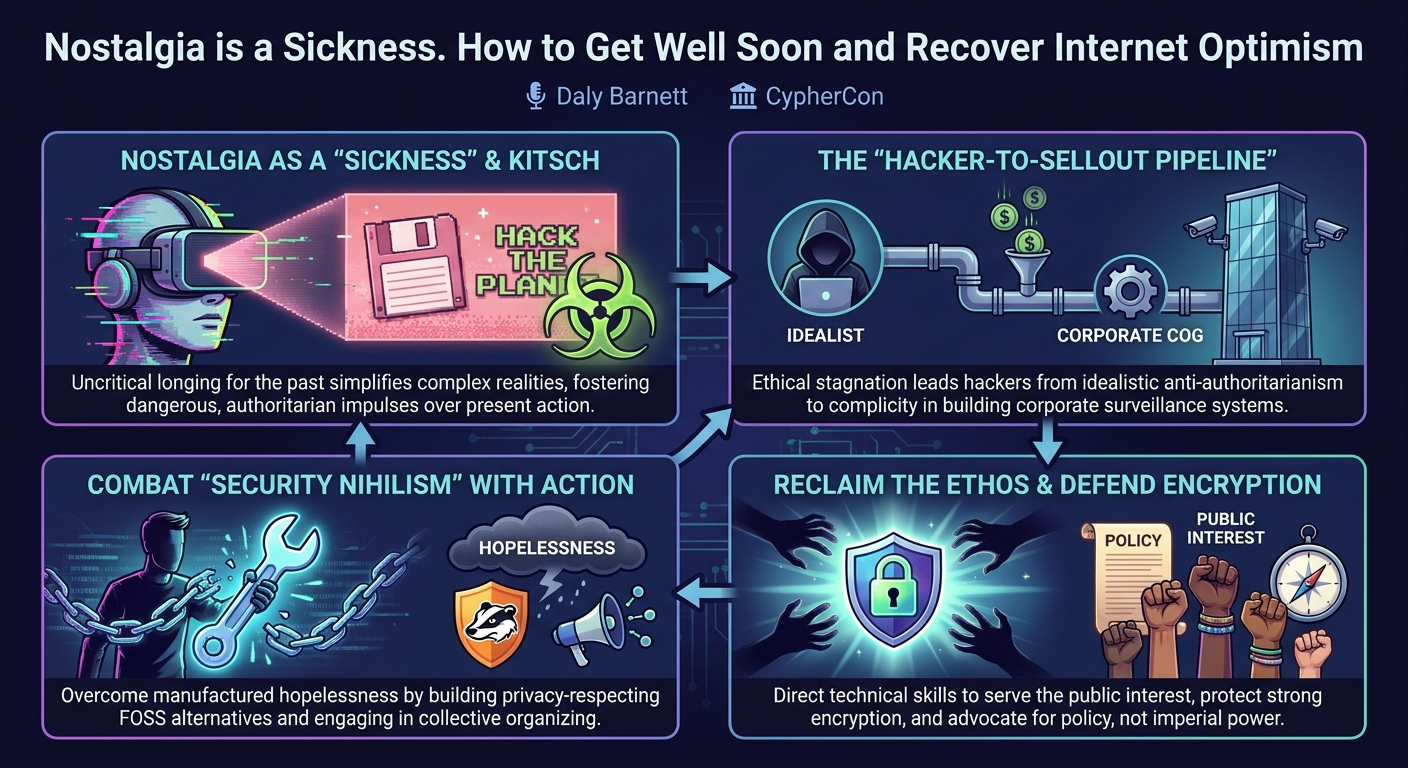
- Nostalgia as a Sickness: Uncritical hacker nostalgia, particularly when tied to superficial aesthetics ("kitsch"), is a dangerous impulse that simplifies complex realities and can harbor authoritarian or even fascist tendencies, preventing meaningful engagement with current ethical challenges.
- Stagnation of Hacker Culture: Hacker culture suffers from both aesthetic and ethical stagnation, failing to evolve beyond outdated tropes and often becoming complicit in the very systems it once opposed, exemplified by the "hacker-to-sellout pipeline."
- Ethical Responsibility is Paramount: Hackers must prioritize ethics over personal profit, question who benefits from their work, and hold themselves and their peers accountable to resist the commodification of inequality and the weaponization of technology.
- Fight Security Nihilism with Action: The pervasive sense of hopelessness ("security nihilism") is manufactured. Counter it through active resistance, building privacy-respecting alternatives, supporting FOSS projects like Privacy Badger, and engaging in collective organizing.
- Protect Encryption and Advocate for Policy: Strong encryption is non-negotiable for digital civil liberties. Continuous advocacy for comprehensive federal data privacy legislation and coders' rights is crucial to establish systemic protections against surveillance and exploitation.
- Reclaim the Hacker Ethos: True hacking is the "art of abstraction" for liberating potential and creating "new worlds beyond necessity." This means directing technical skills to serve people, foster diversity and decentralization, and challenge oppressive power structures, rather than reinforcing them.
About the Speaker(s)
Daly Barnett is a Senior Staff Technologist at the Electronic Frontier Foundation (EFF), a prominent digital civil liberties organization. In her role, she focuses on public interest technology, working to protect privacy, free speech, and innovation. Barnett's work involves extensive research into the "dystopic present" and the growing impact of "tech-enabled violence," particularly on human rights defenders and at-risk communities. She is deeply involved in legal analysis around internet issues, fighting against surveillance technologies like ALPRs, challenging the exploitative practices of "big tech," and providing critical privacy and security advice. Barnett is a prolific writer and speaker, known for her analytical and often provocative critiques of technology's societal implications and the ethical responsibilities of the hacker community.
Reviews
Dr. Zero (Offensive Security Researcher) — SOLID
Daly Barnett spends an hour at CypherCon using French philosophy to tell hackers they sold out to surveillance capitalism. She's not wrong, but you don't need Jacques Derrida to explain why building ad-tech for Meta or targeting algorithms for defense contractors is a moral failure. It's a solid EFF keynote that punches the audience in the teeth, even if it gets bogged down in academic jargon.
Heather Calloway (CISO) — SOLID
This EFF keynote is a sharp critique of how the security industry traded its ethical roots for corporate complacency and surveillance capitalism. It won't hand you a tactical playbook, but it forces a necessary conversation about the vendors we fund and the talent we hire. Worth a watch for leaders who need to understand the cultural undercurrents shaping the next generation of security engineers.