Field Notes from a year of OPSEC Trainings
Daly Barnett
Overview
In "Field Notes from a year of OPSEC Trainings," Daly Barnett, a Senior Staff Technologist at the Electronic Frontier Foundation (EFF), shares critical insights gleaned from a year of providing digital security and privacy training to a diverse array of at-risk communities. This talk moves beyond traditional enterprise cybersecurity, delving into the unique threat models faced by human rights defenders, activists, and marginalized groups caught in the crosshairs of political and cultural conflicts. Barnett illuminates the often-overlooked challenges these communities encounter, from pervasive surveillance to targeted harassment, and outlines the practical, accessible operational security (OPSEC) strategies developed by the EFF to empower them.
Key moments
- 2:00 EFF's mission: security trainings for at-risk communities
- 7:00 Demystifying security: threat modeling over one-size-fits-all VPNs
- 10:30 Supporting criminalized healthcare, activists, sex workers, trans rights
- 22:20 Top threats: doxing, platform censorship, device seizure
- 33:25 Secure communications, data backup, protest safety procedures
- 42:30 Holistic solution: comprehensive federal data privacy legislation
- 49:30 Engaging protesters: using real-world evidence of surveillance impact
- 53:30 Local action: fighting expansion of surveillance like Flock cameras
Field Notes from a year of OPSEC Trainings
Speakers: Daly Barnett, Senior Staff Technologist, Electronic Frontier Foundation
Conference: CypherCon
YouTube: https://www.youtube.com/watch?v=h_6lMLeCHaw
Overview
In "Field Notes from a year of OPSEC Trainings," Daly Barnett, a Senior Staff Technologist at the Electronic Frontier Foundation (EFF), shares critical insights gleaned from a year of providing digital security and privacy training to a diverse array of at-risk communities. This talk moves beyond traditional enterprise cybersecurity, delving into the unique threat models faced by human rights defenders, activists, and marginalized groups caught in the crosshairs of political and cultural conflicts. Barnett illuminates the often-overlooked challenges these communities encounter, from pervasive surveillance to targeted harassment, and outlines the practical, accessible operational security (OPSEC) strategies developed by the EFF to empower them.
Barnett's presentation underscores a fundamental disconnect: the standard cybersecurity solutions and advice often fail to address the realities of individuals and groups fighting for civil liberties, bodily autonomy, and self-determination. These communities, frequently under-resourced and lacking access to expensive infosec services, require tailored approaches that account for both state and non-state adversaries, as well as the operational difficulties of implementing complex technology. The talk serves as a vital call to action for the broader security community, urging a re-evaluation of how digital defense is conceived and delivered to those for whom privacy is not merely a preference but a matter of survival.
The significance of this work extends far beyond the immediate beneficiaries. As digital surveillance becomes more ubiquitous and legislative efforts increasingly erode privacy, the threats currently faced by these at-risk communities represent a potential future for everyone. Barnett eloquently argues that defending the digital rights of the most vulnerable is a proactive measure to safeguard civil liberties for all, advocating for systemic changes like comprehensive federal data privacy legislation and the decentralization of technology.
Background
▶ Watch: EFF's mission: security trainings for at-risk communities (2:00)
The Electronic Frontier Foundation (EFF), founded in 1990, stands as a leading non-profit organization dedicated to defending civil liberties in the digital world. Their mission, as Daly Barnett articulates, is to ensure that when individuals go online, their rights go with them. The EFF is renowned for its impact litigation, policy analysis, and technological expertise, frequently representing hackers, security researchers, and political dissidents against charges like those under the Computer Fraud and Abuse Act (CFAA). Barnett, a Senior Staff Technologist, contributes to this mission as a security researcher, privacy advocate, and cybersecurity educator, specifically focusing on the intersection of surveillance, tech-enabled violence, and resilience.
A cornerstone of EFF's educational outreach is the Surveillance Self-Defense (SSD) project (ssd.eff.org). This comprehensive guide, established 17 years ago, is considered the de facto blueprint for digital security and privacy education. Unlike many commercial offerings, SSD emphasizes threat modeling and risk assessment over one-size-fits-all security solutions, debunking common misconceptions, such as the idea that a Virtual Private Network (VPN) alone provides complete protection. The project offers accessible guides on topics ranging from strong passwords and data safety to understanding encryption and creating personalized security plans, available in over a dozen languages.
In the preceding year, 2023, Barnett and her colleagues at the EFF engaged with an estimated 66 different groups and organizations, conducting approximately 300 engagements for at least 2,000 individual participants. These requests often arise organically, as communities seek practical application of the principles outlined in SSD. The communities served are diverse, encompassing a wide range of human rights defenders and individuals newly impacted by the creep of criminalization and unchecked surveillance.
Key issue spaces that frequently sought EFF's assistance include:
- Reproductive Justice: Particularly following the overturn of Roe v. Wade, individuals involved in abortion access, clinic escorts, medical practitioners, and seekers of medical care faced heightened digital risks due to the criminalization of essential healthcare. The interoperability of digital technologies made threats far more complex than in previous eras of paper records, highlighting the inadequacy of protections like HIPAA (where 'P' stands for portability, not privacy).
- Criminalized Healthcare Providers: Doctors, mental health practitioners, doulas, nurses, and even technologists implementing systems like Epic and EHR systems found themselves unexpectedly vulnerable.
- Legal Defense Groups: Supporting immigrant justice, reproductive justice, and sex worker rights.
- International Researchers and Border Crossers: Concerned about data seizure at state and national borders.
- Climate Justice Activists: Navigating the tension between public advocacy and the need for personal privacy in direct actions.
- Sex Worker Rights Advocates: A long-standing focus for Barnett, facing platform censorship and legal battles.
- Survivors of Intimate Partner Violence: Experiencing doxing, stalkerware, and unique digital risks.
- Transgender Rights Activists: A broad category encompassing medical providers, archivists, parents, and individuals fleeing violent states, all facing specific threats related to their identity and advocacy.
A common thread among these groups is their under-resourced nature and their inability to afford the expensive services of traditional infosec firms. Barnett noted that conventional cybersecurity models often fail to grasp the unique operational contexts of these "movement workers," whose "liberation is not won in Active Directory networks." The EFF leverages its institutional weight, legal expertise, and technological skill set to bridge this gap, offering critical support to those most acutely impacted by the expanding digital frontier of civil liberties.
Key Findings
▶ Watch: Supporting criminalized healthcare, activists, sex workers, trans rights (10:30)
Daly Barnett's extensive work with at-risk communities revealed a consistent set of security challenges and threat patterns that diverge significantly from typical corporate cybersecurity concerns. The overarching finding is that threat modeling and risk assessment are not merely best practices but essential, foundational steps for every engagement, as no two situations are identical, and a "one-size-fits-all" approach is inherently insufficient.
Barnett identified several common threat actors and methodologies that these communities face:
- Non-state actors: Bigots, harassers, and organized opposition groups.
- State actors: Lawmakers and law enforcement agencies.
- Corporate actors: "Spineless tech companies" that cede to governmental pressure or implement policies that enable surveillance and censorship.
The most frequently encountered and feared threats include:
- Doxing and OSINT-driven Violence: This was consistently at the top of communities' concerns, particularly for those in the crosshairs of culture wars. Doxing is a tactic used by both state and non-state actors to escalate harassment and violence.
- Platform Censorship and Loss of Service: Groups often face account shutdowns, content removal, or complete loss of service from cloud-hosted data and intermediaries due to speech deemed "too scary" by platforms or governments.
- Website Defacement and Web Application Vulnerabilities: Surprisingly, classic web defacement incidents, alongside concerns about outdated software, were observed, requiring basic vulnerability identification and remediation advice.
- Insider Threat: While infiltration by adversaries is a risk, a more common form of insider threat stems from accidental errors by community members who lack the time, energy, or resources to be "tech wizards." Upskilling the community is crucial to mitigate this.
- Law Enforcement Investigation and Device Seizure: For activists, especially those crossing borders, the risk of physical devices (computers, phones) being seized and subjected to forensic extraction tools like Cellebrite is a significant concern. The state of the device at seizure and the use of secondary devices become critical considerations.
- Operational Difficulty of Security Tech: Many users are not hackers or technologists (e.g., "grandmas operating out of a church basement"). The complexity of advanced privacy and security tools can be a prohibitive barrier, hindering their core movement work. The goal is "good enough" security that enables, not inhibits.
- Street-Level Surveillance Devices (SLS): Technologies like Automatic License Plate Readers (ALPRs), facial recognition cameras on security towers, and integration with smart city software pose a real, non-theoretical threat. ALPR data, for instance, has been used in criminal cases targeting individuals seeking or aiding abortion.
- Stalking and Harassment: Beyond intimate partner violence survivors, high-profile activists frequently experience stalking and harassment, requiring strategies that balance publicity needs with personal safety.
- Security Nihilism: A pervasive feeling that "Big Brother is too big, and technology is too sophisticated" to fight against. Barnett counters this by highlighting examples of adversaries' failures and emphasizing human factors in security breaches.
A recurring insight from these engagements is that popular "solutions" like VPNs are often not the primary answer to the specific, complex threats faced by these communities. Instead, a deeply customized, context-aware approach grounded in fundamental security principles, adapted for pro-social movements, is required.
Technical Deep Dive
▶ Watch: Secure communications, data backup, protest safety procedures (33:25)
The EFF's approach to digital security training for at-risk communities is meticulously structured around their Surveillance Self-Defense (SSD) framework, with a heavy emphasis on threat modeling and risk assessment. This methodology aims to demystify complex security concepts and retool them for pro-social movements, stripping away corporate or military jargon to make them accessible and actionable.
- Threat Modeling and Risk Assessment:
- Six Questions: The core of SSD's threat modeling involves asking: 1) What do I want to protect? 2) From whom do I want to protect it? 3) How likely is it that I will need to protect it? 4) How bad are the consequences if I fail? 5) How much trouble am I willing to go through to protect it? 6) What are the allies or friends in my community who can help? The inclusion of allies is a notable departure from traditional corporate threat modeling.
- Risk Matrix: Groups engage in an exercise to map potential "unwanted security scenarios" based on their identified threat actors and assets, categorizing them by the consequence and likelihood of occurrence. This visual aid helps prioritize mitigation efforts against the most impactful or probable threats.
- Incident Response Planning (PACE Documentation):
- A crucial output of the risk assessment is the development of PACE (Primary, Alternate, Contingency, Emergency) plans. These documented strategies outline responses to various security scenarios, from website defacement to platform shutdowns or arrests.
- Barnett stresses that even unsophisticated plans provide significant support, offering a clear course of action when individuals are in a state of distress during an incident. This proactive planning, such as having data backups on an encrypted USB drive in a known location, can dramatically reduce the impact of an event.
- Secure Communications:
- End-to-End Encryption (E2EE): While not delving into the cryptographic details, Barnett introduces the concept of E2EE and advocates for tools like Signal, explaining features like usernames and ephemeral messages for managing large activist groups.
- Non-Technical Secure Communications: A unique aspect is the emphasis on non-technical methods, such as developing code words or private jargon. This strategy, often instinctively understood by groups in highly criminalized spaces (e.g., harm reduction, sex worker rights), provides a layer of plausible deniability and obfuscation in riskier communication channels.
- Data Backup Strategies:
- Acknowledging the prevalent use of platforms like Google Office/G Suite, Barnett guides communities on migrating off such services, or, more practically, implementing robust backup plans.
- Recommendations include regular backups to encrypted USB sticks stored securely (e.g., "in this drawer"), and for more intensive operations, implementing warm and cold backup strategies to ensure data resilience against account shutdowns or data breaches.
- Protest Safety Procedures and Street-Level Surveillance (SLS):
- The EFF provides extensive resources on protest safety, covering surveillance likely to be encountered before, during, and after protests (e.g., social media monitoring).
- A significant focus is on Street-Level Surveillance (SLS) technologies. These include surveillance towers with facial recognition cameras, Automatic License Plate Readers (ALPRs), police body cameras, and real-time location tracking via data brokers. The website sls.eff.org offers a detailed taxonomy of these devices, with pictures and examples to help activists identify and understand their implications.
- The logic of evading SLS is applied broadly to any risky activities conducted on the street, such as those by sex workers or other movement workers. Practical advice includes masking for public health and facial recognition evasion.
- Community Upskilling and Contingency Technology Plans:
- Barnett encourages community upskilling, where groups designate roles for security tasks, such as managing Signal groups, overseeing data backups, or maintaining lists of trusted legal contacts. This builds upon existing organizing procedures within activist communities.
- Contingency technology plans extend beyond personal safety to address systemic vulnerabilities, such as anticipating platform shutdowns, data breaches, or single points of failure within a group's technology stack. This ensures operational continuity even when digital infrastructure fails or is compromised.
These technical deep dives are always framed within the context of the movement's goals, ensuring that security measures are "reasonable, useful, and again, not inhibit the more important work that they're doing," with the ultimate goal that "liberation is more important than encryption."
Demo / Proof of Concept
▶ Watch: Holistic solution: comprehensive federal data privacy legislation (42:30)
This talk focused on sharing observations and strategies from extensive training work, rather than demonstrating a specific tool or proof of concept. The "proof" is in the real-world application of these security principles by at-risk communities, and the talk's content is a distillation of lessons learned from those practical engagements.
Defensive Implications
▶ Watch: Local action: fighting expansion of surveillance like Flock cameras (53:30)
The insights from Daly Barnett's talk offer crucial defensive implications for both at-risk communities and the broader cybersecurity landscape.
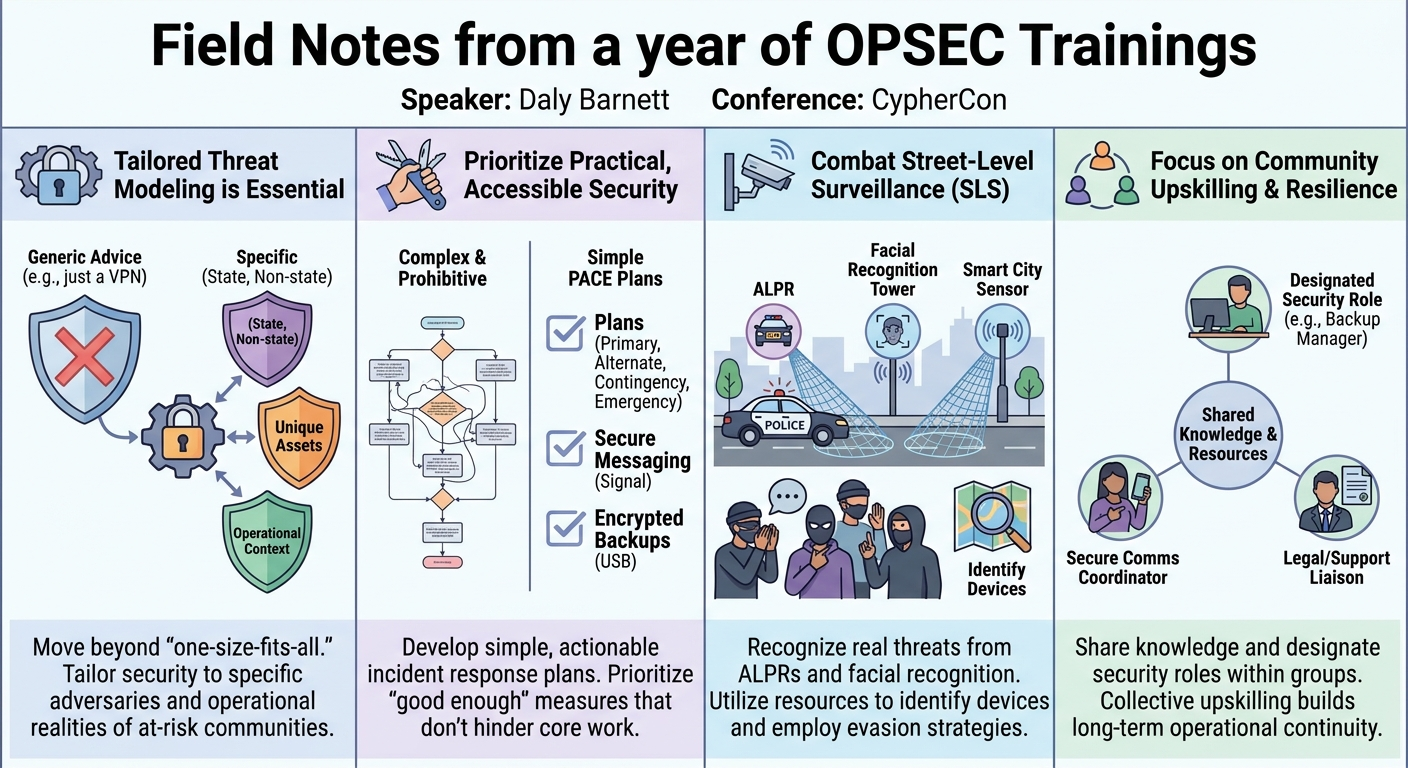
- Tailored Threat Modeling is Paramount: Defenders, particularly those supporting non-traditional groups, must abandon "one-size-fits-all" security solutions. Instead, invest time in deeply understanding the specific adversaries (state, non-state, corporate), assets, and unique operational contexts of the community. The EFF's SSD framework and its six core questions provide an excellent starting point for this tailored threat modeling and risk assessment.
- Prioritize Accessible and Practical Solutions: For communities with limited resources and technical expertise, complex, "perfect" security is often counterproductive. Focus on practical, accessible measures that enhance security without hindering core activities. This means simplifying concepts, avoiding jargon, and building upon existing organizational structures for security roles.
- Develop Incident Response Plans (PACE): Even basic PACE (Primary, Alternate, Contingency, Emergency) documentation can significantly improve resilience. Organizations and individuals should proactively outline steps for common scenarios like account shutdowns, device seizure, or website defacement. Having these plans ready reduces panic and enables more effective responses during stressful events.
- Embrace Secure Communication and Data Hygiene Fundamentals:
- End-to-end encrypted messaging (e.g., Signal) should be standard for group coordination.
- Data backup strategies are non-negotiable. Regularly back up critical data (especially off cloud services like Google Workspace) onto encrypted local storage (e.g., USB drives), considering both warm and cold backup options.
- Leverage non-technical secure communications like code words within trusted groups for sensitive discussions.
- Understand and Resist Street-Level Surveillance (SLS): Activists and concerned citizens must be aware of the pervasive nature of SLS technologies such as ALPRs, facial recognition cameras, and real-time location tracking via data brokers.
- Utilize resources like sls.eff.org to identify these devices in local communities.
- Engage in local advocacy to push back against the expansion of such surveillance, as demonstrated by successful efforts against Flock cameras in rural areas. Educating local politicians and community members on the privacy implications can be highly effective.
- Recognize and Address Insider Threat (Accidental and Malicious): Defenders need to consider both intentional infiltration and, more commonly, accidental data leakage or operational errors by non-technical group members. Community upskilling and clear designation of security roles can mitigate these risks.
- Advocate for Systemic Policy Changes: Ultimately, many digital security threats stem from a lack of robust legal protections. Defenders should support efforts for:
- Comprehensive federal data privacy legislation to establish fundamental digital rights.
- Coders' rights to protect security researchers.
- Decentralization and accessibility in technology to provide user choice and ensure privacy for all, regardless of technical skill.
- Engage with organizations like EFF (act.eff.org) to support legislative efforts and resist harmful bills (e.g., age-gating, paternalistic "save the children" legislation that undermines privacy).
By adopting these defensive postures, individuals and organizations can build more resilient communities, safeguarding civil liberties in an increasingly surveilled and criminalized digital world.
Key Takeaways
- Tailored Security is Essential: Digital security for at-risk communities demands highly customized threat modeling and risk assessment, moving beyond generic advice like "just get a VPN" to address specific adversaries, assets, and operational contexts.
- Accessibility Over Perfection: Practical, accessible security measures (e.g., secure communication, data backups, incident response plans) are prioritized, ensuring they enable rather than inhibit the crucial work of human rights defenders who often lack extensive technical expertise or resources.
- Street-Level Surveillance is a Real Threat: Technologies like Automatic License Plate Readers (ALPRs) and facial recognition cameras are not theoretical concerns but are actively used in criminal cases, posing significant risks to activists and marginalized groups, necessitating awareness and local advocacy against their expansion.
- Proactive Incident Response is Vital: Even simple PACE (Primary, Alternate, Contingency, Emergency) plans for scenarios like platform shutdowns, data breaches, or device seizures provide crucial resilience, offering clear guidance in moments of crisis.
- Community Collaboration and Upskilling are Key: Shared threat actors create opportunities for cross-movement collaboration, while designating security roles and collectively upskilling community members are critical for collective defense and maintaining operational continuity.
- Policy Advocacy is the Ultimate Defense: Many digital security vulnerabilities stem from systemic issues. Advocating for comprehensive federal data privacy legislation, coders' rights, and the decentralization and accessibility of technology is fundamental to securing civil liberties for everyone.
About the Speaker(s)
Daly Barnett is a Senior Staff Technologist at the Electronic Frontier Foundation (EFF), a leading non-profit organization dedicated to defending civil liberties in the digital world. With approximately seven years at the EFF, Barnett initially joined as a developer on their Privacy Badger project. She has since evolved into a prominent security researcher, privacy advocate, and cybersecurity educator. Her work focuses on the critical intersections of surveillance, tech-enabled violence, and digital rights, particularly as they impact human rights defenders and other at-risk communities. Barnett leverages the EFF's institutional weight and expertise to provide accessible and tailored operational security (OPSEC) trainings, empowering those who are often under-resourced and uniquely targeted by both state and non-state adversaries.
Reviews
Dr. Zero (Offensive Security Researcher) — STRONG ACCEPT
This isn't a reverse-engineering talk, but it's a mandatory reality check for defenders who think OPSEC starts and ends with a corporate firewall. Barnett strips away enterprise marketing bullshit and shows what threat modeling looks like when the adversary is a hostile state apparatus and the asset is a human life.
Heather Calloway (CISO) — SOLID
This talk steps outside the corporate perimeter to examine how high-risk, under-resourced groups handle state and non-state surveillance. While the focus is on activists, the threat models directly apply to enterprise executive protection, travel security, and the data exposure of our own employees in high-risk jurisdictions.