Shall We Play a Game? Breaking Weak Ciphers and Exploring Artificial Intelligence Generated Text
Jamie Grunewald
Overview
In his CypherCon talk, "Shall We Play a Game? Breaking Weak Ciphers and Exploring Artificial Intelligence Generated Text," Jamie Grunewald presents "Aegis Leo," a personal research project simulating secure communication between devices in a Low Earth Orbit (LEO) context. The project delves into the critical challenges of post-quantum key management (PQC) and the integration of behavioral anomaly detection using artificial intelligence to fortify satellite communications against emerging and future threats. Grunewald, drawing on his extensive background in military SATCOMs and incident response, emphasizes that while strong cryptography is essential, it is no longer sufficient to secure systems against sophisticated adversaries who might compromise nodes or harvest encrypted data for future decryption by quantum computers.
Key moments
- 0:00 Introduction to Aegis Leo and project background
- 4:40 The problem: Quantum computing threats to current crypto
- 9:50 Home lab setup and RF communication challenges
- 14:00 Post-quantum key exchange (ML-KEM) and crypto stack
- 16:40 PQC impact: increased packet size and processing challenges
- 19:50 Behavioral anomaly detection using an autoencoder
- 22:40 Demonstrating anomaly detection with adversarial packet injection
- 28:00 Future project directions and audience Q&A
Shall We Play a Game? Breaking Weak Ciphers and Exploring Artificial Intelligence Generated Text
Speakers: Jamie Grunewald
Conference: CypherCon
YouTube: https://www.youtube.com/watch?v=KRhU4egiQZk
Overview
In his CypherCon talk, "Shall We Play a Game? Breaking Weak Ciphers and Exploring Artificial Intelligence Generated Text," Jamie Grunewald presents "Aegis Leo," a personal research project simulating secure communication between devices in a Low Earth Orbit (LEO) context. The project delves into the critical challenges of post-quantum key management (PQC) and the integration of behavioral anomaly detection using artificial intelligence to fortify satellite communications against emerging and future threats. Grunewald, drawing on his extensive background in military SATCOMs and incident response, emphasizes that while strong cryptography is essential, it is no longer sufficient to secure systems against sophisticated adversaries who might compromise nodes or harvest encrypted data for future decryption by quantum computers.
The talk highlights the urgent need for robust security paradigms that extend beyond traditional cryptographic assurances. Grunewald demonstrates a multi-layered defense strategy, combining advanced PQC algorithms with an autoencoder-based machine learning (ML) system designed to detect anomalous telemetry data, even when cryptographic integrity remains intact. This approach addresses the evolving threat landscape where adversaries may not break encryption but instead inject manipulated data from compromised sensors or firmware. The project, built with accessible hardware like Raspberry Pi and Jetson Orin Nano, underscores the power of curiosity-driven research in tackling complex cybersecurity problems relevant to critical infrastructure like satellite systems.
Background
▶ Watch: Introduction to Aegis Leo and project background (0:00)
The genesis of the Aegis Leo project is deeply rooted in both historical internet philosophy and contemporary cybersecurity imperatives. Grunewald harks back to the "fun" era of the early internet, built by curious individuals with limited budgets and a "no permissions" mentality—a spirit that fueled his own independent research. This ethos aligns with the need for agile innovation in addressing complex threats. A primary driver for the project is the looming specter of quantum computing, specifically Shor's algorithm, which, when run on sufficiently large quantum systems, is capable of breaking widely used cryptographic primitives like RSA and Elliptic Curve Cryptography (ECC). While fully capable quantum computers are not yet ubiquitous, adversaries are already engaged in a "harvest now, decrypt later" strategy, recording vast amounts of encrypted traffic (e.g., from satellite systems, banking, military, GPS) with the intent of decrypting it once quantum hardware matures.
In response to this existential threat, the National Institute of Standards and Technology (NIST) has been finalizing post-quantum cryptography (PQC) standards, notably FIPS 203 (standard for digital signatures using ML-DSA) and FIPS 204 (standard for key-establishment using ML-KEM). These new standards are crucial for transitioning critical systems to quantum-resistant algorithms. Grunewald's project directly incorporates these PQC standards.
Beyond the quantum threat, the talk also re-evaluates the traditional security triad of Confidentiality, Integrity, and Availability (CIA). While these principles remain foundational, Grunewald introduces a crucial fourth dimension: Authenticity or behavioral integrity. He posits that even if encryption remains unbroken, an adversary might compromise an edge device or sensor, injecting distorted or incorrect telemetry values. Such a scenario would bypass traditional cryptographic integrity checks if the data is signed and encrypted correctly by the compromised (but not cryptographically broken) device. The Aegis Leo project aims to address this gap by detecting anomalous behavior, thereby providing an additional layer of defense against sophisticated, state-sponsored attacks that target the integrity of data at its source, rather than just its transmission. This context sets the stage for a multi-layered approach combining PQC with AI-driven anomaly detection.
Key Findings
▶ Watch: Home lab setup and RF communication challenges (9:50)
Grunewald's Aegis Leo project yielded several critical insights into the practical implementation of post-quantum cryptography and the necessity of advanced anomaly detection in constrained environments like satellite communications:
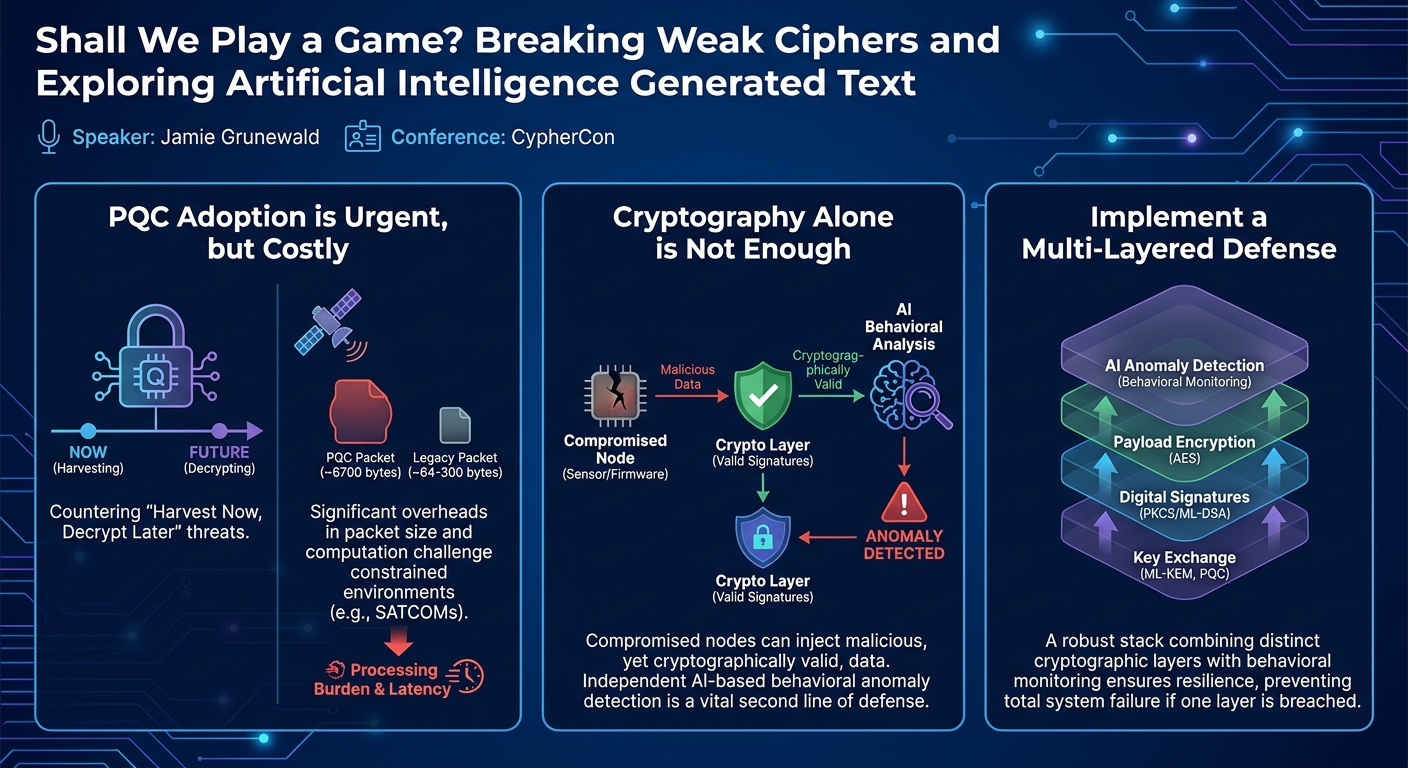
- PQC Overheads are Significant and Impact Performance: A major finding was that post-quantum cryptographic standards, while secure, are "not free." They demand substantially more computational resources and, crucially, lead to significantly larger packet sizes. A typical RSA-2048 handshake might be around 300 bytes, and an ECC-256 key exchange around 64 bytes. In contrast, the PQC packets in his simulated environment jumped to approximately 6,700 bytes. This exponential increase in size has a profound impact, especially over low-bandwidth, high-latency RF communication channels. On a shortwave setup, this resulted in roughly 20% of packets being dropped, necessitating robust chunking, sequencing, buffering, and reassembly mechanisms. This highlights a critical design consideration for real-world PQC deployments in constrained environments.
- Crypto-Only Defenses are Insufficient Against Sophisticated Adversaries: The project underscored that even with a strong, defense-in-depth cryptographic stack, traditional encryption and digital signatures alone cannot fully protect against all attack vectors. An adversary might compromise an edge device (e.g., a satellite sensor or firmware) and inject incorrect or distorted telemetry data that is then legitimately signed and encrypted by the compromised device's own keys. In such a scenario, the cryptographic layers would still validate the packets as authentic and untampered, even though the data itself is malicious. This emphasizes the need for a complementary defense mechanism.
- Behavioral Anomaly Detection is a Vital Independent Layer: To address the limitations of purely cryptographic defenses, Grunewald demonstrated the effectiveness of an independent behavioral anomaly detection layer using an autoencoder neural network. This ML component was trained on "normal" telemetry data and proved capable of flagging packets containing values outside expected parameters, even when those packets passed all cryptographic checks. This anomaly detection acts as a crucial second line of defense, providing alerts when a compromised node attempts to send distorted or incorrect (but cryptographically valid) information.
- Real-World RF Challenges are Non-Trivial: The practical setup of the home lab revealed unexpected challenges in RF communication. Despite the LoRa modules being only two feet apart, issues with power and frequency caused significant packet drops. Moving the Raspberry Pi to a different room, increasing the distance, dramatically improved signal and telemetry transmission, underscoring that theoretical cryptographic strength must contend with the unpredictable realities of physical communication layers.
Technical Deep Dive
▶ Watch: PQC impact: increased packet size and processing challenges (16:40)
The Aegis Leo project leverages a sophisticated, multi-layered approach to secure simulated satellite communications, integrating post-quantum cryptography with advanced machine learning for anomaly detection.
Home Lab and Communication Setup
Grunewald's experimental setup, dubbed his "home lab," consists of readily available hardware:
- An Nvidia Jetson Orin Nano (acting as the ground station)
- A Raspberry Pi 5 (simulating a satellite or edge device)
- A Beelink Mini PC hosting Proxmox with a Kali Linux VM (serving as the adversary)
- Two LoRa SDR modules (one connected to the Orin Nano, one to the Raspberry Pi)
Crucially, communication between the Orin Nano and Raspberry Pi occurs over radio frequency (RF), specifically using the LoRa modules operating around 850 MHz, rather than Wi-Fi. This choice simulates the constrained and often challenging environment of satellite communications. LoRa (Long Range) technology is well-suited for low-power, long-distance data transmission, often used for sensor data and relevant to CubeSats and amateur satellite communities. Initially, proximity issues between the SDRs caused significant packet loss, leading to the discovery that greater physical separation improved signal integrity and packet transmission. The ground station's cryptographic stack runs within a Docker container on the Jetson Orin Nano, utilizing a full Python crypto stack.
Data Packet Structure (CCSDS Concepts)
For structuring the telemetry stream, the project borrowed concepts from CCSDS (Consultative Committee for Space Data Systems) standards. CCSDS defines agreed-upon standards for space agencies like ESA and NASA, covering aspects such as packet protocols, structure, headers, sequencing, and associated metadata. Grunewald cherry-picked relevant elements from these standards to build his telemetry packets, ensuring a realistic representation of data flow in a space communication context.
Post-Quantum Key Exchange (ML-KEM)
The core of the cryptographic security is a post-quantum key exchange mechanism based on ML-KEM (Module-Lattice-based Key Encapsulation Mechanism). This lattice-based algorithm is 1024 bits in size and is a NIST-finalized standard (FIPS 204). Grunewald illustrates this with a padlock analogy: one party sends an open padlock, the other places their secret inside, snaps the lock shut, and sends it back. Only the original sender, holding the key, can open it, without the key ever being exchanged directly. This mechanism ensures that the secret (the symmetric key for payload encryption) travels securely without either party ever possessing the other's long-term private key. The project was inspired by a graduate course where Grunewald implemented Diffie-Hellman key exchange, prompting him to explore its application over RF with PQC.
Defense-in-Depth Cryptographic Stack
The Aegis Leo project implements a robust, three-layered cryptographic stack designed for defense-in-depth:
- Key Exchange Layer: Handled by ML-KEM-1024, which establishes a shared secret key using quantum-resistant lattice-based cryptography.
- Digital Signing Layer: Utilizes the PKCS standard (specifically referencing FIPS 203 for digital signatures, likely ML-DSA) to digitally sign the payload. This layer ensures the integrity and authenticity of the sender, detecting any forged signatures.
- Payload Encryption Layer: Employs AES (Advanced Encryption Standard) to encrypt the actual telemetry payload using the symmetric key established by ML-KEM.
The design philosophy dictates that an adversary would need to break all three layers simultaneously to compromise the communication. If a weakness is found in the key exchange, the signature layer should still catch impersonation. If the signature scheme is compromised, AES should still prevent unauthorized reading of the payload and detect tampering.
PQC Overhead and Packet Reassembly
A significant technical challenge encountered was the substantial increase in packet size due to PQC, with packets reaching approximately 6,700 bytes. Over the constrained LoRa RF link, this led to about 20% packet loss. To mitigate this, the system chunks up the large PQC packets. Each chunk carries a sequence index and a total count, allowing the receiving end to buffer, resequence, and rebuild the complete packet before decryption. This reassembly process was a source of complexity and required careful implementation to ensure data integrity despite transmission challenges.
Behavioral Anomaly Detection with Autoencoders
Recognizing that crypto alone is insufficient against compromised nodes, Grunewald integrated a second, independent layer of defense: behavioral anomaly detection using an autoencoder.
- Autoencoder Functionality: An autoencoder is a type of neural network trained to compress its input into a smaller representation and then reconstruct the original input from that compressed form.
- Training: The autoencoder was trained on approximately 2,000 synthetic "normal" telemetry samples. These samples represented typical, healthy sensor readings and metadata (e.g., temperature, battery percentage) queried from the Raspberry Pi.
- Anomaly Detection: When presented with data it has never seen before or that deviates significantly from its training data, the autoencoder struggles to reconstruct the original input accurately. This inability to reconstruct triggers a high anomaly score.
- Adversary Scenario: In the demonstration, the Kali Linux VM (the adversary) was on the same VLAN as the Orin Nano ground station, allowing it to observe traffic. While Kali could not forge digital signatures (which would be caught by the crypto layer), it could inject packets containing anomalous values (e.g., distorted sensor readings) if it had compromised an edge device.
- Dual Detection: The system provides two independent detection mechanisms:
- The cryptographic layer catches forged digital signatures, rejecting tampered packets.
- The machine learning layer (autoencoder) catches anomalous values within the telemetry, independent of signature validity.
- Output: The ground station output displays both the encrypted/decrypted telemetry information (showing encryption scheme, algorithm, session ID, nonces, cipher, ciphertext) and the independently derived anomaly score. This allows operators to see not only if the communication is cryptographically sound but also if the underlying data appears legitimate. For example, normal packets might have zero anomaly scores, while injected anomalous packets show rapidly increasing scores (e.g., from 0 to 216).
Demo / Proof of Concept
▶ Watch: Behavioral anomaly detection using an autoencoder (19:50)
The core of the talk's demonstration revolved around the live simulation of secure SATCOMs and the subsequent detection of injected anomalous data. Grunewald's home lab setup, comprising the Jetson Orin Nano (ground station), Raspberry Pi 5 (simulated satellite), and LoRa SDR modules, formed the physical backbone of the proof of concept. The Kali Linux virtual machine served as the adversary, positioned on the same network segment as the ground station to observe and inject traffic.
The demonstration showcased two distinct phases of operation:
- Normal Operation: The Raspberry Pi continuously transmitted telemetry data—including values like temperature and battery percentage, queried directly from the device—to the Jetson Orin Nano. This data was secured using the multi-layered PQC cryptographic stack (ML-KEM for key exchange, PKCS for digital signing, AES for payload encryption). The ground station successfully received, reassembled (due to packet chunking), and decrypted these packets. Crucially, the autoencoder, trained on 2,000 synthetic "normal" samples, consistently assigned zero anomaly scores to these legitimate telemetry packets, confirming the baseline of healthy communication. The speaker presented output showing five normal telemetry packets with zero issues and corresponding low anomaly scores.
- Adversarial Injection and Anomaly Detection: In the second phase, the Kali Linux adversary began injecting malicious packets. While Kali could not forge digital signatures (as this would be immediately rejected by the cryptographic layer), it could craft packets with distorted or abnormal telemetry values. These packets, though originating from a compromised source, would attempt to pass themselves off as valid data. The demonstration highlighted how these injected packets, starting from "sequence six," immediately triggered the autoencoder's anomaly detection mechanism. The anomaly scores for these injected sequences rapidly escalated (e.g., "sequence six has a score of 216"), indicating that the data fell outside the parameters the autoencoder was trained on.
The ground station's output interface clearly displayed both the cryptographic status (encryption scheme, algorithm, session ID, nonces, cipher, ciphertext) and the independent anomaly score. This visual feedback vividly illustrated the dual-layer defense in action: the cryptographic layer would reject any packets with forged signatures, while the ML layer would flag any packets with anomalous internal values, even if their signatures were valid (implying a compromised source). This successfully demonstrated that the autoencoder could independently detect behavioral anomalies, providing a critical alert of a potential compromise, even when the cryptographic layers remained technically unbroken from an external attack perspective.
Defensive Implications
▶ Watch: Future project directions and audience Q&A (28:00)
The Aegis Leo project provides several critical insights and actionable recommendations for defenders securing modern communication systems, particularly in constrained environments like SATCOMs and IoT:
- Prioritize and Implement Post-Quantum Cryptography (PQC): The "harvest now, decrypt later" threat is real. Organizations, especially those handling long-lived sensitive data, must urgently begin transitioning to NIST-finalized PQC standards like ML-KEM (FIPS 204) and ML-DSA (FIPS 203). Proactive adoption is key to future-proofing against quantum adversaries.
- Account for PQC Overheads: PQC is not "free." Be prepared for significantly larger key sizes, increased packet sizes (e.g., 6,700 bytes compared to 64 bytes for ECC), and higher computational demands. Design communication protocols, network bandwidth, and hardware capabilities with these overheads in mind, especially for resource-constrained edge devices or low-bandwidth channels. Implement robust packet chunking, sequencing, and reassembly mechanisms to handle potential packet loss in challenging RF environments.
- Adopt a Defense-in-Depth Cryptographic Strategy: Implement multi-layered cryptographic stacks where different components (key exchange, digital signatures, payload encryption) provide independent security assurances. As demonstrated, a stack combining ML-KEM, PKCS-based digital signatures, and AES encryption ensures that a compromise in one layer does not automatically unravel the entire system.
- Integrate Behavioral Anomaly Detection as an Independent Layer: Cryptography alone is insufficient against compromised nodes. Defenders must implement independent behavioral anomaly detection systems (e.g., using autoencoders or other ML techniques) to monitor telemetry and sensor data for deviations from "normal" patterns. This layer should operate independently of cryptographic checks, flagging data that is cryptographically valid but behaviorally anomalous.
- Monitor for Both Cryptographic and Behavioral Integrity: Security monitoring should encompass both traditional cryptographic validation (e.g., signature verification, decryption success) and real-time analysis of data values for anomalies. A system that shows cryptographically sound packets but high anomaly scores for internal data indicates a potentially compromised source, requiring immediate investigation.
- Secure Edge Devices and Firmware: The threat of compromised nodes injecting malicious but cryptographically "valid" data highlights the importance of securing edge devices, sensors, and firmware against tampering. Physical security, secure boot mechanisms, and integrity checking for firmware updates become even more critical.
- Embrace Continuous Learning and Research: The talk itself, a personal project driven by curiosity, underscores the value of independent research and continuous learning in cybersecurity. Defenders should foster environments that encourage experimentation and exploration of new threats and defensive techniques.
Key Takeaways
- Quantum Threat is Imminent: Adversaries are already harvesting encrypted data, awaiting quantum computers to decrypt it, necessitating immediate adoption of Post-Quantum Cryptography (PQC).
- PQC Comes with Costs: Implementing PQC, while essential, introduces significant overheads in terms of packet size and computational requirements, especially challenging for constrained environments like SATCOMs.
- Defense-in-Depth is Critical for Crypto: A multi-layered cryptographic stack (e.g., ML-KEM for key exchange, digital signatures for integrity, AES for payload) is crucial, ensuring that compromising one layer does not break the entire system.
- Cryptography Alone is Insufficient: Even strong crypto cannot protect against compromised nodes that inject malicious yet cryptographically valid data; an independent layer for behavioral anomaly detection is vital.
- AI for Anomaly Detection: Autoencoder-based machine learning provides an effective, independent mechanism to detect anomalous telemetry values, serving as a crucial second line of defense against sophisticated internal compromises.
- Hands-on Research Drives Innovation: The project demonstrates that accessible hardware and a curious mindset can lead to valuable insights into complex, real-world cybersecurity challenges.
About the Speaker(s)
Jamie Grunewald is a seasoned cybersecurity professional with a rich background spanning military service and academic pursuits. As a veteran, he served in the military for seven years, gaining valuable hands-on experience with SATCOMs during his deployments, where he witnessed firsthand the critical importance of secure communications. Academically, he holds a Master's in Cybersecurity from the University of Delaware. In his day job, Grunewald is deeply involved in incident response and full-spectrum defense for a small company in Milwaukee, where he serves as the sole cybersecurity expert, covering the entire "rainbow of teams." His aspirations include pursuing a PhD, and his professional interests lie in SATCOM cryptography and the emerging field of Artificial Intelligence in security, which he explores through personal research projects like Aegis Leo. He embodies a philosophy of continuous learning and hands-on creation, valuing understanding over memorization.
Reviews
Dr. Zero (Offensive Security Researcher) — SOLID
This is a competent, applied engineering project demonstrating the sheer physical pain of running post-quantum cryptography over constrained RF. Grunewald actually built the lab, fought the physical layer, and proved why shoving FIPS 204 through LoRa is an operational nightmare.
Heather Calloway (CISO) — STRONG ACCEPT
Grunewald’s lab experiment on post-quantum cryptography in constrained networks is required viewing for any leadership team managing physical fleets, OT, or IoT systems. The headline isn't the AI anomaly detection; it's the stark proof that migrating to NIST's PQC standards will break existing bandwidth and hardware limits. This turns theoretical quantum risk into an immediate capital expenditure and procurement problem.