Tales From the Crypt…Analyst: The After Life
Jeff Man
Overview
In "Tales From the Crypt…Analyst: The After Life," cybersecurity veteran Jeff Man takes attendees on a captivating journey through the formative years of the internet and modern cybersecurity, seen through the unique lens of his career. From his early days as a cryptanalyst at the National Security Agency (NSA) to his pioneering work in penetration testing and eventual role as a PCI Qualified Security Assessor (QSA), Man provides a deeply personal and historical account of the industry's evolution. This talk is not merely a recounting of past events but a critical reflection on how fundamental security challenges have persisted, often unnoticed or unaddressed, despite decades of technological advancement.
Key moments
- 6:20 Tales From the Crypt Analyst: Early NSA Projects
- 11:20 Origin of the NSA Red Team and 'The Pit'
- 15:50 DOJ Website Hack and its Political Fallout
- 21:00 How 'Sneakers' influenced early pentesting methodology
- 34:00 Favorite Pentest: SQL Injection and its surprising legacy
- 40:30 PCI DSS: A 'magical' way to enforce security
- 48:30 Timeless Security Mistakes (from 1998 slides)
Tales From the Crypt…Analyst: The After Life
Speakers: Jeff Man, Infosec Curmudgeon, Paul's Security Weekly Co-Host, Former NSA Cryptanalyst
Conference: CypherCon
YouTube: https://www.youtube.com/watch?v=jvIqaBBCEyo
Overview
In "Tales From the Crypt…Analyst: The After Life," cybersecurity veteran Jeff Man takes attendees on a captivating journey through the formative years of the internet and modern cybersecurity, seen through the unique lens of his career. From his early days as a cryptanalyst at the National Security Agency (NSA) to his pioneering work in penetration testing and eventual role as a PCI Qualified Security Assessor (QSA), Man provides a deeply personal and historical account of the industry's evolution. This talk is not merely a recounting of past events but a critical reflection on how fundamental security challenges have persisted, often unnoticed or unaddressed, despite decades of technological advancement.
Man, affectionately known as the "Infosec Curmudgeon," leverages his extensive experience to highlight the cyclical nature of cybersecurity problems. He argues that many "new" threats are merely old vulnerabilities resurfacing in different technological contexts, underscoring the enduring importance of basic security hygiene, robust processes, and informed human behavior. By tracing his path from developing manual crypto systems and leading the NSA's first Red Team to navigating the complexities of commercial cybersecurity, Man offers invaluable insights into the foundational principles that remain relevant in today's rapidly changing threat landscape.
This presentation serves as a vital historical archive and a cautionary tale, emphasizing that while technology constantly evolves, the core issues of human error, organizational inertia, and the struggle for executive buy-in remain the weakest links in the security chain. It’s a call for practitioners to learn from the past, to embrace a holistic view of security that extends beyond blinky boxes, and to recognize that security is an ongoing process, not a destination.
Background
▶ Watch: Tales From the Crypt Analyst: Early NSA Projects (6:20)
Jeff Man's journey into cybersecurity began in the late 1900s, specifically 1984, at the Department of Defense (DoD) and the National Security Agency (NSA). His initial role was as a certified cryptanalyst, focusing on secure communications. During this period (1986-1990), he was instrumental in the early adoption of computing for cryptographic tasks. Man developed what he believes was the NSA's first software-based crypto system, enabling a customer to transition from time-consuming manual one-time pads to a PC-based solution by transferring key material onto floppy disks. He also designed a cipher wheel used by U.S. Special Forces for over a decade, a device that was later displayed at the NSA National Cryptologic Museum. His work extended to modernizing Special Forces base stations, helping them shrink equipment from two semi-trucks to transit cases by digitizing one-time keys.
A pivotal shift occurred around 1993, coinciding with the public availability of the first web browser, Mosaic, and the internet's emergence. Man joined an NSA office focused on distributed systems networks, where he and a small group decided to learn how to "hack and break into these computers and networks." This informal initiative ultimately led to the formation of the NSA Red Team, operating from an office they nicknamed "The Pit." Their exploits, including the penetration of U.S. government systems, gained notoriety and were even referenced in the book Dark Territory, solidifying their place in NSA folklore. Man specifically mentions Ron Gula, founder of Tenable Network Security (creators of Nessus), as one of his colleagues in The Pit, whom he taught early penetration testing techniques.
Their "bible" for learning to hack was Gene Spafford's Practical Unix and Internet Security, alongside other influential texts like Firewalls and Internet Security by Cheswick and Bellovin, and Cliff Stoll's The Cuckoo's Egg. Their early methodology often involved exploiting inherent features of operating systems. This era culminated in a controversial incident in 1996 when the team was called in by the Department of Justice (DOJ) after the first hack of a U.S. government website – the DOJ website defacement. Their involvement led to a political firestorm, with accusations of NSA operating outside its charter, reminiscent of the Church Proceedings that investigated government agency overreach in the 1970s. This episode led to Man's departure from the NSA into the private sector at the end of 1996, marking the beginning of his "After Life" in cybersecurity.
Key Findings
▶ Watch: DOJ Website Hack and its Political Fallout (15:50)
Jeff Man's extensive career underscores several critical and often cyclical findings in the cybersecurity domain:
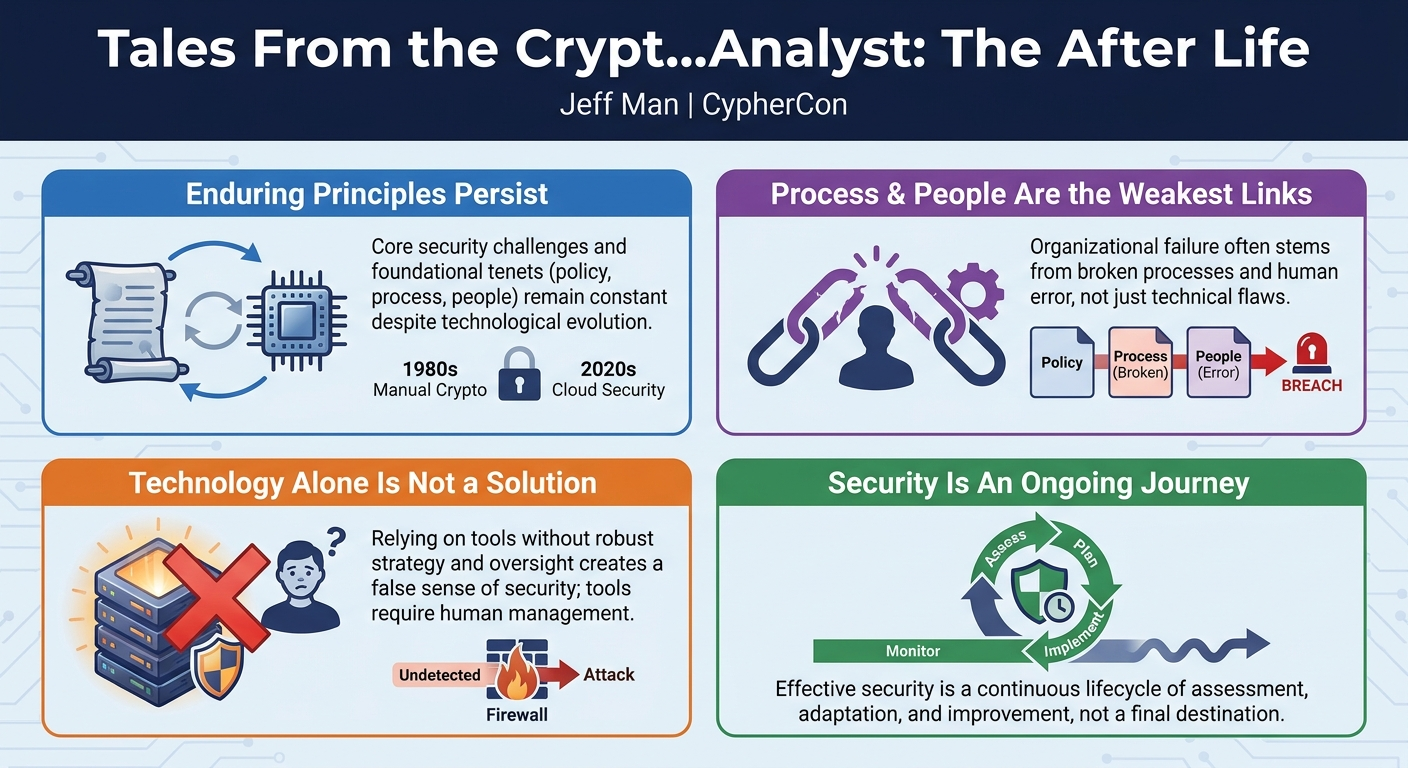
- The Enduring Relevance of Foundational Principles: Despite nearly three decades of technological advancement, the core tenets of cybersecurity—policy, process, people, and technology—remain paramount. Man highlights that the recommendations for building a security program from 1998, focusing on a life cycle approach, planning, and policy, are still fundamentally sound today. The challenge, however, is that while technology has advanced, the human and process elements often lag.
- The Persistent Weakness of Human Factors and Process: Man firmly believes that process is the ultimate point of failure in organizational security, often exacerbated by people not following process. He contrasts this with the common belief that people are the weakest link, suggesting the issue is more nuanced. Senior management's lack of buy-in, end-users opening malicious attachments (now clicking links), and IT professionals making common configuration errors have been constant vulnerabilities since the early days. The "five worst security mistakes end users make," "seven worst security mistakes senior executives make," and "ten worst security mistakes IT people make" from his 2002 slides are strikingly similar to contemporary issues.
- The Illusion of Technology as a Panacea: A recurring theme is the over-reliance on technology as a complete solution. Organizations often believe that purchasing a "blinky box" like a firewall or an Intrusion Detection System (IDS) will solve their security problems. Man's anecdote about the Real Secure IDS failing to detect his team's comprehensive internal scan in 1998, despite being present, vividly illustrates this point. He asserts that technology alone will never fully solve the problem; it must be integrated within a robust policy and process framework.
- The Cyclical Nature of Vulnerabilities and Attack Methodologies: Many "new" attack vectors are, in essence, reincarnations of older techniques. Man notes that early penetration testing methodologies, as depicted in the 1992 movie Sneakers, closely mirror modern approaches. Exploits like SQL injection (used on port 1433 against a misconfigured SQL server in 1998) and password cracking remain prevalent. The shift from perimeter-based defense to cloud computing, while offering new capabilities, often reintroduces similar security challenges in a different architectural context.
- The Value of Regulatory Frameworks (like PCI DSS): While often criticized, frameworks like the PCI Data Security Standard (PCI DSS), which Man adopted as a QSA, served as a crucial mechanism for instilling security discipline in organizations that might otherwise have ignored it. He describes PCI DSS (initially 17 pages with 6 goals and 12 requirements) as a "magical encapsulation" of what security professionals had been trying to convey for years, providing a structured approach to organizational security.
Technical Deep Dive
▶ Watch: How 'Sneakers' influenced early pentesting methodology (21:00)
Jeff Man's journey provides a rich historical tapestry of cybersecurity technologies and techniques, spanning from manual cryptography to early network exploitation and commercial security tools.
His NSA career began with manual crypto systems, particularly one-time pads. These highly secure, but labor-intensive, methods required physical distribution of unique key material. Man innovated by developing a way to transfer these keys from paper pads to floppy disks, creating what he believes was the NSA's first software-based crypto system for use on an IBM PC. This marked a significant step towards automating cryptographic processes. He also designed a cipher wheel, a physical cryptographic aid used by U.S. Special Forces, highlighting the blend of analog and nascent digital techniques of the era.
In the mid-1990s, as part of the NSA Red Team ("The Pit"), Man delved into network exploitation. Their early penetration testing primarily focused on leveraging inherent features of operating systems rather than complex zero-days. Their "bible" was Practical Unix and Internet Security, indicating a focus on Unix-like systems common in early internet infrastructure.
Upon entering the private sector, Man and his team at Nichols InfoTech utilized a variety of nascent commercial and open-source tools for vulnerability assessments and penetration testing. Key tools included:
- ISS (Internet Security Scanner): One of the earliest vulnerability scanners, initially open source before becoming a commercial product by Internet Security Systems (later acquired by IBM).
- Ballista: A scanner from Secure Networks Incorporated (SNI), which Man found superior. In its prime, it could detect around 700 vulnerabilities. SNI was later acquired by Network Associates, and Ballista was rebranded as Cyber Cop Scanner.
- Real Secure: An early Intrusion Detection System (IDS) and Intrusion Prevention System (IPS) from Internet Security Systems, marketed as a robust defensive solution. Man's experience with its failure prompted Ron Gula to develop the Dragon intrusion detection system, a precursor to modern IDS/IPS solutions like Snort.
- War Dialing: A technique to identify modems connected to telephone lines, used for gaining out-of-band access to networks and equipment. Man's team used a commercial product from Sandstorm Enterprises, founded by Becky Bace, a significant figure in early NSA security.
- Firewall Toolkit: Developed by Marcus Ranum, often credited with inventing the commercial firewall, this toolkit provided the foundational architecture for many early firewalls for over 15-20 years.
A highlight of Man's private sector experience was a penetration test in September 1998 against US Internet Networking, an early cloud provider. His team gained initial access by exploiting a misconfigured SQL Server running on Port 1433, likely through SQL injection or weak credentials. Once inside, they immediately established an SSH tunnel for persistent and covert outbound communication. From this beachhead, they deployed the Cyber Cop Scanner (rebranded Ballista) internally to conduct a "comprehensive vulnerability scan" of the entire network. This scan, which generated an 800-page report, went completely undetected by the deployed Real Secure IDS, demonstrating the critical gap between deploying technology and effective security operations. They also successfully cracked Unix and Windows NT passwords, further showcasing common weaknesses.
Man's later career embraced the PCI Data Security Standard (PCI DSS). He describes it as a framework initially comprising 17 pages, built around six overall goals and broken down into 12 specific requirements, often dubbed the "dirty dozen." This standard provided a structured, albeit sometimes rigid, approach to securing cardholder data environments, emphasizing controls across network security, system hardening, access control, monitoring, and policy. This demonstrates a shift from pure technical exploitation to implementing comprehensive, process-driven security programs.
Demo / Proof of Concept
▶ Watch: PCI DSS: A 'magical' way to enforce security (40:30)
While this talk did not feature a live technical demonstration or proof of concept, Jeff Man vividly recounted a seminal penetration test he led in September 1998 against US Internet Networking, an early cloud provider. This engagement served as a powerful historical proof of concept for the effectiveness of a determined attacker against even seemingly protected environments.
Man's team gained initial access by exploiting a misconfigured SQL server listening on Port 1433. This vulnerability, likely a weak password or an SQL injection flaw, provided the critical beachhead. Once inside the perimeter, they immediately established an SSH tunnel for covert, persistent outbound communication, effectively bypassing any superficial network monitoring. Their primary objective, at the request of a frustrated CISO, was to "do as much damage as possible" within a weekend to expose the company's vulnerabilities.
From their internal foothold, Man's team uploaded and executed the Cyber Cop Scanner (the rebranded Ballista vulnerability scanner) to conduct a comprehensive scan of the entire internal network. This extensive internal reconnaissance and vulnerability enumeration went entirely undetected by the deployed Real Secure intrusion detection system (IDS). The outcome was an 800-page report detailing numerous vulnerabilities, including cracked Unix and Windows NT passwords. This stark failure of the IDS directly inspired Ron Gula (Man's former NSA colleague and later founder of Tenable) to develop his own, more effective IDS, the Dragon intrusion detection system. This historical "demo" powerfully illustrated the critical importance of internal security, proper configuration, and attentive monitoring, rather than merely relying on the presence of security tools.
Defensive Implications
▶ Watch: Timeless Security Mistakes (from 1998 slides) (48:30)
Jeff Man's historical narrative carries profound and enduring defensive implications for modern organizations, emphasizing lessons that remain strikingly relevant despite decades of technological change.
- Prioritize Process and People: Man unequivocally states that process is the weakest link in cybersecurity, often failing due to people not following process. Defenders must invest heavily in defining clear, actionable security policies and procedures, and then ensuring robust training and enforcement. Security awareness programs need to go beyond basic phishing and password hygiene to cultivate a culture where every employee understands their role in protecting data. Senior management buy-in is critical, as their adherence (or lack thereof) sets the tone for the entire organization.
- Security is a Life Cycle, Not a State: The concept of security as an 18-month life cycle (as taught in 1998) is still valid, though the pace has accelerated to weeks, days, or even hours. Organizations must adopt a continuous security posture, integrating security into every stage of development and operations. This means constant vulnerability assessment, penetration testing, patching, configuration management, and incident response planning, rather than treating security as a one-time achievement.
- Don't Over-rely on Technology Alone: The anecdote of Real Secure failing to detect a full internal scan is a powerful reminder that security tools, no matter how advanced, are only as effective as their configuration and the human oversight behind them. Defenders should avoid the "blinky box" mentality, understanding that firewalls, IDSs/IPSs, and other solutions are components of a larger strategy, not complete solutions. Regular auditing of tool efficacy and alert fatigue management are essential.
- Know Your Assets and Data: Man stressed 30 years ago that organizations must understand what their valuable assets are, particularly their data, not just hardware and software. Defenders need comprehensive asset inventories and data classification schemes to prioritize protection efforts. Understanding business goals helps align security efforts with what truly matters to the organization, enabling more effective risk management against threats like denial of service and ransomware.
- Embrace "Defense in Depth" Beyond the Perimeter: While early security focused on building a secure perimeter, the shift to cloud computing means that the "most important stuff" is often outside the traditional network boundary. Defenders must adapt the concept of defense in depth to a hybrid or cloud-native environment, implementing layered controls at every point: identity, endpoints, applications, data, and infrastructure, assuming the perimeter will eventually be breached.
- Learn from Historical Mistakes: The "five worst security mistakes end users make," "seven worst security mistakes senior executives make," and "ten worst security mistakes IT people make" from Man's 2002 slides offer timeless advice. These include:
- End Users: Opening attachments/clicking links, poor password choices, not backing up, connecting to insecure networks.
- Senior Executives: Not understanding security as a business function, believing technology is a silver bullet, ignoring the problem until a breach.
- IT People: Ignoring patching, not testing backups, weak access controls, misconfigured systems, lack of documentation.
Addressing these fundamental human and operational failures remains paramount.
- Leverage Frameworks (like PCI DSS): While sometimes seen as burdensome, regulatory and security frameworks can provide a structured roadmap for establishing a baseline security program. Man's experience with PCI DSS highlights its utility in compelling organizations to adopt essential security practices that they might otherwise overlook.
Key Takeaways
- Security is a Continuous Life Cycle: Cybersecurity is not a state to be achieved but an ongoing process requiring constant vigilance, adaptation, and iterative improvement across policy, process, people, and technology.
- The Human Element is Paramount: Human error, lack of awareness, and failure to adhere to established processes remain the most significant vulnerabilities, often undermining even the most advanced technological defenses.
- Fundamental Principles Endure: Many "new" cybersecurity challenges are re-iterations of old problems. Basic hygiene—patching, strong passwords, proper configuration, and regular backups—is as critical today as it was decades ago.
- Technology is a Tool, Not a Solution: Relying solely on security products without robust policies, well-defined processes, and engaged personnel will inevitably lead to failures, as demonstrated by early IDS systems.
- Historical Context is Crucial for Defenders: Understanding the evolution of threats, tools, and defensive strategies provides invaluable insight into persistent weaknesses and effective countermeasures.
- Data is the Ultimate Asset: Organizations must recognize that their most valuable asset is the data they process, not just the hardware or software, and tailor security efforts to protect this data effectively.
About the Speaker(s)
Jeff Man is a highly experienced and respected veteran in the cybersecurity industry, affectionately known as the "Infosec Curmudgeon" or "Infosec Grandpa." His career spans over 40 years, beginning in the late 1900s with the Department of Defense (DoD) and the National Security Agency (NSA), where he served as a certified cryptanalyst from 1984 to 1996. During his time at the NSA, Man was instrumental in developing early software-based crypto systems and designing cipher wheels used by U.S. Special Forces. He was also a foundational member of the NSA's first Red Team, known as "The Pit," where he pioneered penetration testing techniques.
After leaving the NSA, Man transitioned to the private sector, dedicating over 30 years to cybersecurity consulting, vulnerability assessments, and penetration testing for various companies. He is a prominent voice in the community, serving as a co-host for the popular Paul's Security Weekly podcast for 12 years. Man identifies as a hacker and is one of only two individuals featured in all four editions of the Tribe of Hackers book series. His experiences have also been highlighted in Episode 83 of the Darknet Diaries podcast. A member of the "Cabal of the Curmudgeons," a group of industry old-timers, Man later became a PCI Qualified Security Assessor (QSA), applying his deep understanding of security principles to help organizations meet regulatory compliance.
Reviews
Dr. Zero (Offensive Security Researcher) — SOLID
Jeff Man is an absolute legend who was popping boxes for the NSA in 'The Pit' while most of the industry was still figuring out how a modem worked. That said, this is a history lesson, not a modern research briefing. It's a fun walk down memory lane, but the actual takeaways boil down to the same 'process matters' compliance lectures we've been hearing since 1998.
Heather Calloway (CISO) — SOLID
A historically rich retrospective that correctly identifies process and governance, not technology, as the persistent failure points in enterprise security. It is a solid grounding exercise for newer leaders, but seasoned CISOs will find it validation rather than revelation.