Panel: Deepfakes & Vibe Hacking: the next frontier of social engineering
Lucian Constantin (Senior Writer · CSO), Dragos Stanca (Tech entrepreneur and media ethicist), Aurel George Proorocu (IT OPS Manager - Cybersecurity & Fraud · ING Romania), Mihai Rotariu (Communications Manager · Directoratul Național de Securitate Cibernetică - DNSC), Loredana Vladu (Associate Professor, Director of the Department of Communication · FCRP-SNSPA)
DefCamp 2025 · Main Stage
Overview
This DefCamp panel, moderated by Lucian Constantin, Senior Writer for CSO, delved into the rapidly evolving landscape of cyber threats, specifically focusing on how AI-assisted content generation and chain automation are fundamentally transforming social engineering. Titled "Deepfakes & Vibe Hacking: the next frontier of social engineering," the discussion brought together a diverse group of experts from academia, media, government, technology, and banking to dissect the unprecedented challenges posed by these advanced techniques to consumers, businesses, and governments. The central theme explored was the shift towards an era of social engineering characterized by extreme automation, scale, speed, hyper-personalization, and highly realistic impersonations designed to manipulate human psychology.
Key moments
- 2:30 Explosive growth of deepfake incidents (3000% increase)
- 4:30 AI exploits human cognitive biases and emotions
- 13:00 Deepfake audio 'accident scams' target family members
- 16:00 Ad tech ecosystem encourages bad actors; Meta's scam revenue
- 22:00 $25M lost in real-time deepfake video call scam
- 32:00 Finland's media literacy success; systemic education needed
- 65:00 Why banks allow instant transfers; media's role in disinformation
Panel: Deepfakes & Vibe Hacking: the next frontier of social engineering
Speakers: Lucian Constantin (Senior Writer, CSO); Dragos Stanca (Tech entrepreneur and media ethicist); Aurel George Proorocu (IT OPS Manager - Cybersecurity & Fraud, ING Romania); Mihai Rotariu (Communications Manager, Directoratul Național de Securitate Cibernetică - DNSC); Loredana Vladu (Associate Professor, Director of the Department of Communication, FCRP-SNSPA)
Conference: DefCamp
YouTube: https://www.youtube.com/watch?v=aJAbvecb42c
Overview
This DefCamp panel, moderated by Lucian Constantin, Senior Writer for CSO, delved into the rapidly evolving landscape of cyber threats, specifically focusing on how AI-assisted content generation and chain automation are fundamentally transforming social engineering. Titled "Deepfakes & Vibe Hacking: the next frontier of social engineering," the discussion brought together a diverse group of experts from academia, media, government, technology, and banking to dissect the unprecedented challenges posed by these advanced techniques to consumers, businesses, and governments. The central theme explored was the shift towards an era of social engineering characterized by extreme automation, scale, speed, hyper-personalization, and highly realistic impersonations designed to manipulate human psychology.
The panel underscored the critical importance of understanding and addressing deepfakes and vibe hacking as they challenge existing technical and human defenses. Speakers highlighted the explosive growth and qualitative evolution of these attacks, citing alarming statistics such as a 3,000% increase in fraud incidents since 2022 and over 2,000 verified deepfake incidents in a single quarter, representing a 50% jump. The discussion moved beyond mere financial fraud to encompass broader societal implications, including geopolitical influence, election interference, and the generation of non-consensual intimate content, emphasizing the urgent need for comprehensive defensive strategies.
Background
▶ Watch: Explosive growth of deepfake incidents (3000% increase) (2:30)
The problem of social engineering is not new; humans have long been susceptible to manipulation. However, the advent of sophisticated AI technologies has drastically amplified its scale and efficacy. As defined by the moderator, vibe hacking encompasses two main aspects: in its stricter sense, it refers to AI-assisted malicious code generation, including malware payloads, exploits, and vulnerability research. In a broader context, it signifies the automation of the entire attack chain, from reconnaissance to execution, with a heavy focus on psychological manipulation. AI models leverage publicly available data to craft messages with the perfect tone—be it empathetic, formal, or urgent—making them feel incredibly authentic to the target.
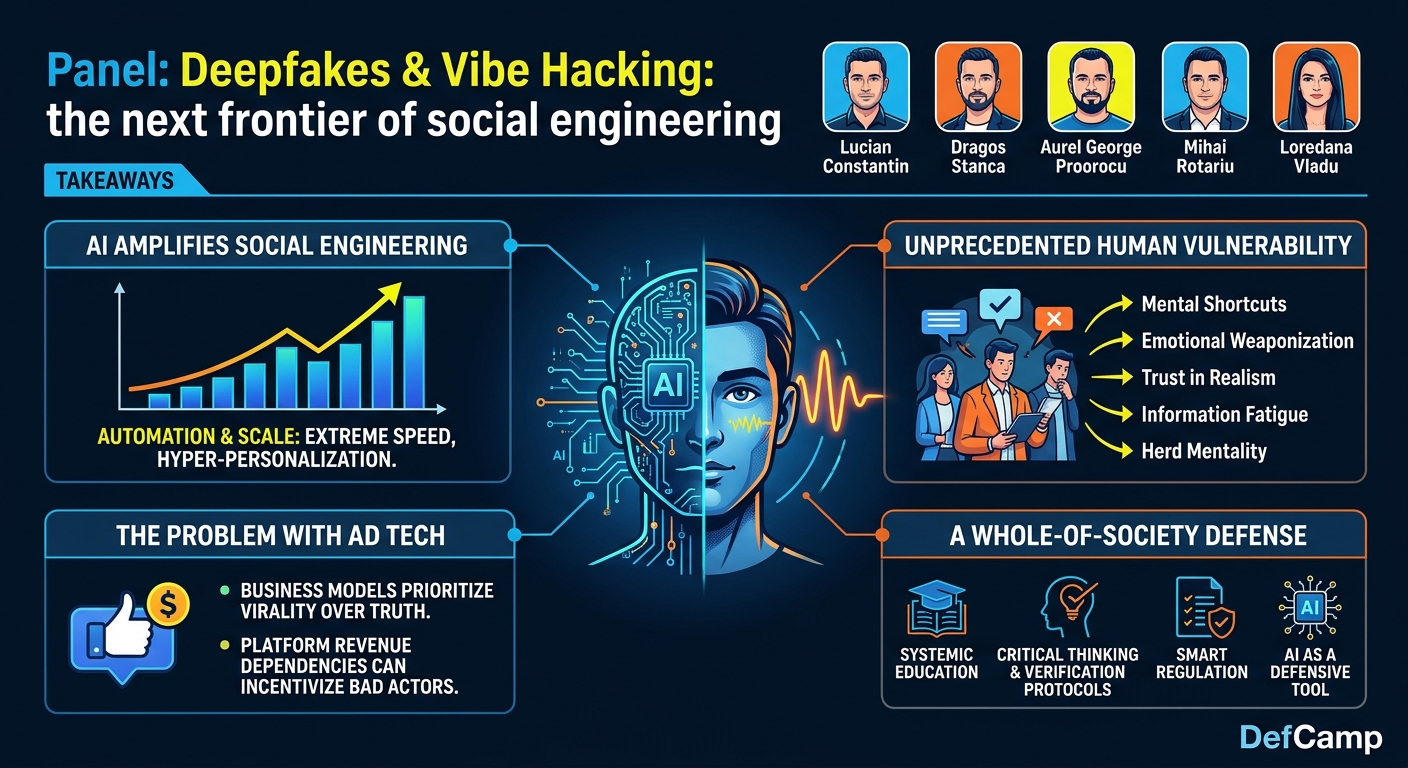
Several fundamental human weaknesses, or cognitive biases, are exploited by AI-driven disinformation. Dr. Loredana Vladu articulated five key vulnerabilities:
- Mental Shortcuts: Humans prefer rapid decision-making, often at the expense of thorough verification, increasing susceptibility to cyber security and social engineering risks.
- Emotional Weaponization: AI-generated messages frequently exploit strong emotions like fear and anger, which exponentially increase the likelihood of information propagation and acceptance.
- Trust in Realism: People naturally trust things that look and sound authentic, a core characteristic of deepfakes.
- Information Fatigue: The overwhelming volume of digital information makes it exceedingly difficult for individuals to discern truth from falsehood and verify sources.
- Herd Mentality: Humans tend to follow the crowd, and algorithms are often designed to reinforce this, creating an illusion of consensus around false narratives.
Prior to AI, scams like business email compromise (BEC) and identity theft were prevalent, relying on meticulous reconnaissance and manual crafting of convincing messages. What AI introduces is the ability to perform these tasks in seconds, with hyper-realistic impersonations that bypass traditional human verification checks and drastically lower the skill barrier for attackers. The panel pointed to statistics from Resemble AI, which tracked over 2,000 verified deepfake incidents in Q3, representing a 50% quarter-over-quarter growth, underscoring the explosive and qualitative evolution in attack sophistication across various target groups.
Key Findings
▶ Watch: Deepfake audio 'accident scams' target family members (13:00)
The panel discussion brought forth several critical insights and observations regarding the evolving threat landscape:
- AI Lowers the Barrier to Entry: AI democratizes cybercrime, allowing individuals without specialized hacking skills to engage in sophisticated fraud by automating reconnaissance, message crafting, and even real-time impersonations. This significantly increases the volume and diversity of attackers.
- Exponential Growth and Sophistication: Deepfake incidents are not only increasing quantitatively but also evolving qualitatively. Attacks are becoming more sophisticated, targeting various groups (celebrities, corporate executives, politicians) and types of content (financial fraud, geopolitical influence, non-consensual content).
- Ad Tech Ecosystem Vulnerabilities: The current digital advertising model, particularly on platforms like Meta, inadvertently incentivizes bad actors. As Dragos Stanca highlighted, a significant portion of platform revenue (estimated at 10% for Meta) can originate from scammers, creating a perverse incentive structure where platforms struggle to aggressively combat fraud due to business model dependencies.
- Web 2.0 Business Model Drives "Shitty Content": The core principle of Web 2.0—reaching the maximum audience at the lowest cost—prioritizes virality over truth or quality. This environment fosters the spread of sensational, often false, content, making it difficult for public interest and educational information to gain traction.
- Bypassing Existing Defenses: Traditional out-of-band verification methods and employee training designed to detect phishing or impersonation are being rendered ineffective. Deepfakes can simulate real-time video calls with known colleagues or executives, creating a false sense of security that overrides learned skepticism.
- The "Knowledge Divide": Vulnerability to deepfakes and disinformation is exacerbated by a "knowledge divide," particularly affecting individuals in rural or economically disadvantaged areas who lack access to digital literacy education and robust defense mechanisms.
- Societal Erosion of Trust: The pervasive nature of deepfakes undermines fundamental societal trust, making it increasingly difficult for individuals to distinguish between reality and fabrication, impacting everything from personal relationships (e.g., accident scams) to democratic processes (e.g., election interference).
- Ethics vs. Efficiency: There's a fundamental conflict between technological efficiency and ethical responsibility. Companies developing AI models often prioritize growth and user engagement, sometimes leading to features that can be exploited for malicious purposes, such as generating explicit content or creating addictive "hooks."
Technical Deep Dive
▶ Watch: Ad tech ecosystem encourages bad actors; Meta's scam revenue (16:00)
The core of the evolving social engineering threat lies in the sophisticated application of AI to generate hyper-realistic content and automate attack processes.
Deepfake Generation and Application:
Deepfakes leverage advanced AI algorithms, particularly Generative Adversarial Networks (GANs) and variational autoencoders (VAEs), to create synthetic media that convincingly mimics real individuals. These can be:
- Audio Deepfakes: Synthesizing a person's voice from minimal audio samples. Aurel George Proorocu from ING Romania described the "accident scam" prevalent in the US, where scammers fetch family relationships and phone numbers from social media, then use AI to generate the voice of a child (e.g., "Mother, I just hit someone, quickly send money via Revolut!"). The quality is so high that even switching between male and female voices is possible, making it usable in live calls.
- Video Deepfakes: Creating realistic video footage of individuals saying or doing things they never did. The panel discussed cases where deepfakes are used for celebrity impersonation (e.g., Elon Musk, Warren Buffett promoting fake investment scams) and corporate fraud. A chilling example was the UK engineering firm employee who transferred $25 million after participating in a video call with real-time deepfakes of his colleagues, including an executive. This goes beyond static images or pre-recorded videos, demonstrating the capability for dynamic, interactive impersonation.
Vibe Hacking and Attack Automation:
Vibe hacking represents the automation of the entire social engineering kill chain. AI models can:
- Automated Reconnaissance: Rapidly analyze vast amounts of publicly available data (OSINT) about a target (social media profiles, professional networks, news articles) to build detailed psychological profiles. This process, which once took days, can now be completed in seconds.
- Personalized Message Crafting: Based on the reconnaissance, AI determines the optimal tone (empathetic, formal, urgent) and content to maximize impact. For instance, in a BEC scenario, AI could draft an email impersonating a CEO, using language and urgency tailored to the specific target employee and the company's internal communications style.
- Payload Generation: While less discussed in detail, the stricter definition of vibe hacking includes AI-assisted generation of malware payloads, exploits, and vulnerability research, potentially accelerating the development of new attack tools.
Exploitation of the Ad Tech Ecosystem:
Dragos Stanca highlighted how the ad tech ecosystem, particularly programmatic advertising on platforms like Meta, is exploited. Scammers use compromised accounts to push deepfake-based ads (e.g., Romanian politicians/journalists promoting investment scams in 2023). The platforms' revenue models, which prioritize reach and engagement, inadvertently create a fertile ground for these fraudulent campaigns. The sheer volume makes it nearly impossible for authorities like DNSC to get all malicious content taken down.
Bypassing Traditional Controls:
- Employee Training: Companies train employees to detect red flags in phishing emails or suspicious requests. However, AI-powered deepfakes can bypass these by adding a layer of hyper-realism. The UK engineering firm case showed an employee who was initially suspicious but succumbed after seeing "familiar faces" in a video conference.
- Out-of-Band Verification: A common defense for BEC is to verify suspicious requests via a different communication channel (e.g., call the sender). Attackers now counter this by sending a phishing email and immediately following up with an AI-generated phone call (using the CEO's voice), making the victim believe they've performed the verification.
- Identity Verification (KYC/Onboarding): Concerns were raised about the use of deepfakes to bypass Know Your Customer (KYC) protocols for banking or employee onboarding. North Korean state-sponsored actors, for instance, have used deepfakes to pass remote video interviews for tech jobs in American companies, creating risks of supply chain attacks and illicit fundraising.
Demo / Proof of Concept
▶ Watch: Finland's media literacy success; systemic education needed (32:00)
The panel, while not featuring a live technical demonstration, extensively detailed real-world incidents and hypothetical scenarios that serve as stark proof points for the capabilities of deepfakes and vibe hacking. These examples vividly illustrated the practical application and devastating potential of these advanced social engineering techniques.
- UK Engineering Firm Fraud: A concrete example involved an employee of a UK engineering firm based in Hong Kong who was tricked into transferring $25 million to fraudsters. The scam began with a phishing message, but the critical element was a subsequent video call where the employee saw real-time deepfakes of multiple colleagues, including a senior executive. This convinced the employee to proceed with the transfer, demonstrating how visual and auditory impersonation can bypass even trained skepticism.
- Ferrari CEO Impersonation: In a contrasting example, a Ferrari executive was nearly scammed by a WhatsApp message impersonating the CEO, complete with a synthesized voice. The executive avoided the scam by asking a very specific, personal question (a book recommendation) that only the real CEO would know. This highlighted the need for unique, personal multi-factor authentication (MFA) in human interactions.
- Investment Scams in Romania: Mihai Rotariu from DNSC and Aurel George Proorocu from ING Romania discussed a wave of deepfake-driven investment scams in Romania in 2023. These ads, propagated on platforms like Meta using compromised accounts, featured deepfakes of prominent Romanian journalists, politicians, and businessmen promoting "super easy to make money solutions" with promised profits of 1,000%. Similar scams were noted in the US with figures like Elon Musk and Warren Buffett.
- Automated Accident Scams: Aurel George Proorocu detailed a sophisticated audio deepfake scam prevalent in the US, where scammers automate calls to parents, using a synthesized voice of their child in distress (e.g., "Mother, I just hit someone, send money quickly!"). The scammers proactively bypass anticipated defenses by claiming to call from a borrowed phone or being too stressed to remember a "family password," illustrating the adaptive nature of these attacks.
- North Korean Fake Employees: The panel touched upon a CrowdStrike report identifying over 200 cases of North Korean state-sponsored actors using deepfakes to pass remote video interviews and secure tech jobs in American companies. This tactic serves dual purposes: illicit fundraising and potential supply chain risk by inserting backdoors into target organizations.
These examples collectively painted a grim picture of the current threat landscape, demonstrating that deepfakes and vibe hacking are not theoretical concepts but active, financially motivated, and state-sponsored attack vectors with significant real-world consequences.
Defensive Implications
▶ Watch: Why banks allow instant transfers; media's role in disinformation (65:00)
Defending against deepfakes and vibe hacking requires a multi-faceted approach, combining technological solutions with significant human and societal adaptations. The panel emphasized that no single solution would suffice, advocating for a "whole-of-society" strategy.
1. Systemic Education and Digital Literacy:
- Early Age Integration: Loredana Vladu stressed the importance of embedding media literacy and digital literacy programs into national curricula from kindergarten, citing Finland as a successful model. This long-term investment aims to build foundational critical thinking skills before individuals are deeply exposed to sophisticated online manipulation.
- Educating the Educators: Acknowledging that educators themselves can be vulnerable to fake news, the panel highlighted the need to educate teachers first, ensuring they possess the knowledge and skills to impart to students.
- Making it "Sexy": Mihai Rotariu pointed out that cybersecurity education often struggles with engagement. Strategies are needed to make the subject more relatable and interesting to a broader audience, fostering a proactive security culture.
- Addressing the Knowledge Divide: Defensive strategies must specifically target vulnerable populations in rural or underserved areas who lack access to information and defense mechanisms, ensuring equitable access to digital education.
2. Enhancing Human Verification and Critical Thinking:
- Personal Protocols: For consumers, setting up "family passwords" or pre-agreed personal questions can act as a multi-factor authentication (MFA) layer for human interactions. If a caller, even with a familiar voice, cannot answer this question, it's a red flag.
- Zero Trust Mentality for Urgency: Lucian Constantin and Mihai Rotariu advocated for a zero trust approach to any communication that conveys extreme urgency or strong emotion. Individuals should be trained to pause, step back, and critically analyze the situation rather than reacting impulsively. Identifying the attack pattern—impersonation, urgency, emotion, request for action—should trigger defensive reflexes.
- Dual Authorization: For businesses, particularly in finance departments, implementing dual authorization for any financial transfer or sensitive action can mitigate the risk of a single employee falling victim to a deepfake scam.
- Training for Evolved Scams: Employee training must be updated to address how deepfakes bypass traditional checks. This includes recognizing real-time deepfakes in video calls and understanding how attackers can mimic out-of-band verification by following up phishing emails with deepfake phone calls.
3. Platform Accountability and Smart Regulation:
- Public Pressure: Dragos Stanca argued that public pressure is more effective than regulation alone in forcing platforms to comply with ethical standards. When public outcry is significant, platforms are more likely to take action.
- Smart Regulation: Instead of blanket fines, "smart regulation" could mandate that a percentage of platform revenue (especially from fraudulent ads) be invested directly into media literacy and digital education initiatives. This draws parallels to how industries like tobacco or sugar are taxed for exploiting human vulnerabilities. The Digital Services Act (DSA) in the EU provides a framework for holding platforms accountable for illegal content, but enforcement remains a challenge.
- AI as a Fact-Checker: Dragos Stanca expressed optimism that AI itself could become a powerful defensive tool, acting as an efficient fact-checker. He suggested that AI, which thrives on real data, could help filter out fictional or misleading content, potentially shifting the Web 2.0 paradigm.
4. Technical Countermeasures (Beyond the User):
- Banking System Enhancements: Aurel George Proorocu mentioned that banks can implement measures like flagging or plugging transfers to suspicious fintech companies. In-app verification for incoming calls from the bank is another layer of security.
- Advanced Identity Verification: For corporate onboarding, technologies like Photo Response Non-Uniformity (PRNU), which identifies unique imperfections in camera sensors, could be used to verify the authenticity of video feeds during remote interviews, making it harder for deepfakes to pass. Issuing company-controlled devices with known PRNU characteristics could enhance internal security.
- Proactive Threat Intelligence: Organizations like DNSC and ING Romania continuously monitor for new deepfake patterns and adapt their defenses, acknowledging the "cat and mouse" game with attackers.
The overarching sentiment was that while the threat is immense, a concerted effort across government, industry, academia, and individual citizens, focusing on education, critical thinking, and ethical responsibility from technology providers, offers the most robust path forward.
Key Takeaways
- AI-Driven Social Engineering is a Game Changer: Deepfakes and vibe hacking represent an unprecedented evolution in social engineering, characterized by extreme automation, hyper-personalization, and hyper-realistic impersonations that fundamentally bypass traditional human and technical defenses.
- Human Vulnerabilities are Primary Targets: These advanced attacks primarily exploit inherent human cognitive biases, emotional responses (fear, urgency), and natural trust in authentic-looking content, making individuals susceptible regardless of technical sophistication.
- The Digital Ecosystem Incentivizes Malice: The current business models of major digital platforms, particularly in ad tech, inadvertently create an environment where fraudulent and misleading content can thrive due to its viral potential and revenue generation for the platforms.
- Existing Defenses are Insufficient: Traditional cybersecurity training, employee awareness programs, and even out-of-band verification methods are increasingly being circumvented by sophisticated AI-generated audio and video impersonations.
- A "Whole-of-Society" Approach is Imperative: Effective defense requires a multi-pronged strategy encompassing systemic digital literacy education from a young age, fostering critical thinking, promoting personal verification protocols, holding technology platforms accountable, and investing in advanced technical countermeasures.
- Optimism for AI as a Defender: Despite AI's role in enabling these threats, there is optimism that AI, when leveraged ethically and focused on factual data, can also become a powerful tool for detection, verification, and fact-checking, potentially shifting the balance in favor of defenders.
About the Speaker(s)
- Lucian Constantin: A Senior Writer for csonline.com, Lucian Constantin has over 15 years of experience covering the cybersecurity field as a journalist, witnessing the evolution of financially motivated cybercrime and state-sponsored attacks. He moderated the panel discussion.
- Dragos Stanca: A tech entrepreneur and media ethicist, Dragos Stanca is the founder of the Upgrade 100 content defense platform. He has experience in programmatic advertising and worked for Meta, now focusing on media ethics through his NGO, Media Alliance.
- Aurel George Proorocu: As the IT Operations Manager for Cybersecurity & Fraud at ING Romania, Aurel George Proorocu brings a crucial banking and finance perspective to the discussion, particularly regarding the practical impact of deepfakes on fraud incidents.
- Mihai Rotariu: Communications Manager at the National Cyber Security Directorate (DNSC), which runs the Romanian government's cybersecurity and incident response team. He provided insights from a government and national security standpoint.
- Loredana Vladu: An Associate Professor and Director of the Department of Communication at the National University of Political Studies and Public Administration (SNSPA), Loredana Vladu offered an academic perspective, particularly on the psychological and communication aspects of AI-driven disinformation.
Reviews
Dr. Zero (Offensive Security Researcher) — WEAK
A surface-level panel that recycles well-known deepfake examples (the Hong Kong $25M case, the Ferrari near-miss) and cognitive bias 101 without offering practitioners anything they couldn't get from a 2023 CSO article. The speakers are credible in their respective lanes, but the format produced zero novel insight or actionable defense.
Heather Calloway (CISO) — WEAK
A panel that names a real problem — AI-powered social engineering and deepfake fraud — but delivers conference-room generalities instead of operational guidance. The discussion stays at altitude without landing on specific decisions, controls, or accountability structures. Not worth leadership time in its current form.