Panel: Zero trust & identity‑first security architectures
Dan Popa (Director of Security Support Engineering Cloud Protection Global Lead · Microsoft), Mircea-Constantin Scheau (President · Cloud Security Alliance Romanian Chapter), Yugo Neumorni (President · CIO Council), Dragos Cazaceanu (Senior Sales Engineer · Sophos), Razvan George Chereches (Director of Solutions Engineering, International · OPSWAT), Raluca-Claudia Seucan (Police Chief Commissioner, Director Institute for Crime Research and Prevention (ICPC) · Romanian Police)
DefCamp 2025 · Main Stage
Overview
This panel discussion, "Zero trust & identity-first security architectures," delves into the foundational shift occurring in cybersecurity paradigms. Moderated by Dan Popa of Microsoft, the esteemed panel of industry leaders, cybersecurity experts, and law enforcement representatives dismantles the traditional notion of implicit trust within corporate networks. The talk challenges the outdated belief that "we don't need security, it's in our corporate network" or "it's behind our next-gen firewall," advocating instead for a security model where trust is never assumed and always verified.
Key moments
- 0:00 Introduction: The core problem zero trust addresses
- 6:30 Data as a commodity: Europol's 'steal, deal, repeat' report
- 12:20 Zero trust: A strategy, not a product or service
- 14:50 Three core principles: never trust, least privilege, assume breach
- 19:30 Practical adoption: mindset shift, baby steps, cloud benefits
- 28:30 Crucial first step: identifying and segmenting assets
- 45:30 Applying zero trust principles to personal online life
- 53:00 Addressing zero trust cost and specialist challenges for SMBs
Panel: Zero trust & identity‑first security architectures
Speakers: Dan Popa (Director of Security Support Engineering Cloud Protection Global Lead, Microsoft); Mircea-Constantin Scheau (President, Cloud Security Alliance Romanian Chapter); Yugo Neumorni (President, CIO Council); Dragos Cazaceanu (Senior Sales Engineer, Sophos); Razvan George Chereches (Director of Solutions Engineering, International, OPSWAT); Raluca-Claudia Seucan (Police Chief Commissioner, Director Institute for Crime Research and Prevention (ICPC), Romanian Police)
Conference: DefCamp
YouTube: https://www.youtube.com/watch?v=-81Qt8aiPH4
Overview
This panel discussion, "Zero trust & identity-first security architectures," delves into the foundational shift occurring in cybersecurity paradigms. Moderated by Dan Popa of Microsoft, the esteemed panel of industry leaders, cybersecurity experts, and law enforcement representatives dismantles the traditional notion of implicit trust within corporate networks. The talk challenges the outdated belief that "we don't need security, it's in our corporate network" or "it's behind our next-gen firewall," advocating instead for a security model where trust is never assumed and always verified.
The core of the conversation revolves around Zero Trust and identity-first security, exploring their principles, practical implementation, and the profound impact they have on an organization's security posture. The panel emphasizes that Zero Trust is not merely a product or a service, but a comprehensive strategy and a change in mindset that has been gaining critical traction in an increasingly complex and threat-laden digital landscape. This discussion is crucial for any organization grappling with evolving cyber threats, hybrid work environments, and the inherent vulnerabilities of traditional network architectures.
Background
▶ Watch: Introduction: The core problem zero trust addresses (0:00)
For decades, enterprise security relied heavily on the concept of a strong perimeter defense. The prevailing assumption was that anything inside the corporate network was inherently trustworthy, while external entities were treated with suspicion. This model, often likened to a castle-and-moat defense, focused on building formidable firewalls and gateways to keep attackers out. However, as networks grew more complex, incorporating cloud services, mobile devices, and remote workforces, this perimeter began to dissolve, rendering the traditional model increasingly ineffective.
The panel highlights that the principles underpinning Zero Trust are not entirely new, with some concepts having been discussed as far back as 30 years ago. Early network segmentation, for instance, aimed to reduce "noise" and manage broadcast domains, laying a rudimentary groundwork for isolating network components. However, the modern context of Zero Trust explicitly acknowledges that the "enemy is inside" – meaning that internal threats, whether malicious insiders or compromised accounts, pose as significant a risk as external attackers. The Sarbanes-Oxley (SOX) Act, mentioned by Mircea-Constantin Scheau, was an early legislative attempt to address the issue of least privilege for administrators, recognizing the inherent risk of unchecked internal access. The persistence of flat networks, where vast segments of an organization's infrastructure remain unsegmented, further exacerbates this problem, allowing attackers, once inside, to move laterally with ease. The panel underscores that the evolution of threats, coupled with the increasing commoditization of data by cybercriminals (as described in the Europol IOCTA 2025 report with its "steal, deal, and repeat" motif), necessitates a fundamental re-evaluation of security architectures.
Key Findings
▶ Watch: Zero trust: A strategy, not a product or service (12:20)
The panel converged on several key findings and definitions regarding Zero Trust and identity-first security:
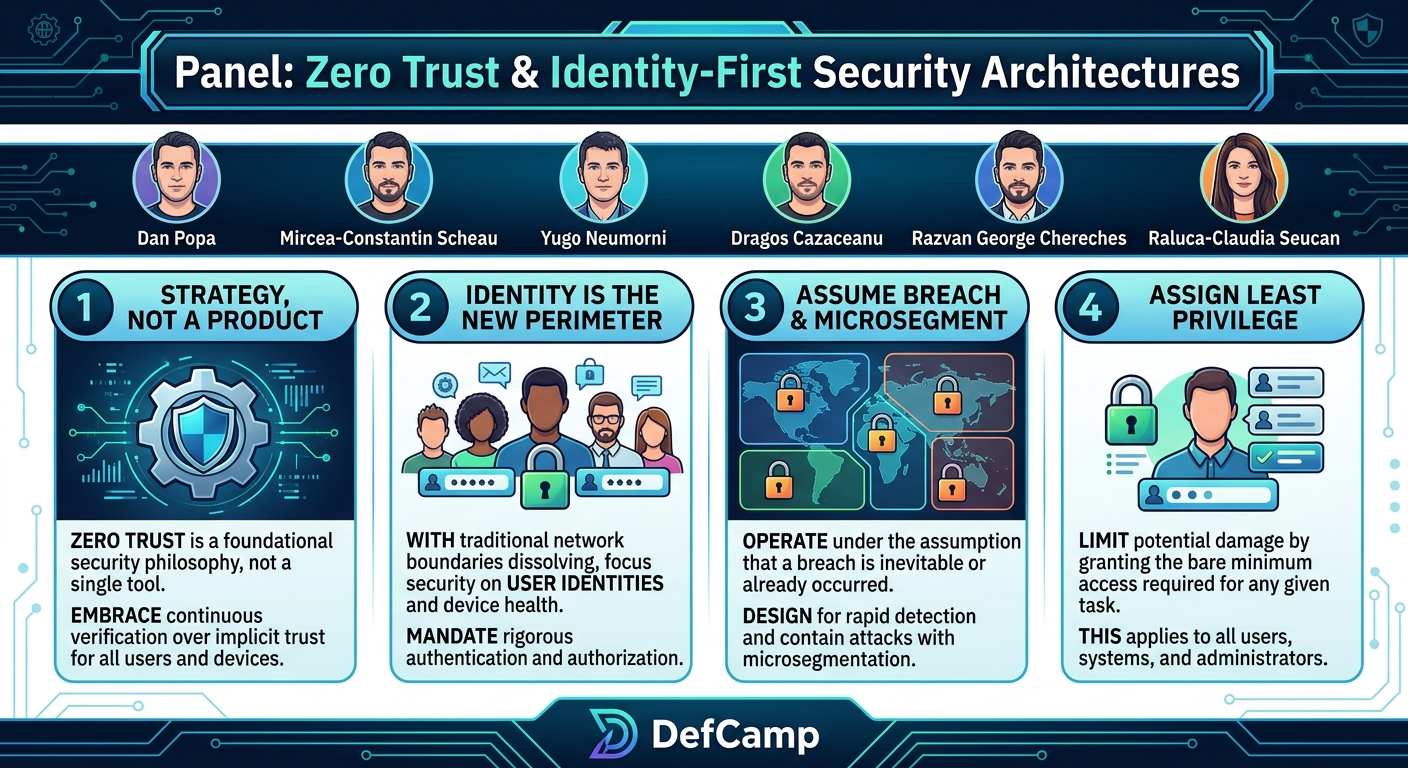
- Zero Trust is a Strategy, Not a Product: A central theme was the clarification that Zero Trust is not a single tool, service, or product, but rather a holistic security philosophy and strategic approach. It represents a fundamental shift in how organizations perceive and manage security, emphasizing continuous verification over implicit trust.
- The Three Core Principles of Zero Trust: Mircea-Constantin Scheau articulated the foundational pillars:
- Never Trust, Always Verify: This is the most critical principle, demanding that no user, device, or application is inherently trusted, regardless of its location (inside or outside the network). Every access attempt must be authenticated and authorized.
- Assign Least Privilege: Users and systems should only be granted the minimum access necessary to perform their specific tasks. This drastically limits the potential damage an attacker can inflict if an account or system is compromised.
- Assume Breach: Organizations must operate under the assumption that a breach is inevitable or has already occurred. This mindset shifts focus from solely prevention to robust detection, containment, and rapid response capabilities.
- Identity as the New Perimeter: With the dissolution of traditional network perimeters due the cloud and remote work, user and device identities become the new control plane. The panel emphasized that securing identity is paramount, as it represents the largest attack vector.
- Data as the Main Commodity for Criminals: Raluca-Claudia Seucan highlighted findings from the Europol IOCTA 2025 report, noting that data has become the primary target for cybercriminals, who "steal, deal, and repeat." This underscores the critical need for robust data protection strategies.
- The Evolving Nature of Perimeter Security: While traditional perimeter security is not "dead," it is evolving. The network itself is increasingly viewed as merely a transport layer, with the true perimeter now defined by user identities and the devices they use to access data.
- The Importance of Asset Visibility: A recurring point was the often-overlooked necessity of knowing and identifying all assets within an organization. Without a comprehensive inventory of servers, devices, applications, and data locations (including cloud environments), effective Zero Trust implementation is impossible.
- The Challenge of Mindset Shift: Implementing Zero Trust requires a significant change in organizational mindset, moving away from a false sense of security provided by traditional firewalls to a proactive, continuous verification approach. This change can be disruptive but is essential for modern cybersecurity.
Technical Deep Dive
▶ Watch: Practical adoption: mindset shift, baby steps, cloud benefits (19:30)
The technical underpinnings of Zero Trust are multifaceted, extending beyond simple product deployments to encompass architectural changes and operational practices. The panel meticulously broke down these technical components:
At its core, Zero Trust redefines the perimeter. As Razvan George Chereches explained, the traditional network becomes a mere transport layer. The actual perimeter shifts to user identities and devices. This identity-first security approach mandates rigorous verification of who is accessing what, from where, and on what device. This involves:
- Continuous Authentication and Authorization: Beyond initial login, Zero Trust environments continuously assess trust. This might involve evaluating user behavior, device posture, location, and the sensitivity of the resource being accessed.
- Device Posture Compliance: Before granting access, the security status of the accessing device is checked. This includes ensuring it has up-to-date patches, antivirus software, and meets specific security configurations.
- Multi-Factor Authentication (MFA): As highlighted by Mircea-Constantin Scheau, MFA is no longer optional but a "must" for sensitive areas, adding a critical layer of identity verification beyond just passwords.
Least privilege is a cornerstone technical control. This principle dictates that users and processes should have only the bare minimum permissions required to perform their duties. This significantly reduces the attack surface and limits an attacker's ability to move laterally or escalate privileges if they compromise an account. This applies not just to end-users but critically to administrators, a point reinforced by the historical context of the Sarbanes-Oxley (SOX) Act which sought to control administrator access.
Microsegmentation emerged as a critical technical enabler for Zero Trust. Yugo Neumorni emphasized its historical roots in reducing network "noise" and its modern relevance in preventing lateral movement. Instead of large, flat networks where a breach in one area could quickly spread, microsegmentation divides the network into small, isolated segments. Each segment has its own security controls, meaning that even if an attacker breaches one segment, their ability to reach other critical systems is severely limited. The panel acknowledged the reluctance, especially in Critical National Infrastructure (CNI) like hydro or power plants, to implement microsegmentation due to the complexity of integrating with legacy SCADA systems. However, the consensus was that it is imperative, regardless of system age, to contain potential breaches.
Data protection is another vital technical aspect. Razvan George Chereches stressed the importance of securing data at rest and in transit. This includes:
- Continuous Rescanning: Data, once on the network, should not be assumed safe. Best practices include continuous rescanning of data sets and ensuring backups are secure and isolated from the primary network.
- Data Loss Prevention (DLP) Solutions: These technologies are crucial for detecting and preventing sensitive data from leaving the organization's control, whether through exfiltration by an attacker or accidental sharing by an employee.
The concept of Defense in Depth was also discussed, advocating for multiple layers of security, applying different technologies to look at the same problem from various angles. This ensures that if one security control fails, others are in place to pick up the slack.
Finally, the panel touched upon the role of Artificial Intelligence (AI). Dan Popa suggested that AI could act as a "democratizer" in cybersecurity, helping to bridge the skills gap and potentially reduce costs, especially for smaller organizations, by automating detection and response tasks. However, the caveat was also raised that AI-driven modules need rigorous checking for compliance before deployment.
Demo / Proof of Concept
▶ Watch: Crucial first step: identifying and segmenting assets (28:30)
The panel discussion focused on strategic principles, architectural shifts, and policy implications rather than specific product demonstrations or proof-of-concept implementations. As such, no live demo or technical walkthrough was presented during this session. The emphasis remained on the conceptual framework and practical advice for adopting Zero Trust.
Defensive Implications
▶ Watch: Addressing zero trust cost and specialist challenges for SMBs (53:00)
Adopting a Zero Trust and identity-first security architecture carries profound implications for defenders, necessitating a comprehensive shift in strategy and operations:
- Mindset Transformation: The most significant defensive implication is the need for a fundamental change in mindset. Organizations must move away from implicit trust and embrace continuous verification. This cultural shift affects every employee, from the C-suite to the end-user, and requires consistent education and reinforcement.
- Phased Implementation ("Baby Steps"): Recognizing the disruptive nature of Zero Trust, especially for organizations with complex or legacy infrastructure (like Critical National Infrastructure), the panel recommended a phased approach. Starting with identifying and protecting the most sensitive data (e.g., financial or HR data) and gradually expanding coverage is a practical strategy.
- Prioritizing Asset Identification: Before any controls can be applied, defenders must have a complete and accurate inventory of all digital assets – users, devices, applications, and data, regardless of location (on-prem or cloud). As Mircea-Constantin Scheau pointed out, many companies, even large ones, struggle with this basic step.
- Strengthening Identity and Access Management (IAM): Identity becomes the new perimeter. Defenders must invest heavily in robust IAM solutions, including MFA, Single Sign-On (SSO), and Privileged Access Management (PAM), to ensure that every access request is authenticated and authorized based on the principle of least privilege.
- Implementing Microsegmentation: To prevent lateral movement, defenders should design and implement microsegmentation across their networks. This involves isolating critical systems and data, limiting the blast radius of any potential breach. This is particularly crucial given the average time to detect an intrusion (9 months, according to an IBM study cited by Mircea-Constantin Scheau).
- Embracing "Assume Breach" for Resilience: Defenders must design their security operations with the assumption that a breach will occur. This means focusing on robust detection, rapid response, and containment capabilities, rather than solely on prevention. Incident response plans should be regularly tested and refined.
- Addressing the Cybersecurity Workforce Gap: The panel acknowledged the persistent lack of specialized cybersecurity professionals. Defenders need to focus on educating and training their existing workforce, promoting interest in the field among younger generations, and potentially leveraging technologies like AI to augment existing teams and democratize skills.
- Integrating Security Technologies: Instead of disparate point solutions, defenders must strive for meaningful integration of their security technologies within a comprehensive cybersecurity framework (e.g., NIST, ISO 27001). This creates a more cohesive and effective security posture.
- Managing Shadow IT: The panel discussed the reality of Shadow IT – unsanctioned applications and services. Instead of outright prohibition, organizations should acknowledge its existence and develop processes and procedures to manage and secure these resources, bringing them into the security fold where possible.
- Applying Personal Security Hygiene: Raluca-Claudia Seucan highlighted that the principles of cybersecurity extend beyond the workplace. Defenders, and all individuals, should apply basic security measures in their personal lives, such as using MFA, exercising caution with suspicious links, and "thinking before clicking" to avoid becoming a vector for attacks.
- Understanding the Cost of Security: Cybersecurity is a significant and growing cost, estimated at 0.5% to 1% of company revenues. Defenders must articulate this cost as an essential operational expense rather than merely an investment, integrating it into product and service P&L, especially given that attackers increasingly target smaller, less-prepared organizations.
- Third-Party Audits and Verification: For resilience and accountability, the panel suggested that secondary security assessments, especially after a breach, should be conducted by independent, certified legal bodies or institutions to avoid conflicts of interest.
Key Takeaways
- Zero Trust is a Foundational Strategy: It's not a product, but a comprehensive philosophy demanding continuous verification, not implicit trust, for all users, devices, and applications.
- Identity is the New Security Perimeter: With dissolving network boundaries, securing user and device identities through MFA, least privilege, and continuous authentication is paramount.
- Assume Breach and Microsegmentation are Critical: Design defenses expecting compromise, and segment networks into small, isolated zones to contain lateral movement and limit the impact of a breach.
- Asset Visibility is Non-Negotiable: A complete and accurate inventory of all digital assets is the foundational step for effective Zero Trust implementation.
- Mindset Shift and Education are Essential: Successful Zero Trust adoption requires a cultural change, moving away from outdated security assumptions and investing in workforce education and skill development.
- Cybersecurity is an Evolving Cost, Not Just an Investment: Organizations must budget for security as an ongoing operational expense, recognizing that attackers increasingly target all sizes of businesses.
About the Speaker(s)
- Dan Popa: The moderator of the panel, Dan serves as the Director of Security Support Engineering Cloud Protection Global Lead at Microsoft. His role focuses on guiding security support engineering for cloud protection on a global scale.
- Mircea-Constantin Scheau: As the President of the Cloud Security Alliance Romanian Chapter, Mircea-Constantin is a prominent voice in cloud security. He emphasized the historical context of Zero Trust and its strategic nature.
- Yugo Neumorni: With over 40 years in IT and more than 35 years in security, Yugo is the President of the CIO Council. He brings a wealth of experience, acting as a consultant in the industry, and provided historical context to many cybersecurity concepts.
- Dragos Cazaceanu: A Senior Sales Engineer at Sophos, Dragos is part of a global team specializing in emergency response. His expertise lies in understanding current threats and incident containment.
- Razvan George Chereches: Razvan heads up the Solution Engineering team at OPSWAT, with a focus on international solutions. He contributed insights on data security, perimeter evolution, and the practical challenges of Zero Trust adoption.
- Raluca-Claudia Seucan: A Police Chief Commissioner and Director of the Institute for Crime Research and Prevention (ICPC) within the Romanian Police, Raluca-Claudia provided the law enforcement perspective, emphasizing awareness, prevention, and the application of security principles to daily life.
Reviews
Dr. Zero (Offensive Security Researcher) — WEAK
A panel that could have been a LinkedIn carousel. Six people on stage, 45 minutes of airtime, and the sharpest insight is 'Zero Trust is a strategy, not a product' — a line that was tired in 2019. No insider signal, no real disagreement, no practitioner detail that isn't in the first three pages of a NIST 800-207 summary.
Heather Calloway (CISO) — WEAK
A panel that promised Zero Trust architecture discussion but delivered recycled fundamentals without operational specificity. Six speakers, sixty minutes, and nothing a CISO couldn't have read in a 2019 Gartner summary. Not worth leadership time.