Stories from a Tor dev
Roger Dingledine
DEF CON 33 · Day 2 · Main Stage
Overview
Roger Dingledine co-created the Tor anonymity network over two decades ago, and at DEF CON 33 he delivered something rare in security conference talks: a frank, first-person narrative of what it actua
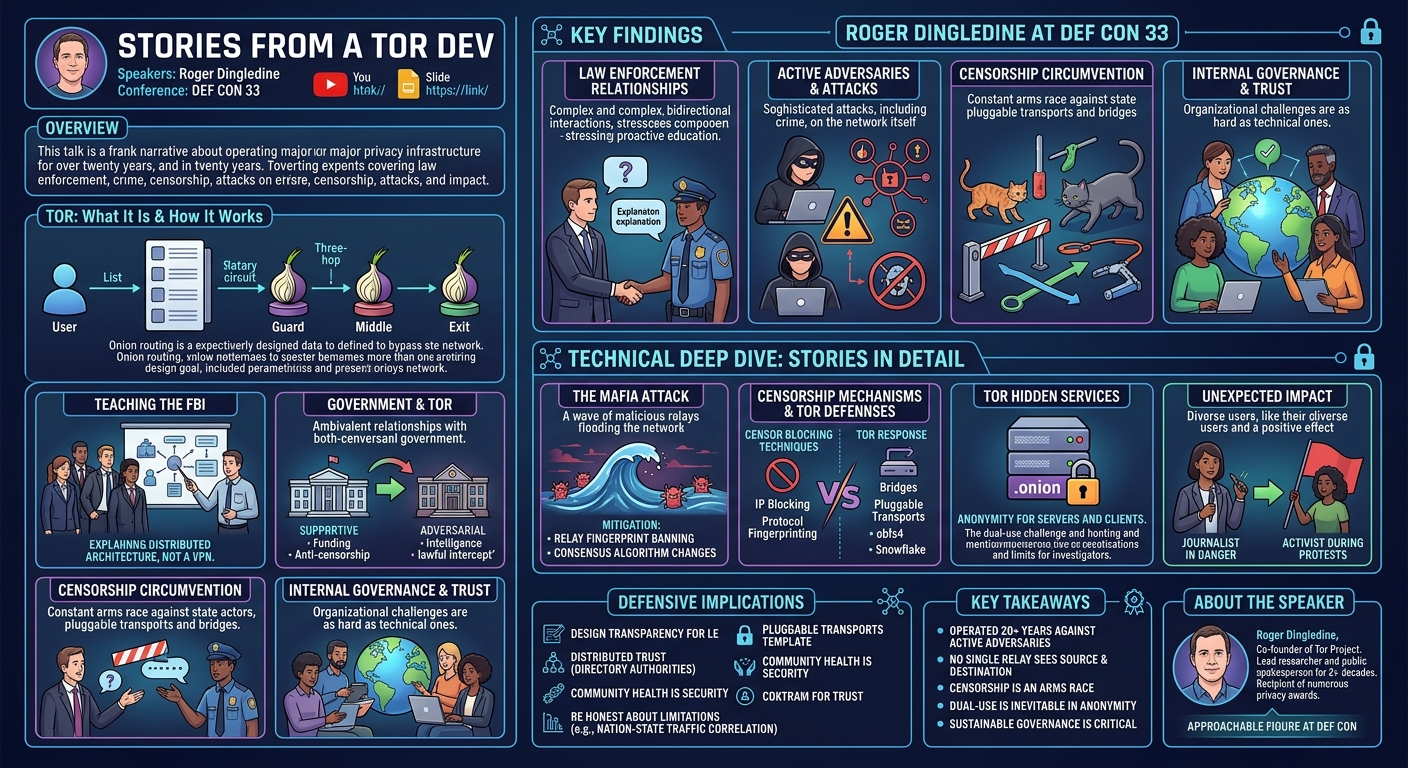
Key moments
- 2:29 Introduction: Life as a Tor developer and network defender
- 30:44 Fighting censorship: how Tor bridges and pluggable transports work
- 12:29 State actor attacks against the Tor network
- 17:29 Deanonymization attacks and how Tor defends against them
- 2:06 Tor protocol improvements and security enhancements
- 21:24 Security bugs found and fixed in Tor over the years
- 13:24 Onion services security and abuse mitigation
- 9:58 Tor community, governance, and sustainability challenges
- 7:49 Future of Tor: new protocols and threat landscape
Stories from a Tor dev
Speakers: Roger Dingledine
Conference: DEF CON 33
YouTube: https://www.youtube.com/watch?v=djM70O0SnsY
Slides: https://media.defcon.org/DEF%20CON%2033/DEF%20CON%2033%20presentations/Roger%20Dingledine%20-%20Stories%20from%20a%20Tor%20dev.pdf
Overview
Roger Dingledine co-created the Tor anonymity network over two decades ago, and at DEF CON 33 he delivered something rare in security conference talks: a frank, first-person narrative of what it actually looks like to operate a major privacy infrastructure project over twenty-plus years. Across twelve stories spanning law enforcement interactions, criminal abuse, state-level censorship, network attacks, internal crises, and moments of unexpected impact, Dingledine gave the DEF CON audience an insider's view of the organizational, political, and technical challenges that no academic paper or press release captures.
The talk is not a vulnerability disclosure or a technical tutorial in the traditional sense. It is a practitioner's account of navigating the contradictions inherent in building a tool that simultaneously protects journalists, abuse survivors, and whistleblowers while also being used for illegal activity — and doing so in a geopolitical environment where authoritarian governments actively try to destroy the network and some democratic governments are deeply ambivalent about its existence. For the security community, it is a case study in adversarial operations at the infrastructure level.
Background
▶ Watch: Tor protocol improvements and security enhancements (2:06)
Tor: What It Is and How It Works
The Tor network (The Onion Router) is a free, open-source anonymity system that routes encrypted traffic through a series of volunteer-operated relays, making it difficult for any single party to link network traffic to its origin. The core mechanism — onion routing — was originally developed by the U.S. Naval Research Laboratory in the mid-1990s; Dingledine, along with Nick Mathewson and Paul Syverson, built the modern Tor project on that foundation.
At a high level, a Tor client:
- Fetches a consensus document from directory servers listing available relays.
- Selects a three-hop circuit: Guard (entry), Middle, and Exit.
- Encrypts the payload in three nested layers, one per hop.
- The Exit relay decrypts the final layer and forwards the request to the destination.
No single relay sees both the source and destination. The design goal is that an adversary who controls fewer than all three relays cannot de-anonymize users with high confidence (traffic correlation attacks being the acknowledged exception at scale).
Dingledine noted he mostly does DEF CON talks that are more technical — this one was deliberately story-driven — but the stories themselves are full of technical and operational substance.
Context for the Stories
Over twelve stories, Dingledine organized the talk into three thematic clusters:
- Law enforcement and government interactions: Cases where agencies wanted to learn about (or shut down) Tor, and the outcomes of those conversations.
- Running the Tor network against active adversaries: Attacks on the network itself by criminals, mafias, and nation-states.
- Tor in authoritarian regimes: How censorship circumvention works and doesn't work in countries where Tor is blocked.
Key Findings
▶ Watch: Future of Tor: new protocols and threat landscape (7:49)
Rather than a list of vulnerabilities, the "findings" from this talk are operational lessons about running critical privacy infrastructure:
- Law enforcement relationships are complex and bidirectional: Some agencies understand and accept Tor; others see it purely as an obstruction. Proactive education and transparency have, in some cases, converted hostile agencies into neutral or cooperative ones.
- The network has been attacked by sophisticated adversaries including organized crime: The Tor network has faced coordinated attacks — including what Dingledine described as sustained, resourced campaigns — designed to de-anonymize users or disrupt service.
- Censorship circumvention is a constant arms race with state actors: Countries like Iran, China, and Russia periodically update their blocking techniques, and Tor's response (pluggable transports, bridges) is an ongoing cat-and-mouse dynamic.
- Internal governance and trust are as hard as the technical problems: Running a security-critical project with a distributed team, external funding pressures, and adversarial scrutiny creates organizational challenges that pure engineering cannot solve.
- Unexpected users and use cases continually reshape priorities: Tor was designed with a specific threat model in mind, but its actual user base spans use cases — from activists in authoritarian regimes to corporate employees accessing the public internet privately — that require continuous re-evaluation of what "protecting users" means.
Technical Deep Dive
▶ Watch: State actor attacks against the Tor network (12:29)
Story 1: Teaching the FBI About Tor
One of the earliest stories Dingledine told involved meeting with FBI agents who had seized a Tor relay and were trying to understand the network. The interaction revealed a gap: many law enforcement agents conceptualized Tor as a single entity (like a VPN provider) that could be served a warrant to reveal user identity. Explaining the distributed architecture — that no single relay has both source IP and destination, and that the project itself has no logs of user activity — required patient, repeated education.
The operational lesson: if you operate infrastructure with a specific security model, you need a clear, accurate, well-rehearsed explanation for law enforcement that neither under- nor overstates what the system can provide. Misunderstandings in either direction create legal and reputational risk.
Story 2–3: Government Entities That Do and Don't Want Tor to Exist
Dingledine described situations ranging from U.S. government agencies that are simultaneously funders of Tor (through democracy promotion and anti-censorship programs) and intelligence agencies that have operational interest in defeating anonymity. The irony — that some of the same government that funds Tor also wants to undermine it — is a structural feature, not a bug, of the network's political environment. This creates a constant tension in funding and organizational independence decisions.
He also described interactions with governments of other democracies where officials asked whether Tor could add a "lawful intercept" backdoor — and the principled refusal, with the technical explanation of why any backdoor that works for one government's law enforcement also works for every other government's secret police.
Story 4–5: The Mafia and Sustained Network Attacks
Among the more striking stories: Dingledine described a period when the Tor network experienced what appeared to be a sustained, targeted attack — flooding the network with malicious relays or traffic designed to degrade performance and potentially enable correlation. The source was attributed (with appropriate epistemic humility) to organized criminal actors who had business reasons for wanting Tor users de-anonymized — possibly related to darknet market competition.
The response involved:
- Network-level banning of malicious relay fingerprints.
- Changes to the consensus algorithm to reduce the weight given to suspicious relays.
- Community coordination with relay operators to identify and report anomalous nodes.
The operational lesson was that Tor's decentralized model is both a strength and a weakness against sustained adversarial injection of relays. The directory authority system (a small number of trusted servers that publish the consensus) is a centralized point that must be protected.
Story 6–8: Censorship Circumvention in Authoritarian Regimes
Dingledine spent a significant portion of the talk on the mechanics and limits of Tor in countries that actively block it. The blocking mechanisms used by major censors include:
- IP blocking: Blocking all known Tor relay and bridge IP addresses. Defeated by bridge addresses (unlisted relays), but bridges can be enumerated over time.
- Protocol fingerprinting: Deep Packet Inspection (DPI) to detect Tor's TLS handshake patterns even when the IP is unknown. Defeated by pluggable transports (obfs4, Snowflake, WebTunnel) that disguise Tor traffic as innocent-looking protocols.
- Timing analysis and traffic correlation: More advanced state-level techniques that require controlling a significant portion of the path. Harder to defeat without adding significant latency or bandwidth overhead.
He described specific incidents in Iran and Russia where Tor usage spiked dramatically after political events (e.g., major protests, the Ukraine invasion), the network's response to provide additional bridge capacity, and the ongoing back-and-forth as censors adapted and Tor deployed new transports.
The honest assessment: Tor works well for most users in most countries most of the time, but against a highly motivated state adversary with full national-level traffic visibility, anonymity is genuinely hard to guarantee.
Story 9–10: Tor Hidden Services and Law Enforcement Friction
The existence of .onion services — hidden services that do not require an exit relay and whose location is not disclosed to users — has been a persistent source of tension with law enforcement. Dingledine walked through the design decision behind hidden services (they provide anonymity for servers as well as clients, which has legitimate uses for whistleblowing platforms, dissident media, and abuse survivor resources) and the challenge of being associated publicly with darknet markets and illegal content hosting.
He described working with law enforcement researchers on technical studies of hidden service traffic, the limits of what Tor's design can reveal even to motivated investigators, and the ongoing policy debate about whether anonymous hosting is inherently irresponsible.
Story 11–12: Unexpected Impact and Community
The final stories were lighter: cases where Tor had a measurable positive impact that Dingledine found personally meaningful — a journalist who attributed their safety to Tor, a case where Tor-provided anonymity was critical during a political crisis — and reflections on the DEF CON community's long relationship with the Tor project, including the network of volunteer relay operators that keep the infrastructure running.
Demo / Proof of Concept
▶ Watch: Deanonymization attacks and how Tor defends against them (17:29)
This was not a demo-driven talk. Dingledine did not present new software or attack tools. The narrative format was intentional — he wanted to convey the human, organizational, and political texture of the work, which does not reduce to a command-line demonstration. He offered, as a post-talk activity, to take audience members to the Tor booth in the nonprofit vendor area to continue the conversation and answer questions in person.
Defensive Implications
▶ Watch: Fighting censorship: how Tor bridges and pluggable transports work (30:44)
The defensive lessons from this talk operate at a different level than most DEF CON presentations:
- Design transparency for law enforcement interactions: Projects operating privacy infrastructure should have clear, accurate documentation of what they can and cannot provide in response to legal process — and invest in proactive engagement with law enforcement to prevent misunderstandings.
- Distributed trust reduces single points of failure: Tor's directory authority system is a potential weakness; the lesson for other projects is to think carefully about centralized trust anchors in otherwise decentralized systems.
- Pluggable transports as a template for censorship resistance: The modular transport layer in Tor (obfs4, Snowflake, WebTunnel) is a design pattern that other communications tools can adopt. The key principle: the censorship bypass mechanism should be separable from the anonymity mechanism so each can evolve independently.
- Community health is a security property: An open-source security project with a burned-out, under-resourced team is more vulnerable to supply-chain attacks, poor decisions, and adversarial infiltration than one with sustainable governance and resources.
- Be honest about the limitations of your security model: Dingledine was notably candid that Tor does not defeat nation-state-level traffic correlation. Overstating security properties to users is itself a harm — it encourages them to take risks the system cannot protect against.
Key Takeaways
- Tor has operated for over twenty years against active adversaries ranging from organized crime to nation-state intelligence agencies — its survival is a testament to both its technical design and community governance.
- No single relay in Tor sees both source and destination — this architectural choice is the foundation of its security model, and explaining it clearly to law enforcement has shaped many of the project's most fraught interactions.
- Censorship circumvention is an arms race: Pluggable transports have repeatedly extended Tor's usefulness in heavily-censored environments, but sophisticated state-level adversaries continue to adapt.
- The dual-use nature of Tor — protecting dissidents and hosting criminal content on the same infrastructure — is not a bug but a mathematical inevitability of strong anonymity, and the project has navigated it through principled technical design (not content filtering).
- Sustaining open-source security infrastructure requires organizational sustainability, legal frameworks, and political engagement alongside technical excellence.
- Roger Dingledine remains actively involved in Tor development and is, as introduced, genuinely approachable — his post-talk availability at the booth reflects a broader culture of transparency that has been central to Tor's credibility.
About the Speaker
Roger Dingledine co-founded the Tor Project in 2006 along with Nick Mathewson, building on the onion routing protocol originally developed at the U.S. Naval Research Laboratory. He received his BS and MEng from MIT and has been the project's lead researcher and primary public spokesperson for over two decades. He has received numerous awards for his work on privacy and censorship circumvention and is one of the most prominent figures in applied anonymity research. His work at DEF CON spans many years — he is a fixture of the community and, as introduced, far more accessible than his stature might suggest.
Reviews
Dr. Zero (Offensive Security Researcher) — SOLID
Twenty years of Tor operations distilled into twelve honest war stories about law enforcement, organized crime, state censorship, and the contradictions of building privacy infrastructure — valuable institutional memory, zero new technical content.
Heather Calloway (CISO) — SOLID
Roger Dingledine delivering twenty-plus years of operational lessons from running the world's most politically contested privacy infrastructure. Not a vulnerability talk — a governance and institutional survival case study at a scale almost no one in the security field has comparable experience with. The lessons on law enforcement engagement, distributed trust architecture, and the limits of honest security claims are directly applicable beyond Tor.