The Ultimate Hack: Applying Lessons Learned from the loss of TITAN
John Mauger
DEF CON 33 · Day 2 · Main Stage
Overview
On June 18, 2023, five people were sealed inside the Titan submersible and began their descent to 3,800 meters below the surface of the North Atlantic, bound for the wreck of the Titanic. None of them
Key moments
- 1:02 Opening: taking the audience to the most inaccessible place on Earth
- 3:01 Framing: Titan disaster as a cybersecurity case study
- 5:03 The unique challenge matrix: what made Titan's situation unprecedented
- 7:03 Real-time response: how first responders searched for Titan
- 8:58 Equipment scarcity: only a handful of ROVs worldwide could reach the depth
- 11:02 The discovery: what the ROV found at the bottom of the Atlantic
- 13:03 Engineering failure: carbon fiber hull not rated for cyclic pressure loading
- 15:04 Organizational failure: regulatory gaps and normalization of deviance
The Ultimate Hack: Applying Lessons Learned from the Loss of TITAN to Maritime Cybersecurity
Speakers: John Mauger
Conference: DEF CON 33
YouTube: https://www.youtube.com/watch?v=dmgjTGuAo38
Slides: https://media.defcon.org/DEF%20CON%2033/DEF%20CON%2033%20presentations/John%20Mauger%20-%20The%20Ultimate%20Hack%20Applying%20Lessons%20Learned%20from%20the%20Loss%20of%20TITAN%20to%20Maritime%20Cybersecurity.pdf
Overview
On June 18, 2023, five people were sealed inside the Titan submersible and began their descent to 3,800 meters below the surface of the North Atlantic, bound for the wreck of the Titanic. None of them would return. The subsequent Coast Guard Marine Board of Investigation produced hundreds of hours of video testimony and thousands of pages of documentary evidence, painting a portrait of a maritime vessel whose design, safety culture, and operational practices were fatally compromised by the same failure modes that cybersecurity professionals encounter in critical systems: dismissal of expert warnings, circumvention of certification processes, substitution of consumer-grade components in safety-critical roles, and a leadership culture that treated safety concerns as obstacles to innovation.
At DEF CON 33, Dr. John Mauger — a maritime expert who was part of the emergency response effort during the 96-hour search for Titan — delivered a talk that is simultaneously a forensic case study in catastrophic system failure and a direct call to action for the cybersecurity community. His argument: the principles that cause ships and submersibles to fail are identical to those that cause information systems to fail, and the maritime industry's hard-won lessons in safety engineering offer a framework that cybersecurity has not yet fully absorbed.
Background
▶ Watch: Opening: taking the audience to the most inaccessible place on Earth (1:02)
The Titan Disaster: What Happened
On the morning of June 18, 2023, five individuals — Suleman and Shazad Dawood, Hamish Harding, Paul-Henri Nargeolet, and OceanGate CEO Stockton Rush — descended in the Titan submersible operated by OceanGate Expeditions. Later that day, a distress alert was transmitted. Over the next 96 hours, an international search and rescue effort was assembled, drawing resources from Pearl Harbor to Portsmouth. After the wreckage was located, it was determined that the pressure hull had suffered a catastrophic implosion during the descent, killing all five occupants instantly.
The subsequent USCG Marine Board of Investigation accumulated a comprehensive evidentiary record: design documentation, internal communications, employee testimony, expert witness statements, and technical analyses of the vehicle's construction and certification history. Mauger, who was involved in the emergency response and has deep expertise in maritime safety, synthesized this record for a DEF CON audience.
Why This Matters for Security Professionals
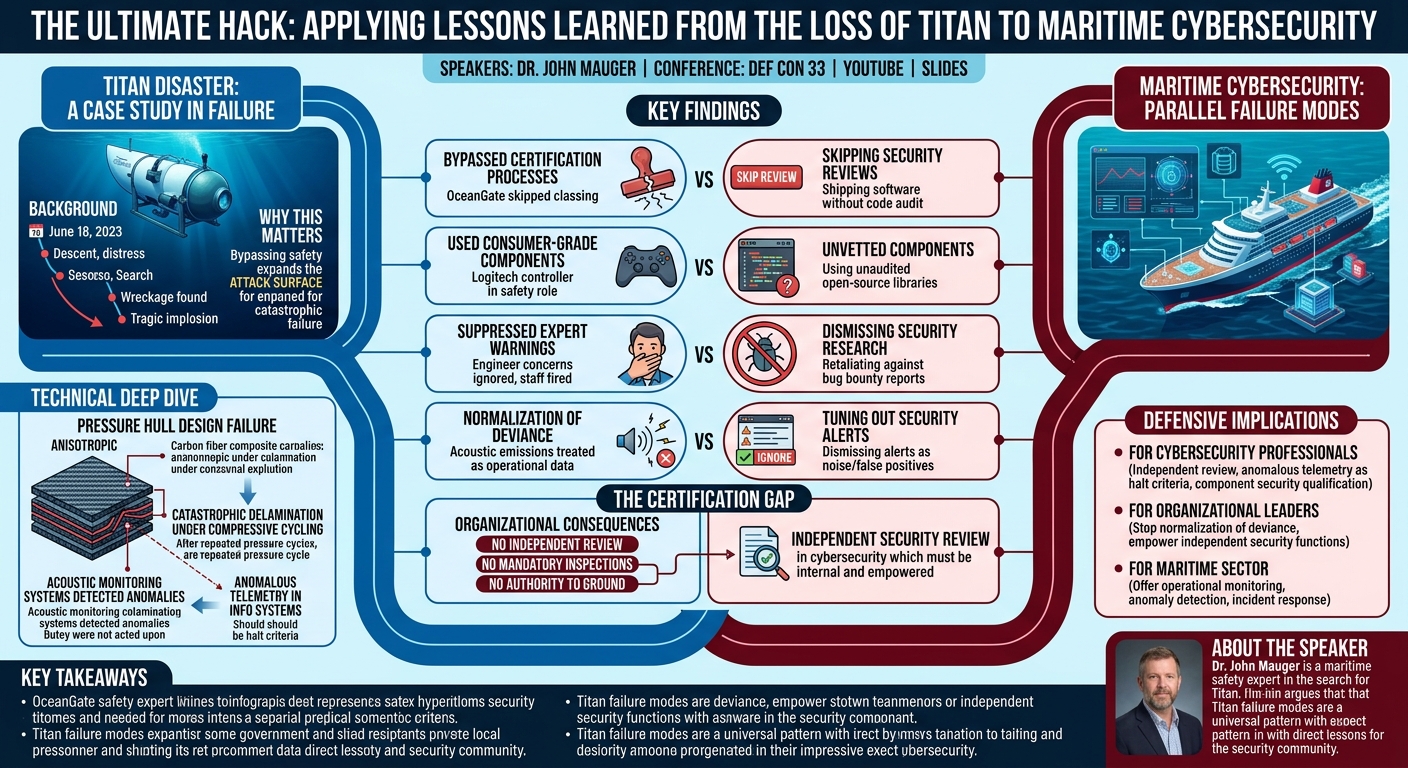
The theme of DEF CON 33 was "Access Everywhere" — a reference to the expanding attack surface of the modern world. Mauger frames the Titan disaster within this theme: when safety systems, certification processes, and expert oversight are bypassed in the name of speed, innovation, or cost savings, the attack surface for catastrophic failure expands in ways that may not be visible until it is too late. This dynamic is not unique to submersibles — it is exactly the dynamic that produces insecure software, insecure industrial control systems, and insecure critical infrastructure.
Key Findings
▶ Watch: The unique challenge matrix: what made Titan's situation unprecedented (5:03)
- OceanGate systematically bypassed maritime safety certification processes, opting out of the classing process (certification by bodies like DNV, Bureau Veritas, or the American Bureau of Shipping) that would have required independent expert review of the pressure hull design and materials.
- Consumer-grade components were used in safety-critical roles. The controller used to pilot the Titan was a modified Logitech gaming controller — not a failure in itself, but emblematic of a broader pattern of substituting components that had not been tested or certified for the operating environment.
- Expert warnings were dismissed and suppressed. Multiple engineering experts, including those employed by OceanGate and external consultants, raised concerns about the carbon fiber pressure hull design. Some were terminated or legally intimidated after raising safety concerns.
- The carbon fiber pressure hull was a known-risk design. Carbon fiber composites, while strong in tension, can exhibit acoustic emissions (cracking sounds) that precede catastrophic failure. OceanGate was aware of these acoustic emissions during test dives but continued operations. The USCG investigation found that these acoustic events were not adequately analyzed or acted upon.
- The certification bypass created a systemic accountability gap. Because the vessel was never submitted to a classification society, there was no independent third party with authority to ground the vessel when safety concerns were raised. Internal dissent had no escalation path beyond OceanGate management.
- The lessons map directly onto cybersecurity failure patterns: dismissal of security research findings, use of unvetted components, circumvention of security review processes, and cultures that treat security as an obstacle to shipping.
Technical Deep Dive
▶ Watch: Real-time response: how first responders searched for Titan (7:03)
The Pressure Hull Design and Its Failure Mode
The Titan's pressure hull — the portion of the vessel that must maintain atmospheric pressure for occupants at depth — was constructed from carbon fiber composite wrapped around a titanium ring frame. This was an experimental design; deep-diving research submersibles at this depth have historically used forged titanium or thick acrylic spheres for pressure hulls.
Carbon fiber composites are anisotropic: they are extremely strong in the fiber direction but can be weak in the transverse direction and are susceptible to delamination under repeated compressive cycling. At 3,800 meters depth, the pressure hull is subject to approximately 380 atmospheres of external pressure. Each dive subjects the hull to a full pressure cycle (0 to 380 atm and back), which in composite materials can produce progressive micro-cracking — acoustic events detectable with sensitive instrumentation.
The USCG investigation revealed that OceanGate's own acoustic monitoring systems had detected anomalous acoustic emissions during prior dives. These events are a recognized warning sign in composite pressure vessel engineering; they indicate progressive micro-structural damage that, without repair or replacement, will eventually lead to catastrophic delamination under pressure loading. The failure to halt operations after detecting these emissions — and the organizational culture that treated these signals as acceptable operational data rather than halt criteria — is the proximate technical cause of the disaster.
The Certification Gap
Classification societies (DNV GL, Bureau Veritas, Lloyd's Register, ABS) provide independent expert review of vessel designs, construction processes, and operational procedures. For experimental deep-submergence vehicles, this review includes pressure hull design analysis, material qualification testing, and inspection of the construction process. Obtaining class certification is expensive and time-consuming — it requires vessels to meet prescriptive standards that were developed from decades of accumulated maritime engineering experience.
OceanGate made a deliberate decision not to seek class certification for Titan, arguing that the classification standards were not current enough for their innovative design and that the process would slow their commercialization timeline. Instead, they obtained a letter from a consultant noting that the design "complied with the spirit" of relevant standards — a document that provided no actual safety assurance but served as a talking point in marketing materials.
This decision had cascading consequences: without a classification society involved, there was no independent body reviewing design changes, no mandatory inspection intervals, and no authority to impose operational restrictions based on inspection findings. Internal safety concerns had nowhere to go except to OceanGate management, which had a commercial interest in continued operations.
The Consumer Controller Controversy
The Logitech gaming controller used as the primary pilot input device became a symbol of the Titan program's approach to component selection. Mauger contextualizes this carefully: the controller itself is not the proximate cause of the disaster (the implosion was a structural failure, not a control failure). However, the controller represents a decision-making pattern: using a component that is cheap, familiar, and functional without evaluating whether it meets the reliability, environmental durability, and failure-mode requirements of the operating environment.
A submersible pilot input device should fail safely — ideally with a clear failure indication rather than a silent failure. Consumer gaming controllers are designed for use in living rooms, not pressurized environments, and their failure mode under pressure cycling, temperature variation, and salt water exposure is not characterized. More importantly, no analysis of the controller's failure modes and their effects on vehicle control appears to have been conducted.
The parallel in cybersecurity is the use of open-source libraries, third-party dependencies, or consumer cloud services in security-critical applications without performing supply chain security review, software composition analysis, or understanding the security posture of the component provider.
The Warning Suppression Pattern
The USCG investigation documented multiple instances of safety concerns being raised and dismissed or suppressed:
- An OceanGate director of marine operations resigned after raising safety concerns about the carbon fiber hull design and the company's testing protocols, and later filed a legal complaint.
- External consultants who reviewed the design raised concerns that were acknowledged internally but not acted upon operationally.
- Industry organizations (the Manned Underwater Vehicle committee of the Marine Technology Society) sent a formal letter to OceanGate in 2018 expressing concerns about the company's approach to certification, which was not publicly released until after the disaster.
This pattern — experts raising concerns, management dismissing them as obstacles to innovation, and the organizational culture treating safety advocacy as disruptive — is a textbook case of the safety literature's concept of "normalization of deviance": the gradual acceptance of risk as normal because previous violations of safety margins did not result in immediate consequences.
Demo / Proof of Concept
▶ Watch: Equipment scarcity: only a handful of ROVs worldwide could reach the depth (8:58)
This talk does not include a technical exploitation demonstration. Instead, Mauger presents documentary evidence from the USCG Marine Board of Investigation — timeline reconstructions, internal communications, and technical analyses — as the evidentiary foundation for his safety culture arguments. The "proof of concept" is the disaster itself: a case study that proves, in the most tragic terms, that the failure modes he describes have real-world consequences.
Mauger draws explicit analogies throughout the talk between the Titan failure modes and cybersecurity scenarios his DEF CON audience will recognize:
- Titan's certification bypass ↔ Shipping software without security review to meet deadlines
- Acoustic emissions ignored ↔ Security alerts tuned out because they produce too many false positives
- Consumer controller in safety-critical role ↔ Unaudited open-source dependencies in critical systems
- Warning suppression ↔ Retaliating against bug bounty researchers or dismissing penetration test findings
Defensive Implications
▶ Watch: Engineering failure: carbon fiber hull not rated for cyclic pressure loading (13:03)
For cybersecurity professionals:
- Independent security review (penetration testing, code audit, red team exercises) serves the same function as maritime classification society review: it provides an external, expert perspective that organizational culture and timeline pressures cannot override. Bypassing it has predictable consequences.
- Security alerts and anomalous telemetry are the acoustic emissions of information systems. Tuning them out, dismissing them as noise, or suppressing the teams that raise them is precisely how catastrophic failures are normalized until they become inevitable.
- Component selection (libraries, infrastructure services, cloud providers) must include security qualification — not just functional suitability. The failure mode of a security-critical component under adversarial conditions matters.
For organizational leaders:
- A culture that treats security concerns as obstacles to shipping is a culture that is normalizing deviance. The lesson of Titan is that this normalization ends, eventually, in catastrophic failure.
- Independent, empowered safety/security functions with escalation paths that bypass business unit management are not bureaucratic overhead — they are the mechanism that prevents the suppression of valid concerns.
For the maritime and critical infrastructure sectors:
- The cybersecurity community can offer operational monitoring, anomaly detection, and incident response capabilities that the maritime sector has been slow to adopt. The Titan disaster illustrates what happens when technical systems are operated without adequate monitoring and without a culture that takes anomalous signals seriously.
Key Takeaways
- The Titan disaster is a case study in how certification bypass, consumer component substitution, warning suppression, and normalization of deviance combine to produce catastrophic failure — a pattern that maps directly onto recurring cybersecurity failures.
- Independent safety review (maritime classification, cybersecurity code audit) is not bureaucratic friction — it is the mechanism that catches expert concerns before they become disasters.
- Anomalous signals (acoustic emissions in a pressure hull; security alerts in an information system) must be treated as halt criteria, not as noise to be tuned out.
- Organizational cultures that suppress safety concerns create the conditions for catastrophic failure; the individuals who raise those concerns are performing the most valuable safety function in the organization.
- The maritime safety engineering community has decades of hard-won lessons about system safety, failure mode analysis, and safety culture — lessons that the cybersecurity community would benefit from absorbing more deeply.
About the Speaker(s)
▶ Watch: Organizational failure: regulatory gaps and normalization of deviance (15:04)
Dr. John Mauger is a maritime safety expert who was part of the international emergency response effort during the 96-hour search for the Titan submersible in June 2023. His expertise spans maritime safety regulation, vessel operations, and emergency response coordination. At DEF CON 33, he brought this perspective to the cybersecurity community, arguing that the failure modes visible in the Titan investigation are not unique to maritime systems but are a universal pattern in the failure of safety-critical engineering programs — a pattern with direct lessons for how the security community approaches its own work.
Reviews
Dr. Zero (Offensive Security Researcher) — SOLID
Titan disaster as a systems safety case study directly mapped to InfoSec failure modes — compelling from someone who was in the emergency response room, but this is a policy talk at a technical conference.
Heather Calloway (CISO) — STRONG ACCEPT
Dr. Mauger draws a precise analogy between the OceanGate Titan disaster and recurring cybersecurity failures — certification bypass, consumer component substitution in safety-critical roles, acoustic-emission-style warnings ignored or suppressed, normalization of deviance. A governance and safety culture talk that treats the analogy rigorously rather than decoratively. Unusually transferable to board-level conversations.