Dendrite: An Evolving, Decentralized Bot Swarm
Michael Grube (Malware Researcher)
DistrictCon 2026 (Year 1) · Day 1 · Disco In The Dark
Overview
In an era increasingly defined by digital surveillance and the consolidation of technological power, Michael Grube, a seasoned malware researcher and co-founder of VX Underground, presented a thought-provoking and technically deep dive into Dendrite: An Evolving, Decentralized Bot Swarm at DistrictCon. This talk explored the potential for advanced, self-modifying malware to serve as a counter-balance to pervasive state-sponsored monitoring, operating under the premise that "sufficiently advanced privacy tech is indistinguishable from malware." Grube's vision is a peer-to-peer botnet designed not just for malicious ends, but as a tool for plausible deniability and resistance in heavily monitored environments.
Key moments
- 4:10 Privacy tech indistinguishable from malware
- 6:30 Introducing Dendrite: a self-modifying bot swarm
- 12:40 Small world networks for robust P2P
- 20:00 Genetic programming for evolving code logic
- 22:50 Simple demo: string evolution in action
- 25:10 PushGP VM: enabling evolving computer programs
- 33:10 Q&A: Evolving network protocol obfuscation
Dendrite: An Evolving, Decentralized Bot Swarm
Speakers: Michael Grube, Malware Researcher
Conference: DistrictCon
YouTube: https://www.youtube.com/watch?v=P4atiauJXAE
Overview
In an era increasingly defined by digital surveillance and the consolidation of technological power, Michael Grube, a seasoned malware researcher and co-founder of VX Underground, presented a thought-provoking and technically deep dive into Dendrite: An Evolving, Decentralized Bot Swarm at DistrictCon. This talk explored the potential for advanced, self-modifying malware to serve as a counter-balance to pervasive state-sponsored monitoring, operating under the premise that "sufficiently advanced privacy tech is indistinguishable from malware." Grube's vision is a peer-to-peer botnet designed not just for malicious ends, but as a tool for plausible deniability and resistance in heavily monitored environments.
The presentation outlined the architecture for such a system, focusing on two primary technical pillars: a resilient, stealthy communication network based on small-world networks, and an adaptive, self-modifying code base enabled by genetic programming and a specialized virtual machine called PushGP. Grube demonstrated how these components could allow a botnet to evolve its own obfuscation, adapt its protocols, and even perform distributed vulnerability research, all while operating with low resources and without a single point of failure. This talk is crucial for understanding the cutting edge of malware development and the profound challenges it poses to conventional cybersecurity defenses in an increasingly surveilled world.
Background
▶ Watch: Privacy tech indistinguishable from malware (4:10)
Michael Grube's motivation for developing Dendrite stems from a profound concern over the direction of the global tech economy and its societal implications. Beginning in 2021, even before the widespread explosion of large language models (LLMs), Grube observed a worrying trend of technological consolidation into centralized cloud environments. He argued that this centralization, coupled with the emerging capabilities of AI, creates an unprecedented opportunity for authoritarian governments to implement pervasive, 24/7 digital surveillance. He cited examples from countries like Russia and China, where national digital IDs are mandatory for internet access, and private conversations on applications like WhatsApp are banned in favor of state-controlled platforms such as Max (Russia's WeChat-esque system), explicitly designed for monitoring.
Grube challenged the Western notion of immunity to such systems, pointing to statements from prominent tech billionaires like Larry Ellison, who enthusiastically spoke about AI's use in civic governments for constant monitoring, and Europe's attempts to legalize broad surveillance. This existential threat to privacy and freedom led Grube to a core thesis: "sufficiently advanced privacy tech is indistinguishable from malware." He posits that in a hostile, authoritarian environment, software identifiable as malware could paradoxically provide a gray area or plausible deniability for individuals seeking private communication. To counter a "centralized super AI that watches everything," Grube envisioned a decentralized, intelligent swarm – a botnet that could adapt, evolve, and resist detection, thereby serving as a critical tool for digital self-defense and anonymous communication. This foundational idea underpins the entire Dendrite project.
Key Findings
▶ Watch: Small world networks for robust P2P (12:40)
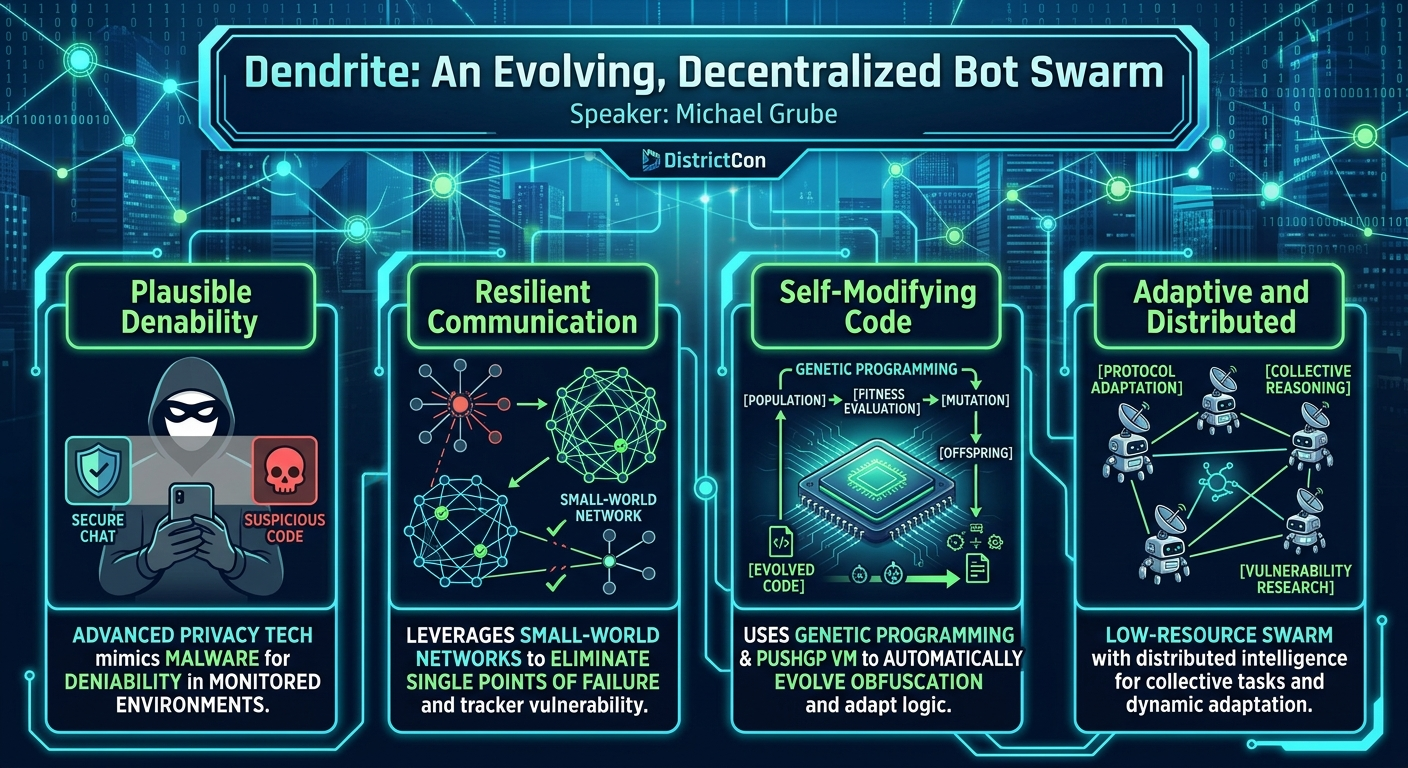
The central finding presented by Michael Grube is the conceptual and demonstrable feasibility of building a decentralized, evolving bot swarm capable of operating with extreme resilience and stealth in heavily monitored environments. This system, dubbed Dendrite, is designed to serve as a counter-balance to pervasive surveillance, offering plausible deniability through its malware-like characteristics.
The core contributions and findings can be summarized as:
- Resilient and Stealthy Communication: Dendrite leverages small-world networks as its communication backbone, moving away from easily disrupted traditional Distributed Hash Tables (DHTs). This network topology provides inherent resilience, lacks a central point of control, and makes enumeration and disruption exceptionally difficult, even with significant node loss.
- Self-Modifying and Adaptive Code: The project demonstrates the application of genetic programming combined with a specialized virtual machine, PushGP, to enable the botnet's code to automatically evolve. This allows for dynamic obfuscation, adaptation to new defensive measures, and potentially even the discovery of new functionalities or vulnerabilities.
- Low-Resource, Distributed Intelligence: The design principles emphasize low resource consumption and distributed collective reasoning, ensuring that the intelligent swarm can operate effectively on diverse hosts without drawing undue attention, and collectively solve problems like protocol adaptation or vulnerability research.
- Proof-of-Concept for Code Evolution: Grube provided practical demonstrations of genetic programming's ability to evolve both simple strings and, more significantly, functional yet obfuscated computer programs within the PushGP VM. This validates the core technical approach for enabling adaptive malware.
These findings collectively present a blueprint for a new generation of adaptive, resilient, and difficult-to-detect malware, with profound implications for both offensive and defensive cybersecurity strategies.
Technical Deep Dive
▶ Watch: Genetic programming for evolving code logic (20:00)
Dendrite's architecture is a sophisticated blend of network topology and artificial intelligence, designed to create a self-sustaining, adaptive, and resilient system. Grube meticulously detailed the underlying technical components that enable this vision.
Network Foundation: Beyond Traditional DHTs
Grube began by critiquing the common programmer's hammer for peer-to-peer networks: Distributed Hash Tables (DHTs). While efficient for storage and retrieval (e.g., BitTorrent), traditional DHTs are notoriously easy to attack. Attackers can query trackers or existing peers to map the entire network, leading to denial of service (DoS) against supernodes or individual hosts. Furthermore, many DHT implementations suffer from application-layer vulnerabilities, such as a lack of cryptographic signing or hash verification, allowing attackers to inject false data or commands. The ease with which botnets relying on DHTs are taken down underscores their fundamental vulnerability to enumeration and disruption.
Dendrite's solution to this problem lies in adopting small-world networks. First studied by Stanley Milgram in the 1950s (famous for the "six degrees of separation" concept, originally an estimation for 150 million people), small-world networks are characterized by their robust, decentralized nature. They lack central control, allow information to flow freely, and are exceptionally difficult to destroy. Unlike centralized systems, removing nodes from a small-world network often leads to adaptation rather than collapse. This topology is not unique to human social networks; it also appears in natural systems like short-term memory.
Key features of small-world networks that make them ideal for Dendrite include:
- Low Connectivity Requirements: Only a small number of connections per node are needed for efficient operation.
- Robustness: Simulations showed that even ripping out 33% of the network randomly resulted in only a 10-15% loss of traffic.
- Topology: They exhibit a higher proportion of local, close connections and a lower, but still existent, probability of longer-distance connections.
- Restricted Route Network: This structure makes it incredibly difficult to randomly connect to or identify nodes. An attacker would essentially need to traverse the entire network, a feat typically only achievable by entities like an ISP or the NSA. This provides a stealthy mechanism for fetching content in restricted environments.
The mathematical foundation for achieving an efficient small-world topology without needing new peers or a tracker was developed by Oskar Sandberg in 2006. His method involves operating within a virtual addressing space, where nodes calculate the mean distance from a randomly selected neighbor to their neighbors versus their own distance. If a node is closer to its peers' neighbors than itself, it can propose a virtual address swap, bringing the network closer to a small-world distribution. This results in an impressive log n squared search performance, meaning even a network of 1000 nodes would require only about 9 hops to find any needed information.
Code Evolution: Genetic Programming and PushGP
The more ambitious goal for Dendrite is evolving code. Grube explored various low-compute AI options, including the Soar Cognitive Framework, but found them too complex and computationally expensive. He settled on genetic programming (GP) as the most promising approach.
Genetic programming is an evolutionary algorithm where computer programs are treated as "individuals" or "genomes" that can be mutated and selected based on a fitness function. This function rigorously defines the desired outcome, guiding the evolution process. The core steps involve:
- Initialization: Create a population of random candidate programs.
- Fitness Evaluation: Each program is tested against the fitness function, which assigns a score based on how well it achieves the goal.
- Selection: Programs with higher fitness are more likely to be selected for reproduction. However, Grube emphasized the critical need to balance fitness with diversity of genomes. Solely selecting the fittest individuals leads to premature convergence on suboptimal solutions.
- Mutation/Crossover: Selected programs are altered (mutated) or combined (crossover) to create new offspring programs.
- Iteration: The process repeats over many generations, gradually improving the population's fitness.
The major challenge with genetic programming for actual computer programs is that random mutations often result in non-functional or crashing code. This problem was elegantly solved by Lee Spector in 2010 with the creation of the PushGP Virtual Machine (VM).
PushGP is a unique stack machine where every type of data has its own stack. This architecture provides remarkable tolerance to bad instructions: if an instruction is encountered that cannot operate on the available data types on its corresponding stack (e.g., a boolean operation on an integer stack), the VM simply no-ops and skips it. This simple trick allows for continuous program execution despite random mutations, making genetic programming viable for evolving functional code.
Furthermore, PushGP is designed to be highly modifiable. It allows for the creation of custom instructions that map to real-world functions, method calls, or API interactions. By balancing these specialized instructions with the VM's inherent operations, the search space for the genetic algorithm can be significantly reduced, making the evolution process far more efficient for real-world tasks. Individuals in PushGP are effectively sets of instructions, and the exact stack itself can even operate on its own contents, adding another layer of flexibility.
Future Work
Grube outlined several ambitious future goals for Dendrite:
- Network Protocol Side Channels: Evolving valid network traffic within arbitrary protocols to covertly hide information without disrupting the protocol's normal function.
- Distributed Vulnerability Research: Using the collective intelligence of the swarm to discover new vulnerabilities, which would then be distributed and leveraged by the network for further propagation. This would turn the botnet into a self-spreading, self-improving exploit delivery system.
- Network Sensing and Decision-Making: Enabling the network to collect data from its environment and make autonomous decisions based on that information.
- Pluggable Transports: Developing the ability to adapt to and utilize any convenient or unmonitored protocol for communication, enhancing stealth and resilience.
By partitioning the virtual addressing space, nodes can be assigned responsibilities, effectively turning the botnet into a large, distributed compute cluster for code evolution and other tasks.
Demo / Proof of Concept
▶ Watch: PushGP VM: enabling evolving computer programs (25:10)
Michael Grube presented two key demonstrations to illustrate the principles of genetic programming and the PushGP VM's capabilities.
The first demonstration showcased simple string evolution. Starting with a population of 1,000 random strings, the system aimed to evolve them towards a specific target string (e.g., "hello world"). The fitness function measured the "closeness" of each generated string to the target, based on factors like character position and identity. The demo visually illustrated how, over successive generations, the seemingly random noise gradually converged, character by character, until the target string was successfully generated. This provided an intuitive understanding of how genetic algorithms, guided by a fitness function, can discover solutions from a vast search space.
The second, more technically significant demonstration involved code obfuscation using the PushGP VM. The task for the evolving program was to pop a sequence of integers (1, 2, 3, 4, 5) off a stack. The fitness function was configured not just to achieve this functional goal, but also to maximize specific obfuscation metrics: stack junk, conditionals, and overall instruction length. The PushGP VM, through genetic programming, generated a sequence of instructions that successfully accomplished the task of popping the integers, but did so through a long chain of effectively no-op instructions. This demonstrated that the system could:
- Evolve functional code.
- Achieve specific, non-functional goals (like obfuscation) simultaneously.
- Operate with the fault tolerance of the PushGP VM, allowing random mutations to produce valid, albeit obfuscated, programs.
Grube also mentioned ongoing work on network protocol side channels, where the goal is to take an arbitrary protocol and evolve valid traffic that can hide information without disrupting the protocol's core function. While not demonstrated live, this highlighted the broader potential for genetic programming to adapt communication methods for stealth. These demonstrations, particularly the code obfuscation, provided concrete evidence that the core concept of evolving, functional, and adaptive code is not merely theoretical but practically achievable with relatively low computational resources.
Defensive Implications
▶ Watch: Q&A: Evolving network protocol obfuscation (33:10)
Dendrite's design presents a formidable challenge to conventional cybersecurity defenses, fundamentally shifting the paradigm of detection and response. The core thesis that "sufficiently advanced privacy tech is indistinguishable from malware" directly implies that traditional signature-based and even many behavioral detection methods will struggle.
Here are the key defensive implications:
- Erosion of Signature-Based Detection: The self-modifying nature of Dendrite's code, powered by genetic programming, means that static signatures (file hashes, byte patterns, specific instruction sequences) will become rapidly obsolete. Each instance, or even each generation, of the malware could present a unique signature, rendering traditional antivirus and intrusion detection systems ineffective. Defenders must move beyond static analysis.
- Resilience to Centralized Takedowns: The adoption of small-world networks for communication eliminates single points of failure and trackers. This makes it incredibly difficult for law enforcement or cybersecurity researchers to enumerate the network, map its C2 infrastructure, or perform a coordinated takedown. Disrupting such a network would require an unprecedented level of access, potentially at the ISP or national infrastructure level. Defenders cannot rely on traditional C2 disruption strategies.
- Adaptive Protocol Obfuscation: The ability to evolve new network protocol side channels or adapt to "pluggable transports" means that network-based detection signatures for C2 traffic will also become short-lived. The malware could dynamically change its communication patterns, blend into legitimate traffic, or even mimic existing unmonitored protocols. Network monitoring needs to focus on deeper behavioral anomalies rather than specific protocol patterns.
- Challenging Behavioral Analysis: While behavioral analysis is often touted as the next line of defense, Dendrite's low-resource design and the potential for collective reasoning could make it stealthier. The obfuscated code might perform its malicious actions in subtle, intermittent ways, making it hard to distinguish from background system noise or legitimate applications, especially if it mimics benign processes.
- Plausible Deniability as a Defensive Shield: The very motivation behind Dendrite – to offer plausible deniability – means that even if suspicious activity is detected, attributing it definitively to malicious intent versus legitimate privacy-enhancing activity (especially in authoritarian contexts) becomes ambiguous. This introduces a significant legal and ethical gray area for incident response.
Recommendations for Defenders:
- Focus on Anomaly Detection and Behavioral Baselines: Instead of signatures, defenders must invest heavily in advanced anomaly detection systems that can establish robust baselines of "normal" system and network behavior. Any deviation, no matter how subtle or fleeting, from these baselines should be flagged for investigation. This includes unusual process interactions, unexpected network flows, or resource consumption spikes that don't align with known applications.
- Embrace AI-Powered Behavioral Analytics: To counter evolving AI-driven threats, defenders need their own AI and machine learning capabilities. These could be used to identify complex behavioral patterns indicative of self-modification, unknown C2 protocols, or distributed coordination that human analysts might miss.
- Deep Packet Inspection (DPI) with Behavioral Context: While protocol patterns might change, the intent of data exfiltration or command execution might still leave detectable traces. DPI, combined with contextual behavioral analysis, could help identify unusual data structures or command flows even within evolving protocols.
- Zero Trust Architecture: Given the difficulty of detection post-infection, a Zero Trust model becomes paramount. Strict authentication, authorization, and least-privilege principles for every user, device, and application are essential to limit lateral movement and damage, even if initial compromise occurs.
- Enhanced Endpoint Detection and Response (EDR): EDR solutions must evolve to continuously monitor process creation, memory access, file system changes, and API calls for patterns that indicate code modification or the execution of genetically evolved instructions, even if the instructions themselves are "no-ops" from a functional perspective.
- Threat Intelligence Sharing: Rapid and effective sharing of threat intelligence regarding new obfuscation techniques, adaptive C2 strategies, and the characteristics of genetically programmed malware will be crucial for the defensive community to stay informed and develop countermeasures.
Dendrite represents a significant leap in adaptive malware, forcing defenders to re-evaluate their fundamental strategies and embrace more dynamic, behavioral-centric approaches to security.
Key Takeaways
- The Threat of AI-Powered Surveillance: The talk highlights a critical concern about the consolidation of tech and the use of AI by authoritarian governments for pervasive digital surveillance, posing a significant threat to global privacy and freedom.
- Plausible Deniability through "Malware": Michael Grube's core thesis, "sufficiently advanced privacy tech is indistinguishable from malware," proposes that malware-like systems can offer plausible deniability and serve as a tool for resistance in heavily monitored environments.
- Resilient Communication with Small-World Networks: Dendrite's use of small-world networks provides a highly resilient, decentralized, and stealthy communication infrastructure, making it exceptionally difficult to enumerate, disrupt, or take down compared to traditional DHT-based systems.
- Self-Modifying Code via Genetic Programming: The application of genetic programming and the PushGP VM enables the botnet's code to automatically evolve its own obfuscation and adapt to new defensive measures, challenging conventional signature-based detection.
- Adaptive and Distributed Intelligence: Dendrite is designed for low-resource operation, collective reasoning, and future capabilities like distributed vulnerability research and dynamic protocol adaptation, showcasing a new frontier for intelligent, autonomous malware.
- Profound Challenges for Defenders: The combination of decentralized C2 and evolving code creates significant defensive implications, necessitating a shift from signature-based detection to advanced behavioral analytics, anomaly detection, and robust Zero Trust architectures.
About the Speaker(s)
Michael Grube is a distinguished Malware Researcher with a rich background in offensive security and reverse engineering. He is a co-founder of VX Underground, a prominent online repository and community for malware collection and analysis. In this role, he also created the Black Mass magazine, a publication dedicated to in-depth technical articles on malware. Grube's expertise extends to decentralized systems, having worked on Freenet, a peer-to-peer anonymous publication system. He has also shared his knowledge by teaching classes on rootkit design, covering everything from userland to firmware. Currently, Michael Grube works as a security engineer, bringing his deep understanding of malware and system internals to defensive applications, though he explicitly stated that the views expressed in his talk are his own and do not represent his employer.
Reviews
Dr. Zero (Offensive Security Researcher) — STRONG ACCEPT
Grube delivers exactly what you want from a VX Underground co-founder: a conceptually ambitious architecture for adaptive malware that actually engages with the hard problems. The small-world network choice is defensible and the PushGP integration for code evolution is the real meat here. Not a finished weapon, but a serious design doc with working demos.
Heather Calloway (CISO) — SOLID
Interesting technical concept for adaptive malware using genetic programming and small-world networks. The defensive implications are real but overstated relative to the maturity of the work. Worth tracking, not worth restructuring your program around.