Putting Workload Identity to Work: Taking SPIFFE past day 0
Dave Sudia
fwd:cloudsec North America 2025 · Day 1 · Track 1 - Crystal
Overview
Dave Sudia, a former platform engineer, delivers a lightning talk on moving SPIFFE (Secure Production Identity Framework for Everyone) from proof of concept to production at scale. SPIFFE is a graduated CNCF project that provides a standard for issuing cryptographic identities to workloads using X.509 certificates with custom extensions, enabling true zero trust without long-lived static secrets. Sudia draws on his experience working with several large organizations (including unnamed financial institutions) to share practical implementation strategies, common failure modes, and a structured approach to adoption that begins with a single enthusiastic team and a tightly scoped use case before expanding organization-wide.
Key moments
- 1:30 The secrets-all-the-way-down problem: why workload identity matters
- 3:30 X.509 certificates and SPIFFE ID structure explained
- 6:00 Results: real zero trust, removing long-lived static secrets
- 8:00 Financial org case study: credential rotation consuming entire team capacity
- 10:00 Reference GitHub Actions pipeline with no stored AWS credentials
- 12:00 Scaling strategy: start with one team, keep SPIFFE IDs simple
- 16:00 Data center multi-tenancy solved with cryptographic identity
- 22:00 Agentic AI identity: SPIFFE for Bedrock/Lambda agent workloads
Putting Workload Identity to Work: Taking SPIFFE past day 0
Speakers: Dave Sudia
Conference: fwd:cloudsec North America 2025
YouTube: https://www.youtube.com/watch?v=oHlPGzpFT_c
Overview
Dave Sudia, a former platform engineer, delivers a lightning talk on moving SPIFFE (Secure Production Identity Framework for Everyone) from proof of concept to production at scale. SPIFFE is a graduated CNCF project that provides a standard for issuing cryptographic identities to workloads using X.509 certificates with custom extensions, enabling true zero trust without long-lived static secrets. Sudia draws on his experience working with several large organizations (including unnamed financial institutions) to share practical implementation strategies, common failure modes, and a structured approach to adoption that begins with a single enthusiastic team and a tightly scoped use case before expanding organization-wide.
Background
▶ Watch: The secrets-all-the-way-down problem: why workload identity matters (1:30)
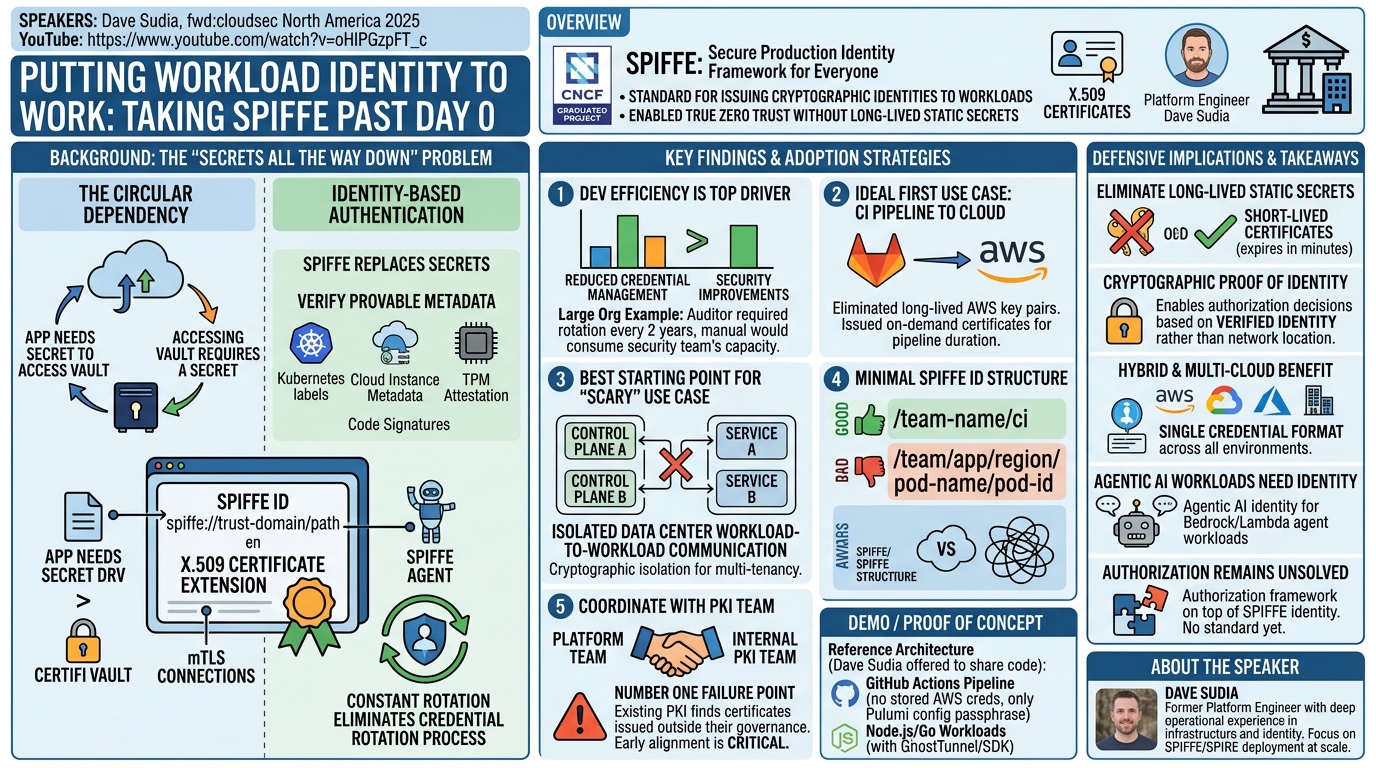
The fundamental problem SPIFFE addresses is the "secrets all the way down" paradox in application authentication. Applications need secrets to access services, and those secrets are stored in vaults, but accessing the vault itself requires a secret. SPIFFE replaces this circular dependency with identity-based authentication: instead of asking a workload for an API key, you verify provable metadata about the workload (Kubernetes labels, cloud instance metadata, TPM attestation, code signatures) and issue it a short-lived cryptographic identity document.
The identity document is an X.509 certificate with a SPIFFE-specific extension containing a SPIFFE ID -- a structured URI with a trust domain and workload identifier. Workloads establish mTLS connections and verify each other's certificates against trusted certificate authorities. The certificates are short-lived and constantly rotated by SPIFFE agents running alongside the workloads, eliminating the need for credential rotation processes.
SPIFFE has achieved broad ecosystem adoption as a graduated CNCF project. The reference implementation, SPIRE (SPIFFE Runtime Environment), provides the server and agent architecture for certificate issuance. SDKs exist for multiple languages, and proxy solutions (like GhostTunnel) fill gaps where direct code integration is not feasible.
Key Findings
▶ Watch: Results: real zero trust, removing long-lived static secrets (6:00)
Sudia's primary contribution is distilling patterns from real-world SPIFFE deployments at scale into actionable guidance:
- Dev efficiency is the top adoption driver. Organizations are choosing SPIFFE primarily to reduce developer time spent on credential management rather than for security improvements. The case study of a large financial organization whose auditor required credential rotation every two years -- a task that would consume all of the security team's capacity if performed manually -- illustrates the scale of the problem.
- CI pipeline to cloud provider is the ideal first use case. Multiple organizations started with GitLab CI or similar external CI systems authenticating to AWS. One team eliminated the need for long-lived AWS key pairs in every pipeline by issuing on-demand certificates with TTLs matching the pipeline execution time plus one minute.
- Isolated data center workload-to-workload communication is the best starting point for the "scary" use case. A financial organization needed to enforce multi-tenancy isolation within a data center where network controls were not feasible. SPIFFE certificates allowed them to enforce that Control Plane A could only communicate with Service A, and Control Plane B only with Service B, using cryptographic identity rather than network segmentation.
- SPIFFE ID structure should be kept minimal. Organizations that define overly complex URI structures (team/app/region/pod-name/pod-id) create rigidity. Starting with simple structures like
/team-name/ciallows complexity to be added later as needs emerge.
- Internal PKI team coordination is the number one failure point. Teams implementing SPIFFE for workload-to-workload communication frequently expand beyond their initial scope, and the existing PKI team discovers certificates being issued outside their governance. Early alignment with internal PKI is critical.
Technical Deep Dive
▶ Watch: Reference GitHub Actions pipeline with no stored AWS credentials (10:00)
The SPIFFE architecture consists of three layers. A central issuing server (typically SPIRE) maintains the trust domain and issues certificates. Agents run at the edge -- as DaemonSets in Kubernetes clusters, or as agents on EC2 instances -- and perform workload attestation by verifying metadata before distributing certificates. Workloads consume certificates through SDKs (replacing standard TLS implementations with SPIFFE-aware ones) or through proxies that handle the mTLS termination.
Workload attestation uses multiple metadata sources. In cloud environments, this includes OIDC tokens (the pattern used by GitHub Actions), cloud instance metadata (EC2 instance profiles and assumed roles), and Kubernetes JWKS for in-cluster identity. For on-premises workloads, TPM attestation provides hardware-backed identity. Workload-level metadata includes pod labels, systemd unit properties, and code signing signatures.
The SPIFFE Verifiable Identity Document (SVID) is an X.509 certificate containing a SPIFFE ID in a custom SAN field, formatted as spiffe://trust-domain/path. The certificate can also be a JWT for environments where X.509 is impractical. Workloads establish mTLS connections and verify the peer's SVID against the trust domain's certificate authority chain.
Sudia demonstrated a reference architecture with a Node.js frontend running behind GhostTunnel proxy (for SPIFFE compatibility), a Go backend natively integrating the SPIFFE SDK, and a GitHub Actions pipeline that uses SPIFFE certificates instead of AWS key pairs. The pipeline's only stored secret is a Pulumi config passphrase; all AWS authentication is handled through on-demand certificates with minimal TTL.
For Lambda and serverless workloads, implementation is more complex since there is no persistent agent to handle certificate rotation. Sudia noted this as an active area of development in the ecosystem.
Demo / Proof of Concept
▶ Watch: Scaling strategy: start with one team, keep SPIFFE IDs simple (12:00)
No live demo was presented during the talk, though Sudia referenced a working reference architecture including a GitHub Actions pipeline, a Node.js/Go workload-to-workload setup, and offered to share code examples and conduct deeper dives in a breakout session. The presentation focused on architectural patterns and case studies rather than live demonstrations.
Defensive Implications
▶ Watch: Agentic AI identity: SPIFFE for Bedrock/Lambda agent workloads (22:00)
For security teams evaluating workload identity, several defensive implications emerge:
- Eliminating long-lived static secrets (AWS key pairs in CI pipelines, database credentials, inter-service API keys) removes the most common credential theft vector. Short-lived certificates that expire in minutes are dramatically harder to exploit than static keys that persist indefinitely.
- mTLS with SPIFFE provides cryptographic proof of workload identity, enabling authorization decisions based on verified identity rather than network location or shared secrets. This is the foundation of actual zero trust rather than marketing zero trust.
- Hybrid and multi-cloud environments benefit most. Organizations running across AWS, GCP, Azure, and on-premises currently need to issue and distribute separate credentials for each environment. SPIFFE provides a single credential format that works across all of them.
- Agentic AI workloads need identity. Sudia's team is actively researching how SPIFFE applies to agentic AI architectures, where Bedrock-powered Lambda functions and tool-calling agents need cryptographic identity to enforce authorization boundaries.
- Authorization remains unsolved. SPIFFE handles identity and authentication but provides no authorization framework. Organizations must build their own authorization logic on top of SPIFFE identity, and no standard exists for this yet.
Key Takeaways
- SPIFFE replaces the "secrets all the way down" problem with cryptographic workload identity based on provable metadata, using short-lived X.509 certificates that are constantly rotated.
- Dev efficiency (reducing credential management burden) is the primary adoption driver, followed by breach risk reduction and enabling new multi-cloud capabilities.
- Start with a single enthusiastic team and the simplest use case (typically CI pipeline to cloud provider), then expand through collaboration with the platform/cloud team.
- Keep SPIFFE ID structures minimal -- it is easier to add complexity than remove it.
- Coordinate with internal PKI teams early, as workload-to-workload expansion is the number one failure point when existing PKI governance is bypassed.
- Authorization on top of SPIFFE identity remains bespoke with no industry standard, representing the next major gap to address.
About the Speaker(s)
Dave Sudia is a former platform engineer who has worked at organizations where platform engineering and security responsibilities overlapped. He currently works at a company focused on SPIFFE/SPIRE deployment and has helped multiple large organizations, including financial institutions, implement workload identity at scale. He is not from the traditional security side but brings deep operational experience in platform engineering, infrastructure automation, and identity systems. His team is actively researching SPIFFE's application to agentic AI identity.
Reviews
Dr. Zero (Offensive Security Researcher) — WEAK
A competent overview of SPIFFE adoption patterns with useful case studies from unnamed financial institutions, but this is fundamentally an implementation guide for infrastructure plumbing, not security research. No new vulnerabilities, no novel techniques, no exploits. Useful if you're evaluating workload identity; skippable if you're here for the sharp end of the stick.
Heather Calloway (CISO) — SOLID
A practical, experience-driven guide to deploying workload identity at enterprise scale. The case studies from financial institutions demonstrate real governance value -- eliminating long-lived credentials, enabling auditable zero trust, and reducing operational burden on security teams. Falls short on addressing the authorization gap and regulatory compliance dimensions that would make this a must-see for security leaders.