NVIDIA GTC DC 2025: Healthcare Special Address
Kimberly Powell (Vice President, Healthcare and Life Sciences · NVIDIA)
NVIDIA GTC 2025 · Session
Overview
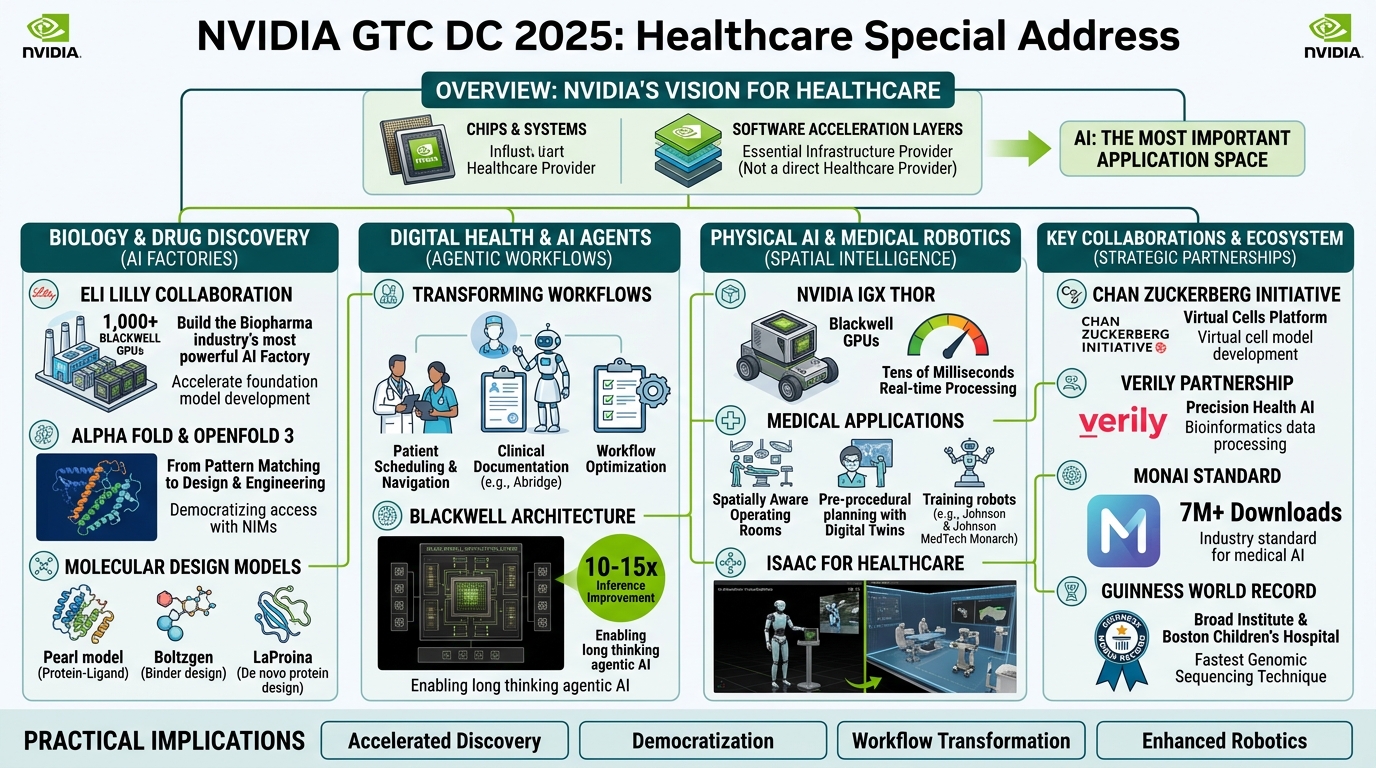
This special address from NVIDIA at GTC DC 2025 provides a comprehensive overview of the company's strategic vision and ongoing contributions to the healthcare and life sciences sectors. The talk, delivered by a leading NVIDIA executive, positions GTC as a "family reunion" for innovators in the field and a "wedding" where new connections are forged to collectively build a different future for healthcare. It emphasizes NVIDIA's foundational role not as a healthcare provider, but as an essential infrastructure company that builds the chips, systems, and software acceleration layers necessary for artificial intelligence, simulation, and physical AI to revolutionize biology, drug discovery, digital health, and medical devices.
Key moments
- 0:00 Introduction: GTC as a family reunion for healthcare
- 2:00 NVIDIA's role: Infrastructure and acceleration for healthcare
- 4:00 Overview of NVIDIA's healthcare acceleration stack and libraries
- 6:00 Broad Ro Sequencing breaks world record with NVIDIA Parabricks
- 7:30 AI as the new math for biology, inspired by AlphaFold
NVIDIA GTC DC 2025: Healthcare Special Address
Speakers: NVIDIA (NVIDIA)
Conference: NVIDIA GTC
YouTube: https://www.youtube.com/watch?v=Lzcz1exMrKk
Overview
This special address from NVIDIA at GTC DC 2025 provides a comprehensive overview of the company's strategic vision and ongoing contributions to the healthcare and life sciences sectors. The talk, delivered by a leading NVIDIA executive, positions GTC as a "family reunion" for innovators in the field and a "wedding" where new connections are forged to collectively build a different future for healthcare. It emphasizes NVIDIA's foundational role not as a healthcare provider, but as an essential infrastructure company that builds the chips, systems, and software acceleration layers necessary for artificial intelligence, simulation, and physical AI to revolutionize biology, drug discovery, digital health, and medical devices.
The presentation articulates NVIDIA's conviction that AI is the most important application space for accelerating breakthroughs in healthcare, a belief held by CEO Jensen Huang since 2016. It delves into the full-stack approach NVIDIA employs, from core CUDA acceleration to domain-specific libraries, models, and platforms, all co-designed with a deep understanding of application-layer challenges. The talk highlights significant collaborations with industry leaders like Eli Lilly, the Chan Zuckerberg Initiative, Verily, and Johnson & Johnson, showcasing how NVIDIA's technology is being deployed to address acute pain points in healthcare, accelerate scientific discovery, and redefine patient care and medical innovation.
Background
▶ Watch: Introduction: GTC as a family reunion for healthcare (0:00)
NVIDIA's journey in healthcare is rooted in its evolution from a systems company to a data center company, and now a global infrastructure provider. Its core business of building chips and systems, coupled with Melanox connectivity, forms the bedrock. However, NVIDIA's true impact in healthcare stems from its CUDA acceleration layer and its strategic focus on artificial intelligence, which, by nature, is domain-specific. The company's recognition of AI's transformative potential in biology was significantly amplified by breakthroughs like AlphaFold from the DeepMind team, which demonstrated how AI could solve long-standing scientific problems, such as protein structure prediction. This ignited a new era, moving science from pattern matching to a design and engineering discipline.
The healthcare and life sciences industry faces immense computational challenges. Drug discovery, for instance, involves complex molecular systems and requires modeling, simulation, and optimization at scales previously unimaginable. This creates an "insatiable demand for compute" to build molecules in silico. Beyond discovery, the healthcare delivery system is grappling with an acute crisis: demand for services far outstripping supply. This global phenomenon necessitates novel approaches, and NVIDIA believes that digital healthcare agents and physical AI offer pathways to close this gap by enhancing efficiency, expanding access, and enabling entirely new workflows. NVIDIA's strategy involves building domain-specific libraries, models, and full-stack platforms, largely informed by collaborations with domain experts at the application layer, ensuring that the underlying technology is precisely tailored to the industry's unique needs.
Key Findings
▶ Watch: NVIDIA's role: Infrastructure and acceleration for healthcare (2:00)
The talk unveiled several pivotal advancements and strategic directions underscoring NVIDIA's deep commitment to transforming healthcare:
- Comprehensive Acceleration Stack: NVIDIA's treasure trove of domain-specific acceleration modules, built upon CUDA, runs coherently across its entire platform range, from small credit card-sized computers to large-scale AI factories in the cloud. This includes libraries like Kublas for molecular dynamics and FFTs for advanced image reconstruction, crucial for technologies like photon-counting CT.
- Record-Breaking Genomics: NVIDIA, through its Parabrics platform, contributed to the Broad Institute and Boston Children's Hospital achieving a Guinness World Record for the fastest genomic sequencing technique. This demonstrates the impact of accelerated analysis in critical care scenarios like the NICU, aiming to shorten the diagnostic odyssey.
- Third Generation AI for Molecular Design: The field is rapidly advancing beyond basic pattern matching. New models like AlphaFold 3, MIT's Boltzgen for binder design, and Genesis Molecular AI's Pearl model for protein-ligand prediction are achieving high performance and pushing towards an "engineering discipline" in biology.
- OpenFold 3 and NVIDIA Inference Microservices (NIMs): NVIDIA announced the availability of the OpenFold 3 model, optimized into a NIM. This packaging allows for extreme performance and enterprise-scale deployment of open models as microservices, democratizing access to cutting-edge AI for R&D and product development.
- Open Model Ecosystem Expansion: NVIDIA is committed to an open-source imperative, making training recipes, weights, and synthetic data available. This includes families like Nemo Neotron for agentic AI, the Cosmos World Foundation Model, Groot for robotic policy training, and the new Clara open models for biomolecular design and medical imaging (e.g., LaProina, Codon FM, Resin, Gen). These models are being made available on platforms like Hugging Face.
- Eli Lilly's BioPharma AI Factory: A landmark extended collaboration with Eli Lilly was announced to build the biopharma industry's most powerful AI factory, based on over a thousand NVIDIA Blackwell GPUs. This factory will accelerate the development of breakthrough foundation models for understanding biology, exploring molecules, and optimizing clinical development. Lilly also launched Lily Tune Labs, a federated platform enabling startups to access models, data, and tools.
- Chan Zuckerberg Initiative Partnership: NVIDIA is joining forces with the Chan Zuckerberg Initiative to accelerate virtual cell model development, contributing tools like Codon FM and Parabrics to their Virtual Cells Platform, aiming to understand biology at multiscale and longitudinally, potentially enabling clinical trials in cells.
- Digital Health AI Acceleration: Healthcare providers are deploying enterprise AI faster than any other US industry. Digital healthcare agents are poised to revolutionize workflows from patient scheduling and navigation to clinical documentation (e.g., Abridge). The Blackwell architecture offers a 10-15x inference improvement, critical for these complex, agentic AI systems.
- Verily Partnership for Precision Health: Verily is accelerating its precision health AI with NVIDIA, integrating NVIDIA's tools and models into the Verily Workbench and Verily Pre platform to enhance bioinformatics data processing and multimodal language model development for researchers accessing large genomic datasets like "All of Us."
- Physical AI and Medical Robotics: NVIDIA introduced NVIDIA IGX Thor, an enterprise-ready physical AI platform for robotics, capable of real-time processing in tens of milliseconds. This platform, leveraging Blackwell, integrates vision language models for advanced edge capabilities. Collaborations with Diligent Robotics (Moxy 2) and Johnson & Johnson MedTech (Monarch platform) demonstrate its application in training robots in digital twins, spatially aware operating rooms, and eventually enabling robotic surgery.
- MONAI as Medical AI Standard: MONAI (Medical Open Network for AI) continues to be the industry standard for medical AI, with over 7 million downloads and exponential growth, pushing research and enabling competition wins.
Technical Deep Dive
▶ Watch: Overview of NVIDIA's healthcare acceleration stack and libraries (4:00)
NVIDIA's technical strategy in healthcare is characterized by a full-stack, co-designed approach, extending from fundamental hardware to sophisticated application-level platforms. The core of this is CUDA, NVIDIA's parallel computing platform and programming model, which serves as the acceleration layer for all computational tasks.
At the base, NVIDIA develops highly optimized domain-specific libraries. For instance, FFTs (Fast Fourier Transforms) are critical for advanced image reconstruction techniques in medical imaging, such as photon-counting CT. Similarly, Kublas, a CUDA-accelerated basic linear algebra subroutine library, is fundamental for high-performance molecular dynamics simulations. This bespoke optimization at the library level ensures maximum efficiency for common, computationally intensive operations.
The talk highlighted the evolution of AI models, particularly in biology. The groundbreaking work of AlphaFold and DeepMind showcased the power of Transformer architectures to move beyond simple pattern matching to complex sequence-to-structure prediction, solving long-standing problems like protein folding. Building on this, NVIDIA announced OpenFold 3, a high-performance protein structure prediction model, which has been rigorously validated by a consortium. To facilitate its deployment, OpenFold 3 has been optimized into an NIM (NVIDIA Inference Microservice). NIMs are essentially pre-built, optimized containers that allow these complex models to be deployed as microservices at enterprise scale, ensuring extreme performance and ease of integration into existing workflows.
NVIDIA's commitment to open models is further concretized through specific offerings:
- LaProina: An all-atom generative model for de novo protein design. It can generate exquisite proteins up to 800 amino acids, significantly extending capabilities beyond previous models which struggled around 400 amino acids. It supports both uncontrolled generation and sequence-conditioned design with specific functional parameters.
- Codon FM: A foundation model specifically designed for optimizing RNA sequences, crucial for RNA-based therapies and diagnostics.
- Resin: An application for predicting chemical synthesis pathways, vital for both chemistry and materials science.
- Gen: A generative model that creates novel drug-like molecules, accelerating early-stage drug discovery.
These and other Clara open models for biomolecular design and medical imaging (e.g., segmentation models for whole-body 3D, models for synthetic data generation, and models capturing radiologist "chain-of-thought" reasoning) are made available on platforms like Hugging Face, complete with training recipes and weights.
For generalized AI, NVIDIA offers:
- Nemo Neotron: A family of open models for agentic AI systems, designed to enable intelligent agents capable of reasoning, calling tools, and performing research.
- Cosmos: The World Foundation Model, which won an innovation award at CES and has broad applicability across domains, including healthcare.
- Groot: A model specifically for training robotic policy models, essential for physical AI.
A major technical leap discussed is the Blackwell architecture. Described as a "technology marvel," Blackwell offers a 10-15x improvement in inference performance compared to previous generations. This immense leap is attributed to extreme co-design, where not just the chip but the entire system, its connectivity, and the acceleration libraries are architected together. This performance is critical for the "long thinking" required by agentic AI systems in digital health, where models are queried multiple times to refine answers.
In the realm of physical AI, NVIDIA IGX Thor was introduced as an enterprise-ready platform for medical robotics. This system is designed for real-time processing, achieving signal-to-display latency in the tens of milliseconds, a crucial requirement for surgical applications. IGX Thor integrates Blackwell GPUs, enabling advanced vision language models (VLMs) and vision language action models (VLAMs) at the edge, capable of processing multiple sensor streams. The Isaac for Healthcare platform complements this by providing an environment to simulate robots, generate synthetic data (critical for generalization), and train robot policies before deployment on IGX Thor. Tools like HoloScan and ND Blocks are used for building 3D maps and enabling spatial awareness.
Finally, MONAI (Medical Open Network for AI) was highlighted as the industry standard for medical AI. It's an open-source framework co-developed with the community, providing a robust, modular, and extensible platform for medical imaging AI research and development, with integrations into clinical viewers like Kitware's VView. The talk also touched upon projects like Pian's Heart, which aims to create incredibly physically accurate simulations of human anatomy, vital for medical device development and surgical training, pushing towards a future of digital twins for every human.
Experimental Setup & Results
▶ Watch: Broad Ro Sequencing breaks world record with NVIDIA Parabricks (6:00)
The talk highlighted several concrete examples of experimental success and real-world deployment, demonstrating the tangible impact of NVIDIA's technologies:
- Genomic Sequencing World Record: The Broad Institute and Boston Children's Hospital, utilizing NVIDIA's Parabrics and Ro's new SBX technology, achieved a Guinness World Record for the fastest genomic sequencing technique. While specific throughput numbers were not detailed in the transcript, the achievement signifies a dramatic acceleration in genomic analysis, critical for rapid diagnosis in time-sensitive situations like NICU care.
- Molecular Design Benchmarks: The "third generation" of AI models for molecular design is showing significant performance gains. MIT's Boltzgen was announced to be "beating some fantastic benchmarks" for binder design. Similarly, Genesis Molecular AI's Pearl model was noted for "crushing benchmarks on protein-ligand" prediction. These results indicate a substantial leap in the accuracy and efficiency of in silico molecular design.
- LaProina's Protein Generation Scale: The LaProina all-atom generative model for de novo protein design demonstrated the ability to create proteins up to 800 amino acids long. This is a significant improvement over previous models of its kind, which "were really kind of falling down around the 400 amino acid size," showcasing a new scale of capability in protein design.
- Blackwell Inference Performance: The Blackwell architecture was stated to deliver a "10 or 15x improvement" in inference performance in a single generation. While specific benchmarks or models were not detailed for this claim in the context of healthcare, this general performance uplift is critical for the real-time demands of agentic AI systems across digital health applications.
- Abridge's Cost Reduction: NVIDIA is working deeply with Abridge on an R&D level to "reduce that cost" of initial speech recognition and subsequent inference for their AI-powered clinical documentation platform. The ability for Abridge to leverage NVIDIA's libraries and transition to Blackwell provides the flexibility needed to scale their platform in earnest, implying significant efficiency gains are being realized or are imminent.
- MONAI Adoption and Growth: MONAI was reported to have "over 7 million downloads" and is on "an exponential growth every every month." This widespread adoption and continuous growth within the medical AI research community underscore its effectiveness and utility as an industry-standard framework.
- "Hello World" Robotics Demo: A 3D-printed robot called the Sew Arm, integrated with Hugging Face Robot, was demonstrated for tool picking. This open-source setup, running on an NVIDIA DGX Spark (a small form factor system), provides an accessible "hello world" for healthcare robotics labs, enabling development for "a couple hundred bucks." This practical demonstration highlights the ease of entry into medical robotics development with NVIDIA's stack.
- Johnson & Johnson MedTech's Monarch Platform: This platform leverages digital twins and NVIDIA's AI for pre-procedural planning and training for broncoscopy and urology. While specific quantitative results were not provided, the collaboration is described as accelerating innovation across healthcare robotics, indicating successful integration and expected improvements in surgical precision and training.
The experimental results, while sometimes qualitative or high-level, consistently point to significant advancements in speed, scale, and capability across genomics, drug discovery, digital health, and robotics, driven by NVIDIA's hardware and software ecosystem.
Practical Implications
▶ Watch: AI as the new math for biology, inspired by AlphaFold (7:30)
The advancements highlighted in this GTC special address carry profound practical implications for various stakeholders across the healthcare and life sciences ecosystem:
For Practitioners and Infra Teams:
- Accelerated Drug Discovery & Development: The emergence of "AI factories" (e.g., Eli Lilly's Blackwell-based supercomputer) means pharmaceutical companies can dramatically shorten drug discovery timelines. They can move from traditional, lengthy experimental cycles to in silico design, simulation, and optimization, potentially learning from both successful and failed experiments at scale. This requires significant investment in compute infrastructure and specialized AI talent.
- Democratization of AI: NVIDIA's commitment to open models (e.g., OpenFold 3 as a NIM, Clara open models on Hugging Face) lowers the barrier to entry for researchers, startups, and even smaller enterprises. This fosters a collaborative ecosystem, allowing faster iteration and broader adoption of cutting-edge AI techniques without needing to build every model from scratch.
- Transformation of Digital Health Workflows: The rise of digital healthcare agents, powered by Blackwell's inference capabilities, promises to alleviate acute pain points in healthcare delivery. Practitioners can offload clerical tasks like scheduling, patient navigation, and documentation to AI, freeing up valuable time for direct patient care. This necessitates a "rewrite of the digital health stack," requiring infrastructure teams to integrate agentic AI systems securely and efficiently into existing EHRs and clinical workflows.
- Enhanced Medical Robotics and Surgery: NVIDIA IGX Thor and Isaac for Healthcare are paving the way for more precise and autonomous medical devices. Surgeons and interventional radiologists can benefit from real-time AI assistance, spatially aware robots, and comprehensive pre-procedural planning using digital twins of operating rooms and anatomies. This evolution from robotic-assisted to eventual robotic surgery will demand rigorous certification processes and new training paradigms for medical professionals.
For Model Builders and Deployers:
- Focus on Domain Specificity: AI in healthcare is inherently domain-specific. Model builders must deeply understand clinical context, biological mechanisms, and regulatory requirements. NVIDIA's strategy of co-designing with application experts reinforces the need for close collaboration between AI engineers and subject matter experts.
- The Importance of Data Readiness: A significant challenge acknowledged is that "most of the data is not AI ready." Model deployers must prioritize efforts in data ingestion, curation, refinement, and enrichment to create high-quality, AI-ready datasets, whether for research or clinical applications. Platforms like Verily Workbench are crucial for this.
- Scalability and Performance are Paramount: The "insatiable demand for compute" means that models must be optimized for extreme performance, especially for inference at enterprise scale. NIMs provide a blueprint for deploying optimized models, and hardware like Blackwell is essential for meeting the computational demands of complex agentic systems and high-throughput R&D.
- Evaluation and Benchmarking: The field needs robust methods to evaluate these new, sophisticated models. The Chan Zuckerberg Initiative's work on benchmarks, in collaboration with NVIDIA, is critical for establishing MLOps workflows for biology models and ensuring reliable, trustworthy AI deployments.
Tradeoffs and Limitations:
- Data Privacy and Security: While not explicitly detailed, the handling of sensitive patient and proprietary pharmaceutical data, especially in federated platforms like Lily Tune Labs or the "All of Us" dataset on Verily Workbench, implies a need for robust privacy-preserving AI techniques and stringent security protocols.
- Regulatory Hurdles: Deploying AI in clinical settings and medical devices faces significant regulatory challenges. While NVIDIA IGX Thor is "enterprise grade" and "built for medical grade," it still requires medical certification. Model builders must navigate complex approval processes for diagnostic, therapeutic, and robotic applications.
- Interpretability and Trust: For AI agents to be adopted by clinicians and patients, they must be transparent and interpretable. Models capturing "chain-of-thought" reasoning (like some Clara open models) are a step in this direction, but building trust remains a key challenge, especially for critical decisions.
- Bias and Fairness: Large datasets and foundation models can perpetuate biases present in the training data. Ensuring fairness and equity in AI-driven healthcare solutions is a continuous ethical and technical challenge.
- Human-in-the-Loop: Despite the rise of agentic AI and robotic assistance, the human element remains crucial. AI is positioned as a tool to augment, not fully replace, human professionals, requiring careful design of human-AI interaction.
Overall, NVIDIA's vision pushes healthcare towards an era of unprecedented computational power and AI-driven innovation, demanding a fundamental rethinking of infrastructure, workflows, and collaboration across the entire ecosystem.
Key Takeaways
- NVIDIA is building the foundational AI and simulation infrastructure for healthcare and life sciences, from chips and systems to domain-specific software, models, and platforms.
- "AI Factories," exemplified by Eli Lilly's Blackwell-powered supercomputer, are becoming indispensable for biopharma to accelerate drug discovery, moving towards an engineering discipline for molecular design.
- NVIDIA's commitment to open models, libraries, and data (e.g., OpenFold 3 NIMs, Clara open models) fosters a collaborative ecosystem, democratizing access to cutting-edge AI for R&D and enterprise deployment.
- Digital healthcare agents, leveraging Blackwell's extreme inference performance, are poised to revolutionize patient care by automating administrative tasks, improving access, and optimizing clinical workflows.
- Physical AI and simulation are transforming medical devices and robotics, enabling the creation of digital twins of operating rooms and human anatomies for training, precision surgery, and device development.
- Major collaborations with industry leaders like Eli Lilly, Chan Zuckerberg Initiative, Verily, and Johnson & Johnson are crucial for integrating NVIDIA's full stack into real-world healthcare challenges and driving systemic change.
About the Speaker(s)
The special address was delivered by a prominent leader within NVIDIA's Healthcare and Life Sciences division. While not identified by name in the provided transcript, the speaker's deep understanding of the industry, familiarity with long-standing partners, and articulation of NVIDIA's strategic vision clearly position them as a key executive driving the company's initiatives in this critical sector. The speaker conveyed NVIDIA's long-standing conviction in AI's transformative power for healthcare, a belief shared by CEO Jensen Huang, and emphasized the company's role as a partner building the essential infrastructure for a future of AI-powered medicine.
Reviews
Simon Wisk (Open Source Developer & AI Tooling Expert) — WEAK
A polished NVIDIA marketing keynote dressed up as a technical talk. The breadth of announcements is impressive on paper — Blackwell, OpenFold 3 NIMs, Clara open models, IGX Thor, the Lilly AI factory — but the article consistently gestures at technical depth without delivering it. Benchmark claims are asserted without methodology, architectural decisions are described at the level of a press release, and the 'technical deep dive' section amounts to little more than a glossary of product names. Engineers leave knowing what NVIDIA is selling, not how any of it actually works.
Jensen Hitch (AI Compute Platform CEO) — STRONG ACCEPT
This GTC DC special address is a well-executed platform-level talk that articulates NVIDIA's full-stack infrastructure strategy for healthcare and life sciences. It reasons correctly from the base layer — CUDA, domain libraries, interconnect — up through systems like DGX and IGX Thor, through software abstractions like NIMs and MONAI, to application outcomes in genomics, drug discovery, digital health agents, and physical AI. The industrial 'AI factory' framing is doing real work here, not just marketing: it repositions the unit of value from a model or a chip to a production facility that converts data and energy into biological and clinical intelligence at scale. The EliIlly Blackwell…