NVIDIA GTC 2025: Healthcare Special Address
Kimberly Powell (Vice President, Healthcare and Life Sciences · NVIDIA)
NVIDIA GTC 2025 · Session
Overview
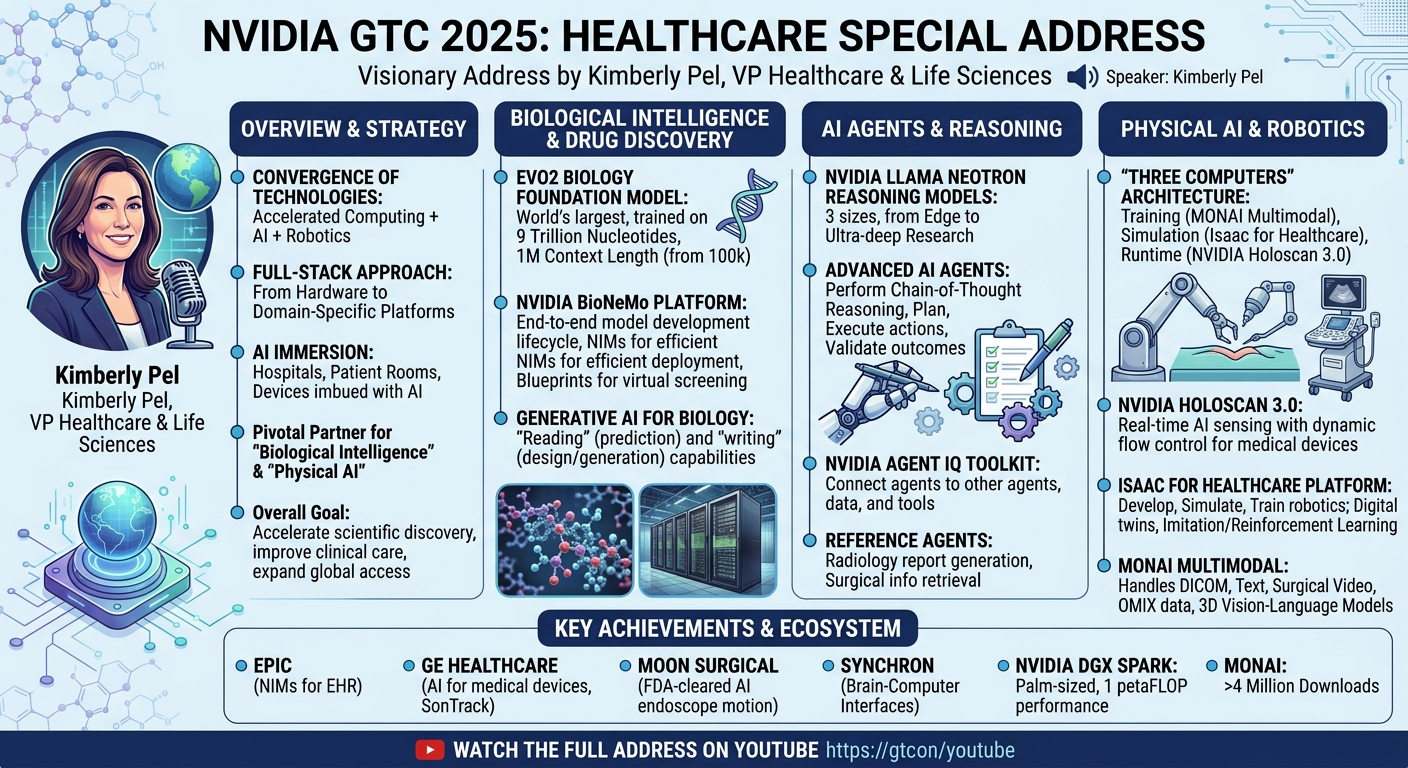
NVIDIA's GTC 2025 Healthcare Special Address, delivered by Kimberly Pel, Vice President of Healthcare and Life Sciences, unveiled a comprehensive vision for transforming the healthcare and life sciences industries through the convergence of accelerated computing, artificial intelligence, and robotics. The talk emphasized NVIDIA's full-stack approach, from foundational hardware and software platforms to domain-specific AI models and agentic workflows, all aimed at accelerating scientific discovery, improving clinical care, and expanding access to health services globally. Pel highlighted that the industry is at a "new frontier" where every aspect of healthcare, from hospitals to patient rooms and medical devices, will be imbued with AI.
Key moments
- 0:00 NVIDIA's vision for accelerated computing in healthcare
- 2:00 Welcome to GTC 2025, the AI and healthcare conference
- 4:00 NVIDIA's approach: Accelerated computing and domain-specific AI
- 6:00 Applying generative AI to unlock biology's mysteries
- 7:30 Announcing EVO2, the world's largest biology foundation model
- 8:00 EVO2's breakthrough: Extended context length for biological understanding
NVIDIA GTC 2025: Healthcare Special Address
Speakers: Kimberly Pel, Vice President of Healthcare and Life Sciences, NVIDIA
Conference: NVIDIA GTC
YouTube: https://www.youtube.com/watch?v=qbD9w0C0CGQ
Overview
NVIDIA's GTC 2025 Healthcare Special Address, delivered by Kimberly Pel, Vice President of Healthcare and Life Sciences, unveiled a comprehensive vision for transforming the healthcare and life sciences industries through the convergence of accelerated computing, artificial intelligence, and robotics. The talk emphasized NVIDIA's full-stack approach, from foundational hardware and software platforms to domain-specific AI models and agentic workflows, all aimed at accelerating scientific discovery, improving clinical care, and expanding access to health services globally. Pel highlighted that the industry is at a "new frontier" where every aspect of healthcare, from hospitals to patient rooms and medical devices, will be imbued with AI.
The address positioned NVIDIA not merely as a hardware provider but as a pivotal partner in building the digital infrastructure necessary for a new era of "biological intelligence" and "physical AI." Pel showcased breakthroughs across drug discovery, digital health, and medical robotics, demonstrating how NVIDIA's platforms like BioNeMo, MONAI, Holoscan, and the newly introduced Isaac for Healthcare are empowering researchers, clinicians, and industry partners. The core message was one of profound collaboration and the urgent need to leverage advanced computing to tackle complex human health challenges, ultimately giving patients the best chance to heal and recover.
Background
▶ Watch: NVIDIA's vision for accelerated computing in healthcare (0:00)
For nearly two decades, NVIDIA's accelerated computing platform has been instrumental in advancing healthcare. Early applications revolutionized medical imaging, drastically reducing radiation dosages while improving scan times and image quality. In genomics, accelerated computing made complex analyses tractable, moving from decoding the human genome in days to minutes. Molecular dynamics simulations, crucial for understanding protein interactions and drug design, also saw unprecedented speedups. These foundational advancements laid the groundwork for the most significant technological breakthrough of our time: artificial intelligence.
However, healthcare presents unique challenges for AI. Unlike generalized AI, healthcare AI is inherently domain-specific. Physicians, clinicians, and nurses undergo years of specialized training, accumulating deep expertise that general-purpose AI struggles to replicate. NVIDIA's approach has been to codify this domain-specific knowledge into specialized platforms and acceleration libraries, enabling breakthroughs in imaging, genomics, and drug discovery. The problem NVIDIA addresses is the immense complexity and data volume inherent in biology and clinical practice, coupled with the need for highly accurate, interpretable, and scalable AI solutions. The vision is to complement traditional "wet labs" with "dry labs" – digital environments where AI can accelerate hypothesis generation, experimentation, and data analysis, creating a continuous "data flywheel" that transforms scientific IP into actionable insights.
Key Findings
▶ Watch: NVIDIA's approach: Accelerated computing and domain-specific AI (4:00)
The talk highlighted several pivotal advancements and strategic initiatives across NVIDIA's healthcare portfolio:
- EVO2 Biology Foundation Model: The announcement of EVO2, developed with the ARK Institute, as the world's largest biology foundation model. Trained on 9 trillion nucleotides, it significantly increased context length from 100,000 to 1 million, crucial for understanding complex biological sequences like the 3 billion base pairs of the human genome. EVO2 demonstrates generalizable capabilities, from predicting pathogenicity to generating plausible whole genomes.
- NVIDIA DGX Spark: A revolutionary, palm-sized AI supercomputer offering one petaFLOP of FP4 performance. Designed for immediate deployment at the benchside, it provides out-of-box efficiency with pre-integrated NVIDIA NIM software for biology foundation models, imaging, and agent development, enabling rapid, localized research.
- NVIDIA BioNeMo Platform Enhancements: Continued development of the BioNeMo platform to provide an end-to-end model development lifecycle for biology. This includes open-sourcing training optimizations and recipes (e.g., for EVO2), integrating models into NVIDIA NIMs (NVIDIA Inference Microservices) for efficient deployment with simple API wrappers, and assembling these NIMs into "blueprints" for complex workflows like virtual screening.
- Advanced AI Agents and Reasoning Models: Introduction of NVIDIA Llama Neotron reasoning models (in three sizes for edge to ultra-deep research) as a new frontier for large language models. These models enable agents to perform chain-of-thought reasoning, plan, execute actions by calling tools and data, and validate outcomes. The NVIDIA Agent IQ toolkit was announced to facilitate the connection of agents to other agents, data, and tools.
- MONAI Multimodal: The evolution of MONAI, the standard for medical AI development, into a multimodal platform. It now handles diverse healthcare data (DICOM, text, surgical video, OMIX), supports 3D vision-language models, and incorporates a new agent framework. Reference agents for radiology (report generation) and surgery (information retrieval, notetaking) were presented.
- NVIDIA Holoscan 3.0: A significant update to NVIDIA's real-time AI sensing platform for edge devices. Holoscan 3.0 introduces dynamic flow control, allowing runtime decisions on image processing pipelines based on incoming sensor data, critical for agentic and physical AI applications in operating rooms and medical devices.
- Isaac for Healthcare Platform: The launch of Isaac for Healthcare, a specialized platform for developing, simulating, and training physical AI for robots and autonomous systems in healthcare. It enables developers to create digital twins of robots and patients, use physics and sensor simulation, and leverage imitation learning and reinforcement learning for complex task automation. Early access includes workflows for autonomous medical imaging and surgical task automation.
- Strategic Partnerships and Ecosystem Growth: Numerous collaborations were highlighted, including Epic (accelerating AI with NVIDIA NIMs on Microsoft Azure for EHRs), GE Healthcare (extending partnership to physical AI for autonomous ultrasound and X-ray), Moon Surgical (first FDA-cleared AI-driven endoscope motion), Synchron (brain-computer interfaces), Barco/Soft Acuity (intelligent OR solutions with Holoscan), Abridge (reasoning in patient-clinician interactions), Concert AI (virtualizing clinical trials), and Hippocratic AI (agent marketplace for clinicians).
These findings collectively underscore NVIDIA's commitment to delivering a comprehensive and integrated ecosystem that accelerates every facet of healthcare innovation, from drug discovery to patient care and medical robotics.
Technical Deep Dive
▶ Watch: Applying generative AI to unlock biology's mysteries (6:00)
NVIDIA's strategy in healthcare AI is built upon a layered technical stack, extending from fundamental accelerated computing hardware to sophisticated application-level frameworks and models. A core tenet is the development of domain-specific AI, acknowledging that healthcare requires highly specialized models and workflows.
At the foundation is accelerated computing, pioneered by NVIDIA, which provides the raw computational power necessary for modern AI. This includes GPUs and specialized architectures like the NVIDIA DGX Spark, a compact supercomputer designed to bring petaFLOP-scale FP4 performance directly to research benches. Its "out-of-box day zero efficiency" means researchers can immediately access pre-optimized software, including NIMs, for biology, imaging, and language models, without extensive configuration.
A significant focus is on biological intelligence, driven by generative AI and large language models (LLMs). The NVIDIA BioNeMo platform is central to this, providing an end-to-end framework for developing, training, and deploying biology foundation models. A prime example is EVO2, a genomic foundation model trained on an unprecedented 9 trillion nucleotides. Its breakthrough lies in its context length, expanded from 100,000 to 1 million, which is critical for understanding the vast sequences of biology (e.g., the human genome's 3 billion base pairs). This model leverages transformer architectures and unsupervised learning to develop a deeper understanding of biological sequences, enabling both "reading" (prediction) and "writing" (generation/design) of biology. NVIDIA emphasizes optimizing both pre-training (on massive datasets) and post-training (fine-tuning for specific tasks) for efficiency, recognizing that biology models are beginning to follow the scaling laws observed in other LLM domains. NIMs (NVIDIA Inference Microservices) play a crucial role in deploying these models. They encapsulate highly optimized models, often built by NVIDIA or its partners, into standardized, high-efficiency compute containers with simple API wrappers. This simplifies integration into broader workflows, such as the "virtual screening blueprint" for drug discovery, which assembles multiple NIMs to perform complex calculations.
The talk also heavily featured AI agents, which represent the next frontier beyond generative AI. These agents are powered by advanced reasoning models, such as the newly introduced NVIDIA Llama Neotron models. Available in three sizes, these models are designed for deployment across a spectrum of devices, from edge devices requiring compact agents to cloud-based systems for "ultra-deep research." Reasoning, in this context, is defined by the agent's ability to:
- Chain of Thought: Develop a coherent sequence of steps to address a problem.
- Planning: Formulate a strategy based on the chain of thought.
- Execution (Action): Call into specific tools and access data to carry out the plan.
- Validation: Critically evaluate its own output and decisions.
An illustrative example involved a biomed research agent assisting with cystic fibrosis research. The agent would first perform a literature search to identify therapeutic targets (e.g., CFTR protein), then formulate a hypothesis, call into BioNeMo NIMs for virtual screening of small molecules against the target, and finally generate a structured research report, including self-criticism. The NVIDIA Agent IQ toolkit provides the necessary infrastructure to connect these agents to each other, to data sources, and to various tools, enabling complex, automated scientific workflows.
The concept of Physical AI was introduced as the embodiment of AI into physical things, necessitating AI's understanding of the physical world. This paradigm relies on a "three computers" architecture:
- AI Development Computer: This is where AI models are developed and trained. MONAI Multimodal is NVIDIA's platform for this in healthcare. It handles the complexities of healthcare-specific data formats (e.g., DICOM, text, surgical video, various OMIX data), providing data I/O and transformation pipelines. It supports the creation of multimodal vision-language models that understand 3D imaging and text, as well as surgical video and text. Crucially, MONAI Multimodal now incorporates reasoning capabilities and an agent framework, providing transparency through "chain of thought" descriptions for clinical applications like radiology report generation or surgical notetaking.
- Simulation Computer: Before deploying AI in the physical world, especially in high-stakes environments like surgery, it must be rigorously tested and validated in a digital realm. Isaac for Healthcare serves this purpose. It allows developers to import digital twins of robots, sensors, and patient models into highly accurate virtual environments. The platform provides powerful physics simulation, sensor simulation, and environment creation tools. It supports imitation learning (teaching robots by demonstration) and reinforcement learning (allowing robots to learn complex tasks through trial and error in simulated scenarios), which are often too difficult for traditional programming.
- Real-time Runtime Computer: This is the computer embedded within the physical robot or device that executes the AI's decisions with low latency. NVIDIA Holoscan 3.0 is the platform for this, functioning as a real-time AI sensing platform that can run on edge devices or in data centers. Its new dynamic flow control feature enables runtime adaptation of image processing pipelines based on incoming sensor data, essential for responsive, intelligent medical devices and surgical robotics.
This integrated technical framework, from accelerated computing to domain-specific foundation models, intelligent agents, and a comprehensive physical AI development and deployment pipeline, positions NVIDIA at the forefront of healthcare innovation.
Experimental Setup & Results
▶ Watch: Announcing EVO2, the world's largest biology foundation model (7:30)
While Kimberly Pel's address was primarily a strategic overview and announcement of new platforms and partnerships rather than a detailed presentation of novel experimental benchmarks from NVIDIA's internal research, it did highlight several quantitative achievements and real-world adoption metrics from NVIDIA and its collaborators. These figures underscore the practical impact and growing maturity of the technologies discussed.
In the realm of biological intelligence, the EVO2 foundation model was described as being trained on 9 trillion nucleotides, a massive dataset indicative of its scale. A key technical achievement mentioned was the increase in context length from 100,000 to 1 million base pairs, a critical factor for the model's ability to understand complex biological sequences. While specific performance benchmarks for EVO2 were not detailed in the talk, its general capabilities, such as predicting pathogenicity and generating whole genomes, suggest significant progress in biological understanding.
For AI-driven drug discovery, Pel cited Insilico Medicine as a pace-setter, achieving target-to-candidate identification within a 13-month timeframe and having 10 assets greenlighted for clinical trials. This demonstrates the real-world productivity gains enabled by AI drug discovery factories. The use of predictive and generative models allows companies to screen billions of compounds while synthesizing far fewer, optimizing R&D productivity.
In digital health and AI agents, the adoption numbers were compelling:
- Abridge has deployed its reasoning-powered platform in over 100 health systems, enriching patient-clinician interactions by providing context from electronic health records.
- Hippocratic AI has identified over 400 use cases for its agent marketplace, targeting over 25 different medical specialties and boasting dozens of current installations, empowering clinicians to design custom AI assistants.
- Epic, managing health records for approximately 325 million patients worldwide (80% of the US), is integrating NVIDIA NIMs via Microsoft Azure AI Foundry, targeting around 200 use cases to improve patient care and operational efficiency.
For medical AI development, MONAI has achieved over 4 million downloads and is cited in several thousand research papers, solidifying its position as the de facto standard. The continued success of MONAI in competitions further validates its effectiveness.
In physical AI and robotics:
- Moon Surgical achieved an industry first with FDA clearance for AI-driven motion of its endoscope, allowing it to autonomously track tools.
- GE Healthcare is leveraging AI capabilities for its over 500,000 medical devices, including the SonTrack foundation model for real-time ultrasound segmentation.
- The NVIDIA DGX Spark was highlighted for its one petaFLOP of FP4 performance, making high-performance AI compute accessible at the lab bench.
These figures, while not always presented as direct "experimental results" in a research paper sense, serve as strong indicators of the rapid adoption, demonstrated efficacy, and transformative potential of NVIDIA's platforms and the broader ecosystem's innovations in healthcare.
Practical Implications
▶ Watch: EVO2's breakthrough: Extended context length for biological understanding (8:00)
The advancements outlined by Kimberly Pel have profound practical implications for a wide range of stakeholders in the healthcare and life sciences industries.
For practitioners and scientists, the emergence of "digital labs" alongside traditional "wet labs" signifies a paradigm shift. The NVIDIA DGX Spark puts a supercomputer-level dry lab right at the benchside, enabling immediate, iterative research without reliance on large data centers. AI agents, powered by NVIDIA Llama Neotron reasoning models and the Agent IQ toolkit, are poised to become indispensable digital assistants. These agents can automate literature reviews, formulate hypotheses, run virtual experiments (e.g., drug screening via BioNeMo NIMs), and generate reports, effectively acting as "digital scientists" that accelerate the entire research cycle and allow human scientists to focus on higher-level critical thinking and experimental design. This promises to drastically improve R&D productivity, which currently costs the industry $300 billion annually.
Infrastructure teams and IT departments will benefit from the streamlined deployment of AI. NVIDIA NIMs offer highly optimized, containerized AI models with simple API wrappers, making integration into existing workflows significantly easier. The partnership with Microsoft Azure AI Foundry for Epic's EHR system exemplifies a zero-configuration deployment model that allows for rapid scaling of AI applications, reducing the operational burden of managing complex AI infrastructure.
For model builders and developers, platforms like MONAI Multimodal provide standardized tools and frameworks for developing sophisticated AI models that can handle the unique complexities of healthcare data (3D imaging, surgical video, OMIX data, EHRs). The inclusion of reasoning and an agent framework within MONAI also pushes towards more transparent and interpretable AI, crucial for clinical adoption. BioNeMo offers the scaffolding for creating and optimizing large-scale biology foundation models, empowering researchers to build upon state-of-the-art biological intelligence.
Medical device manufacturers and deployers are entering the age of Physical AI. NVIDIA Holoscan 3.0 provides the real-time AI sensing platform necessary to embed intelligence directly into devices, enabling dynamic decision-making at the edge. Isaac for Healthcare offers a crucial development and simulation environment, allowing autonomous medical imaging devices, surgical robots (like Moon Surgical's FDA-cleared endoscope), and humanoid assistants to be safely developed and rigorously tested in digital twins before real-world deployment. This will lead to more autonomous, efficient, and accessible medical devices, extending healthcare reach beyond hospital walls.
The practical implications also extend to patient care and access. AI agents can enhance patient experience by automating check-in processes and providing personalized avatars. They can enrich clinician-patient interactions by providing immediate contextual information from patient records (as demonstrated by Abridge). In clinical trials, AI can virtualize and optimize trial design and patient selection, accelerating the delivery of new drugs to market. The push for autonomous medical devices, as envisioned with GE Healthcare's partnership, aims to make early detection and diagnosis more accessible and regular, especially in underserved areas.
However, the talk also implicitly acknowledges tradeoffs and limitations. The speaker noted that "we're nowhere near where we need to be in terms of their capabilities" for biology models, indicating that while foundational, models like EVO2 are still evolving. The immense computational resources required for training models with increased context lengths (e.g., EVO2's 1 million context length) highlight the continued need for highly efficient accelerated computing. The domain-specific nature of healthcare AI means that generalized models often require significant fine-tuning or specialized architectures, preventing a "one-size-fits-all" solution. Furthermore, the development of physical AI, particularly for safety-critical applications like surgery, necessitates rigorous simulation and validation processes, which, while accelerated by Isaac for Healthcare, are inherently complex and time-consuming. The ethical considerations of AI in healthcare, though not explicitly detailed, are implicitly addressed by the emphasis on transparency ("chain of thought") in agentic AI and the need for human oversight in critical decision-making processes.
Key Takeaways
- NVIDIA is driving a comprehensive transformation of healthcare through a full-stack approach, integrating accelerated computing, domain-specific AI platforms, and robotics.
- Generative AI and large language models are unlocking "biological intelligence," with breakthroughs like EVO2 (9 trillion nucleotides, 1M context length) accelerating drug discovery via platforms like BioNeMo and NIMs.
- AI agents, powered by NVIDIA Llama Neotron reasoning models and the Agent IQ toolkit, are poised to revolutionize research and clinical workflows by enabling chain-of-thought planning, execution, and validation.
- Physical AI and robotics are the next frontier, built on a "three computers" paradigm (training, simulation, runtime) utilizing MONAI Multimodal, Isaac for Healthcare, and NVIDIA Holoscan 3.0 for safe and efficient development and deployment.
- Strong ecosystem partnerships with industry leaders like Epic, GE Healthcare, Moon Surgical, and Synchron are crucial for integrating these technologies into real-world clinical and research settings.
- The overarching goal is to significantly enhance R&D productivity, expand access to care, and improve patient and provider experiences by making AI pervasive across every aspect of healthcare.
About the Speaker(s)
Kimberly Pel is the Vice President of Healthcare and Life Sciences at NVIDIA. In this role, she leads NVIDIA's strategic initiatives and development across the healthcare sector, encompassing areas such as medical imaging, genomics, drug discovery, digital health, and robotics. Her address at GTC 2025 showcased her deep understanding of the industry's challenges and opportunities, as well as NVIDIA's vision and extensive portfolio of technologies designed to drive innovation in human health.
Reviews
Simon Wisk (Open Source Developer & AI Tooling Expert) — WEAK
A polished, well-organized keynote-style overview of NVIDIA's healthcare AI portfolio that names a lot of products, cites some impressive adoption numbers, and gestures at interesting technical concepts — but never descends to the level of implementation detail where an engineer could actually do something with it. This is a product announcement dressed up as a technical talk.
Jensen Hitch (AI Compute Platform CEO) — SOLID
A competent and well-organized executive address that maps NVIDIA's healthcare platform stack clearly — BioNeMo, MONAI, Holoscan, Isaac for Healthcare — and lands the 'three computers' architecture as a genuine organizing principle. The vision is real and the platform thinking is present. But this is a product keynote, not a technical talk. It doesn't reason from physical constraints upward, it reasons from product announcements outward. The 'so what at scale' question — cost per inference, memory bandwidth requirements for 1M-context biology models, deployment bottlenecks in regulated environments — is left on the table. Engineers leave knowing what NVIDIA is selling. They don't leave…