Physical AI at GTC 2025 Preview
NVIDIA Omniverse Team (NVIDIA)
NVIDIA GTC 2025 · Session
Overview
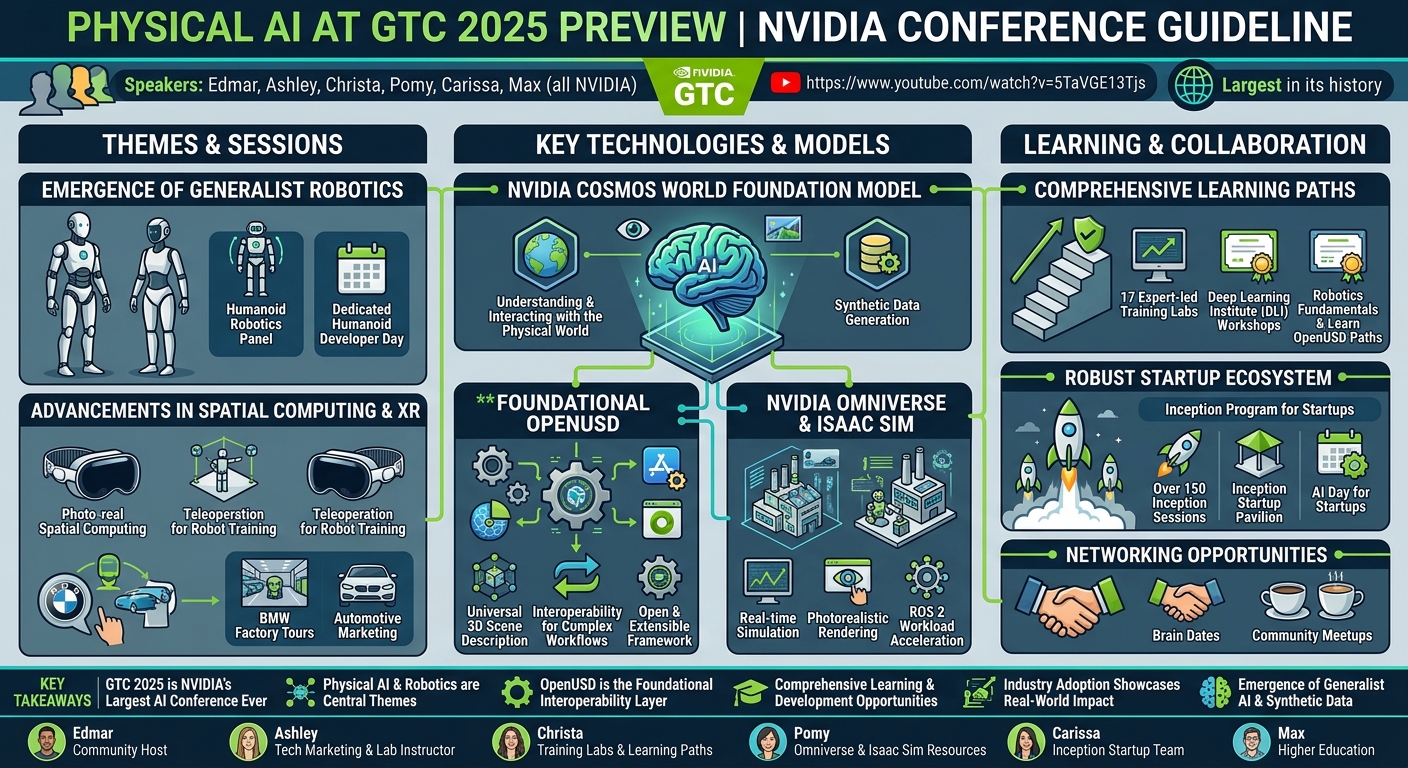
This article provides an in-depth preview of NVIDIA's GTC 2025, the premier global conference for AI. The session, hosted by NVIDIA's Edmar and Ashley, with special guests Christa, Pomy, Carissa, and Max, serves as an insider's guide to the expansive event, highlighting key themes, featured sessions, workshops, and networking opportunities. GTC 2025 is positioned as the largest in its history, boasting over 1,200 sessions, 442 talks, 61 panels, and 15 lightning talks, a significant 40% increase in scale from the previous year. The conference is a critical nexus for developers, researchers, industry leaders, and startups, offering deep dives into NVIDIA's cutting-edge technologies and their real-world applications.
Key moments
- 0:00 Welcome to OpenUSD Insiders and GTC preview
- 1:30 NVIDIA GTC Keynote: Don't miss the announcements
- 2:45 Networking at GTC using the Brain Date app
- 3:25 New Robotics Fundamentals learning path for developers
- 4:05 Omniverse XR experiences on Apple iPad early access
- 4:50 OpenUSD learning resources: "Why you should use OpenUSD"
- 5:55 Featured Physical AI and Robotics GTC sessions
- 6:20 GTC attendance tips: add to calendar, arrive early
Physical AI at GTC 2025 Preview
Speakers: Edmar, Ashley, Christa, Pomy, Carissa, Max (all NVIDIA)
Conference: NVIDIA GTC
YouTube: https://www.youtube.com/watch?v=5TaVGE13Tjs
Overview
This article provides an in-depth preview of NVIDIA's GTC 2025, the premier global conference for AI. The session, hosted by NVIDIA's Edmar and Ashley, with special guests Christa, Pomy, Carissa, and Max, serves as an insider's guide to the expansive event, highlighting key themes, featured sessions, workshops, and networking opportunities. GTC 2025 is positioned as the largest in its history, boasting over 1,200 sessions, 442 talks, 61 panels, and 15 lightning talks, a significant 40% increase in scale from the previous year. The conference is a critical nexus for developers, researchers, industry leaders, and startups, offering deep dives into NVIDIA's cutting-edge technologies and their real-world applications.
The central focus of GTC 2025, as emphasized in this preview, revolves around Physical AI and Robotics, underpinned by the foundational OpenUSD framework. The talks and workshops span critical areas such as spatial computing, extended reality (XR), industrial AI, and digital twins, illustrating NVIDIA's comprehensive ecosystem for building and deploying intelligent systems in the physical world. This preview is designed to help attendees, both in-person and virtual, navigate the vast agenda and identify the most relevant content, from hands-on training labs and expert-led certifications to startup showcases and academic research discussions. The sheer breadth of topics underscores NVIDIA's pervasive influence across the AI/ML landscape, from foundational models to edge deployment.
The importance of GTC 2025 extends beyond mere technical presentations; it is a vibrant ecosystem for collaboration, learning, and innovation. The event facilitates unparalleled networking opportunities through features like "Brain Dates" and community meetups, fostering connections between developers, startups, educators, and industry veterans. By registering virtually, attendees gain free access to a significant portion of the content, with registered participants receiving early access to session recordings. This strategic approach ensures that the insights and advancements shared at GTC reach a broad global audience, accelerating the adoption and development of AI technologies across diverse sectors.
Background
▶ Watch: Welcome to OpenUSD Insiders and GTC preview (0:00)
NVIDIA GTC has evolved into a cornerstone event for the AI and accelerated computing community, serving as a critical platform for unveiling groundbreaking research, product innovations, and strategic partnerships. In the rapidly advancing fields of AI and machine learning, the ability to translate theoretical models into practical, real-world applications is paramount. This is precisely where the concept of Physical AI comes into play – the development of intelligent systems that can perceive, reason, and act within physical environments. This domain is experiencing explosive growth, driven by advancements in robotics, autonomous systems, and the increasing demand for automation across industries.
Prior to the current focus on Physical AI, NVIDIA established itself as a leader in GPU-accelerated computing, initially for graphics and later for general-purpose computing, which proved instrumental for deep learning. Technologies like CUDA and cuDNN became essential tools for researchers and developers, significantly accelerating the training of complex neural networks. This foundation paved the way for NVIDIA to expand into broader AI ecosystems, including platforms like Omniverse, which provides a scalable, multi-GPU real-time simulation and collaboration platform for 3D workflows, and Isaac Sim, a robotics simulation platform built on Omniverse.
The problem that GTC 2025 addresses, particularly through its emphasis on Physical AI, is the growing complexity and fragmentation in the development and deployment of intelligent agents. Building robots that can operate autonomously, creating accurate digital twins of industrial facilities, or developing spatial computing applications requires a confluence of advanced simulation, sensor integration, AI model training, and robust deployment frameworks. Traditional siloed approaches often lead to inefficiencies, interoperability challenges, and slower development cycles. OpenUSD (Universal Scene Description) emerges as a critical solution here, acting as an open, extensible framework for describing, composing, simulating, and collaborating on 3D scenes. Its adoption is vital for creating a unified language across diverse tools and applications, enabling seamless data exchange and collaborative development in complex physical AI and digital twin projects. GTC 2025 aims to showcase how NVIDIA's integrated hardware and software stack, centered around these technologies, provides a holistic approach to tackling these multifaceted challenges in the ML/systems space.
Key Findings
▶ Watch: Networking at GTC using the Brain Date app (2:45)
As a conference preview, this talk highlights anticipated themes and significant content rather than presenting novel research findings. The "Key Findings" section therefore outlines the primary discoveries, contributions, and application areas that GTC 2025 is set to showcase, emphasizing the breadth and depth of NVIDIA's ecosystem.
- Emergence of Generalist Robotics and Humanoids: A major focus is the "New Era of Generalist Robotics: The Rise of Humanoids." GTC will feature panels with leading humanoid robotics companies (e.g., Skilled AI, Tiffin Tech, Boston Dynamics, Agility Robotics, Onx) discussing the future and challenges of humanoid robots. A dedicated Humanoid Developer Day will offer introductory and deep-dive sessions, including "101 to Building Humanoid Robots" and "A New Path to Embodied AI," proposing frameworks for deploying robots and agents.
- NVIDIA Cosmos World Foundation Model: The conference will introduce the NVIDIA Cosmos World Foundation model, a generalist AI model aimed at understanding and interacting with the physical world. Sessions like "Intro to NVIDIA Cosmos World Foundation Model" will provide foundational knowledge and hands-on access for attendees to explore its capabilities for synthetic data generation and perception AI models.
- Ubiquitous Role of OpenUSD: OpenUSD is presented as the foundational technology for 3D workflows, simulation, and digital twins across all domains. Sessions include an "Intro to OpenUSD" covering roadmaps and core concepts. Real-world applications will be highlighted, such as Coca-Cola leveraging OpenUSD for marketing operations and a lightning talk featuring Inception startups utilizing OpenUSD and Omniverse in their 3D workflows.
- Advancements in Spatial Computing and XR: GTC 2025 will feature extensive content on Spatial Computing and XR, particularly with Apple Vision Pro integration. Sessions like "Develop the Future of Photo-Real Spatial Computing with Apple Vision Pro and Omniverse" will offer technical deep dives. Practical applications include automotive marketing (e.g., Katana), BMW factory tours, and using Apple Vision Pro for teleoperation and training robots in simulation.
- Industrial Digitalization and Digital Twins: The conference emphasizes the transformative impact of physical AI on industrial digitalization. A panel with top companies like Microsoft, Siemens, Intrinsic, Agility Robotics, and Foxconn will discuss industry outlooks. Specific sessions will showcase Siemens using photorealistic digital twins for product design and Foxconn applying physical AI in industrial manufacturing, demonstrating the power of Omniverse and OpenUSD in these sectors.
- Comprehensive Learning and Certification Pathways: GTC offers 17 expert-led, two-hour training labs, including topics on Isaac Sim, ROS 2 acceleration, Sensor RTX API, and OpenUSD best practices for robotics. The Deep Learning Institute (DLI) provides full-day certification workshops on topics like generative AI and LLMs. New learning paths, such as "Robotics Fundamentals" and "Learn OpenUSD," are available online for free, supporting continuous developer education.
- Robust Startup Ecosystem: The Inception program for startups will have a significant presence, with over 150 sessions led by or featuring Inception members. A dedicated Inception Startup Pavilion will host 60 startup booths. An "AI Day for Startups" will include VC-led sessions on fundraising and industry insights, alongside pitch sessions from both startups and VCs, fostering investment and collaboration.
These highlights collectively paint a picture of GTC 2025 as a pivotal event for understanding the current state and future trajectory of AI, with a strong emphasis on practical application and ecosystem-wide integration.
Technical Deep Dive
▶ Watch: Omniverse XR experiences on Apple iPad early access (4:05)
GTC 2025, as previewed, delves into a broad spectrum of NVIDIA's core technologies, showcasing their synergistic application across Physical AI, Robotics, and Digital Twins. The technical content emphasizes integrated platforms, advanced simulation capabilities, and the foundational role of universal data description.
OpenUSD and the Omniverse Ecosystem
At the heart of NVIDIA's strategy for Physical AI and digital twins is OpenUSD, an open, extensible 3D scene description. OpenUSD acts as a universal language for describing, composing, simulating, and collaborating on 3D data. Its importance is underscored by sessions like "Intro to OpenUSD," which will cover its roadmap and fundamental concepts. In the context of GTC, OpenUSD is not merely a file format but a crucial interoperability layer that enables complex workflows across diverse software applications and hardware.
NVIDIA Omniverse, built on OpenUSD, serves as a platform for connecting and building custom 3D pipelines. It provides a real-time simulation and collaboration platform that leverages NVIDIA's GPU architecture for high-fidelity rendering and physics simulation. Omniverse is instrumental in creating digital twins, photorealistic virtual replicas of physical assets, environments, or processes. Sessions will explore how Omniverse, paired with OpenUSD, facilitates industrial digitalization, with examples like Siemens using it for product design at scale and Foxconn applying it in manufacturing. The platform's ability to stream applications, as discussed in the context of Microsoft PowerBI integration, highlights its utility for browser-based factory monitoring and dashboarding.
Robotics and Simulation with Isaac Sim
For robotics, NVIDIA Isaac Sim is a key component, providing a powerful, GPU-accelerated robotics simulation platform within Omniverse. It enables developers to train, test, and deploy AI-powered robots in virtual environments before physical deployment. The conference offers several deep dives into Isaac Sim's capabilities:
- Introduction to Robotic Simulation: Partners like Scaled Foundations will demonstrate browser-based access to Isaac Sim, making advanced robotics simulation more accessible.
- ROS 2 Workload Acceleration: Sessions on "Accelerating ROS 2 Workloads with Isaac ROS" will cater to existing ROS developers, showcasing how NVIDIA's optimized libraries and tools can enhance the performance of robotic applications.
- Software-in-the-Loop (SIL) Testing: The "Software in the Loop Testing for Robots with OpenUSD, Isaac Sim, and ROS" lab will guide attendees through integrating their robot control systems with high-fidelity simulations for robust testing and validation.
- Reinforcement Learning at Scale: A lab taught by AWS focuses on "Robotic Simulation with Reinforcement Learning at Scale," specifically training humanoid robots to walk and behave in complex environments. This highlights Isaac Sim's capability to generate massive amounts of synthetic data for RL agent training.
- Sensor RTX API: This early access API, featured in a dedicated lab, provides realistic sensor simulation capabilities crucial for autonomous driving and physical AI in buildings, allowing developers to simulate various sensor types (e.g., lidar, radar, cameras) with high fidelity.
Generative AI and Foundation Models
The talk previews the integration of generative AI into 3D workflows. Ashley's lab, "Controlling OpenUSD Applications for Generative AI," will demonstrate connecting ComfyUI (a popular stable diffusion workflow tool) to a Kit application within Omniverse. This allows for the generative augmentation of USD scenes, such as dynamically altering kitchen backsplashes, countertops, and decorative elements around a fixed asset (e.g., an espresso machine). This session will also offer exclusive access to the early access Edify 360 Nim (NVIDIA Omniverse Extension), enabling learners to create custom 360-degree panoramic HDRI environments for their scenes, showcasing real-time environment generation.
The NVIDIA Cosmos World Foundation model is another significant technical highlight. Announced at CES, GTC will provide a "101" introduction, explaining its architecture and capabilities as a generalist AI model designed to understand and operate within the physical world. While specific architectural details are not provided in this preview, the model's purpose points towards large-scale, multimodal learning for embodied AI, likely leveraging vast datasets of real-world and synthetic data.
Spatial Computing and Apple Vision Pro Integration
GTC 2025 places a strong emphasis on spatial computing and XR, particularly the integration with Apple Vision Pro. Sessions like "Develop the Future of Photo-Real Spatial Computing with Apple Vision Pro and Omniverse" will offer technical deep dives, likely covering the necessary SDKs, rendering pipelines, and data synchronization mechanisms to bridge Omniverse's simulation capabilities with Vision Pro's immersive display. Applications include using Vision Pro for automotive marketing campaigns (e.g., Katana) and creating immersive factory tours (e.g., BMW). A hands-on lab will demonstrate using Apple Vision Pro for teleoperation to train robots in simulation, showcasing a more intuitive and efficient method for generating training data compared to traditional manual approaches. This involves capturing human demonstrations and then scaling them up with algorithms for reinforcement learning.
Overall, the technical deep dive at GTC 2025 reflects NVIDIA's strategy to provide an end-to-end platform for AI in the physical world, from foundational 3D data interoperability with OpenUSD, through high-fidelity simulation with Omniverse and Isaac Sim, to the deployment of intelligent agents and the integration of cutting-edge generative AI and spatial computing technologies. The emphasis on hands-on labs and expert-led training underscores NVIDIA's commitment to enabling developers to master these complex interconnected systems.
Experimental Setup & Results
▶ Watch: OpenUSD learning resources: "Why you should use OpenUSD" (4:50)
As this talk serves as a preview of an upcoming conference, it does not present new experimental setups or quantifiable results in the traditional academic sense. Instead, it highlights the types of applications, industry adoptions, and practical demonstrations that will be showcased at GTC 2025, serving as "results" in the form of real-world impact and technological capability.
The conference will feature various companies demonstrating how they are leveraging NVIDIA's technologies:
- Coca-Cola's OpenUSD Application: Coca-Cola will present on how they are applying OpenUSD within their marketing operations. This demonstrates the practical utility of OpenUSD beyond traditional 3D content creation, showcasing its expansion into enterprise marketing workflows for large-scale content generation and management.
- BMW's Apple Vision Pro Factory Tour: BMW will showcase how they are using Apple Vision Pro to create immersive factory tours. This highlights the application of spatial computing and XR in industrial settings, likely for training, facility planning, or remote collaboration, providing a photorealistic and interactive experience of a manufacturing environment.
- Siemens' Digital Twin for Product Design: Siemens will present on their use of photorealistic digital twins at scale in their product design processes. This demonstrates the power of Omniverse and OpenUSD in industrial engineering, enabling virtual prototyping, simulation, and optimization before physical production, leading to faster iterations and reduced costs.
- Foxconn's Industrial AI Applications: Foxconn will share insights into applying physical AI within their industrial manufacturing operations. This illustrates the integration of AI models and robotic systems to enhance automation, efficiency, and quality control in complex production lines.
- Microsoft PowerBI Integration: A session partnered with Microsoft will explore hands-on experiences with app streaming to bring factory data into a browser, and how Microsoft's PowerBI platform can be used to set up dashboards and additional interfaces. This showcases the integration of NVIDIA's simulation and data streaming capabilities with enterprise analytics tools for real-time monitoring and decision-making in digital twin environments.
- AWS's Reinforcement Learning for Robotics: AWS will lead a lab on "Robotic Simulation with Reinforcement Learning at Scale," focusing on training humanoid robots to walk and behave. While not a direct experimental result, this highlights the practical application of cloud-based compute for large-scale AI training, demonstrating the feasibility of complex robotic behaviors through simulated learning environments.
The "experimental setup" in the context of GTC's hands-on labs involves Dell workstations provided for attendees, ensuring access to the necessary compute power for running Omniverse, Isaac Sim, and other NVIDIA software without requiring personal hardware. These labs, such as those on Sensor RTX API or Generative AI with ComfyUI, provide practical experience with the technologies rather than presenting new research outcomes. The "results" are therefore the successful implementation of these technologies by leading companies and the enablement of developers through practical training.
Practical Implications
▶ Watch: GTC attendance tips: add to calendar, arrive early (6:20)
GTC 2025's focus on Physical AI, OpenUSD, and the broader NVIDIA ecosystem carries significant practical implications for a wide range of professionals in the AI/ML and systems development space.
For Practitioners (Developers, Engineers, Data Scientists)
- Skill Development and Access to Tools: GTC provides unparalleled access to hands-on training labs and Deep Learning Institute (DLI) certifications. Developers can gain practical experience with Omniverse, Isaac Sim, ROS 2, OpenUSD, and generative AI tools like ComfyUI. This directly translates to enhanced skill sets, making practitioners more adept at building and deploying complex AI systems. The free online learning paths for "Robotics Fundamentals" and "Learn OpenUSD" further democratize access to essential knowledge.
- Faster Prototyping and Deployment: The integration of high-fidelity simulation platforms like Isaac Sim, coupled with tools for synthetic data generation, means practitioners can rapidly prototype, test, and refine AI models and robot behaviors in virtual environments. This significantly reduces the cost and time associated with real-world experimentation, accelerating the deployment cycle for physical AI applications.
- Interoperability and Collaboration: The emphasis on OpenUSD as a universal 3D scene description framework addresses a critical pain point in collaborative workflows. Practitioners can expect improved interoperability between different software tools and departments, fostering more efficient collaboration on complex projects involving 3D assets, simulations, and digital twins.
For Infrastructure Teams
- Scalable Simulation and Compute: Infrastructure teams responsible for deploying and managing AI workloads will find valuable insights into scaling GPU-accelerated simulation environments. The discussions around NVIDIA Cosmos World Foundation Model and large-scale reinforcement learning hint at the substantial computational resources required, guiding teams in designing robust and scalable AI infrastructure.
- Digital Twin Management: For teams managing industrial operations, the advancements in digital twins offer a blueprint for optimizing factory layouts, predicting maintenance needs, and improving operational efficiency. The integration with platforms like Microsoft PowerBI for dashboarding demonstrates how IT infrastructure can support real-time data analytics and visualization for complex physical assets.
For Model Builders
- Synthetic Data Generation: The ability to generate vast amounts of high-quality synthetic data through simulation platforms like Isaac Sim is a game-changer for model builders. This addresses challenges of data scarcity, privacy concerns, and the difficulty of acquiring diverse real-world data, enabling the training of more robust and generalizable perception AI models.
- Foundation Models for Embodied AI: The introduction of the NVIDIA Cosmos World Foundation Model signifies a shift towards more generalist AI models for understanding and interacting with the physical world. Model builders will gain insights into developing and leveraging these large-scale models, moving beyond task-specific AI to more adaptable and capable embodied AI agents.
For Deployers (of Robots and AI Agents)
- Robust Testing and Validation: The focus on Software-in-the-Loop (SIL) testing for robots in simulation provides a critical methodology for ensuring the safety and reliability of deployed AI agents. Deployers can use these virtual testing environments to thoroughly validate robot behaviors under various conditions, reducing risks in physical deployments.
- Frameworks for Embodied AI: Sessions like "A New Path to Embodied AI" offer proposed frameworks for deploying robots and agents, addressing the practical challenges of integrating AI models with physical hardware, sensor data, and real-time control systems.
Tradeoffs and Limitations
While the implications are largely positive, certain tradeoffs and limitations are inherent:
- Computational Cost: The advanced simulations, large foundation models, and high-fidelity rendering showcased at GTC demand significant computational resources, primarily powerful NVIDIA GPUs. This can represent a substantial initial investment for many organizations.
- Complexity and Learning Curve: Mastering the interconnected ecosystem of OpenUSD, Omniverse, Isaac Sim, and various AI frameworks presents a steep learning curve. While NVIDIA offers extensive training, the sheer breadth of technologies requires dedicated effort and expertise.
- Data Fidelity in Simulation: While synthetic data generation is powerful, achieving perfect fidelity between simulation and the real world (the "sim-to-real gap") remains a challenge. Deployers must still account for real-world nuances not perfectly captured in virtual environments.
- Interoperability Challenges (Despite OpenUSD): While OpenUSD greatly improves interoperability, integrating legacy systems and proprietary software with the OpenUSD/Omniverse ecosystem can still pose challenges, requiring custom connectors and adaptation.
In essence, GTC 2025 outlines a future where AI-powered physical systems are increasingly sophisticated and ubiquitous. The practical implications are about empowering professionals with the tools, knowledge, and collaborative frameworks to navigate this complex landscape, driving innovation across industries while acknowledging the inherent technical and resource demands.
Key Takeaways
- GTC 2025 is NVIDIA's Largest AI Conference Ever: With over 1,200 sessions and a 40% increase in scale, it is the premier event for insights into AI, accelerated computing, and the future of intelligent systems.
- Physical AI and Robotics are Central Themes: The conference heavily emphasizes the development and deployment of intelligent agents in the physical world, featuring a dedicated Humanoid Developer Day and discussions on generalist robotics.
- OpenUSD is the Foundational Interoperability Layer: OpenUSD is critical for 3D workflows, simulation, and digital twins, enabling seamless collaboration and data exchange across diverse applications within the Omniverse ecosystem.
- Comprehensive Learning and Development Opportunities: GTC offers extensive hands-on training labs on Isaac Sim, ROS 2, Apple Vision Pro integration, and generative AI, alongside DLI certifications and free online learning paths, empowering developers at all levels.
- Industry Adoption Showcases Real-World Impact: Leading companies like Coca-Cola, BMW, Siemens, and Foxconn will demonstrate practical applications of Omniverse, OpenUSD, and Apple Vision Pro in marketing, manufacturing, and product design.
- Emergence of Generalist AI and Synthetic Data: The introduction of the NVIDIA Cosmos World Foundation Model and advanced synthetic data generation capabilities signal a significant step towards more versatile and data-efficient AI models for embodied intelligence.
About the Speaker(s)
The GTC 2025 preview was hosted and presented by several NVIDIA team members, each playing a crucial role in the company's developer relations, marketing, and educational initiatives.
- Edmar (Host): An NVIDIA team member, Edmar served as the primary host of the live stream. He is actively involved in community engagement, including managing the Discord server and facilitating networking opportunities at GTC. He also discussed his role in connecting developers with NVIDIA programs and resources.
- Ashley (Co-host and Presenter): Ashley is a tech marketing team member at NVIDIA and co-host of the live stream. She is instrumental in planning GTC content, including teaching a two-hour training lab on "Controlling OpenUSD Applications for Generative AI" using ComfyUI and NVIDIA Kit applications. She previously moderated a panel at GTC on career paths in simulation technology.
- Christa (Presenter): Christa works alongside Ashley on the tech marketing team, focusing on training content and developer enablement. Her team is responsible for producing learning paths like "Learn OpenUSD" and "Robotics Fundamentals." At GTC, she organized 12-14 two-hour training labs covering Omniverse and robotics, utilizing Dell workstations.
- Pomy (Presenter): Pomy is a product marketing manager at NVIDIA, specifically focused on Omniverse developers. She helps provide resources and guidance for those interested in Isaac Sim, Kit SDK, and other Omniverse technologies. At GTC, she is moderating a lightning talk for Inception startups using OpenUSD and Omniverse, and she set up "Brain Dates" for networking.
- Carissa (Presenter): Carissa is from the Inception team at NVIDIA, which focuses on supporting startups through a free program. Her role involves fostering the startup ecosystem, showcasing their work at GTC, and organizing VC-led sessions and pitch events. She highlighted the significant presence of over 130 startups at the GTC Expo floor, including a dedicated Inception Startup Pavilion.
- Max (Presenter): Max is the marketing campaign manager for higher education and research at NVIDIA. He works with students, educators, and academic researchers on various programs. At GTC, he organized specific sessions for students, educators, and researchers, including graduate fellowship talks, DLI training, and a special "Student Experience" event in the Bay Area. He also shared information about the "Educators ebook" for getting started with NVIDIA resources.
Reviews
Simon Wisk (Open Source Developer & AI Tooling Expert) — PASS
This is a conference preview infomercial dressed up as a technical talk. Six NVIDIA marketing and developer relations employees tell you what sessions you should attend at GTC 2025. There is no engineering here — no architecture, no code, no failure modes, no reproducible anything. It's a press release with timestamps.
Jensen Hitch (AI Compute Platform CEO) — WEAK
This is a conference marketing preview, not a technical talk. There is no novel research, no systems reasoning, no physical constraint analysis, and no performance claims to evaluate. The content is a well-organized guide to attending GTC 2025, presented by NVIDIA marketing and developer relations staff. It is professionally executed for its intended purpose — driving registration and session attendance — but it has no business being evaluated as a technical contribution to AI systems or infrastructure.