BREAKMEIFYOUCAN!: Exploiting Keyspace Reduction and Relay Attacks in 3DES and AES-protected NFC Technologies
Philippe Teuwen (Senior Principal Hardware Security Expert · Ledger), Nathan Nye (Staff Cybersecurity Engineer · True Anomaly)
Hardwear.io Security Trainings and Conference USA 2026 · Day 2 · Main Stage
Overview
In this comprehensive talk, "BREAKMEIFYOUCAN!: Exploiting Keyspace Reduction and Relay Attacks in 3DES and AES-protected NFC Technologies," security researchers Philippe Teuwen from Ledger and Nathan Nye from True Anomaly unveiled a series of critical vulnerabilities impacting widely deployed NFC cards. Their research focuses on NXP's Ultralight C, Ultralight AES, and NTAG DNA families, which are commonly found in hotel key cards, public transport systems, and product authentication solutions. The presentation meticulously details how these cards, despite their perceived security, can be compromised through a combination of sophisticated techniques, including relay attacks, partial key overrides, and advanced EPROM tearing.
Key moments
- 0:00 Introduction to Ultralight cards and research context
- 5:30 Ultralight C relay attack demo to unlock card
- 12:30 EPROM tearing technique for faster key recovery
- 18:30 Discovery of counterfeit cards and weak LFSRs
- 22:00 Live GPU brute force demo: key recovery in seconds
- 28:00 Ultralight AES: Uncovering key masking and tearing
- 39:30 Summary of attack times and essential mitigations
BREAKMEIFYOUCAN!: Exploiting Keyspace Reduction and Relay Attacks in 3DES and AES-protected NFC Technologies
Speakers: Philippe Teuwen (Senior Principal Hardware Security Expert, Ledger); Nathan Nye (Staff Cybersecurity Engineer, True Anomaly)
Conference: Hardwear.io USA
YouTube: https://www.youtube.com/watch?v=KtDusaUZw5o
Overview
In this comprehensive talk, "BREAKMEIFYOUCAN!: Exploiting Keyspace Reduction and Relay Attacks in 3DES and AES-protected NFC Technologies," security researchers Philippe Teuwen from Ledger and Nathan Nye from True Anomaly unveiled a series of critical vulnerabilities impacting widely deployed NFC cards. Their research focuses on NXP's Ultralight C, Ultralight AES, and NTAG DNA families, which are commonly found in hotel key cards, public transport systems, and product authentication solutions. The presentation meticulously details how these cards, despite their perceived security, can be compromised through a combination of sophisticated techniques, including relay attacks, partial key overrides, and advanced EPROM tearing.
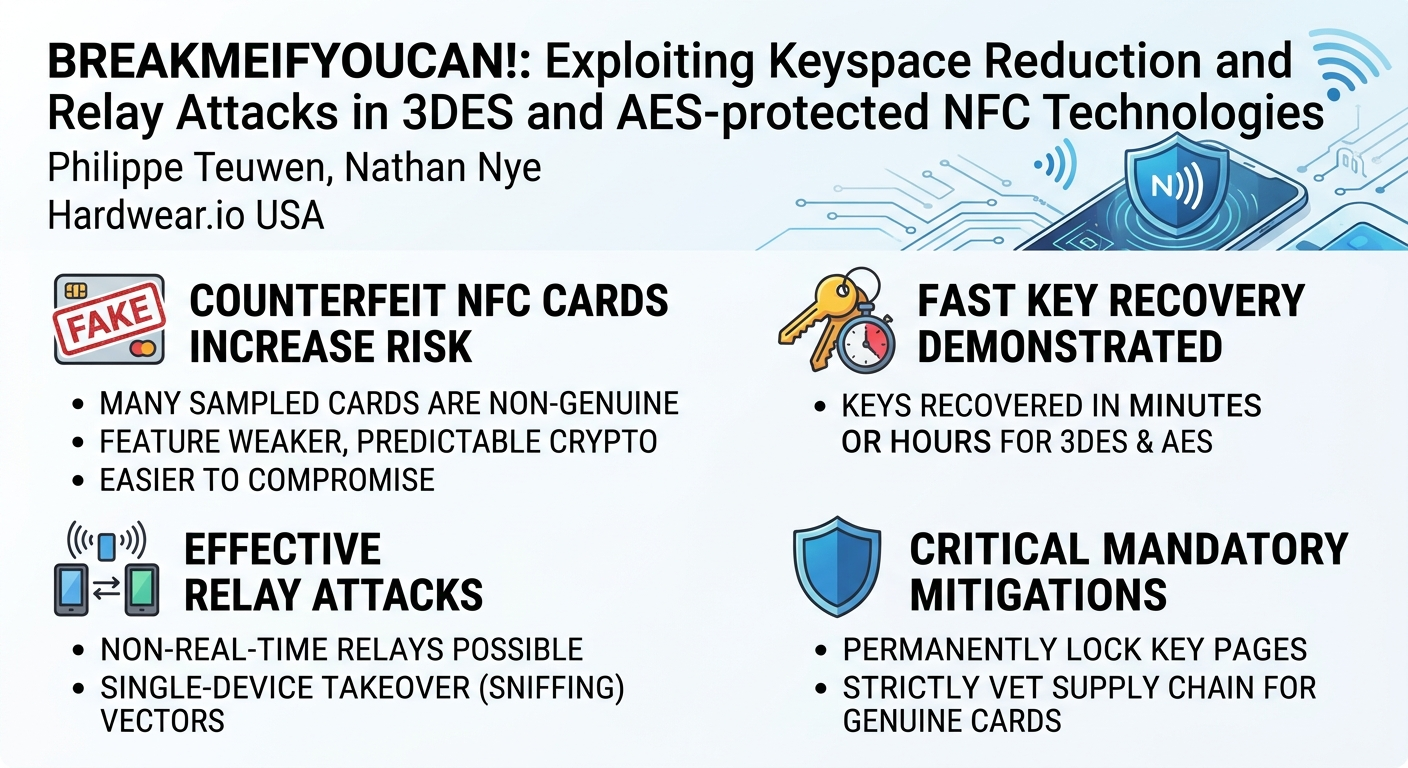
The core of their findings exposes not only design flaws in the cryptographic implementations of these cards but also highlights the pervasive threat posed by counterfeit NFC chips. A significant portion of the cards sampled by the researchers were found to be non-genuine, often featuring drastically weaker pseudorandom number generators (PRNGs) that simplify attacks dramatically. Teuwen and Nye demonstrate practical, often rapid, methods for key recovery, card cloning, and credential forgery, underscoring the severe implications for physical access control, data integrity, and supply chain security.
The talk serves as a stark warning to integrators and users of NFC technologies, urging a re-evaluation of security assumptions and a diligent application of proposed mitigations. By dissecting the technical underpinnings of these attacks, the researchers provide actionable intelligence for defenders, emphasizing the need for robust supply chain vetting, proper configuration, and an understanding of the cryptographic nuances that can make or break a system's security posture. Their collaborative effort, born from independent parallel research, culminates in a compelling demonstration of how seemingly minor hardware or software discrepancies can lead to full system compromise.
Background
▶ Watch: Introduction to Ultralight cards and research context (0:00)
The evolution of NFC security has been a continuous battle, often driven by the discovery and exploitation of vulnerabilities in existing technologies. Following the widespread defeat of Myfair Classic security, which Philippe Teuwen himself contributed to revealing in past research, the industry sought more robust alternatives. NXP's Ultralight family emerged as a popular replacement, offering various memory tags with improved security features. The Ultralight C introduced mutual authentication based on Triple DES (3DES), while the later Ultralight AES version upgraded this to AES-128. Additionally, the NTAG DNA branch brought NFC compatibility, allowing dynamic content generation and cryptographic signing of URLs using CMAC for product authentication and tamper detection.
Despite these advancements, the researchers highlight that the transition did not fully address fundamental security challenges. For instance, Ultralight C cards, post-authentication, revert to cleartext communication—a deliberate design choice by NXP to keep costs low, but one that introduces significant risk. Prior research by Teuwen, including work with Iceman on EPROM tearing techniques, proved foundational, demonstrating how physical manipulation of memory could defeat security features in various RFID technologies. This concept of non-atomic memory writes and the exploitation of physical characteristics of flash memory (EPROM) became central to their current findings.
The problem, as identified by Teuwen and Nye, stems from several areas: the inherent design choices that prioritize cost over comprehensive security, the potential for implementation flaws in the cryptographic primitives, and critically, the proliferation of counterfeit NFC chips. These non-genuine cards often mimic the form factor and basic functionality of their NXP counterparts but house significantly weaker cryptographic implementations, particularly in their pseudorandom number generators (PRNGs). This creates an environment where systems designed with certain security assumptions are undermined by components that fail to meet those standards, leading to a widespread vulnerability landscape across diverse applications from physical access control to supply chain verification.
Key Findings
▶ Watch: EPROM tearing technique for faster key recovery (12:30)
The research by Teuwen and Nye uncovered a range of critical vulnerabilities and attack vectors across NXP Ultralight C, Ultralight AES, and NTAG DNA cards:
- Non-Real-Time Relay Attacks: For Ultralight C cards, a relay attack was demonstrated to unlock cards without the need for real-time communication between the attacker's devices. This is possible because the card has no timeout, patiently waiting indefinitely for the reader's next command. This allows attackers to capture a challenge-response pair and use it later to impersonate the reader and unlock the card's configuration.
- Partial Key Override (PKO) for 3DES: Traditional brute-forcing of a 112-bit 3DES key is infeasible (5 decillion possibilities). However, by exploiting the non-atomic write operations to the key stored across four 32-bit pages, attackers can erase three of these pages, leaving only 28 bits (approximately 268 million keys) to brute-force online. This attack, combined with optimizations like skipping RF field cycles and specific commands, achieves a rate of 100 keys per second, recovering a key in about 25 days with four cards. This was further optimized by using reader challenge-response pairs offline, reducing online brute-force requirements to as few as two cards.
- EPROM Tearing for Accelerated Key Recovery: This advanced technique leverages the physical characteristics of EPROM memory. By interrupting the erase cycle at precise moments, bits can be left in an indeterminate state, leading to bit flips. This allows attackers to create keys with very low Hamming weight (few bits set), dramatically reducing the brute-force search space. For Ultralight C, this enabled full 3DES key recovery from 56 cards in just 1 hour, a significant speedup for large deployments.
- Prevalence of Counterfeit Cards and Weak PRNGs: A significant discovery was the prevalence of non-genuine NXP cards. Out of over 70 sampled cards, one-third were counterfeits, identified as Giant Tech (GT-2302F), USCID magic cards, and Fuzhou FG810 (FG810). These counterfeits often utilize severely flawed pseudorandom number generators (PRNGs), specifically 16-bit LFSRs (Linear Feedback Shift Registers) with fixed initial values, leading to predictable and repeating nonces. One identified LFSR was even from a previously broken Myfair Classic card.
- Nonce Collision Attack (Single Device): The weak PRNGs in counterfeit cards enable a "nonce collision attack." By repeatedly querying a card, attackers can collect common challenge nonces. They then take this common nonce to a genuine reader to obtain its response. Finally, they repeatedly query the card until it reuses the common nonce, at which point the collected reader response can be used to authenticate and unlock the card with a single device, bypassing the need for a full relay.
- Single-Card PKO for Counterfeits: The predictability of nonces on counterfeit cards allows for a Partial Key Override (PKO) attack against a single card. By progressively erasing the key while collecting encrypted nonces, attackers can brute-force the key quarter by quarter in reverse, irrespective of KDFs. This GPU-accelerated attack takes only 30-45 seconds in demonstrations.
- Credential Forgery Attacks: The research introduced the concept of credential forgery attacks. If card data is not cryptographically tied to the card's unique identifier (UID), a single valid key and UID pair can be used to generate an virtually unlimited number of valid, cloned cards. Even with properly implemented Key Derivation Functions (KDFs), a distributed online brute-force across many individually diversified cards can recover the master key, taking about 15 days online and 6 hours offline (on GPU for $120).
- AES Key Masking and Advanced Tearing: For Ultralight AES and NTAG DNA cards, EPROM tearing revealed an additional layer of protection: the stored key is masked (XORed) with a unique, per-card mask value. To recover the actual key, the mask must first be discovered. For Ultralight AES, this is achieved by sacrificing one of the card's two keys (e.g., the privacy mode UID key) to reveal its mask, then using this mask to attack the other key. This process, utilizing advanced probabilistic tearing optimizations, can recover a full AES-128 key from 20 cards in about 2 hours.
- Single-Device Sniffing Relay: A novel relay technique was demonstrated where a single Proxmark device, acting first as a sniffer, observes a legitimate authentication sequence between a card and a reader. Once the card is authenticated, the Proxmark immediately activates its own strong RF field, overpowering the legitimate reader and taking control of the authenticated card. This allows the attacker to send arbitrary commands, such as unlocking the card, even for genuine NXP cards, and was demonstrated in a nearby hotel.
- NTAG DNA Key Recovery via CMACs: For NTAG DNA, which typically has only one key (the SUN CMAC key), the key masking prevents the dual-key sacrifice method. Instead, attackers use a multi-stage tearing process: progressively tear the unknown key while collecting signed URLs (CMACs). Then, overwrite the key with zeros and tear again to establish a known starting point and discover the mask. Finally, working backward offline from the mask key using the collected CMACs, the original unknown key can be reconstructed. This complex online tearing and offline cracking process recovers the NTAG DNA key in approximately 38 seconds.
Technical Deep Dive
▶ Watch: Discovery of counterfeit cards and weak LFSRs (18:30)
The technical depth of the vulnerabilities presented by Teuwen and Nye hinges on a meticulous understanding of NFC protocol intricacies, cryptographic primitives, and the physical characteristics of non-volatile memory.
Ultralight C Mutual Authentication and Relay Attacks
The Ultralight C employs a three-pass mutual authentication scheme. After the anti-collision phase and obtaining the card's UID, the reader initiates authentication. The card generates a random challenge (nonce), encrypts it, and sends it to the reader. The reader then performs a rotation operation on this challenge, encrypts it along with its own challenge, and sends it back. This proves the reader knows the key. The card then completes the mutual authentication by proving its own knowledge of the key. Critically, after this three-pass exchange, all subsequent communication between the card and the reader occurs in cleartext, lacking confidentiality or integrity protection. This cleartext channel becomes the primary target for manipulation.
The relay attack exploits this cleartext communication window. An attacker positions a relay device near the card and another near the reader. The card's challenge is relayed to the reader. The reader computes its response and sends it back, but this response is intercepted by the attacker's relay device. This device then assumes the role of the legitimate reader, sending the intercepted response to the card. Since the card has no timeout mechanism, it waits indefinitely for the reader's next command. This allows the relay device to successfully authenticate with the card, gaining access to the cleartext channel. Once authenticated, the attacker can send commands to modify the card's configuration, such as unlocking protected memory pages. The demonstration highlighted that this does not require a real-time relay, meaning an attacker could collect a challenge, go to a reader, get a response, and then return to the card to complete the authentication at a later time.
Partial Key Override (PKO) and Optimization for 3DES
The 3DES key on Ultralight C cards is 112 bits long, residing across four 32-bit memory pages. The NXP datasheet suggests that these four pages must be updated atomically, but the researchers discovered this is not enforced; writes are effective immediately. This allows for the Partial Key Override (PKO) attack. By erasing three of the four key pages, only 28 bits of the key remain. This reduces the brute-force search space from an astronomical 2^112 to 2^28 (approximately 268 million possibilities).
To optimize the online brute-force process, several tricks were employed:
- Instead of cycling the RF field to reset the card between attempts, the
Whoopacommand resets the card directly. - A special command allows reading a single memory page, bypassing card selection and immediately placing the card in an active, ready-for-authentication state.
- Authentication success is quickly determined by observing the card's response: a short NAK indicates failure, while a longer response signals successful mutual authentication.
With these optimizations, a rate of 100 key attempts per second was achieved. Attacking four cards simultaneously on four readers would average 25 days for key recovery. Further optimization involved capturing a single challenge-response pair from a legitimate reader after partially erasing the key. This allows the remaining brute force to be performed offline against the captured pair. The 112-bit 3DES key is effectively a pair of two 56-bit DES keys. By recovering the first 56-bit key, the first third of the 3DES procedure can be pre-computed. Additionally, leveraging the structure of CBC encryption, the second half of the challenge can be decrypted directly without decrypting the first half. These optimizations reduce the computational effort by 55%, lowering the requirements for offline brute force to as few as two cards.
EPROM Tearing for Enhanced Key Recovery
EPROM tearing is a sophisticated physical attack that exploits the manufacturing variations in floating-gate transistors used in EPROM memory. When a bit is stored, electrons are injected into a floating gate. To erase a page, these electrons are "sucked out." By precisely interrupting this erasure process, the floating gate can be left with an intermediate charge level. Depending on the exact charge, the reader's sensing circuitry might interpret it as a '0' or a '1', or even exhibit probabilistic bit flips.
The researchers applied EPROM tearing to the PKO attack. Instead of erasing three key quarters completely, they almost erase the fourth quarter, leaving only a few bits in an indeterminate state. This results in a key with a very low Hamming weight, drastically reducing the number of candidates for online cracking. While this yields only a few bits per card, by combining results from many cards (e.g., 56 cards), the full 3DES key for Ultralight C can be reconstructed in approximately 1 hour. This technique is particularly effective in scenarios with large deployments of identical cards, such as public transportation systems.
Counterfeit Cards and Flawed PRNGs
A critical discovery was the widespread presence of counterfeit NFC cards. These cards, from manufacturers like Giant Tech, USCID, and Fuzhou FG810, were found to be present in one-third of the sampled population. A key vulnerability in these counterfeits lies in their pseudorandom number generators (PRNGs), which are used to generate the nonces for authentication challenges. Instead of robust PRNGs, these cards employed simple 16-bit Linear Feedback Shift Registers (LFSRs) to produce 64-bit nonces. Moreover, their initial values were often fixed. This combination makes the nonces highly predictable and prone to repetition, especially with consistent timing. This predictability enables nonce collision attacks where attackers can collect a set of challenges, identify a frequently repeating one, obtain a legitimate reader's response for that nonce, and then wait for the card to emit that same nonce again to authenticate.
Ultralight AES Key Masking and Advanced Tearing
Ultralight AES cards introduced AES-128 encryption. When applying EPROM tearing to these cards, the researchers observed a peculiar behavior: tearing an erased key (zeroes in EPROM) did not result in a key of all zeroes. This led to the discovery of key masking: the actual key stored in the EPROM is XORed with a unique, per-card mask value. If the key is '0', the EPROM stores the mask itself. If a key K is written, the EPROM stores K XOR Mask.
To recover the AES key, the mask must first be determined. Ultralight AES cards typically have two keys: one for user data and another for a privacy mode that reveals the real UID. The strategy is to sacrifice one key (e.g., the privacy key) by tearing it to discover its mask. Once the mask is known, it can be used to unmask and then attack the primary user data key. Advanced EPROM tearing optimizations, including physical manipulation like heating the card, can probabilistically revive more bits, enabling the recovery of up to 7 bits per page. With 20 cards and 2 hours of online time on a single reader, a full AES-128 key can be recovered.
NTAG DNA Key Recovery via CMACs
NTAG DNA cards, often used for product authentication, typically have only one key: the SUN CMAC key, which signs URLs and other dynamic content. The key masking observed in Ultralight AES also applies here, but without a second key to sacrifice, a different approach is needed. The attack involves a multi-stage tearing process:
- Progressive Tearing and CMAC Collection: The attacker progressively tears the unknown SUN CMAC key, collecting signed URLs (CMACs) at each stage. Each CMAC corresponds to a slightly modified key state.
- Mask Discovery: The full key is then overwritten with zeros. The tearing process is repeated, this time changing the key from zero to the unknown mask. The CMACs collected during this phase help determine the mask.
- Offline Reconstruction: Once the mask is known, the collected CMACs from the first phase (unknown key to unknown mask) can be used in reverse. Starting from the known mask key, attackers work backward offline, using the CMACs to determine the slightly modified keys at each tearing step, eventually reconstructing the original unknown key. This online tearing phase takes about 30 seconds, followed by an offline phase of a few seconds, recovering the NTAG DNA key in approximately 38 seconds.
Credential Forgery Attacks and KDF Implications
The concept of credential forgery highlights a fundamental design flaw: if the data on the card (e.g., access credentials) is not cryptographically tied to the card's unique identifier (UID), then a single valid key and UID pair is sufficient to create an unlimited number of valid, cloned cards. This means if an attacker recovers one key, they can effectively bypass UID-based security mechanisms.
The researchers also addressed Key Derivation Functions (KDFs), which vendors propose as a mitigation by generating unique keys per card based on the UID. While proper KDFs aim for a uniform distribution across the key space, they are not a panacea. If resources allow (e.g., procuring multiple readers), a "many one card attack" can be executed. This involves distributing an online brute-force attack across numerous individually KDF-diversified cards. By repeatedly overwriting a key page and authenticating with a reader, the earliest card that successfully authenticates provides the necessary key. This slow online brute force (around 15 days) is followed by a faster offline GPU attack (6 hours, costing ~$120) to recover the single UID and key pair needed for credential forgery.
Single-Device Sniffing Relay
This advanced relay technique bypasses the need for two separate relay devices. A Proxmark device is placed near the target card in sniffing mode, passively observing the RF field. Both the Proxmark-card pair are then brought near a legitimate reader. As soon as the legitimate authentication occurs and the card sends its reply to the reader (indicating it's in an authenticated state), the Proxmark immediately activates its own powerful reader field. This strong field overwhelms the legitimate reader's signal, effectively jamming it and taking exclusive control of the authenticated card. The attacker can then move away from the legitimate reader and send arbitrary commands to the card, such as unlocking it, as demonstrated in a hotel environment.
Demo / Proof of Concept
▶ Watch: Ultralight AES: Uncovering key masking and tearing (28:00)
The talk featured several compelling demonstrations, showcasing the practical feasibility and speed of the attacks:
- Ultralight C Relay Attack to Unlock Card:
- Demonstration: The speakers first showed an Ultralight C card in a locked state, with only 10 out of 48 memory pages readable.
- Execution: A two-device relay setup, communicating over sub-gigahertz radio, was used. One device collected the challenge from the card, transmitted it to the second device near the reader. The second device collected the reader's authentication response, which was then relayed back to the card.
- Result: The card was successfully authenticated and unlocked. A subsequent read showed 44 out of 48 pages readable, confirming the configuration change. This demo explicitly highlighted that the relay did not require real-time operation, as the card would wait indefinitely for the reader's response.
- Nonce Collision Attack for Single-Device Unlock (Counterfeit Cards):
- Demonstration: A locked card (10/48 pages readable) was shown again, this time with a custom application designed for counterfeit cards.
- Execution: The app repeatedly queried the card to identify a commonly repeating nonce (due to the weak LFSR PRNG). It then took this common nonce to a reader to collect the reader's response. Finally, it waited for the card to emit the common nonce again, at which point it used the stored reader response to authenticate.
- Result: The card was unlocked using a single device, demonstrating a more efficient attack vector for vulnerable counterfeit chips.
- Single Card PKO on Counterfeit with GPU Acceleration:
- Demonstration: A hotel card, identified as vulnerable, was placed on a reader.
- Execution: A script was run that performed the partial key overwrite (PKO) attack against the single card, progressively erasing the key while collecting encrypted nonces. The brute-force phase, leveraging GPU acceleration, was then executed in reverse.
- Result: The entire process, from PKO to key recovery, completed in a remarkably short time, approximately 5 seconds, eliciting applause from the audience. This emphasized the devastating speed when counterfeit cards with weak PRNGs are combined with optimized brute-force.
- Single-Device Sniffing Relay (for Any Ultralight C/AES Card):
- Demonstration: A locked card was shown, with its memory dump displaying 'x6x' values, indicating locked pages.
- Execution: A Proxmark device, operating in sniffing mode, was placed near the card. Both were then brought close to a legitimate reader. The Proxmark observed the legitimate authentication. Immediately after the card's reply to the reader (indicating authentication), the Proxmark activated its own powerful reader field, taking over the card. The Proxmark then sent the unlock command.
- Result: A subsequent check on the phone showed a full memory dump, confirming the card was unlocked. This demo proved that even genuine NXP cards are vulnerable to this sophisticated single-device takeover.
- NTAG DNA Key Recovery via Tearing and CMACs:
- Demonstration: An NTAG 223 DNA card with an unknown key was placed on a device.
- Execution: A script was run that progressively tore the unknown key, recording CMAC changes (indicated by dots on screen). This online phase, which involved tearing from the unknown key to the mask, and then writing a zero key and tearing again from zero to the mask, took about 30 seconds. This was followed by an offline phase to reconstruct the key from the collected CMACs.
- Result: The full SUN CMAC key was recovered in less than 38 seconds total (online + offline), demonstrating the rapid key recovery possible even for AES-protected NTAG DNA cards through advanced tearing and CMAC analysis.
Defensive Implications
▶ Watch: Summary of attack times and essential mitigations (39:30)
The findings presented by Teuwen and Nye carry significant defensive implications for any organization utilizing NXP Ultralight C, Ultralight AES, or NTAG DNA cards. The widespread nature of these vulnerabilities, especially exacerbated by counterfeit chips, necessitates a proactive and multi-faceted security strategy.
- Permanently Lock Key Pages: The most critical mitigation, now mandatory according to the latest NXP datasheets, is to permanently lock the key pages. This prevents partial key override (PKO) attacks and other memory manipulation techniques that rely on modifying key storage. Organizations must ensure that this setting is correctly configured and enforced during the card provisioning process.
- Review Supply Chain for Counterfeits: The high prevalence of non-genuine cards (one-third of samples) with severely weakened security features (e.g., flawed PRNGs) is a major concern. Defenders must implement stringent supply chain vetting to ensure they are sourcing genuine NXP products. Tools like the Proxmark can be leveraged to fingerprint cards using commands like
HF MFU info, which can detect whether a card is counterfeit. Regular audits of deployed cards are also advisable. - Enable Session Integrity (Sec Message Act) for Ultralight AES: For Ultralight AES products, enabling the Sec Message Act feature provides CMAC (Cipher-based Message Authentication Code) protection for all exchanged messages, adding session integrity. This helps to mitigate replay and manipulation attacks on the communication channel post-authentication.
- Avoid Reliance on UID as Sole Identifier/IV: The research highlights the risk of credential forgery attacks when card data is not cryptographically tied to the card's unique identifier (UID). Systems should avoid using the UID as the sole identifier or as an Initialization Vector (IV) for encryption without additional strong cryptographic binding. This prevents a single compromised key and UID pair from being used to generate an unlimited number of valid cloned credentials.
- Proper KDF Implementation and Multi-Factor Authentication: While Key Derivation Functions (KDFs) can diversify keys per card, they are not a complete solution against determined attackers, especially if physical access to multiple cards and readers is possible. If KDFs are used, they must be implemented with strong, uniformly distributed outputs. For high-security applications, relying solely on NFC card authentication is insufficient; multi-factor authentication (MFA) should be implemented to add additional layers of security beyond the card itself.
- Assume Ultralight C Systems are Vulnerable: Given the comprehensive nature of the attacks demonstrated, the researchers conclude that "every Ultralight C system we examined was vulnerable to one or more attacks." Organizations still using Ultralight C should operate under the assumption that their systems are compromised or easily compromisable and prioritize upgrades or robust compensatory controls.
- Consult Research Resources: The speakers provided a dedicated paper and an FAQ website as resources. Organizations should consult these materials to understand the specific implications for their deployments, assess their vulnerability, and guide their mitigation or upgrade paths. This includes answering questions like "Should I be concerned about my room key?" or "What should my mitigation or upgrade path look like?"
Key Takeaways
- Widespread Vulnerability: NXP Ultralight C, Ultralight AES, and NTAG DNA cards, widely used in hotel keys, public transport, and product authentication, are vulnerable to a range of sophisticated attacks.
- Counterfeit Card Epidemic: A significant portion (one-third) of sampled cards were non-genuine counterfeits with drastically weaker PRNGs (16-bit LFSRs with fixed initial values), making them exceptionally easy to exploit.
- Rapid Key Recovery: Techniques like Partial Key Override (PKO) and EPROM tearing enable rapid key recovery for both 3DES and AES-128 keys, often within minutes or hours, even for masked AES keys.
- Flexible Relay Attacks: Relay attacks can be performed non-real-time due to card timeouts, or with a single device by sniffing legitimate authentication and then taking over the card, bypassing traditional relay limitations.
- Credential Forgery Risk: If card data is not strongly tied to the UID, a single compromised key and UID pair can lead to the creation of an unlimited number of valid, cloned cards, undermining KDFs and UID-based security.
- Mandatory Mitigations: Defenders must permanently lock key pages, rigorously vet their supply chain for genuine cards, enable session integrity (Sec Message Act) for Ultralight AES, and assume all Ultralight C systems are vulnerable.
About the Speaker(s)
Nathan Nye is a Staff Cybersecurity Engineer at True Anomaly, an aerospace company based in Colorado, where he focuses on security for space vehicles, describing their work as "dog fighting satellites in space." With approximately 20 years of experience in security, Nathan has a strong background in identifying and submitting high-severity vulnerabilities to numerous companies. His independent research on NFC cards led to his collaboration with Philippe Teuwen, culminating in this talk.
Philippe Teuwen is a Senior Principal Hardware Security Expert at Ledger, a prominent company in the cryptocurrency hardware wallet space. He is also a long-standing organizer of the hardware CTF (Capture The Flag) competition at Hardwear.io. Philippe has a history of presenting significant security research, including previous talks at Hardwear.io where he revealed vulnerabilities and backdoors in Myfair Classic cards and demonstrated EPROM tearing techniques, which are directly relevant to the research presented in this talk.
Reviews
Dr. Zero (Offensive Security Researcher) — MUST SEE
This is the kind of talk that makes vendors update datasheets mid-quarter. Teuwen and Nye systematically dismantled the security of three NXP NFC card families with a toolkit that ranges from clever protocol abuse to precision EPROM tearing, and they did it with live demos that actually worked. If you deploy Ultralight anything, this talk just became mandatory reading.
Heather Calloway (CISO) — STRONG ACCEPT
Serious research with immediate implications for any organization deploying NFC-based physical access control, transit, or product authentication. The counterfeit supply chain findings alone warrant a procurement review. This is the kind of work that changes your vendor risk conversations.
→ Top-rated talks at Hardwear.io Security Trainings and Conference USA 2026
All talks from Hardwear.io Security Trainings and Conference USA 2026