Unveiling The Trails Of Infostealer Malware Ecosystems
Pavan Karthick M (CloudSEK)
HITBSecConf2023 - Phuket · Day 2 · CommSec Track
Overview
In this insightful HITB Phuket talk, Pavan Karthick M from CloudSEK sheds light on the rapidly evolving and increasingly sophisticated ecosystem behind information stealer malware. The presentation meticulously dissects how these pervasive threats operate, from their initial development and distribution to the intricate financial models that sustain their growth. Karthick emphasizes that information stealers are not merely isolated malware strains but are part of a highly organized, automated, and financially driven criminal enterprise, capable of combining multiple dangerous attack vectors identified by SANS, such as SEO-boosted attacks, malvertising, targeting developers, and weaponizing AI for social engineering.
Key moments
- 1:59 Infostealer capabilities: bypassing defenses, data exfiltration
- 5:00 Real-world case study: $30B company compromised
- 6:40 Understanding the sophisticated 'Traffer' infostealer ecosystem
- 12:00 YouTube channels used for malware delivery & bypass
- 18:50 Exponential growth of infostealer attacks and evasion techniques
- 20:50 Global infostealer log market scale and operator motivation
- 24:30 Practical prevention and mitigation strategies against infostealers
Unveiling The Trails Of Infostealer Malware Ecosystems
Speakers: Pavan Karthick M, CloudSEK
Conference: HITB Phuket
YouTube: https://www.youtube.com/watch?v=p6DJMsWeM0U
Overview
In this insightful HITB Phuket talk, Pavan Karthick M from CloudSEK sheds light on the rapidly evolving and increasingly sophisticated ecosystem behind information stealer malware. The presentation meticulously dissects how these pervasive threats operate, from their initial development and distribution to the intricate financial models that sustain their growth. Karthick emphasizes that information stealers are not merely isolated malware strains but are part of a highly organized, automated, and financially driven criminal enterprise, capable of combining multiple dangerous attack vectors identified by SANS, such as SEO-boosted attacks, malvertising, targeting developers, and weaponizing AI for social engineering.
The talk provides a comprehensive look at the lifecycle of an information stealer attack, revealing how threat actors leverage stolen credentials and data to bypass traditional security measures like Multi-Factor Authentication (MFA) and IP-based logins. By presenting a detailed case study and exposing the inner workings of "traffer" groups – Russian-speaking cybercriminal organizations – Karthick illustrates the immense damage these seemingly simple attacks can inflict on individuals and high-revenue organizations alike. The presentation serves as a critical warning, highlighting the exponential rise in these attacks and offering actionable defensive strategies against a threat that continues to adapt and bypass conventional security paradigms.
Background
▶ Watch: Infostealer capabilities: bypassing defenses, data exfiltration (1:59)
Information stealer malware is specifically designed to surreptitiously exfiltrate sensitive data stored on a victim's machine. This includes a wide array of personal and corporate information such as saved passwords, browser cookies, credit card details, cryptocurrency wallet credentials, and data from popular communication and productivity software like Discord and Telegram. The pervasive habit of users saving credentials and other sensitive data within browsers and applications creates an irresistible target for these attackers.
The capabilities of modern information stealers are advanced, making them particularly difficult to detect and mitigate. Many are packed with obfuscation layers to hide their true payload, bypassing static analysis. They often employ loaders, which are specialized malware types designed to drop specific information stealers based on the victim's geographical region or system configuration. Furthermore, some sophisticated variants boast capabilities to bypass endpoint security solutions like Windows Defender, AMSI (Antimalware Scan Interface), and EDR (Endpoint Detection and Response) systems. They frequently exploit newly popular CVEs (Common Vulnerabilities and Exposures) to gain easier access to user data. Once established, these stealers are updated to exfiltrate data from an ever-growing list of applications, including browser autofills, download histories, text files, private keys, and even Discord tokens and Telegram key data, which can be used to decrypt otherwise encrypted communications. The ultimate goal is to obtain a complete digital fingerprint of the victim's online presence, allowing threat actors to mimic their browser, bypass 2FA, and circumvent IP-based login restrictions without needing to resort to further social engineering.
A compelling case study presented during the talk underscored the real-world impact of these threats. A 16-year-old threat actor, possessing minimal technical skills, inflicted significant reputational damage on an organization with approximately $30 billion in revenue. The attack began not directly with an information stealer, but with social engineering to obtain VPN credentials, granting initial internal network access. Once inside, the attacker scanned the intranet, identifying numerous services but lacking direct access. To escalate privileges, the attacker purchased information stealer infection logs from an underground marketplace. These logs contained credentials that facilitated access to network shares, which in turn held PowerShell scripts embedding administrative credentials for the organization's PAM (Privileged Access Management) system. This pivotal compromise led to unauthorized access to critical infrastructure, including AWS, Git repositories, EDR systems, and the company’s HackerOne bug bounty account. This incident starkly illustrates how readily available information stealer logs can empower even low-skilled adversaries to execute highly damaging, multi-stage attacks, highlighting the critical vulnerability posed by stolen credentials.
Key Findings
▶ Watch: Understanding the sophisticated 'Traffer' infostealer ecosystem (6:40)
The research unveiled a highly organized and financially driven traffer ecosystem, predominantly run by Russian-speaking threat actors known as traffer admins. These admins recruit individuals, skilled or unskilled, to act as "traffers." The ecosystem is supported by specialized roles: malware developers create the core stealer, while crypto developers produce cryptors to pack payloads, ensuring each malware instance has a new signature to evade detection. Automation is central, with Telegram bots managing malware uploads to delivery mechanisms and receiving infection logs. SEO panels are used to boost search engine visibility, and log checker software identifies valuable data within exfiltrated logs, such as cryptocurrency holdings.
This sophisticated structure generates thousands of infection logs daily. These logs are then sold on underground marketplaces for $10 to $15 each, creating a continuous funding loop that sustains the entire operation. The speaker highlighted an alarming trend in the delivery mechanisms, particularly through YouTube. From October 2022 to February 2023, approximately 6,000 malicious videos were uploaded weekly. This escalated dramatically between May and August, with these videos collectively averaging an astounding 1 million views per week. While not all viewers are compromised, even a small percentage translates to tens of thousands of new victims.
A critical finding was the low detection rate of these evolving threats. When CloudSEK analyzed newly observed samples in sandboxes, approximately 80% of them went undetected by existing antivirus and sandbox solutions. The few that were detected were typically older versions of well-known information stealers. The most prevalent stealer families observed in these marketplaces include Raccoon, Vidar, Redline, and Luma, each with distinct capabilities but a shared objective of data exfiltration.
Geographic analysis of the infection logs revealed that India, Brazil, and the United States were the most targeted countries. Notably, Russia exhibited the lowest number of compromised logs, a strategic avoidance by threat actors to prevent potential retaliation from Russian authorities. At one point, over 7 million infection logs were actively available for sale, underscoring the massive scale of this illicit trade. The primary motivation driving this ecosystem is financial gain; top traffers can earn an estimated $100,000 USD per year, significantly more than entry-level cybersecurity professionals, fueled by low barriers to entry and the widespread misuse of cracked software.
Technical Deep Dive
▶ Watch: YouTube channels used for malware delivery & bypass (12:00)
The information stealer ecosystem operates with a remarkable degree of specialization and automation, resembling a legitimate business in its structure and efficiency.
Traffer Ecosystem Components
- Malware Developers: These individuals are responsible for crafting the core information stealer malware. Their creations are continuously updated to target new applications, exploit emerging vulnerabilities, and incorporate new evasion techniques.
- Crypto Developers: Crucial for evading detection, crypto developers create cryptors. A cryptor is a tool that encrypts or obfuscates the malware payload. Each time the cryptor runs, it produces a slightly different, polymorphic variant of the malware, ensuring that the file hash and signature change. This effectively bypasses static signature-based detections used by antivirus software and sandboxes.
- Traffer Resources and Automation: The operational backbone of the ecosystem.
- Telegram Bots: These bots automate critical processes, including uploading malware to various distribution platforms and receiving exfiltrated logs from infected victims. This streamlines the entire infection chain.
- SEO Panels: Used to boost the search engine ranking of malicious domains and content, ensuring higher visibility for potential victims searching for specific software or content.
- Log Checker Software: Specialized tools designed to parse incoming infection logs, automatically identifying and flagging valuable data such as cryptocurrency wallet details, high-value credentials, or specific document types, allowing traffers to quickly prioritize and monetize the most lucrative logs.
Delivery Mechanisms
The talk detailed several sophisticated delivery mechanisms, with a strong emphasis on malicious domains and the 911 infection chain primarily leveraging YouTube.
1. Malicious Domains
Threat actors create convincing fake websites hosted on cheap domains. To obscure their true origin, they often place these domains behind services like Cloudflare, which hides the actual IP address of the command-and-control (C2) server. These sites are designed with high-quality templates to appear legitimate and often incorporate anti-analysis techniques such as detecting crawling or redirecting automated analysis tools to benign pages. A key tactic involves serving malware archives – compressed files containing the stealer. These archives are often encrypted with strong passwords, making it difficult for sandboxes or VirusTotal to analyze their contents without the password.
Furthermore, these malicious domains frequently use URL shorteners and redirectors. The speaker demonstrated a scenario where a single click on a download link could initiate multiple redirections, each with up to 10 different potential pathways, effectively creating numerous distinct infection chains. This complexity makes it challenging for security researchers to track the full attack flow and for defenders to block all associated malicious infrastructure. The use of DGA (Domain Generation Algorithm)-generated domains also contributes to the ephemeral nature of these links, as new domains are constantly created for redirection, further hindering detection and blocking efforts.
2. 911 Infection Chain (YouTube)
This highly effective mechanism starts with compromising high-subscriber YouTube channels:
- Targeting YouTube Influencers: Threat actors use targeted email spam, often disguised as promotional offers, to trick YouTube influencers into installing malware. Influencers typically list their contact emails in their "About" sections, making them easy targets.
- Buying Compromised Logs: Once an influencer's account is compromised, their information stealer logs (containing browser cookies, IP, etc.) are sold on underground forums. These logs fetch high prices, often hundreds to thousands of dollars, depending on the subscriber count (e.g., 10,000 to 100,000 subscribers).
- Bypassing Authentication: To access the compromised YouTube account, threat actors use anti-detect browsers. These specialized browsers allow attackers to load the victim's stolen browser fingerprint (cookies, user-agent, IP address) and combine it with a proxy service geographically close to the victim's original IP. This sophisticated approach effectively mimics the legitimate user's browsing environment, bypassing 2FA, IP-based login restrictions, and other behavioral security checks.
- Malware Delivery through YouTube: Once authenticated, the attackers upload malicious videos, often disguised as cracked software (e.g., video editing tools). These videos include download links, typically redirecting to file-sharing services like MediaFire.
- Archive Compression Trick: The downloaded malware archives employ a deceptive technique: they appear small (e.g., 7 MB) but, upon extraction, inflate to an unusually large size (e.g., 820 MB). This is achieved by padding the archive with random bytes, a tactic designed to bypass initial file scanning checks by antivirus software that often skip large files or those with unusual compression ratios.
- Social Proof: To enhance credibility, attackers use other compromised YouTube accounts to post fake "it works" comments on the malicious videos. This creates a false sense of legitimacy, encouraging more users to download and execute the malware.
3. Mail Spam
While not detailed, the talk acknowledged that mail spam remains a consistent vector for spreading information stealers, as seen in the initial compromise of YouTube influencers.
Evolving Tactics
The information stealer ecosystem is characterized by its continuous evolution:
- AI-Generated Content: Threat actors now leverage AI-generated videos, personas, and voice-overs to create highly convincing malicious content, making it even harder for users to discern legitimate from fake.
- Service Shifting: When platforms like YouTube identify and block specific malicious links (e.g., Telegraph links, a Pastebin-like service by Telegram), threat actors rapidly shift to new hosting providers such as Google Drive, GitHub, or other cloud storage services. This adaptability ensures business continuity for their operations, making it a constant cat-and-mouse game for defenders.
The prevalence of stealer families like Raccoon, Vidar, Redline, and Luma highlights the diverse toolkit available to these groups, each offering different features and evasion capabilities tailored to specific attack scenarios. The sheer scale of automation, from malware creation to log processing and distribution, underscores the industrialization of these cybercriminal operations.
Demo / Proof of Concept
▶ Watch: Global infostealer log market scale and operator motivation (20:50)
While the talk did not feature a live demonstration or a proof-of-concept developed by the speaker, it extensively detailed and illustrated the operational tactics and delivery mechanisms employed by information stealer threat actors. Pavan Karthick M presented numerous screenshots of malicious websites, underground forum advertisements for stolen logs, and network capture analyses, effectively demonstrating the observable evidence and technical intricacies of these sophisticated attack chains in the wild.
Defensive Implications
▶ Watch: Practical prevention and mitigation strategies against infostealers (24:30)
Combating the pervasive threat of information stealer malware requires a multi-faceted and continuously evolving defensive strategy, moving beyond traditional reactive measures.
- Continuous Evolution in Detection Engineering: Given the rapid evolution of information stealers and their use of cryptors to generate polymorphic variants, relying solely on static IOCs (Indicators of Compromise) or Yara rules is insufficient. Defenders must invest in advanced detection engineering focusing on behavioral analysis, anomaly detection, and machine learning models that can identify malicious activity regardless of minor code changes or obfuscation techniques. Automated detection and mitigation systems are crucial to keep pace with the attackers' automation.
- Enhanced Employee Awareness Training: Social engineering remains a primary vector for initial compromise. Comprehensive and continuous employee awareness training is paramount. This training should educate users about the dangers of clicking suspicious links, downloading unofficial software, the risks associated with cracked software, and recognizing sophisticated phishing attempts, including those leveraging AI-generated content.
- Enforce Multi-Factor Authentication (MFA) and Strict Session Limits: While MFA is a critical security control, information stealers can bypass it by exfiltrating session cookies. Organizations must not only enforce MFA but also implement strict session limits, automatically logging out users after a period of inactivity. Additionally, systems should be configured to alert users to concurrent logins or logins from unusual locations, prompting immediate action if a session is compromised.
- BYOD Policy Review: For organizations with Bring Your Own Device (BYOD) policies, it is crucial to implement policies that prevent employees from storing sensitive organizational passwords or credentials directly within their web browsers or unapproved applications. Secure password managers, specifically sanctioned by the organization, should be mandated.
- Provide Legitimate Software: A significant motivation for users to download cracked software, a common infection vector, is the cost or availability of legitimate licenses. Organizations should proactively provide employees with access to all necessary licensed and premium software. This eliminates the need for employees to seek out potentially malicious cracked versions, thereby significantly reducing the attack surface.
By implementing these proactive and adaptive defensive measures, organizations can significantly enhance their resilience against the persistent and evolving threat posed by information stealer malware ecosystems.
Key Takeaways
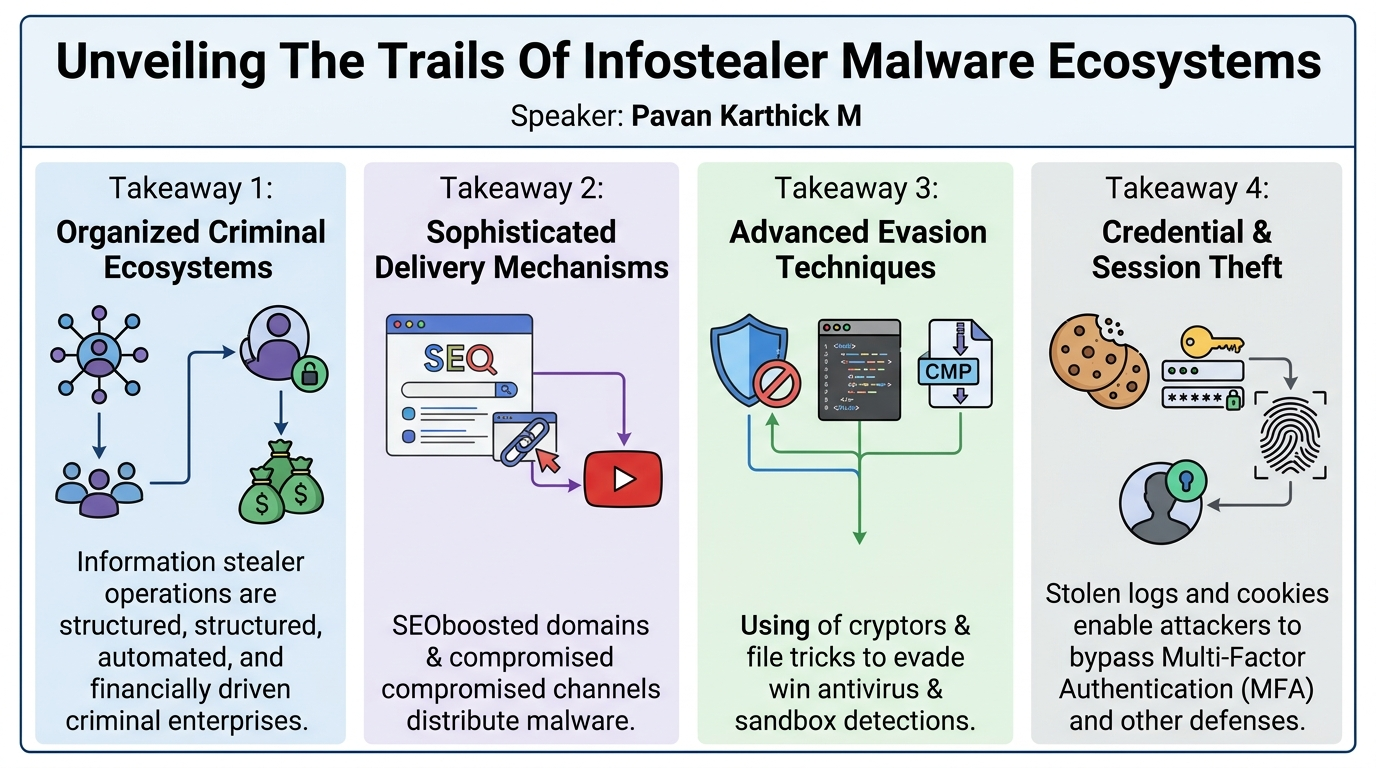
- The information stealer ecosystem is a highly organized, financially driven, and automated criminal enterprise, often run by "traffer" groups.
- Sophisticated delivery mechanisms, including SEO-boosted malicious domains and compromised YouTube channels, are used to widely distribute malware and bypass traditional defenses.
- Information stealers leverage advanced evasion techniques like cryptors and archive compression tricks, leading to an 80% bypass rate against common AV and sandbox solutions.
- Stolen infection logs containing browser fingerprints and session cookies enable threat actors to bypass Multi-Factor Authentication (MFA) and IP-based login restrictions.
- Defenders must move beyond static IOCs, focusing on continuous detection engineering, behavioral analysis, and robust employee awareness programs.
- Strict session limits, providing legitimate software, and strong BYOD policies are critical complements to MFA in mitigating the risk of information stealer compromises.
About the Speaker(s)
Pavan Karthick M is a security researcher from CloudSEK. His work focuses on understanding and analyzing complex cybercriminal ecosystems, with a particular emphasis on malware threats like information stealers. His expertise involves dissecting the technical mechanisms, delivery methods, and financial motivations behind these operations, providing critical insights for the cybersecurity community.
Reviews
Dr. Zero (Offensive Security Researcher) — SOLID
Competent ecosystem walkthrough of infostealer operations — the traffer structure, YouTube 911 chain, and marketplace economics are well-presented and useful for threat intel teams who haven't tracked this space. But it's observational work, not novel research, and the 'findings' are things Mandiant, Recorded Future, and a dozen vendors have published variants of for two years.
Heather Calloway (CISO) — SOLID
Useful operational intelligence on the infostealer economy — the traffer ecosystem, delivery mechanisms, and session-hijacking bypass of MFA. Worth a threat intel team's time, but the defensive recommendations are table stakes and won't surprise anyone running a mature program.