Embracing Failure To Be A Better Hacker (and Human)
Joe Grand (hardware hacker · Grand Idea Studio)
HITBSecConf2023 - Phuket · Day 1 · Keynote
Overview
In a refreshing departure from typical security conference fare, renowned hardware hacker Joe Grand delivered a keynote at HITB Phuket titled "Embracing Failure To Be A Better Hacker (and Human)." Grand, known for his deep technical expertise and contributions to the hardware hacking community, shifted focus from successful exploits to the often-unspoken journey of mistakes, missteps, and lessons learned. The talk served as a powerful reminder that failure is not only inevitable but also a crucial catalyst for growth, innovation, and personal development in the demanding world of cybersecurity and engineering.
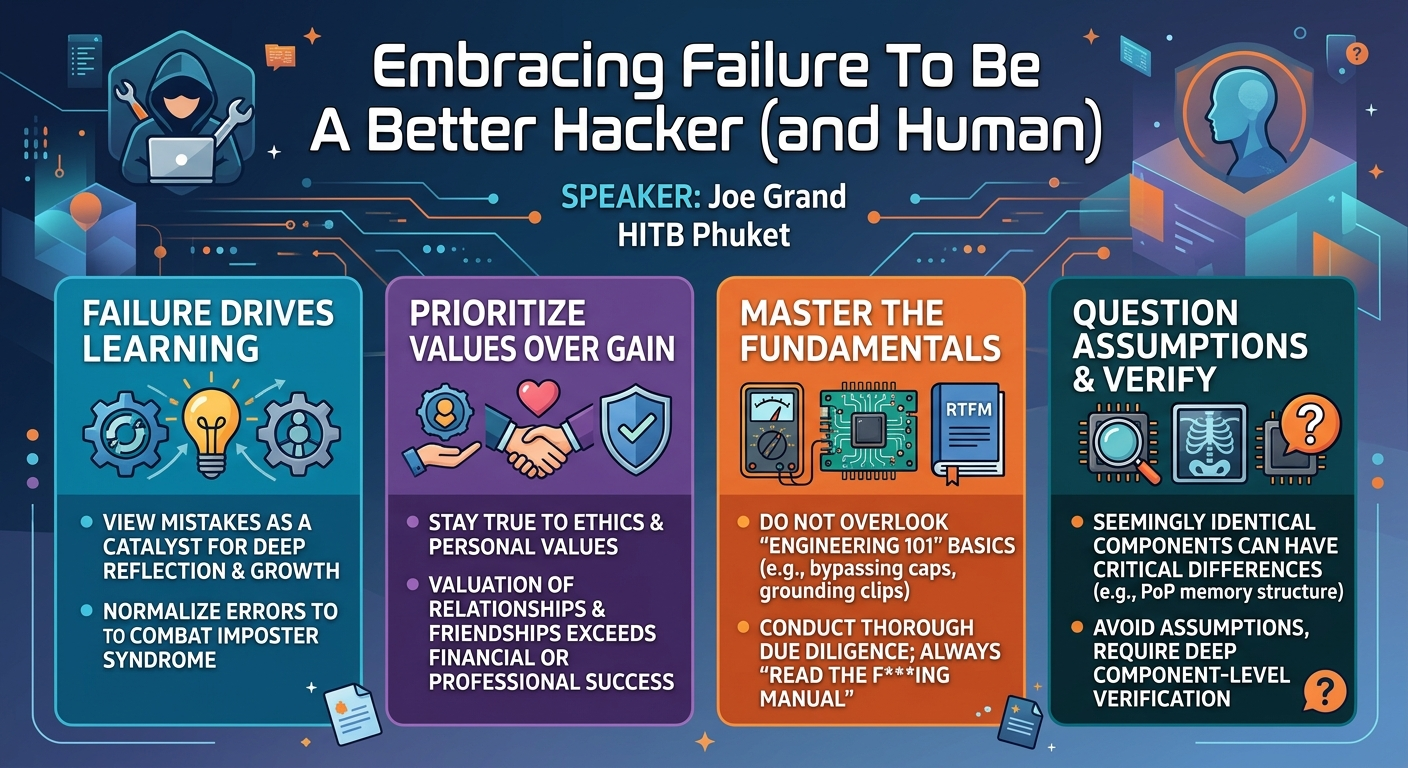
Key moments
- 0:00 Embracing failure to learn and grow
- 6:00 First turning point: getting arrested at 15
- 10:00 The Loft's "failure": selling out and losing friends
- 20:00 Defcon badge failure: RTFM on capacitive touch
- 26:00 "Prototype This" 6x6 robot failure taught valuable lessons
- 34:00 Five years debugging RFID reader, simple capacitor fix
- 41:30 High-stakes Trezor hack: forgot oscilloscope ground clip
- 52:30 Audience Q&A on package-on-package chip probing
Embracing Failure To Be A Better Hacker (and Human)
Speakers: Joe Grand, hardware hacker, Grand Idea Studio
Conference: HITB Phuket
YouTube: https://www.youtube.com/watch?v=hCUyTl3O288
Overview
In a refreshing departure from typical security conference fare, renowned hardware hacker Joe Grand delivered a keynote at HITB Phuket titled "Embracing Failure To Be A Better Hacker (and Human)." Grand, known for his deep technical expertise and contributions to the hardware hacking community, shifted focus from successful exploits to the often-unspoken journey of mistakes, missteps, and lessons learned. The talk served as a powerful reminder that failure is not only inevitable but also a crucial catalyst for growth, innovation, and personal development in the demanding world of cybersecurity and engineering.
Grand's presentation resonated deeply by tackling the pervasive issue of imposter syndrome and the societal pressure to always succeed. He meticulously walked the audience through a chronological series of his own "face palm moments," from early career blunders to highly complex, recent technical challenges. Each anecdote, stripped of sensationalism, underscored a profound learning experience, demonstrating how reflection on failures can transform perceived setbacks into invaluable knowledge that shapes one's professional and personal trajectory.
The significance of this talk extends beyond individual self-improvement. By openly sharing his vulnerabilities and acknowledging the messy reality of technical work, Grand demystifies the hacking process, making it more accessible and less intimidating. For an industry often characterized by high-stakes victories and hidden struggles, his message champions a culture of transparency, mentorship, and continuous learning, ultimately fostering a more resilient and supportive community of hackers and engineers.
Background
▶ Watch: Embracing failure to learn and grow (0:00)
Joe Grand's journey into the world of hacking began remarkably early, in 1982, with an Atari 400 computer and a modem. From this humble setup in his childhood room, he immersed himself in bulletin board systems (BBS), connecting with a nascent global hacker community. His early experiences, starting around 1985 at the age of 10, were driven by pure curiosity and a desire for knowledge, which sometimes manifested as "mischief," such as exploring credit card numbers. Despite these early forays into grey areas, Grand maintained a strict personal and ethical boundary: he would never maliciously damage any system.
This quest for knowledge led to a significant turning point at 15 when he was arrested, not for computer crime (as laws were vague then), but for physically breaking into a telephone company building to obtain documentation on how the phone system worked. This incident, while a wake-up call, didn't deter his fascination with technology. Instead, it steered him towards a more constructive path when he joined The Loft in the early 1990s (around 1991-1992). The Loft, a hacker space in Boston, became a formative environment where Grand, as the youngest member, was mentored by older, more experienced hackers. Here, he learned to channel his curiosity into ethical hacking within controlled environments, focusing on learning and sharing information without breaking the law.
The Loft became instrumental in pioneering early full disclosure practices, forcing companies like Microsoft to address vulnerabilities they initially dismissed. This period culminated in 1998 when members of The Loft famously testified before the US Senate on computer security, marking a pivotal moment in the relationship between hackers and the government. However, this success also led to one of Grand's most significant personal failures: the decision to commercialize The Loft into a consulting company called At Stake. The transition from an "anarchist collective" to a hierarchical, billable-hours-driven corporate structure eroded the group's original ethos. The purity of curiosity was replaced by client demands, and personal relationships within the group suffered, particularly when a co-founder was fired, and Grand himself felt he didn't stand up for his friend. This experience profoundly shaped his understanding of the importance of valuing relationships and personal integrity over financial gain, a lesson that stuck with him for decades.
Key Findings
▶ Watch: The Loft's "failure": selling out and losing friends (10:00)
Joe Grand's talk, while not presenting traditional research findings, distills a series of profound "key findings" or lessons learned from his career failures, offering critical insights for anyone in a technical field:
- Failure is an Inevitable and Essential Component of Learning: Grand repeatedly emphasizes that mistakes are not aberrations but integral to the hacking and engineering process. He argues that true learning comes from reflecting on these experiences, rather than merely having them. This perspective combats imposter syndrome by normalizing errors and reducing the stigma associated with not knowing everything.
- Prioritize Relationships and Personal Values Over Purely Financial or Professional Gain: The painful dissolution of The Loft's original dynamic after becoming At Stake taught Grand a crucial lesson about the corrosive effect of money and corporate structures on genuine collaboration and friendship. He highlights the importance of staying true to one's values and supporting colleagues, even when it's professionally inconvenient.
- The Importance of Mentorship and a Supportive Environment: His early experience with the bypass capacitors, where senior engineers guided him without judgment, underscored the value of mentors and a community where one can admit mistakes and learn without fear of ridicule. This fosters a safe space for experimentation and growth.
- "RTFM" (Read The F*ing Manual) and Thorough Due Diligence are Non-Negotiable:** The Defcon badge's capacitive touch issue, stemming from overlooking a critical voltage requirement in the documentation, served as a stark reminder that even experienced engineers can miss fundamental details. Similarly, the rental car incident highlighted the need to ask probing questions and trust one's gut regarding project ethics and environment.
- Under-designing and Unforeseen Constraints Can Cascade: The "Prototype This" 6x6 robot project demonstrated how a single decision (using a heavy steel chassis for safety reasons) could drastically impact the entire design, leading to under-powered components and project failure. This illustrates the complex interdependencies in engineering and the need for holistic design considerations.
- Complex Problems Can Have Simple Solutions, But Persistence is Key: The five-year struggle with the RFID reader, ultimately resolved by changing a single 10-cent capacitor, exemplifies how seemingly insurmountable technical challenges can sometimes boil down to a minor detail. This reinforces the need for persistent, systematic troubleshooting and the ability to step back and re-evaluate assumptions.
- Verify Assumptions, Especially with Seemingly Identical Components: The package-on-package memory extraction challenge revealed that physically identical-looking chips can have vastly different internal structures and manufacturing processes. This highlights the critical need for deep component-level verification in hardware hacking to avoid costly and time-consuming errors.
- Leverage Complementary Skills and Community Expertise: The successful repair of the damaged package-on-package chip, facilitated by an x-ray specialist and a reballing expert, demonstrated the immense value of building relationships and knowing when to seek external expertise. No hacker or engineer works in a vacuum.
Technical Deep Dive
▶ Watch: "Prototype This" 6x6 robot failure taught valuable lessons (26:00)
Joe Grand's narrative is rich with technical details, even when describing failures, offering valuable insights into hardware engineering and hacking methodologies.
One of his earliest technical "face palm" moments involved a portable infusion pump, a medical device he helped design as a junior engineer. Tasked with overall system design and schematic development for this battery-powered unit, Grand presented his initial 30-page schematic. A senior engineer immediately pointed out the missing bypass capacitors. Grand, who was largely self-taught and noted that university courses hadn't covered this, was embarrassed. He learned that bypass capacitors, typically 0.1 microfarad, are crucial on every power line connected to a digital device. They act as small local reservoirs of charge, filtering out noise and ensuring power stability for the integrated circuits, a fundamental concept in digital electronics often termed "engineering 101."
Later, for the Defcon 15 electronic badge, Grand aimed to incorporate capacitive touch sensing buttons as the user interface for its scrolling LED matrix. He prototyped the feature successfully. However, in the final proof of concept prototype, powered by a single battery, the buttons failed. His oversight was a missed detail in the component's documentation regarding the specific voltage requirements for the capacitive touch functionality. His prototype had been powered by a regulated power supply, providing the correct voltage, whereas the battery-powered badge did not. The quick fix involved adding a second battery holder, a compromise that bothered him aesthetically but resolved the functionality. This incident underscored the critical importance of thoroughly reading and understanding component datasheets (RTFM). Another minor but illustrative error on the badge was a stencil cutout for "UBER" that was partially missing, highlighting the need for careful visual mock-ups and testing before fabrication.
The "Prototype This" 6x6 robot project, designed to mimic the alternating tripod gait of a six-legged insect, presented a major engineering challenge. The team aimed to scale up a small student-designed robot into a human-writable version, featuring carbon fiber legs and a complex PID (Proportional-Integral-Derivative) loop for stability control. The primary technical failure stemmed from a cascading effect of design decisions. Safety requirements mandated a heavy steel chassis instead of lighter aluminum, tripling the robot's weight. This increased mass immediately under-designed the chosen motor controllers, which were too small to handle the load and maintain stability. Early tests showed the robot simply falling over, with smoke eventually emerging from the overloaded motor controllers. Despite redesign efforts and significant time/budget overruns, the control systems couldn't adequately handle the weight, and the robot could only stand, not walk. This demonstrated how a single, seemingly external requirement can fundamentally undermine a complex electromechanical design.
A more embarrassing personal incident involved attempting to hack a popular electric vehicle's infotainment unit. The goal was to find hardware vulnerabilities to gain software control (likely over a Linux-based operating system). Grand was using an oscilloscope to probe signals on the circuit board, with the unit precariously balanced on a pillow in a driveway. The pillow slipped, the unit fell, and a tiny tear in a flexible cable connecting the touchscreen to the main system rendered it inoperable. This was not a consulting project; the vehicle was a rental car. The technical detail here lies not in a hack, but in the fragility of modern electronics and the importance of a controlled, professional environment for sensitive hardware work, along with basic operational security.
The troubleshooting of an RFID reader for hobbyists, designed to add USB capability, became a five-year ordeal. Despite seemingly minor changes from a serial to a USB interface, the device exhibited constant misbehavior, often interpreting noise as valid data. Grand's extensive debugging included manually decoding bits from the RF front-end, questioning his own code, and redesigning parts of the circuit. The root cause, eventually discovered after years of stress, was that a subtle change in the board layout had altered the tuning requirements for the RFID antenna, making it excessively sensitive to ambient noise. The solution was remarkably simple: changing a single, 10-cent capacitor value to reduce the antenna's sensitivity, highlighting how complex problems can sometimes have elementary fixes.
One of the most compelling technical narratives involved hacking a Trezor One cryptocurrency hardware wallet to recover $2 million. This project required three months of intensive reverse engineering and mastering fault injection techniques. Grand's setup involved an oscilloscope and custom hardware to perform voltage glitching, a technique that rapidly manipulates the power supply to a microcontroller at precise moments. The goal is to induce a transient fault that causes the chip to skip instructions, such as authentication checks or code protection mechanisms, thereby granting unauthorized access. During the filmed recovery attempt, under pressure with cameras rolling, Grand initially saw incorrect signals on his oscilloscope. After frantic troubleshooting (turning off lights, microphones, Wi-Fi), he realized he had forgotten to connect the ground clip on his oscilloscope probe. The ground clip provides a shared 0-volt reference, essential for accurate signal measurement. Once connected, the voltage glitch signal appeared perfectly, confirming the setup was correct and leading to a successful recovery. This again underscored "engineering 101" basics.
Finally, Grand detailed a recent project involving memory extraction from a device featuring package-on-package (PoP) memory. PoP involves stacking two or more integrated circuits (e.g., a memory controller and memory) within a single package, connected by through mold vias and solder balls, to save space and improve performance. His initial test on a reference device worked flawlessly because, unbeknownst to him, that chip had both the controller and memory integrated into a single die within the package, not stacked. When attempting the same procedure on the actual target device, which was a true PoP with two separate stacked chips, heating the chip to remove it caused the top chip to slide slightly, creating short circuits between the delicate solder balls. This rendered the memory unreadable. The solution required specialized equipment for x-ray inspection (for failure analysis) and reballing (cleaning and replacing the solder balls) performed by an external expert. This highly advanced technical problem highlighted the critical importance of verifying seemingly identical components and the value of collaborative expertise for complex hardware challenges.
Demo / Proof of Concept
▶ Watch: Five years debugging RFID reader, simple capacitor fix (34:00)
While Joe Grand's talk was primarily a narrative about learning from failure rather than a live technical demonstration, several of the projects he discussed did involve explicit demonstrations or served as proofs of concept, even if the path to success was fraught with errors.
The Defcon 15 electronic badge itself was a public-facing proof of concept. Despite Grand's initial design flaw with the capacitive touch buttons, the final version, with the added battery, was successfully produced and distributed to thousands of hackers at Defcon. The badge demonstrated its intended functionality, including the scrolling LED matrix and the "persistence of vision" effect that displayed text like "Defcon" when waved, showcasing a hackable and artistic electronic device.
The "Prototype This" 6x6 robot was explicitly designed as a large-scale prototype for a television show. While it ultimately failed to achieve its primary objective of walking with a human inside, the team did demonstrate its ability to stand stably. This represented a partial proof of concept, showing progress towards the complex control systems required, even if the project was halted before full success. The footage of its struggles and partial victories served as a powerful demonstration of the realities of engineering and prototyping.
The most direct "proof of concept" discussed was the Trezor One hardware wallet recovery. This entire project was filmed and released as a video, serving as a detailed, real-time demonstration of fault injection in action. Grand meticulously showed the setup, the debugging process (including the infamous ground clip oversight), and the eventual successful voltage glitch that bypassed the wallet's security. The recovery of $2 million in cryptocurrency validated the effectiveness of the fault injection technique and provided a concrete example of advanced hardware hacking capabilities, captured transparently for public viewing.
Although not a live demo in the traditional sense, Grand's presentation effectively used these project narratives, supported by images and video snippets, to "demonstrate" the challenges and eventual resolutions (or lessons learned) of his technical endeavors. The core idea was to show the process of hacking and engineering, including its inevitable failures, as a form of proof that learning and perseverance are paramount.
Defensive Implications
▶ Watch: Audience Q&A on package-on-package chip probing (52:30)
Joe Grand's candid account of his failures offers numerous critical defensive implications for individuals, organizations, and the broader cybersecurity community.
Firstly, the Trezor One hardware wallet hack is a stark reminder of the persistent threat posed by fault injection attacks against secure hardware. While Trezor had existing research on vulnerabilities, Grand's successful recovery highlights that even devices designed for high-security applications are susceptible to physical attacks. Defenders, particularly hardware manufacturers, must incorporate robust countermeasures such as tamper-resistant packaging, active tamper detection, voltage and clock glitch detectors, and redundant security checks within their secure elements and microcontrollers. It underscores the need for continuous research and development into physical security at the chip level.
The challenges with package-on-package (PoP) memory extraction reveal a growing complexity in hardware forensics and reverse engineering that also has defensive implications. The fact that seemingly identical chips can have different internal manufacturing processes (e.g., stacked versus monolithic) means that generic security assumptions based on external appearance are dangerous. Defenders must demand detailed component specifications from their supply chain and conduct thorough hardware validation to understand the true underlying architecture of critical components. This helps in identifying potential attack surfaces or unexpected behaviors that could be exploited. The need for specialized tools like X-ray inspection and reballing for forensic analysis also indicates that physical access to a device can yield significant information, emphasizing the importance of securing physical assets.
Grand's early experiences with The Loft and their pioneering work in full disclosure provide a foundational defensive strategy. By proactively finding and publicly reporting vulnerabilities, The Loft forced companies to improve their security posture, demonstrating that ethical hacking is a vital component of defense. Organizations should embrace vulnerability disclosure programs and collaborate with ethical hackers, rather than dismissing or penalizing them.
The repeated emphasis on "engineering 101" failures (e.g., bypass capacitors, ground clips) highlights the importance of fundamental engineering rigor in product development. Many security vulnerabilities stem not from complex exploits but from basic design flaws or oversights. Defenders should advocate for stringent design reviews, comprehensive testing protocols, and adherence to best practices in hardware and software development. Ensuring that engineers are well-trained and have access to mentorship can prevent these "simple" mistakes from becoming exploitable weaknesses.
The 6x6 robot's failure due to under-design and cascading effects from a single constraint (heavy chassis) illustrates the need for a holistic approach to system design and risk assessment. Changes in one part of a system can have unforeseen impacts on others. Defenders need to consider system-level security and the potential for seemingly innocuous design choices or external requirements (like safety mandates) to introduce new vulnerabilities or stress points.
Finally, the incident with the rental car infotainment unit underscores crucial operational security (OpSec) principles. Unsanctioned hacking, even for curiosity, carries significant risks—legal, ethical, and practical. For organizations conducting security assessments, proper authorization, controlled environments, and clear ethical guidelines are paramount. Trusting one's "gut" about risky situations and asking probing questions before engaging in activities involving sensitive or unauthorized systems is a critical defensive measure against self-inflicted harm and legal repercussions.
Key Takeaways
- Embrace Failure as a Learning Opportunity: Failure is an inevitable and crucial part of the hacking and engineering process. Instead of being a source of embarrassment or imposter syndrome, it should be viewed as an opportunity for deep learning and reflection, propelling personal and professional growth.
- Prioritize Relationships and Ethics Over Pure Gain: The experience with The Loft's corporatization demonstrated that sacrificing personal values and community bonds for financial or professional advancement can lead to profound regret. Maintaining integrity and supporting peers is paramount.
- Master the Fundamentals and Document Thoroughly: Even seasoned experts can overlook "engineering 101" basics (like bypass capacitors or ground clips) or miss critical details in documentation (RTFM). A solid foundation and meticulous attention to detail are crucial for preventing significant project setbacks.
- Cultivate a Supportive Learning Environment: Surround yourself with mentors and colleagues who provide constructive feedback rather than ridicule. A culture that encourages open discussion of mistakes fosters innovation and accelerates collective problem-solving.
- Question Assumptions and Verify Everything: Seemingly identical components can have critical differences (e.g., package-on-package memory). Always verify specifications and test assumptions rigorously, as superficial similarities can lead to complex and time-consuming problems.
- Persistence and Collaboration Solve Complex Problems: While some issues have simple fixes, others require years of dedicated troubleshooting. Knowing when to persist, systematically debug, and leverage the specialized skills of others (e.g., X-ray analysis, reballing) is essential for overcoming seemingly insurmountable technical challenges.
About the Speaker(s)
Joe Grand is a highly respected and influential figure in the world of hardware hacking and product design, operating through his company, Grand Idea Studio. His fascination with technology began at a very young age, engaging with computers and bulletin board systems from 1982. This early immersion led him to become a prominent member of The Loft, a pioneering hacker group in the early 1990s. As the youngest member, Grand benefited immensely from mentorship within the group, which shaped his approach to ethical hacking and vulnerability disclosure. He was instrumental in The Loft's efforts to educate the public and government on cybersecurity, famously testifying before the US Senate in 1998.
Professionally, Grand is a skilled computer engineer with extensive experience in designing electronic products. He has also ventured into television, co-hosting the Discovery Channel show "Prototype This," which showcased the engineering process behind innovative inventions. Beyond his consulting and design work, Joe Grand is widely recognized for his contributions to the hacker community, including his designs for early electronic badges at conferences like Defcon. His expertise spans hardware reverse engineering, embedded systems, and advanced attack techniques such as fault injection, as demonstrated in his high-profile recovery of cryptocurrency from a Trezor One hardware wallet. Throughout his career, Grand has consistently championed the importance of curiosity, learning from mistakes, and maintaining ethical standards in the pursuit of technical knowledge.
Reviews
Dr. Zero (Offensive Security Researcher) — SOLID
Joe Grand doing Joe Grand things — war stories, self-deprecation, community-building vibes. It's a well-delivered talk about the importance of failing gracefully, but there's no new technical content here. You're getting life advice from a respected elder, not research.
Heather Calloway (CISO) — SOLID
A senior practitioner sharing hard-won lessons about failure, mentorship, and professional ethics. Useful for engineering culture and team-building conversations, but light on operational or strategic content a security program can act on.