Stunt Hackers and Engineers and the Dawn of LOUD
Wade Winright (Senior Director of Security · Aiven)
Kawaiicon 2025 (Kawaiicon III) · Day 1 · Main Stage
Overview
In his Kawaiicon talk, "Stunt Hackers and Engineers and the Dawn of LOUD," Wade Winright, Senior Director of Security at Aiven, masterfully draws parallels between the pioneering innovators of the music world—Les Paul and Leo Fender—and the disruptive forces and foundational builders within the cybersecurity industry. The presentation is a journey through time and technology, illustrating how core principles of experimentation, innovation, and collaboration have consistently driven progress, whether in crafting the electric guitar or securing the digital realm. Winright champions the idea that understanding these historical processes can profoundly benefit modern security practitioners.
Key moments
- 0:00 Introduction: Stunt Hackers vs. Innovative Engineers
- 4:00 Les Paul's 'Log' Guitar & Gibson's Rejection
- 6:10 Leo Fender's 'Easy to Repair' Engineering Philosophy
- 9:40 Les Paul's Multitrack Recording Innovation & Demo
- 20:00 Collaboration: Dan Kaminsky and the DNS Flaw Fix
- 21:40 Recognizing Women's Contributions to Les & Leo's Success
- 22:30 Inspiration: Marshall Amps and Van Halen's Frankenstein Guitar
- 24:30 Talk Summary: Experimentation, Innovation, Collaboration, Inspiration
Stunt Hackers and Engineers and the Dawn of LOUD
Speakers: Wade Winright, Senior Director of Security, Aiven
Conference: Kawaiicon
YouTube: https://www.youtube.com/watch?v=vRje8Md-I0Y
Overview
In his Kawaiicon talk, "Stunt Hackers and Engineers and the Dawn of LOUD," Wade Winright, Senior Director of Security at Aiven, masterfully draws parallels between the pioneering innovators of the music world—Les Paul and Leo Fender—and the disruptive forces and foundational builders within the cybersecurity industry. The presentation is a journey through time and technology, illustrating how core principles of experimentation, innovation, and collaboration have consistently driven progress, whether in crafting the electric guitar or securing the digital realm. Winright champions the idea that understanding these historical processes can profoundly benefit modern security practitioners.
The talk introduces two archetypes: the stunt hacker—an individual driven by insatiable curiosity, often seeking the "lols" and thriving on the spotlight their discoveries generate, much like Les Paul's relentless pursuit of new sounds. Counterbalancing this is the seasoned and innovative engineer—a pragmatic builder focused on creating robust, practical, and enduring solutions, exemplified by Leo Fender's commitment to modularity and ease of repair. Winright argues that the interplay and integration of these mindsets are crucial for the "Dawn of LOUD," a metaphorical term for the emergence of impactful, often revolutionary, advancements that challenge the status quo and reshape their respective industries.
This insightful comparison serves not just as a historical retrospective but as a compelling framework for understanding how breakthroughs happen in cybersecurity. By examining the methodologies of these musical legends, Winright provides a lens through which security professionals can evaluate their own approaches to problem-solving, vulnerability research, and defensive architecture. The talk underscores the importance of both audacious exploration and meticulous engineering in navigating the ever-evolving landscape of digital threats and opportunities.
Background
▶ Watch: Introduction: Stunt Hackers vs. Innovative Engineers (0:00)
The premise of Winright's talk rests on the enduring relevance of foundational principles of creation and problem-solving, regardless of the field. He posits that the journey from an initial spark of curiosity to a widely adopted, impactful solution follows a consistent path, illuminated by the stories of figures like Les Paul and Leo Fender. These individuals, operating in the nascent stages of electric music, faced challenges analogous to those confronting modern cybersecurity—the need to push boundaries, overcome technical limitations, and anticipate unforeseen uses and abuses of their creations.
Les Paul is presented as the quintessential stunt hacker. His early life was marked by relentless, often unorthodox, experimentation. Frustrated by the lack of volume from his acoustic guitar, he famously disassembled his father's phonograph arm and jammed it into the instrument. When feedback became an issue, he sought the most solid material he could find: a piece of railroad rail, across which he strung a wire and used a telephone receiver speaker as a pickup. This crude setup yielded a crystal-clear sound with long sustain, a stark contrast to the feedback-laden acoustics. His subsequent creation, "The Log"—a solid block of wood with a guitar neck and custom pickups—was initially mocked by Gibson, the leading musical instrument company of the era, who dismissed it as no threat to their business. This initial rejection, however, only fueled Paul's drive, a common trait among disruptive innovators.
In contrast, Leo Fender embodies the seasoned and innovative engineer. His journey began not with a guitar, but with a radio repair business, showcasing an early aptitude for understanding and fixing complex electronic systems. Fender's philosophy, as quoted by his engineer Freddy Tvarz, was "to make it practical, as practical as possible, and as simple as possible." This ethos guided his development of public address amplifiers, lap steel guitars, and eventually, the first mass-produced solid-body electric guitars. His designs prioritized ease of repair and modularity, a stark departure from the intricate, often unserviceable, instruments of the time. Fender's deep awareness that users would "find ways to use and abuse their products that will be completely unexpected by its creators" informed his engineering decisions, leading to robust, resilient, and enduring designs. This foresight, Winright argues, is directly applicable to designing secure systems today. The problem that both archetypes address is how to move beyond existing limitations, create novel solutions, and ensure those solutions can withstand the rigors of real-world application, a challenge that cybersecurity faces daily.
Key Findings
▶ Watch: Leo Fender's 'Easy to Repair' Engineering Philosophy (6:10)
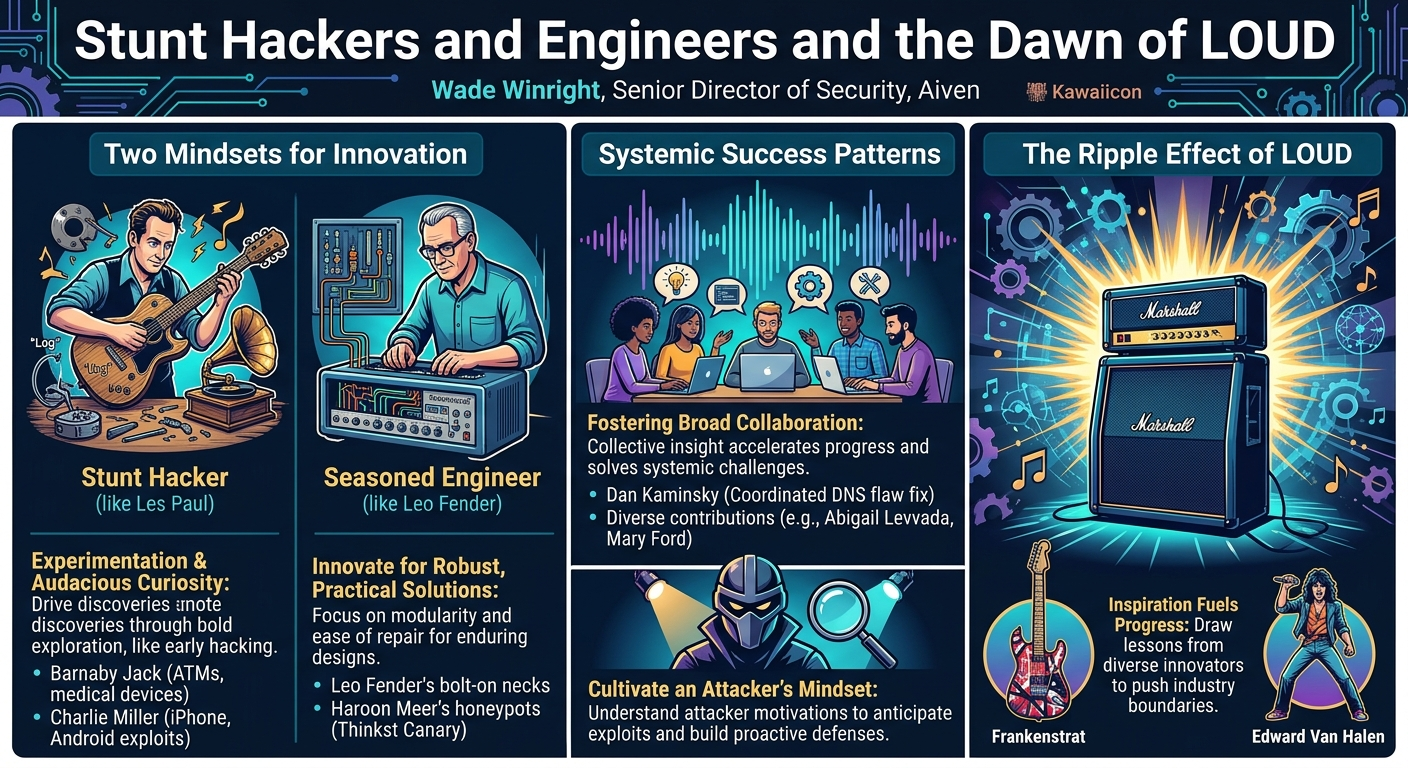
Winright's talk distills the shared success patterns of musical pioneers and cybersecurity trailblazers into four fundamental principles: experimentation, innovation, collaboration, and inspiration. These are presented not just as abstract concepts but as actionable methodologies that drive the "Dawn of LOUD"—the emergence of significant, often disruptive, advancements.
Experimentation is highlighted as the bedrock of discovery. Les Paul's journey from a phonograph arm in an acoustic guitar to "The Log" demonstrates an unyielding curiosity, pushing boundaries even when met with skepticism. In the security domain, Winright draws parallels to Barnaby Jack, whose relentless experimentation led to the discovery of numerous vulnerabilities, famously allowing him to "jackpot" ATMs and conduct groundbreaking research in medical devices, where lives were literally on the line. Similarly, Simone Giertz, the "Queen of Shitty Robots," exemplifies experimentation for the "lols," expanding knowledge through unorthodox creation. Dr. Charlie Miller is cited for finding the first Apple iPhone exploit (a mobile Safari vulnerability leading to full control, file exfiltration, and password theft) and the first Android exploit (a WebKit vulnerability for remote device control), both results of deep technical probing.
Building upon experimentation, innovation transforms raw discoveries into practical, impactful solutions. Les Paul's innovations included arguably the world's first home studio, the invention of multitrack recording (initially by layering lacquered discs using a Cadillac engine flywheel, then refined with an 8-track recorder commissioned from Ampex after Bing Crosby gifted him a tape machine), and sound effects like tape delay and flanger. Leo Fender's innovations focused on modularity and ease of repair, designing guitars with bolt-on necks and replaceable parts, a radical concept at the time. In cybersecurity, Haroon Meer of Thinkst Canary innovated by leveraging years of offensive security testing to build superior honeypots, providing invaluable insights into breaches. Jess Brazelle is recognized for her impactful contributions, including the IMG tool (an unprivileged container image builder), Bane (an AppArmor profile generator for Docker), am I contained (a container introspection tool), and binctr (for packaging static, unprivileged containers as executable binaries).
Collaboration is presented as the catalyst that elevates individual efforts to industry-wide impact. The legendary late-1940s gatherings at Les Paul's home, involving Leo Fender and Paul Bigsby (inventor of the Bigsby vibrato arm), underscore how shared obsession and collective insight can accelerate innovation. A prime example in security is Dan Kaminsky's discovery of a massive flaw in the DNS system. His collaborative efforts with numerous companies and individuals responsible for DNS infrastructure led to a coordinated fix and distribution before the vulnerability was publicly disclosed, averting a potential internet-wide catastrophe. Charlie Miller's car hacking research with Chris Valasek and the subsequent media collaboration with Wired and Andy Greenberg amplified its impact. The speaker also highlights the often-overlooked contributions of Mary Ford to Les Paul's success and the vital role of Hispanic workers, particularly women like Abigail Levvada, Lily, and Lupe, in Fender's production line, emphasizing that true collaboration is inclusive and multifaceted.
Finally, inspiration represents the ripple effect of these advancements, motivating future generations. Jim Marshall, inspired by Fender's Bassman amp, innovated to create the iconic Marshall amplifiers, pushing the boundaries of "loud." Edward Van Halen is cited for his innovations in guitar playing and his "Frankenstrat"—a hacked instrument embodying "security through obscurity" with its non-functional parts designed to deter copying. Winright concludes by listing numerous security figures who have inspired him, including Dino, Doug Song, HD Moore, Joanna Darovska, Mark Cavage, and Katie Mo, reinforcing that the cycle of experimentation, innovation, and collaboration continues to drive the industry forward.
Technical Deep Dive
▶ Watch: Collaboration: Dan Kaminsky and the DNS Flaw Fix (20:00)
The technical core of Winright's talk lies in the detailed examples of engineering and hacking that illustrate the principles of experimentation, innovation, and collaboration. These examples, drawn from both the music and security domains, showcase ingenious solutions to complex problems.
Les Paul's technical journey began with an urgent need for amplified sound. His initial pickup experiments involved a phonograph arm inserted into an acoustic guitar, quickly followed by a primitive setup using a piece of railroad rail, a wire, and a telephone receiver speaker. This rudimentary system demonstrated the potential for a solid-body instrument to eliminate feedback and achieve sustained, clean audio. "The Log" was the culmination of these early experiments: a solid block of wood forming the core, to which a guitar neck was mounted, and custom-designed magnetic pickups were affixed. This design fundamentally addressed the acoustic feedback issues prevalent in hollow-body guitars when amplified, providing a clean sound with extended sustain.
Paul's pioneering work in recording technology is equally significant. He effectively established the world's first home studio. His early attempts at multitrack recording were remarkably inventive: he would cut a recording onto a lacquered disc, then play it back while simultaneously recording a new track onto a second disc, often accompanied by his own live playing. His first cutting lathe for this process incorporated the flywheel from a Cadillac car engine, showcasing his improvisational engineering prowess. The breakthrough came when Bing Crosby gifted him a new Ampex tape machine, a technology borrowed from post-WWII Germany. Paul added an additional play head to this machine, enabling him to record multiple layers more efficiently and with higher fidelity. He subsequently commissioned Ampex to build an eight-track recorder, a revolutionary advancement that set the stage for modern music production. Furthermore, Paul innovated iconic sound effects such as tape delay and flanger, achieved by manipulating the playback and recording heads of tape machines to create echoes and sweeping phase shifts.
Leo Fender's technical contributions were characterized by their practicality and robustness. His amplifier designs, such as the 1966 Fender amp showcased in the talk, were meticulously wired with careful consideration for signal integrity and electromagnetic interference (EMI). His philosophy, "if something is easy to repair, it is easy to construct," was evident in the clean, organized internal layouts of his amps, a stark contrast to the "vomited spaghetti" wiring sometimes seen in other designs. This approach minimized manufacturing complexity and maximized field serviceability. Fender's most enduring technical innovation in guitars was modularity. Unlike Gibson's set-neck designs, Fender guitars featured bolt-on necks and easily replaceable components (pickups, bridges, wiring harnesses). This design significantly reduced repair costs and time, as damaged parts could be swapped out by a general technician rather than requiring a highly trained luthier. This modularity made his instruments accessible and durable, especially for rock musicians who might abuse their gear on stage. He also pioneered the modern electric bass guitar, fundamentally altering the rhythm section of popular music.
In the cybersecurity realm, Winright highlights technical achievements that mirror these principles:
- Barnaby Jack's work on ATM jackpotting involved exploiting vulnerabilities in the software and network configurations of these machines, allowing him to force them to dispense cash on command. His medical device research exposed critical flaws in embedded systems, demonstrating how to remotely compromise devices like insulin pumps and pacemakers, underscoring the severe implications of insecure IoT.
- Charlie Miller's first Apple iPhone exploit targeted a WebKit vulnerability within the mobile Safari browser. This exploit allowed a remote attacker to gain full control of the iPhone, exfiltrate user files (including mail passwords), send text messages to sign users up for premium services, and even record and relay audio. His first Android exploit similarly leveraged a WebKit flaw, granting an adversary control over the device with the same permissions as the browser application. Later, his car hacking research with Chris Valasek demonstrated the ability to remotely control critical driving functions, such as steering, brakes, and acceleration, through vulnerabilities in vehicle infotainment and network systems.
- Haroon Meer's Thinkst Canary solution represents a technical leap in honeypot technology. Moving beyond traditional, easily detectable honeypots, Canary tokens and devices are designed to mimic real assets (databases, file shares, network services) and alert defenders the moment an attacker interacts with them, providing early detection of breaches.
- Jess Brazelle's suite of tools provides critical capabilities for container security:
- The IMG tool is a standalone daemon and unprivileged container image builder, offering a secure and isolated way to construct container images.
- Bane is an AppArmor profile generator specifically designed for Docker containers, helping to enforce mandatory access control policies and restrict container capabilities.
- am I contained is a container introspection tool that allows users to quickly determine the runtime environment and available security capabilities within a container, aiding in security posture assessment.
- binctr packages fully static, unprivileged, self-contained containers as executable binaries, simplifying deployment and enhancing isolation by minimizing external dependencies.
These examples collectively demonstrate how deep technical understanding, coupled with a willingness to experiment and innovate, leads to both groundbreaking creations and critical security discoveries.
Demo / Proof of Concept
▶ Watch: Recognizing Women's Contributions to Les & Leo's Success (21:40)
During the talk, Wade Winright provided a live demonstration of two of Les Paul's most famous audio innovations: the tape delay and flanger effects. While acknowledging the prohibitive cost and complexity of setting up an actual vintage tape delay system, Winright used a modern guitar pedal to emulate these effects, playing his electric guitar to illustrate their sonic characteristics.
He first showcased the tape delay, explaining how the original effect was created by routing a signal through multiple play heads on a tape machine, creating distinct, repeating echoes. The audience could hear the clear, rhythmic repetition of his guitar notes, demonstrating how this effect adds depth and space to a sound. He then transitioned to the flanger, describing its creation by subtly varying the speed of two synchronized tape recorders playing the same source, resulting in a distinctive "whooshing" or "jet plane" sound. Although he encountered a slight technical hiccup with the pedal initially ("got to be smarter than the equipment you're working on"), he quickly resolved it, allowing the audience to hear the characteristic swirling, metallic timbre of the flanger effect. These live musical examples served as a direct and engaging way to connect the historical technical innovations of Les Paul to tangible auditory experiences, reinforcing the impact of early experimentation in sound engineering.
Defensive Implications
▶ Watch: Talk Summary: Experimentation, Innovation, Collaboration, Inspiration (24:30)
The core message of Winright's talk carries profound implications for cybersecurity defenders, urging them to adopt a mindset that blends the audacious curiosity of the "stunt hacker" with the pragmatic resilience of the "seasoned engineer."
Firstly, embracing experimentation is paramount. Defenders should not be afraid to "scratch that itch" and explore unconventional approaches to security. This means experimenting with new detection methodologies, threat intelligence sources, and defensive tools, even if they seem unorthodox at first. Just as Les Paul tinkered with railroad rails, security teams should constantly test the boundaries of their existing defenses and be open to unexpected solutions. Learning from both successes and failures in these experiments is crucial.
Secondly, prioritizing innovation means building upon experimental results to create robust and lasting security solutions. Leo Fender's philosophy of "easy to repair, easy to construct" directly translates to defensive architecture. Security systems should be designed with modularity, maintainability, and resilience in mind. This includes developing security controls that are easy to deploy, monitor, and update, and that can withstand unexpected abuse from sophisticated adversaries. The insights gained from offensive security testing, much like Haroon Meer's journey from pentesting to building Thinkst Canary, should directly inform the development of better defensive mechanisms, anticipating attacker techniques before they materialize.
Thirdly, fostering collaboration is not just beneficial but essential. The scale and complexity of modern cyber threats demand collective action. Defenders must actively collaborate within their organizations, across industries, and with security researchers. Dan Kaminsky's coordinated disclosure and patching of the DNS flaw serve as a blueprint for how industry-wide collaboration can prevent catastrophic outcomes. Sharing threat intelligence, best practices, and even code (as seen with Jess Brazelle's contributions to container security tools) strengthens the entire defensive posture. Recognizing and valuing diverse contributions, including those from often-overlooked groups, broadens perspectives and enhances problem-solving capabilities.
Finally, defenders must cultivate an attacker's mindset. By understanding the motivations and methodologies of "stunt hackers" like Charlie Miller and Barnaby Jack, defenders can better anticipate how their systems might be exploited. This involves continuous vulnerability research, red teaming, and penetration testing to identify weaknesses before adversaries do. Leveraging container introspection tools like am I contained allows teams to understand the security posture of their environments from an attacker's perspective, ensuring that runtime capabilities and isolation are properly configured. Ultimately, the "Dawn of LOUD" for defenders means not just reacting to threats, but proactively shaping the security landscape through continuous learning, bold innovation, and strong partnerships, inspired by those who have pushed boundaries in all fields of human endeavor.
Key Takeaways
- Embrace Experimentation: Unconventional curiosity and a willingness to try new approaches are foundational to discovering vulnerabilities and developing novel security solutions.
- Innovate for Resilience: Build security systems and processes that are practical, modular, and easy to maintain, anticipating unexpected abuse and evolving threats.
- Prioritize Collaboration: Systemic security challenges require broad cooperation across organizations, industries, and with researchers to achieve impactful, lasting solutions.
- Learn from Attacker Mindsets: Understanding the "stunt hacker's" drive and methodologies is crucial for anticipating exploits and building robust, proactive defenses.
- Modularity Enhances Security: Designing systems with easily replaceable and repairable components simplifies maintenance and allows for quicker adaptation to new threats.
- Inspiration Fuels Progress: Drawing lessons from innovators in diverse fields, like music, provides valuable frameworks and motivation for pushing the boundaries of cybersecurity.
About the Speaker(s)
Wade Winright is the Senior Director of Security at Aiven. His talk at Kawaiicon demonstrates a deep passion for the history of innovation and its direct applicability to the field of cybersecurity. Winright possesses a unique ability to connect seemingly disparate domains—music and technology—to illuminate universal principles of creation, problem-solving, and progress. Through his engaging storytelling and detailed historical accounts, he encourages security professionals to adopt a mindset of continuous experimentation, pragmatic engineering, and collaborative spirit, drawing inspiration from pioneers who dared to challenge the status quo.
Reviews
Dr. Zero (Offensive Security Researcher) — SOLID
A well-delivered talk that draws entertaining parallels between guitar pioneers and security researchers, but the actual security content is thin. You'll enjoy the storytelling and leave feeling inspired, but you won't learn anything technically actionable you didn't already know.
Heather Calloway (CISO) — WEAK
This is a motivational talk dressed as professional development. The analogies are entertaining but the strategic value for a security leader is near zero—no framework, no decision, no action follows from it.