The Enigma Machine: Live Demo'd and Explained
Mike Pritchard (Founder · Australian Spy Museum)
Kawaiicon 2025 (Kawaiicon III) · Day 2 · Main Stage
Overview
In an engaging and highly illustrative talk at Kawaiicon, Mike Pritchard, founder of the Australian Spy Museum, delivered a compelling presentation titled "The Enigma Machine: Live Demo'd and Explained." This session offered attendees a rare opportunity to delve into the intricate mechanics and historical significance of the Enigma machine, a device synonymous with the cryptographic battles of World War II. Pritchard not only provided a comprehensive technical breakdown of the machine's operation but also conducted a live demonstration of its encryption and decryption capabilities, bringing a pivotal piece of cyber history to life.
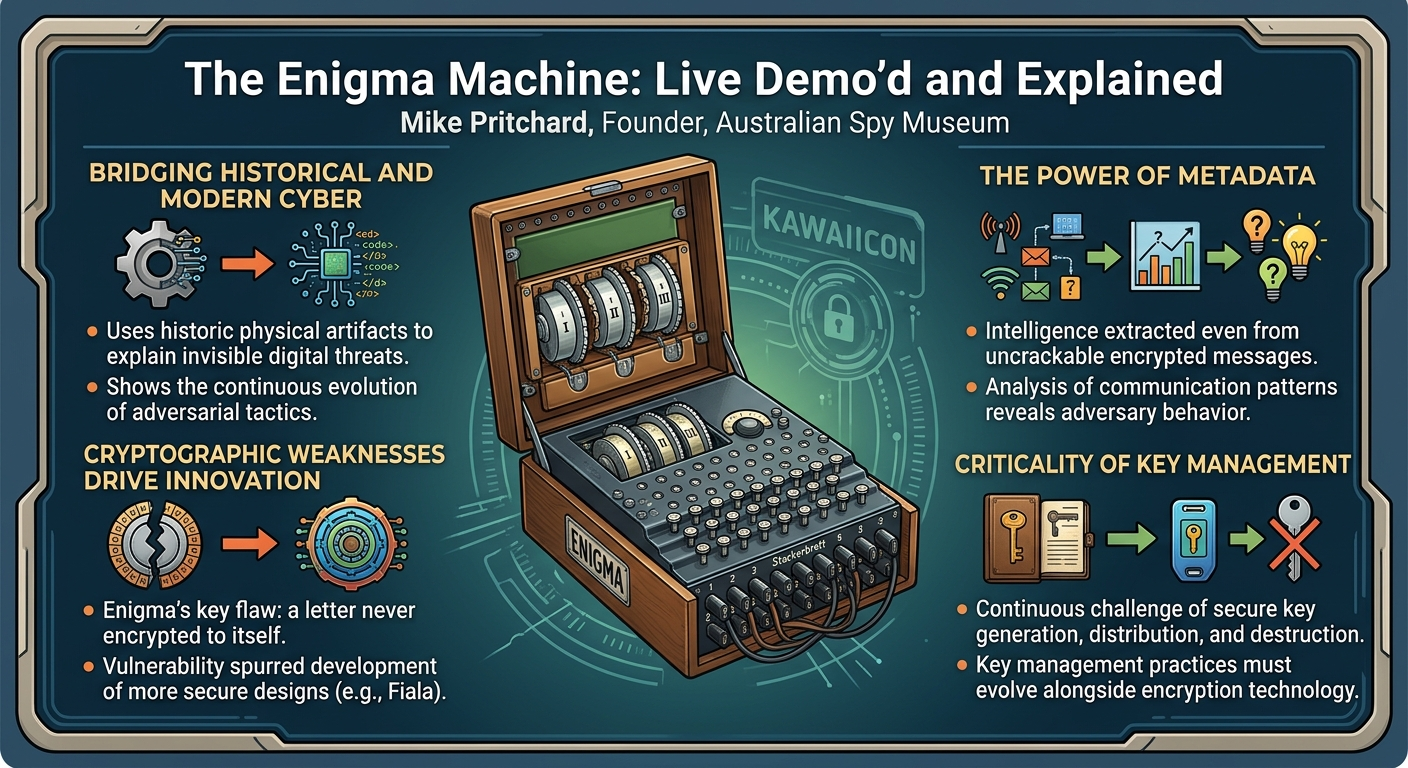
Key moments
- 0:00 Introduction and Australian Spy Museum vision
- 11:58 Introducing the 1935 Military Enigma M1
- 13:38 Why Enigma never encrypts a letter as itself
- 16:30 Daily Enigma configuration: rotors, rings, plugboard
- 22:58 Per-message key and recipient decryption process
- 31:38 Live Enigma encryption and decryption demonstration
- 36:00 Post-Enigma advancements: Fiala, one-time pads
The Enigma Machine: Live Demo'd and Explained
Speakers: Mike Pritchard, Founder, Australian Spy Museum
Conference: Kawaiicon
YouTube: https://www.youtube.com/watch?v=cG43nvEYAjM
Overview
In an engaging and highly illustrative talk at Kawaiicon, Mike Pritchard, founder of the Australian Spy Museum, delivered a compelling presentation titled "The Enigma Machine: Live Demo'd and Explained." This session offered attendees a rare opportunity to delve into the intricate mechanics and historical significance of the Enigma machine, a device synonymous with the cryptographic battles of World War II. Pritchard not only provided a comprehensive technical breakdown of the machine's operation but also conducted a live demonstration of its encryption and decryption capabilities, bringing a pivotal piece of cyber history to life.
Pritchard's motivation for the Australian Spy Museum stems from a deep-seated belief in making intangible cyber threats relatable through physical artifacts. Drawing from his 13 years in IT and cyber, he argues that by tracing the evolution of adversarial tactics from mechanical ciphers to modern digital threats, the broader public can better grasp the complexities of cybersecurity. This talk served as a prime example of the museum's mission, using the Enigma to bridge the gap between historical espionage and contemporary information security challenges, emphasizing the foundational principles of cryptography and the enduring relevance of understanding an adversary's mindset.
The presentation underscored why understanding historical cryptographic systems like the Enigma remains crucial for today's security professionals. It highlighted the fundamental concepts of key management, the challenges of cryptanalysis, and the continuous arms race between code-makers and code-breakers. By presenting the Enigma not merely as an antique but as an object lesson in secure communication design and its inherent vulnerabilities, Pritchard offered valuable insights into the iterative nature of security innovation and the timeless importance of robust cryptographic practices.
Background
▶ Watch: Introduction and Australian Spy Museum vision (0:00)
The genesis of the Australian Spy Museum, as articulated by Mike Pritchard, is rooted in the challenge of communicating abstract cyber threats to a "normal" audience. He observed that industries like power generation and distribution often struggle to grasp the concept of invisible threat actors. His vision was to create a tangible timeline of adversarial evolution, translating "cyber" concepts into physical objects that people could more easily relate to. Beyond public education, the museum also aims to serve the cyber community by archiving its relatively young history, providing a cultural center akin to those found in other established industries.
The museum's collection spans seven domains, each contributing to this narrative. These include cultural artifacts (e.g., propaganda posters, cryptography books dating back to 1571 by authors like Trius and Gaspbar Shot), Cold War espionage technology, tradecraft tools (recorders, bugs, spy cameras), covert communications (spy radios, burst encoders), cryptography, the "birth of cyber" (the pivot from purpose-specific calculating equipment to general-purpose computing), and "modern threats" relevant to contemporary intelligence agencies. The Enigma machine, a central piece of the cryptography collection, represents a critical juncture in this historical progression.
Before the advent of the Enigma, cryptographic devices were largely manual and relatively simple. Examples included basic monoalphabetic substitution discs, such as a French variant or the US Army Signal Disc used in World War I, which offered minimal security. A more advanced, yet still mechanical, innovation was Joseph Moore's M94 cipher device, featuring 25 discs on a central spindle, each with a different alphabet order. The key involved the specific order of these discs. Similarly, the French Lagan Sphinx used 20 rods whose order and relative sliding positions formed the key. These devices, while ingenious for their time, lacked the complexity and dynamic key changes that the Enigma would introduce, setting the stage for a radical leap in cryptographic security.
Key Findings
▶ Watch: Why Enigma never encrypts a letter as itself (13:38)
The talk's central "key finding" is the comprehensive deconstruction and live demonstration of the Enigma machine, revealing its revolutionary yet ultimately vulnerable design. Pritchard traced its lineage through early electrical cipher machines developed by individuals like Edward Heburn (who started with single-rotor machines and progressed to five-rotor variants) and Arvin Dam in Sweden. However, it was Arthur Scherbius's work in Germany that led to the commercialization of the Enigma, an idea initially conceived by two Dutch sailors whose patent was effectively appropriated.
The evolution of the Enigma itself was a significant finding, moving from early, unreliable printing machines (like the initial "handle" machine and the Shribender Enigma) to the more robust Glue Lampen machine (glowing lamp machine) which used light bulb outputs for greater reliability. The pivotal addition of the Steckerbrett (plugboard) in 1935, particularly for military models like the Enigma M1, dramatically increased the machine's key space, making brute-force attacks exponentially more difficult. Pritchard highlighted that the inherent design of the Enigma, utilizing a reflector, meant that a letter could never encrypt to itself – a critical cryptographic weakness that Bletchley Park famously exploited.
Furthermore, the presentation showcased the significant advancements made by subsequent machines, learning from Enigma's vulnerabilities. The Swiss NEMA machine, developed after the Swiss discovered both Germans and Allies could read their Enigma traffic, introduced a mechanically simpler yet cryptographically stronger design. Its rotors could come apart and spin on their axis, with multiple "lands and grooves" triggering rotor turnovers, leading to an even larger key space without a plugboard. Later, machines like the US KL7 and Soviet Fiala introduced re-injection circuits, allowing a letter to encrypt to itself, thus overcoming Enigma's "no self-encryption" limitation and demonstrating the continuous iterative improvement in cryptographic design.
Technical Deep Dive
▶ Watch: Daily Enigma configuration: rotors, rings, plugboard (16:30)
The Enigma machine is an electromechanical device whose complexity arises from the interplay of mechanical rotor movement and electrical signal routing. At its core, the machine consists of a keyboard, a lamp board for output, a plugboard (Steckerbrett), and a rotor assembly. Power is supplied by a 4.5-volt battery or transformer.
The rotor assembly is the heart of the encryption engine, typically comprising three rotors selected from a set of five (for the M1 military version). Each rotor is a disk with 26 electrical contacts on one side and 26 on the other, internally wired to perform a unique substitution cipher. For example, a signal entering contact 'A' on one side might exit contact 'F' on the other. Crucially, the wiring within each rotor is distinct, but once the wiring for one rotor is understood, the wiring for all others of the same type can be inferred, a fact critical for cryptanalysts like those at Bletchley Park.
A small notch on the circumference of each rotor plays a vital mechanical role. Every time a key is pressed, the rightmost rotor advances one position. When this rotor completes a full rotation (26 steps), its notch engages a mechanism that causes the adjacent rotor to advance, mimicking an odometer. This chained movement ensures that the substitution pattern changes with every key press, preventing simple frequency analysis. Pritchard demonstrated how a small slip ring inside the rotor allows the position of this notch to be adjusted relative to the rotor's wiring, further exploding the potential key space by altering the turnover behavior.
The electrical path is as follows: A signal from a pressed key first passes through the plugboard. The plugboard, or Steckerbrett, is a critical component introduced in 1935. It allows for pairwise swapping of letters (e.g., E to Y, D to T). The Germans would remap 10 letters daily using 10 cables, significantly increasing the key space to an astounding 150 million million possibilities. After the plugboard, the signal enters the rotors, passing sequentially through all three. At the end of the rotor assembly, it encounters the reflector, a fixed wired component that bounces the signal back through the rotors in reverse order, then back through the plugboard, finally illuminating a lamp on the lamp board. This reflective design ensures that a letter can never encrypt to itself, as the electrical path cannot return along the exact same route it entered.
Daily operation required precise configuration, guided by a pre-shared keybook. This involved:
- Volten Lagger (Rotor Order): Specifying which three rotors (e.g., 5, 2, 4 for October 23, 1944) were inserted into the machine and in what order.
- Ringellung (Ring Settings): Adjusting the slip ring positions on each rotor (e.g., 1, 2, 5, 2) to control the odometer turnover.
- Steckerverbindungen (Plugboard Connections): Connecting specific letter pairs on the plugboard (e.g., E-Y, D-T, K-F, M-D).
Beyond these daily settings, a per-message key, or decrypt secret, was used. The operator would choose a three-letter key (e.g., "SUB"), encrypt it twice using the daily settings (e.g., SUB -> WAW, then WAW -> SUB), and send the encrypted version (WAW) to the recipient along with an initial rotor setting (e.g., 123). The recipient would use the daily settings and initial rotor position to decrypt WAW back to SUB, then set their machine's rotors to SUB to decrypt the actual message. This complex process, while seemingly secure, was eventually cracked by Allied cryptanalysts using machines like the Bombe, which essentially simulated 36 Enigma analogs to hunt for the daily settings.
Demo / Proof of Concept
▶ Watch: Live Enigma encryption and decryption demonstration (31:38)
Mike Pritchard conducted a compelling live demonstration of the Enigma machine's operation, illustrating both the encryption and decryption processes using two machines keyed alike. For the demonstration, both Enigma machines were configured with a shared keyword, "Wellington," set across their bottom rows. This served as the common daily key for the exercise.
Pritchard, assisted by a volunteer named Philip, first demonstrated encryption. Philip typed the clear text message "submarines" one letter at a time on the sender's machine. As each letter was pressed, the corresponding ciphertext letter illuminated on the lamp board. Pritchard meticulously recorded the output, which for "submarines" became "A I Q Q M T O Y X D". He highlighted an interesting outcome where both the 'M' and 'B' in "submarines" encrypted to 'Q', demonstrating the machine's complex substitution patterns and desired unpredictability. He also reiterated the core principle that Enigma's design prevents a letter from encrypting to itself.
The demonstration then switched roles for decryption. Pritchard called out the recorded ciphertext "A I Q Q M T O Y X D," and Philip entered these letters into the second Enigma machine, which was identically configured. The lamps on the second machine's board, as well as an officer's panel, illuminated the original clear text: "S U B M A R I N E S." This perfectly illustrated the reciprocal nature of the Enigma system, where if 'E' encrypts to 'Y', then 'Y' must decrypt to 'E'. This reciprocity was a fundamental characteristic that Bletchley Park exploited in their cryptanalytic efforts.
Pritchard emphasized that the Enigma was inherently a two-operator machine: one person for typing and another for recording the results from the lamp board. He also touched upon the various methods of transmitting the encrypted messages, from radio and teleprinter to motorcycle courier and even, less commonly for Germans in WWII, messenger pigeons. The live demo served as a powerful, tangible illustration of the theoretical principles discussed, allowing the audience to witness firsthand the intricate dance of electromechanical encryption.
Defensive Implications
▶ Watch: Post-Enigma advancements: Fiala, one-time pads (36:00)
While the Enigma machine is a relic of a bygone era, the lessons derived from its design, deployment, and eventual decryption hold profound defensive implications for modern cybersecurity.
- The Enduring Value of Metadata: Pritchard highlighted that even when Allied forces couldn't decrypt Enigma messages, the metadata (sender, location, time of day, number of characters, communication patterns) provided invaluable intelligence. Analysts like Irving John Good at Bletchley Park, who ran statistical operations with Hollerith machines, extracted critical insights. In today's context, this translates to the importance of threat intelligence and network traffic analysis. Even if encrypted payloads remain unreadable, patterns of communication, source/destination IPs, packet sizes, and timing can betray adversary behavior, revealing command and control channels, exfiltration attempts, or attack preparation. Defenders must prioritize collecting and analyzing metadata from their networks.
- Robust Key Management is Paramount: The Enigma's security relied heavily on the daily key settings and per-message keys. The talk underscored the challenges of distributing and managing these keys. The Germans' decision to use exactly 10 plugboard cables daily, while simplifying analog construction for Allied cryptanalysts, shows how small operational choices can have significant security impacts. Modern systems, while digital, still grapple with key management. The shift from physical keybooks to keyfill devices that electronically store and securely destroy keys under duress, or the use of one-time pads in conjunction with number stations to eliminate physical key material handling, illustrates the continuous effort to "engineer out the chance that a human can have the key material and mishandle it." This lesson is directly applicable to managing cryptographic keys, certificates, and secrets in modern applications, cloud environments, and IoT devices, where automated, secure key rotation and destruction are critical.
- Understanding and Mitigating Cryptographic Weaknesses: The Enigma's inherent inability to encrypt a letter to itself was a critical weakness, a "crib" that Bletchley Park exploited. Subsequent machines like the US KL7 and the Soviet Fiala introduced re-injection circuits to overcome this limitation, allowing a letter to encrypt to itself and significantly strengthening their security. This historical progression emphasizes the importance of cryptographic agility and vulnerability assessment in modern defense. Security professionals must understand the underlying mathematical and design principles of the cryptographic algorithms they employ, be aware of known weaknesses (e.g., side-channel attacks, implementation flaws), and be prepared to migrate to stronger algorithms or patched implementations as new vulnerabilities are discovered. The continuous evolution of cryptographic standards, from DES to AES, and the deprecation of weak hash functions, are direct descendants of this historical lesson.
- Adversarial Mindset and Continuous Improvement: The entire narrative, from early simple ciphers to the Enigma, its cracking, and the development of more secure successors, demonstrates the constant arms race between attackers and defenders. Defenders must adopt an adversarial mindset, continuously probing their own systems for weaknesses and anticipating how attackers might exploit them. The Swiss experience with the NEMA machine, built specifically because their Enigma traffic was compromised, highlights the need for national cryptographic independence and the dangers of relying on foreign-controlled encryption systems, a lesson relevant to supply chain security and trust in cryptographic backdoors today.
Key Takeaways
- Bridging Historical and Modern Cyber: Understanding historical cryptographic systems like the Enigma provides tangible analogies for complex, intangible modern cyber threats, aiding both public education and professional insight.
- The Power of Metadata: Even uncrackable encrypted communications can yield crucial intelligence through metadata analysis (sender, time, volume, patterns), a principle highly relevant to modern threat intelligence and network forensics.
- Cryptographic Weaknesses Drive Innovation: The Enigma's "no letter encrypts to itself" flaw was a critical vulnerability that spurred the development of more advanced machines (like Fiala with re-injection) capable of overcoming such limitations, emphasizing the iterative nature of security design.
- Criticality of Key Management: The evolution from physical keybooks to electronic keyfill devices and one-time pads highlights the perennial challenge of secure key generation, distribution, and destruction, a core tenet of modern information security.
- Electromechanical Ingenuity: The Enigma's complex electromechanical design, combining rotors, a reflector, and a plugboard, represented a significant leap in cryptographic complexity, demonstrating how physical mechanisms can create vast key spaces.
- Adversarial Evolution is Constant: The journey from simple substitution ciphers to the Enigma, its cracking by the Bombe machine, and the subsequent development of more secure systems like the Swiss NEMA machine underscores the perpetual arms race between code-makers and code-breakers, demanding continuous vigilance and adaptation from defenders.
About the Speaker(s)
Mike Pritchard is the Founder of the Australian Spy Museum, an ambitious initiative born from his passion to connect the abstract world of cyber and espionage with tangible historical artifacts. With 13 years of experience in IT and cyber, Pritchard recognized the difficulty many "normal people" have in grasping intangible threats. His vision for the museum, initially conceived as a "cyber espionage museum," is to build a collection that preserves the heritage of the cyber community and educates the wider public through physical analogies and historical timelines. He is driven by a "madman's idea" to bootstrap this museum into a physical presence in Sydney, aiming to create a cultural center for the cyber industry and a unique educational resource for understanding the evolution of adversarial tactics.
Reviews
Dr. Zero (Offensive Security Researcher) — SOLID
A well-executed museum piece on a museum piece. Pritchard clearly knows his hardware and the live demo is genuinely engaging, but this is history education, not security research. Fine for a community con's 'culture track' — just don't expect to learn anything you couldn't get from a good YouTube documentary.
Heather Calloway (CISO) — SOLID
Engaging historical cryptography demonstration with genuine artifacts. No operational relevance to modern security programs, but solid educational content for those interested in cryptographic heritage.